HubSpot Tips From Erin Wiggers: Make the AI Prove It
Erin Wiggers has led hundreds of HubSpot implementations. Her tips for admins who build with Claude: bring your own answer, ask the AI to attack it, treat last year's build as a test, and keep a sandbox for breaking things.
HubSpot tips are practical habits for building and running a HubSpot portal well, and Erin Wiggers's all rest on one idea: test every answer, the AI's and your own, before it reaches the live portal.
Erin Wiggers does much of her HubSpot solution design with Claude, and she has learned to double-check the answers she likes best. “I’ll read it and I’ll be like oh cool I didn’t know HubSpot would do that,” she said, “and it’s like because it does it does not do that.”
Erin runs Geekery, a Denver RevOps and AI consultancy. She spent five years as a technical director at HubSpot agencies and has led hundreds of implementations in 10 years of HubSpot work, after starting out as an academic scientist and then working in music. She sat down with Lindsey Smith and Cameron Conner for a Becoming Admin episode on why Claude “sounds right” about HubSpot, and nearly every HubSpot tip she gave them comes back to that moment: a confident answer on the screen, and an admin deciding whether to believe it.
What does it mean to go from HubSpot admin to architect?
For Erin, the move from admin to architect starts close to the work. “Being close to the pains of daily operations so that you can address those,” she said, is what makes people exceptionally good at the job. She tries to step into the user’s seat and ask whether a build would be intuitive for her. Then she sits with one question: “where is the friction?”
The science degree shows up in how she builds. Erin has degrees in biology and psychology and wrote an honors thesis on how certain bone and immune cells change when challenged with infection. “I never build something thinking, ‘Oh, this is the only time I’m ever going to build this,’” she said. She is already planning the next version, poking holes in the current one, and running experiments. Could a custom object hold this data, and what would that allow downstream? She calls that side of herself the mad scientist. “I come by it honestly,” she said. Both of her parents are scientists.
She said “being close to the pain opens your eyes.” Her example was scrolling LinkedIn and seeing that “somebody just posted that they updated something and it’s going to solve something that I’ve been running into for years now.” She recognized the fix because she had been living with the problem.
Will AI ever build HubSpot without an admin?
The hosts asked whether tools like Breeze and Claude will eventually do the building that admins enjoy. Erin thinks there is “something uniquely human” about fitting together a system as large as HubSpot, with its documentation and its “temporal knowledge of you used to be able to do this in HubSpot, now you do it a different way.”
Her example was a client project. She is looking at using HubSpot’s lead scoring as a loyalty points system, “and that’s not something that Claude or chat GPT is ever going to come up with because it’s just it’s a little too out of the box.” It came, she said, from the mad-scientist urge to see whether something would work, “not that it’s documented anywhere.”
She did not start out calm about AI. “I started with AI from that place of fear,” she said, so she made a plan: “AI can’t take my job if I make AI my job.” Using it every day changed her view of the hype on LinkedIn. “I’m here to tell you most of it is like smoke and mirrors,” she said, and the cure is to “go in and actually use it.”
How should an admin use Claude on HubSpot work?
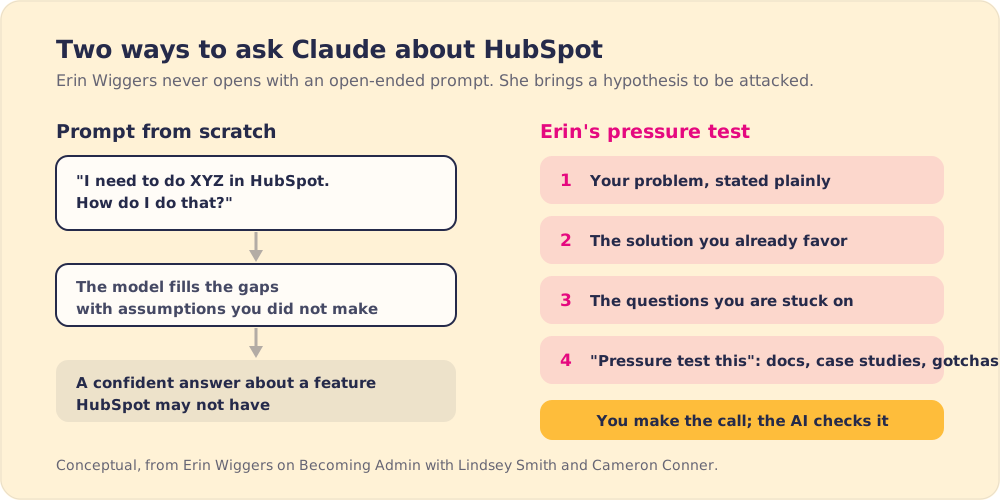
Erin never opens a chat with a blank request. “I need to do XYZ in HubSpot. How do I do that? Like that is that’s a non-starter for me,” she said, “because you’re an a question that is so open-ended like that, the AI is going to fill in with a lot of assumptions that you probably don’t want.”
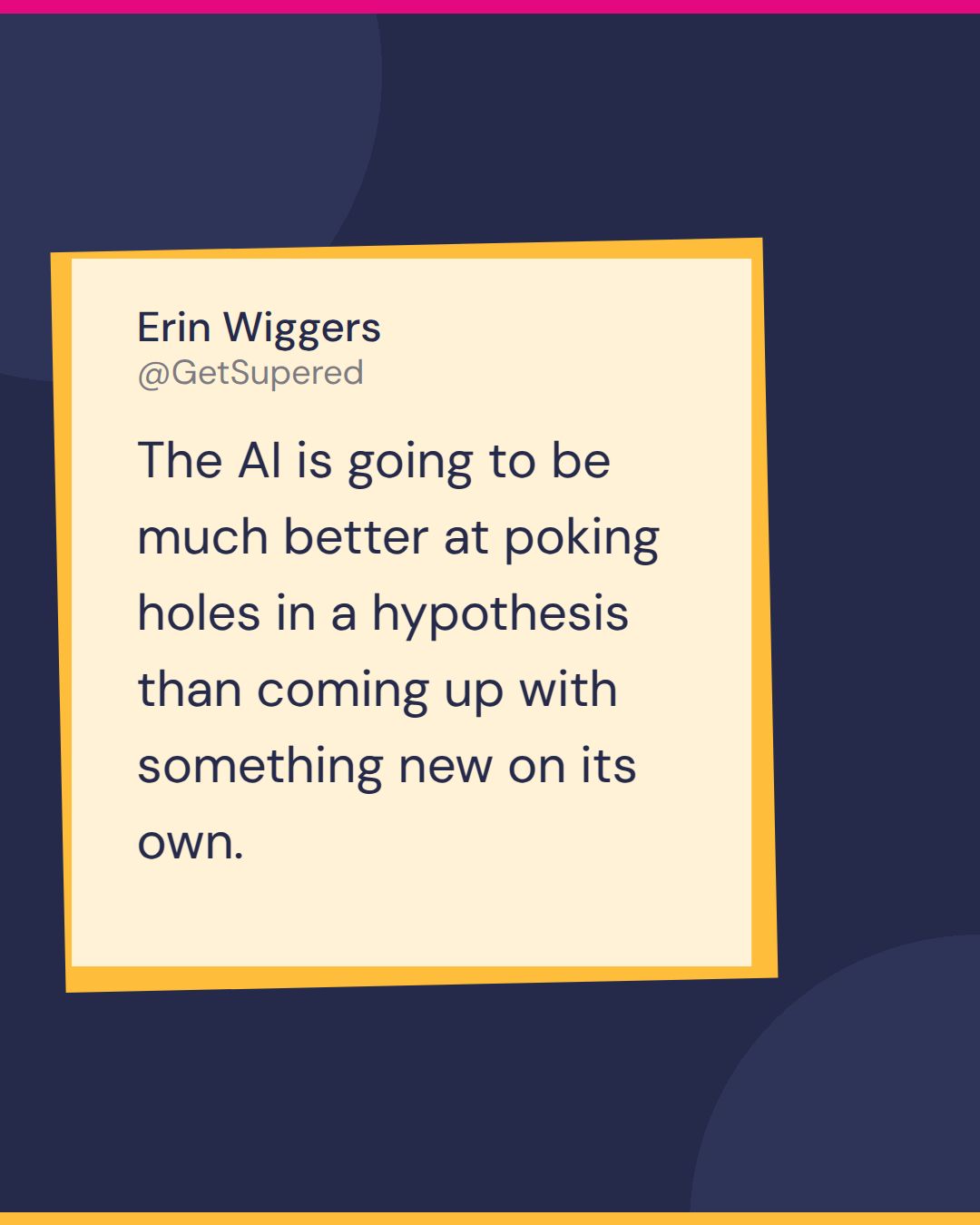
She brings her own answer instead: here is the problem, here is how I was thinking we could solve it, here are the questions I am running into. Then she asks the model to “pressure test this. Like check the documentation, check, you know, case studies that are out there.” “The AI is going to be much better at poking holes in a hypothesis than coming up with something new on its own,” she said. “I’m not using the AI to tell me what the solution should be.”
She also repeated a phrase she had come across that the hosts wanted on a shirt: the models’ “confidence is not correlated with correctness.”
OpenAI’s researchers have a reason for the confidence. In a 2025 paper they argued that “language models hallucinate because standard training and evaluation procedures reward guessing over acknowledging uncertainty” (OpenAI, 2025). In their SimpleQA example, one model declined to answer 1% of questions and was wrong 75% of the time, while a newer model declined 52% of the time and was wrong 26% of the time, with nearly the same accuracy.
Erin’s answer is to keep the final call with a person who has used the portal. She described it as the difference between the AI and “a HubSpot expert who’s been in again, been in the trenches, been using the tool, been keeping up with the updates,” someone who knows when to push back.
How do you keep up with HubSpot updates?
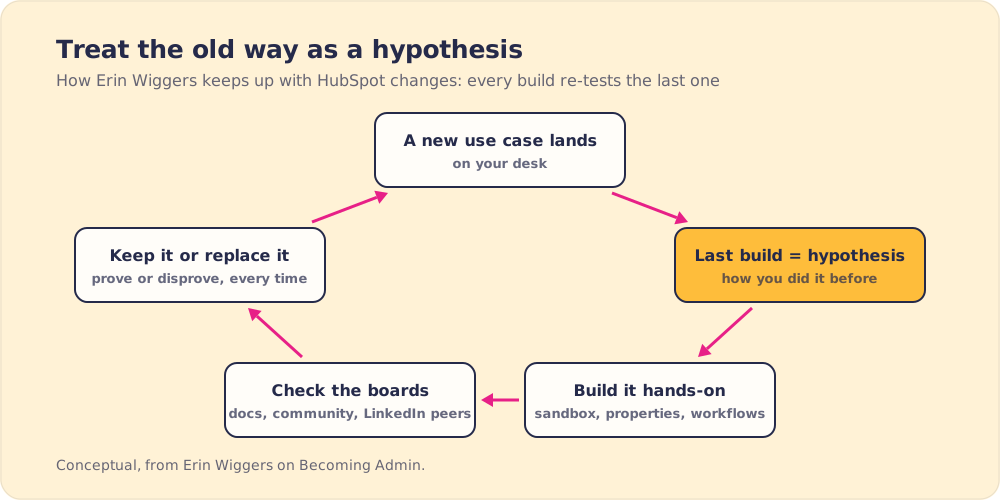
“So much of what I learn about HubSpot, I learn because I’m doing it,” she said. A use case lands on her desk, and hands on the keyboard she sees the holes faster, especially in workflows and calculated properties “where there’s a lot of different variables at play.”
She leans on what she has built before, “but every time I do it, don’t just assume the way I did it before is still correct,” she said. “However you think you should do it, that’s the hypothesis.”
She keeps a mental list of questions that come up often on the community boards without a good answer, because those tend to be the ones HubSpot’s product team fixes next. And she reads people. “Following good people on LinkedIn has done wonders for my career,” Erin said. She named Alyssa Wiley, saying she has read “like every blog she ever wrote,” and that is a big reason she knows HubSpot as well as she does. No one person can track every HubSpot release, so the people she follows each post the part they caught. Erin posts too, because she wants “to contribute to that community which I think makes HubSpot really special.”
Where should a new HubSpot admin practice?
“Get a sandbox and just go to town,” Erin said. “Treat it like a toy and just go and play.” Be willing to break things, she added, and count each wall you hit as a lesson for next time.
She learned the hard way herself. After years in music she moved to Colorado, needed a real job, and decided to learn development by getting hired as a developer. It was motivating, since her feet were to the fire, and she does not recommend it. A sandbox gives a new admin the same pressure to figure things out, without a client’s live data on the line.
Harvard’s Amy Edmondson has studied why a safe place to fail helps people learn. In a study of 51 work teams at a manufacturer, she found team psychological safety was associated with learning behavior, and learning behavior mediated between safety and performance (Administrative Science Quarterly, 1999).
A HubSpot sandbox comes two ways. Enterprise plans include standard sandboxes that copy the production account’s setup and up to 5,000 contacts (HubSpot Knowledge Base). Anyone can open a free developer account and create up to 10 test accounts with a 90-day trial of many Enterprise features (HubSpot Developers). Our guide to moving from sandbox to production covers what carries over when the experiment works.
Erin’s last piece of beginner advice was social. Find a few collaborators, talk shop, and ask “Hey, I did it this way. What do you think?” Hearing how other people would solve a problem was one of her favorite parts of being a technical director at an agency. “I’m a yes and person,” she said.
What quick HubSpot tips came out of the rapid-fire round?
The hosts closed with three fast questions, and Erin’s answers make a short list of their own:
- Claude Desktop first. She opens it first thing each morning. “That’s where all of my all of my stuff lives.”
- Custom objects, with an asterisk. She reaches for a custom object before a simple workflow, “with an asterisk.” Custom objects were “the hammer for every nail for a little while,” she said, and she knows she can do anything with one, but “that’s not always what you need.”
- A drag-and-drop portal. Her magic-wand wish is a friendlier front end, so a HubSpot customer could build their own portal by drag and drop and use their CRM data on it without custom code. “I’m kind of talking myself out of a job here,” she said.
Erin Wiggers’s HubSpot habits
- A seat next to the user. Erin designs from the friction people feel in daily operations, and asks whether a build would be intuitive for her.
- A hypothesis before the prompt. She brings Claude her problem, her favored answer and her open questions, and asks it to pressure-test them.
- Last year’s build on trial. How she did something before is a hypothesis each new use case gets to prove or disprove.
- A sandbox for breaking things. Erin wants new admins playing where a mistake costs nothing, and Edmondson’s study of 51 teams tied that kind of safety to learning.
- Peers who check your work. Community boards and LinkedIn practitioners each catch part of HubSpot’s changes, and Erin posts to return the favor.
What should a HubSpot team change about how it uses AI?
Make Erin’s pressure test the house rule. Before an AI-suggested build goes near the live portal, the admin writes down the problem, the answer they expect and what they are unsure of, and asks the model to find the holes against HubSpot’s documentation. Then build it in a sandbox. The model will sound sure either way, and in OpenAI’s own test one model declined to answer only 1% of the time. The doubt has to come from the admin.
Our AI sales enablement guide makes the same case for sales teams: settle the process, then add AI to it. Supered works in that order, putting the tested process in front of reps inside HubSpot while they work and measuring whether they follow it. For the prompting side, our piece on ChatGPT for sales covers where these tools help a revenue team and where they need a human check.
Frequently asked questions
How should a HubSpot admin use Claude or ChatGPT?+
Why does AI sound confident about HubSpot features that do not exist?+
What is the best way to learn HubSpot as a beginner?+
How do you keep up with HubSpot updates?+
Should I use a custom object or a workflow in HubSpot?+
Your process, running itself.
Turn the playbook into rep behavior.
More from Becoming Admin

How to Become a HubSpot Admin: Jorge Fuentes on Degrees, 51 Certifications and Owning Problems You Didn't Create
Jorge Fuentes
HubSpot Commission Tracking Without a Developer: Jordana De Bruin's Build
Jordana De Bruin