Build vs Buy vs Expand: Daniel Seiuk on Why Vibe-Coded CRMs Fail at Scale
Daniel Seiuk watched his father's job sites get run by graduates who were good at the math and had never worked a job site. Now a go-to-market engineer, he says the same gap sinks vibe-coded CRMs, and that admins forget a third option.
Build vs buy is the choice between creating a tool yourself and paying for one; Daniel Seiuk adds a third option, expand, which means getting more out of the platform you already pay for before you do either.
Daniel Seiuk’s father was a union carpenter for 20 or 30 years and never went to college. About halfway through his career, recent graduates started showing up to run his projects. They were good with architecture and CAD and “really good at the math behind everything,” Daniel said, “but didn’t understand how fundamentally like a job site works.”
Daniel told that story on Becoming Admin when hosts Lindsey Smith and Cameron Conner asked him how an admin should settle build vs buy inside HubSpot. He sees the same gap in vibe coding. “There’s three of us sitting in this room right now and there’s 3,000 people that are sitting there vibe coding another CRM,” he said. His answer starts with how the business runs and with what the company already pays for.
What is the most important skill for a HubSpot admin?
Daniel has spent about 10 years in RevOps, marketing ops and sales ops and now works as a go-to-market engineer. Asked what makes a good admin, he began by crossing things off. The job “has absolutely nothing to do with mouse clicks. It has absolutely nothing to do with understanding integrations or automations or anything. It has everything to do with being able to translate.”
The admin has to understand how the data is built, explain it to leadership, and explain it again to the people who use the system all day. “Being that master translator in the middle, I think might be the most important skill that anybody could really have.”
The trouble he runs into most often comes after a growth spurt, when a company levels off and starts cutting and consolidating. You inherit a portal from a company that “looks great on paper,” and the reports are only sort of right. “Everybody wants to be like rowing in the same direction, but you feel like your oars are all different sizes.”
He traces a messy portal to “a very fundamental constraint in the way that the leadership team is able to communicate the results that they want” to the people using the system. Before any build vs buy call, write down the result leadership wants and how the team works today, and study the gap between them.
Why is plugging Claude into HubSpot not AI readiness?
Daniel was preparing an AI fundamentals session with HubSpot’s education partners program, and he said the problem “is no different than it was 10 years ago when AI wasn’t a part of anything. It’s the data structure and the integrity behind it.” Plans to connect an AI model to the CRM and multiply the team’s output “are pipe dream aspirations if you don’t have the right data integrity and structure and processes all set up already.”
“Claude can only do what you tell it to do, and if you don’t know how to tell it to do what you really want to do, then it’s just simply not going to be able to do the job.”
When one of the hosts said plugging Claude into your HubSpot isn’t AI readiness, Daniel answered with one word. “Nope.”
How should a HubSpot admin decide build vs buy?
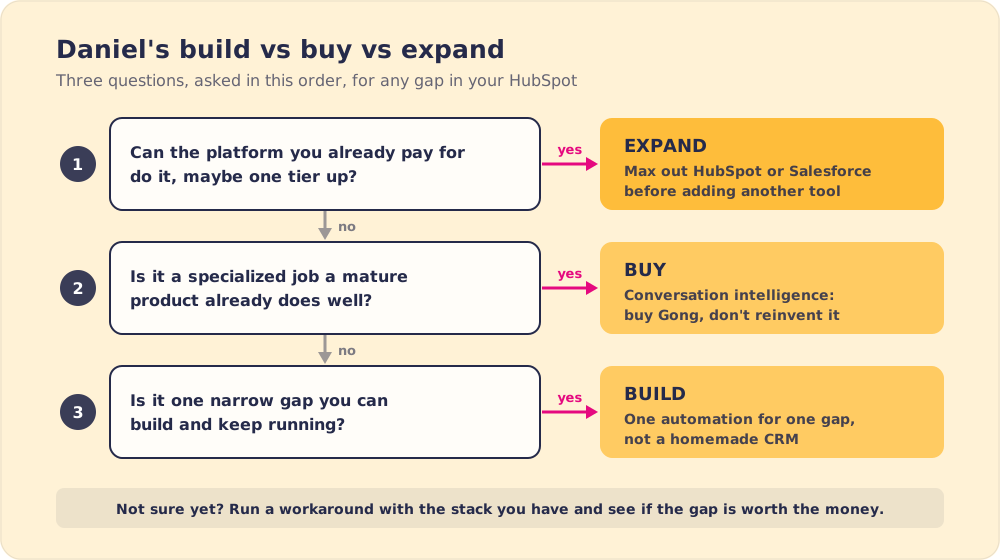
Daniel added a third option. Build vs buy, he said, “should also have another piece that’s expand.”
Building means making it yourself, with custom code or “a skill pack download from a LinkedIn guru.” Buying means paying for a tool that does something specialized. For conversation intelligence, “instead of reinventing Gong, just go buy Gong if it makes sense for the organization and fills that very very distinct gap.”
Expanding means using more of the platform you already own, and Daniel looks there first. “If you’re going to invest in any platform, whether it’s HubSpot or Salesforce or any of these, maximize what you’re able to do within the environment and look at the internal expansions within that environment before you go and hunt down yet another third-party tool.”
Some of his clients have fewer than 50 employees and $70 million to $100 million in revenue, still think of themselves as small businesses, and balk at HubSpot’s Enterprise tier. Daniel asks whether the features one tier up justify the price before anyone shops for another tool.
Gartner’s survey numbers give his habit some weight. Marketers used about one-third of their martech stack’s capabilities in 2023, down from 42% in 2022 and 58% in 2020 (MarTech, on Gartner’s 2023 survey). Zylo’s 2025 SaaS Management Index found that companies with up to 500 employees run an average of 152 apps (Zylo).
When he can’t tell which way to go, Daniel tests with what the team already has. He asks whether “we just do some sort of internal workflow or workaround or work with the tech stack that we currently have to get the job done today to see if it’s even worth the investment of looking at buying or expanding.” A workaround that strains under real work tells the team what the gap costs, and that figure is what the buy or expand decision needs.
Is it cheaper to build or buy?
Most build vs buy software conversations begin with price, and Daniel steers them elsewhere. He looks at the average contract value first, then separates the price of a tool from the cost of running the business. “Every successful business owner I’ve ever met has always looked at those things as just the cost of doing business.”
He learned it at his last company, which the founder had started in his garage and had been running for 27 years when Daniel joined. The trade show budgets shocked him: $100,000 to $150,000 to bring about seven people and a booth to a large show. Standing on the floor in Vegas, he came around to the founder’s view, and he treats software the same way. Whatever the monthly figure on a HubSpot tier, “it just gets added to your expenditures.” And “if you have to justify that too heavily, perhaps your revenue can’t support that kind of investment.”
Then he puts a question to whoever holds the budget. “What am I really scared of here? Am I scared of a long-term commitment into a system or am I scared of the price that comes with it?” In his experience it is usually the commitment, the worry that the bill grows into something the company can’t justify three years out.
Why do vibe-coded CRMs fail at scale?
Daniel reads the HubSpot and CRM subreddits, where people keep posting CRMs they built with AI over a weekend. He grants that it works on a technical level. Then he asks “why are we spending a weekend rebuilding HubSpot or rebuilding the same thing over and over again for the sake of just saying that I did it for free.” A homemade CRM can run a hobby, he said, “but no business is going to be able to support that and the costs are not going to be able to be absorbed and be free. It’s just it’s pet projects at that point.”
He tied it back to his father. Without time inside a business, a builder knows the tools and not the job site, and “everybody can technically build something, but does it actually do anything of relevance?” His test for anything an admin builds is whether you can point to “the real results that are actually achievable,” and “not theory, not projections, not attainment goals, like straight-up facts.” Build “this one automation to handle this one gap” and keep the data clean. “You just have to take away as many touch points as you can reliably and with certainty.”
A weekend CRM also has to get used, and it starts with no training and no support desk. Our guide to CRM adoption covers what an unused system costs a sales team.
Daniel does want admins learning to build as a way to grow, and “they don’t necessarily have to put anything in production,” he said, because “HubSpot is not going to slow down for your business.”
What does The Goal teach a RevOps admin about build vs buy?
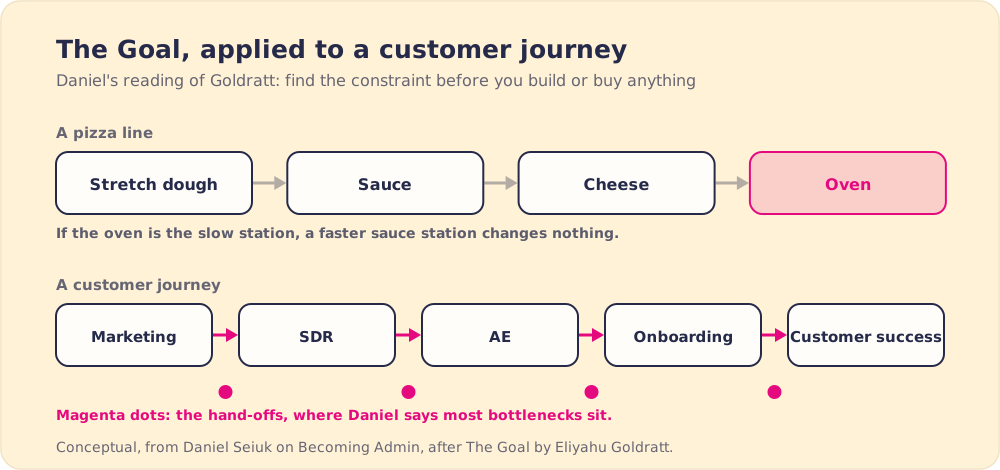
Asked how an admin decides what to automate first, he said his answer “has absolutely nothing to do with HubSpot.” He recommends one book, The Goal by Eliyahu Goldratt, a 1984 factory novel that TIME put on its list of the 25 most influential business management books (TIME). Goldratt’s theory of constraints says a production line moves only as fast as its slowest station, so you find that station and fix it first.
Daniel used a Domino’s kitchen. One person stretches the dough, the next adds sauce, then cheese, then the pizza goes in the oven. In a go-to-market team, the customer journey is the line, and of the slow spots he said, “most of them are related to hand-ins and hand-offs.” An admin who hunts for the constraint first stops “getting inundated with the priorities of every team when you walk in the door.”
He thinks this is the part of the job AI won’t take. An admin can hold every HubSpot certification and know the whole API, and “Claude does the same thing cuz I just dumped a bunch of documents at it.” In his words, “We don’t need people to do that anymore. We need people to understand how those things connect.” Our guide to HubSpot workflow dependencies is a practical place to start tracing those connections in your own portal.
What Daniel Seiuk’s build vs buy lessons add up to
- Translation as the core skill. Daniel says the admin’s main job is carrying results between leadership and the team using the system.
- Clean data before AI. Connecting Claude to HubSpot does little for a team whose data and processes are a mess.
- Expansion first. Check the platform and tier you already pay for.
- Buying for specialized jobs. Conversation intelligence is Gong’s job, and Daniel would buy it.
- Building for one narrow gap. One automation that removes touch points, kept clean and maintained.
- The constraint before the tool. The Goal sends an admin to the hand-offs first.
What should an admin do before the next build vs buy decision?
Use Daniel’s order. Map the gap against the HubSpot tier you have and the one above it. Run a workaround with the current stack to learn what the gap costs. Buy when a mature product does a specialized job, the way Gong handles calls. Build last, and only for one narrow gap you can keep running. We recommend that order because the Gartner figures show teams sitting on capability they have not switched on, and anything new has to earn adoption from zero. Our sales tech stack guide covers the rest of the stack.
Daniel’s father knew the job site because he had worked it for decades. Learn how your business runs first, and the build vs buy call gets much easier.
Frequently asked questions
How do you decide between build vs buy software?+
What does expand mean in build vs buy vs expand?+
Is it cheaper to build or buy?+
Why do vibe-coded CRMs fail at scale?+
What is AI readiness for a HubSpot admin?+
Your process, running itself.


