Gong Pricing in 2026: the Meter Moved from Seats to Behavior
What Gong costs in 2026, what the June 2026 AI credit model changed, and why a metered meter puts a price on a process your reps were never running.
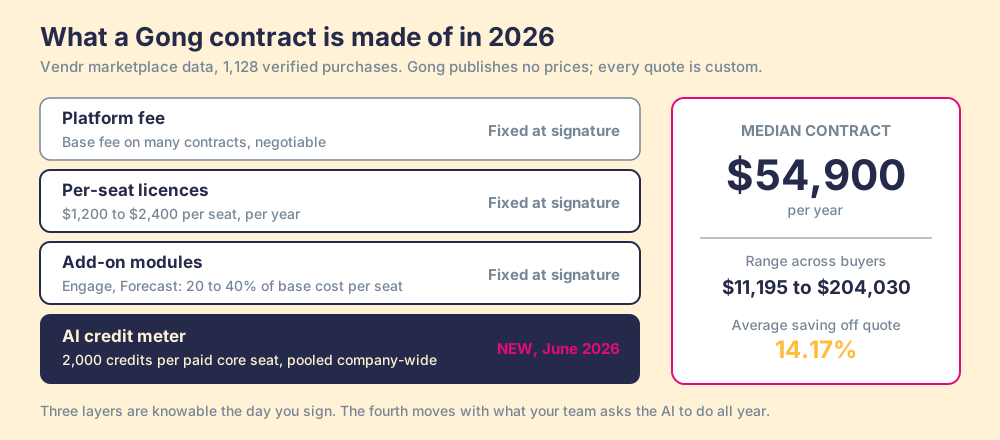
Gong pricing in 2026 is quote-only: a platform fee plus roughly 1,200 to 2,400 dollars per seat a year, a Vendr-verified median contract of 54,900 dollars, and, since June 2026, a metered layer of 2,000 AI credits per paid core seat.
A library card and a taxi meter are both fair ways to pay for something you want, and they ask entirely different questions of you. The card is settled at the counter, once, before you have read a page. It prices your existence as a reader. The meter prices the route you take, and it does its counting where you can watch it, which is the part that gets into people’s heads. No one has ever felt anxious holding a library card.
Gong spent a decade selling library cards. In June 2026 it put a meter in the cab.
Gong pricing in 2026 is quote-only: a platform fee plus roughly 1,200 to 2,400 dollars per seat a year, a Vendr-verified median contract of 54,900 dollars, and, since June 2026, a metered layer of 2,000 AI credits per paid core seat (Vendr, 1,128 verified purchases). The seat prices are the part every competitor blog has already counted for you. The meter is the part worth understanding, because it changed what you are buying, and not just what you are paying for it.
How much does Gong cost in 2026?
Gong publishes no prices. There is no free tier, no self-serve checkout, and no published tier names, so every number below comes from transaction data rather than a pricing page. (Searches for gong io pricing land in the same place; the company sold as gong.io for years and the domain still carries the brand.)
Vendr’s marketplace, which aggregates anonymized contracts, puts the median Gong deal at 54,900 dollars a year across 1,128 verified purchases, with buyers saving an average of 14.17 percent off quote. The full range runs from 11,195 dollars at the low end to 204,030 dollars at the high end, which tells you how little a single median means without the shape around it.
| Cost component | What Vendr’s data shows |
|---|---|
| Per-seat, per year | $1,200 to $2,400, lower at volume |
| Median total contract | $54,900/yr (1,128 purchases) |
| Contract range | $11,195 to $204,030/yr |
| Typical mid-market, 50 seats | $70,000 to $110,000/yr |
| Enterprise, 200 seats | $240,000 to $360,000/yr |
| Add-on modules (Engage, Forecast) | 20 to 40% of base cost per seat |
| Seat overages mid-contract | 10 to 20% above contracted rate |
| Auto-renewal escalation | 5 to 10% per year |
Three things in that table matter more than the median.
- Seat count is the whole ballgame on the fixed side. Gong charges per licensed user and does not generally offer a cheaper view-only licence, so a manager who looks at dashboards once a month costs what a rep on the phone all day costs.
- The modules are where budgets break. Gong Engage and Gong Forecast are quoted separately at 20 to 40 percent of base cost per seat, and buyers who add them mid-contract pay 15 to 30 percent more for the same modules than buyers who bundled them at signature.
- Growth is priced punitively. Adding seats mid-term runs 10 to 20 percent above your contracted rate, and Vendr notes the average Gong customer spends more in year two than year one, driven by seat growth. A seat buffer negotiated up front costs nothing and saves that premium.
None of this is unusual for enterprise software. It is the same shape we found looking at Seismic pricing, and the same one that makes Scribe pricing legible only after you find the doors. What is new at Gong is the fifth column that no table had until this summer.
What changed in June 2026, and why did it rattle buyers?
Gong rolled out a usage-based AI meter through June 2026. Customers were emailed their company-specific allocations in late May, and Gong’s announcement page carries a June 9, 2026 date. The mechanics are simple enough to state in a sentence: each paid core seat includes 2,000 AI credits a year, pooled across the whole company, reset at the start of each contract year.
Gong’s co-founder and chief product officer, Eilon Reshef, framed the change as tracking the work Gong’s AI agents perform on a customer’s behalf rather than counting raw tokens, and as an alternative to raising seat prices for every customer to fund AI processing only some customers use. That is a defensible design. Charging the heavy users for the heavy processing is fairer than socializing it across a base that does not touch it.
It still landed badly, and the reaction was loud. Winning by Design’s Jacco van der Kooij wrote that Gong’s pricing changes “have sent shockwaves through the industry,” with buyers asking one another what to do about their quotes. Others in the RevOps community were calmer, pointing out that standard platform features were untouched and that many teams would never approach the ceiling. Both readings were correct, which is itself the interesting part. The change was modest in substance and enormous in feel.
The reason has a name, and it was published twenty years before Gong shipped this. In 2006, Anja Lambrecht and Bernd Skiera studied why people choose tariffs that cost them money, and documented what they called the flat-rate bias: users routinely prefer a flat rate even when pay-per-use would bill them less (Journal of Marketing Research, Vol. XLIII, 2006). Among the causes they isolated and confirmed, one is named, with no metaphorical stretching required, the taxi meter effect: the discomfort of watching a meter run while you consume, independent of what it finally reads.
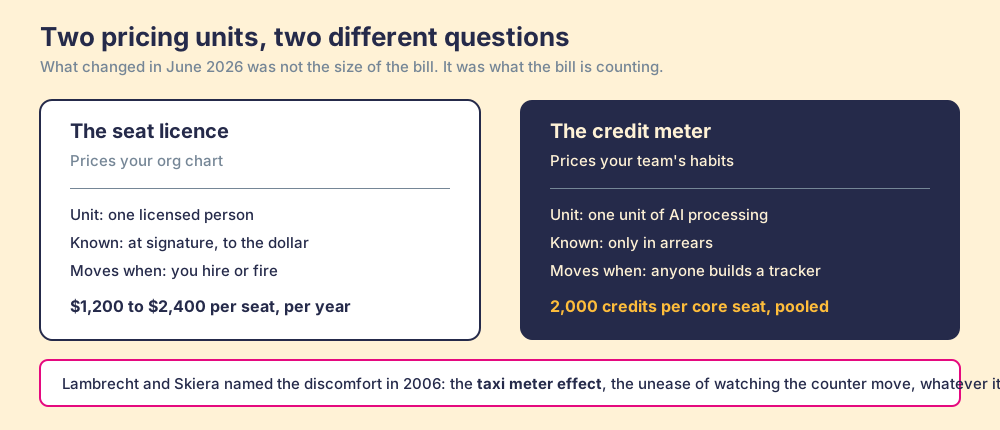
So the shockwave was never about money. A buyer who signs a 54,900 dollar contract has already made peace with a large number. What the meter removed was the ability to know the number in advance, and predictability is a thing buyers pay real premiums to keep. Lambrecht and Skiera found the flat-rate bias persistent and, for the seller, profitable, because it does not drive churn the way its opposite does. Gong has moved its customers to the side of that trade people like less.
What consumes Gong credits, and what stays free?
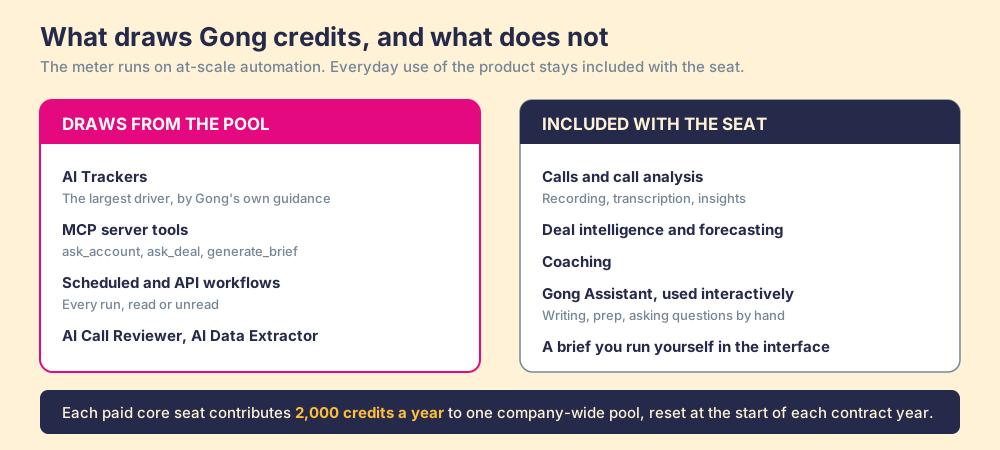
Most of the alarm dissolves once you see how narrow the meter is. Credits are drawn by three categories of at-scale processing, and everyday use of the product draws nothing at all.
| Capability | Draws credits? |
|---|---|
| AI Trackers | Yes, the largest driver by Gong’s own guidance |
| MCP server tools (ask_account, ask_deal, generate_brief) | Yes, on every request |
| API-based and scheduled AI workflows | Yes, every time they run |
| AI Call Reviewer, AI Data Extractor | Yes |
| Calls, call analysis, conversation insights | No |
| Deal intelligence, forecasting, coaching | No |
| Gong Assistant, used interactively | No |
| Running a brief by hand in the Gong interface | No |
Two mechanics inside that table decide whether your pool lasts the year.
The first is that MCP requests re-analyze from scratch every time. Asking the same question about the same account twice analyzes the same calls twice. A brief with ten open-ended sections triggers ten separate analysis passes over the underlying conversations. Nothing is cached in your favor.
The second is that automation multiplies the first. A brief a person generates in the interface is free. The identical brief on a recurring schedule through the API draws credits on every run, whether or not a human ever opens the output. A weekly brief that lands in an inbox and goes unread is a standing order at the meter.
When the pool empties, the failure mode is a stoppage rather than a surprise bill. API and MCP requests return an error. AI Trackers pause, and have to be resumed by hand, at which point they work through the backlog that accumulated while they slept. Gong does not auto-purchase or auto-charge, and additional credits expire at the end of the contract term rather than carrying forward. That design is more considerate than the reaction suggested, and it is worth saying so.
Why does metered AI put a price on an unadopted process?
Here is the part the pricing roundups miss, and it is the reason this change matters past the invoice.
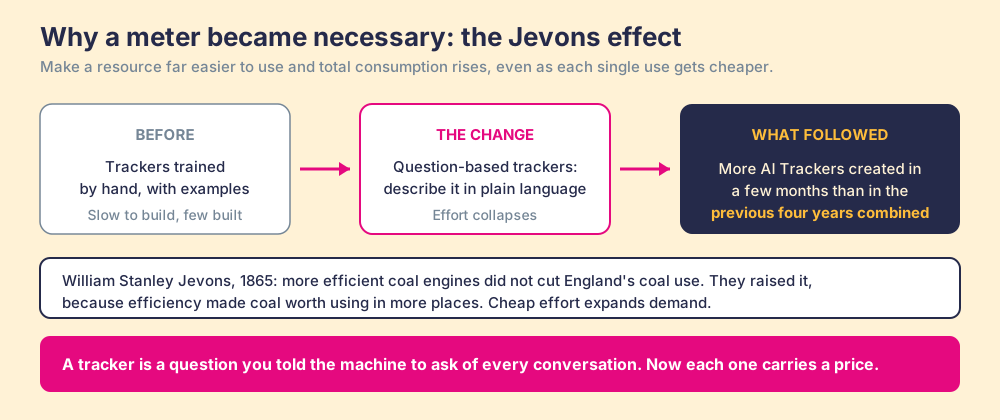
Reshef shared a detail about AI Trackers that deserves more attention than it got. Gong had introduced question-based trackers, which let a team create a tracker by describing what it wants in plain language instead of training it with examples. In the few months after that shipped, Gong’s customers created more AI Trackers than in the previous four years combined.
That is not a usage anomaly. It is a 160-year-old economic result arriving on a SaaS invoice. In 1865, William Stanley Jevons observed that improvements in the efficiency of coal-burning engines did not reduce England’s coal consumption. They raised it, because efficiency made coal useful in more places. Make a resource dramatically easier to use and total consumption climbs, even as each individual use gets cheaper. Gong made asking a question of every conversation nearly free in effort, and its customers responded exactly as Jevons would have predicted, which is precisely why a meter became necessary.
Now follow it one step further, because this is where a pricing change becomes an operating question.
A tracker is a question you have told the machine to ask of every conversation your company has. Under seat pricing, asking a hundred badly-scoped questions cost the same as asking five good ones. The waste was real, and it was invisible, absorbed into a fixed fee. Under a meter, every broad tracker scanning every call, every scheduled brief that goes unopened, every duplicate query against the same account becomes a line item you can see.
Which means the meter is doing something no dashboard managed to do. It is putting a number on the gap between the process you think you run and the one your reps perform.
Our own field research in The State of Sales Enablement found 89 percent of sales teams had a documented process while only 36 percent saw it followed, a 53-point gap between the standard on paper and the behavior in the field. Point continuous AI analysis at that gap and the arithmetic is unkind. You are paying, per unit of processing, to measure conformity to a standard that two-thirds of the organization was never performing. The analysis will be accurate. It will also be expensive, and it will mostly tell you what you already suspected.
This is the sequencing problem we keep coming back to. AI amplifies the process you have. Run it in front of an adopted process and it compounds something real. Run it in front of a documented-but-unfollowed one and it produces a precise, well-formatted, metered account of drift. That was always true. What changed in June 2026 is that it now shows up on an invoice, and finance can see it.
The fix is not smaller trackers, though smaller trackers help. The fix is upstream: make the process something reps perform, so the thing you are paying to analyze is worth the analysis. That is the work a behavior layer does, guiding the rep to the next right action in the moment the question arises, in the tools where the work is already happening, so adherence is produced rather than merely audited. Supered exists for that job. It is upstream of Gong, not a replacement for it, and the two get along fine. But the order matters, and the meter has made the order legible.
How do you negotiate Gong pricing before you sign or renew?
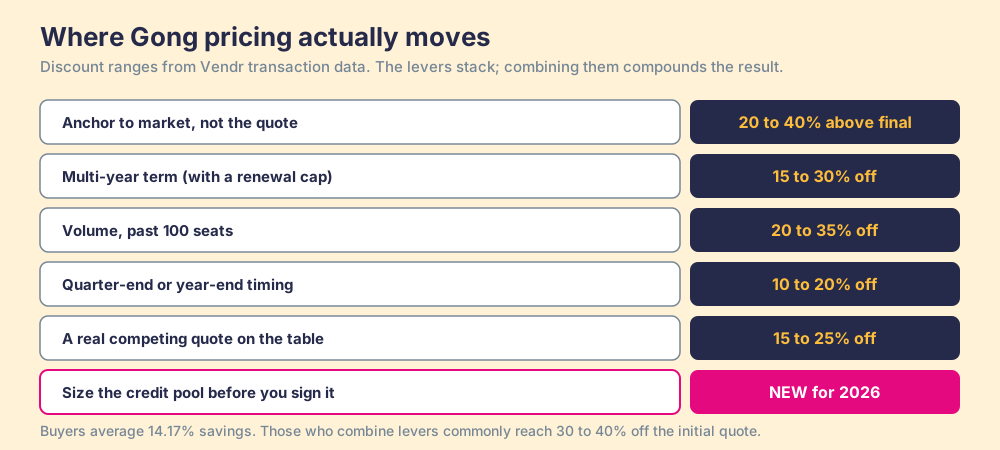
The negotiation data is unusually clear, and the levers stack.
- Anchor to market, not to the quote. Vendr reports initial Gong quotes typically run 20 to 40 percent above final negotiated pricing. The first number is a starting position, and treating it as information is the most expensive mistake on this list.
- Trade term for rate, with protection. Two and three-year contracts commonly bring 15 to 30 percent lower annual pricing, and 60 to 70 percent of Gong deals are already multi-year. Take the discount, then negotiate annual true-ups at the original per-seat rate, a renewal price cap, and removal of the auto-renewal clause, which otherwise escalates 5 to 10 percent a year.
- Buy volume and modules at once. Deployments past 100 seats reach 20 to 35 percent off, and bundling Engage or Forecast at signature beats adding them later by 15 to 25 percent.
- Time it. Quarter-end and year-end deals land 10 to 20 percent better than mid-quarter ones. Start 60 to 90 days out and let the calendar work.
- Bring a real alternative. Buyers who evaluate Gong alternatives and share competing quotes commonly win a further 15 to 25 percent. Chorus under ZoomInfo prices 10 to 20 percent below Gong; Clari runs 15 to 30 percent above. The comparison we wrote on Gong versus Salesloft covers where the jobs genuinely differ.
- Size the meter before you sign it. This one is new, and no legacy playbook has it. Ask for your projected annual credit consumption based on your intended tracker count and any scheduled briefs, in writing, and ask what a credit top-up costs. Audit trackers before renewal the way you audit seats: unpublish the ones no manager has opened in a quarter, scope the survivors by team or deal stage, and query at deal level rather than account level where the question is about one opportunity.
The verdict
Gong is not overpriced, and the credit model is not a trap. The company is growing past 55 percent year over year with ARR above 500 million dollars as of May 2026, it remains independent with no acquisition and no IPO filing, and it is charging the heavy users for AI processing rather than funding it invisibly by raising every customer’s seat price. On the merits, the design is reasonable and the disclosure has been decent.
What we would tell a buyer is this. Budget the seats, negotiate them hard using the levers above, and expect to land near the 54,900 dollar median if you are a mid-market team. Then treat the credit pool as an operating metric rather than a line item, because that is what it is. It measures how many questions you are asking of your conversations, and asking a great many questions of a process your reps are not running is the most expensive way to learn something you could have learned for free.
The order we recommend has not changed, though the meter has made it cheaper to get right and dearer to get wrong: get the process adopted, then point the analysis at it. A team whose reps run the standard gets a precise instrument for a fair price. A team whose reps do not gets an itemized bill for the privilege of watching them not.
If the second description lands closer to home, the useful next read is our field data on why documented processes go unfollowed in The State of Sales Enablement, or you can book a demo and we will show you what closing that gap looks like in the flow of work.
Frequently asked questions
How much does Gong cost in 2026?+
What are Gong credits, and what uses them?+
What happens if you run out of Gong credits?+
Is Gong worth the price?+
How much can you negotiate off a Gong quote?+
Does Gong have a free trial or self-serve plan?+
Your process, running itself.