Showpad Pricing in 2026: The Quote, the Merger, and the Cost the Invoice Never Shows
A clear-eyed look at Showpad pricing in 2026: the quote-based Content and Coach plans, the real contract numbers buyers report, the merger that changed your bargaining position, and the adoption risk no tier removes.
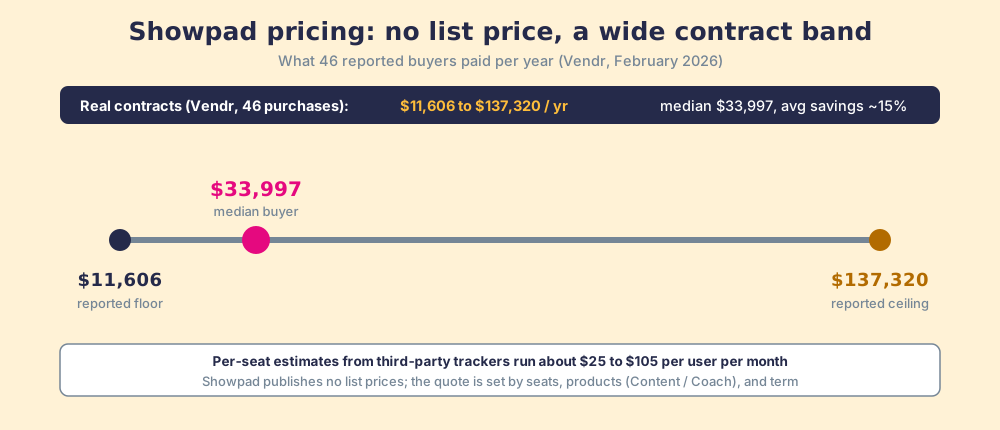
Showpad pricing is quote-based rather than published: per-user Content and Coach plans billed annually, with real contracts running from 11,606 to 137,320 dollars a year and a median near 33,997 (Vendr, February 2026).
A Showpad quote arrives the way a tailored suit does: no price on the rack, and the number decided in the fitting room by your measurements. Seats, products, term length, feature tier. Two buyers with the same headcount can sign contracts an order of magnitude apart, and neither of them saw a price list, because there is none to see.
Showpad pricing is quote-based rather than published: per-user Content and Coach plans billed annually, with real contracts running from 11,606 to 137,320 dollars a year and a median near 33,997 (Vendr, February 2026). Hold the spread in mind before any sales call. The ceiling is nearly twelve times the floor, and where you land is a negotiation, not a menu. One more thing moved since the last time you may have priced this category: Showpad is no longer the company it was in 2024, and the change reshapes what you should pay.
How much does Showpad cost in 2026?
Showpad sells two core products, and the quote is assembled from them.
- Showpad Content. The content management and buyer engagement product: organize collateral, deliver presentations, track buyer interactions. Priced per user per month, billed annually, quote only (Vendr).
- Showpad Coach. The training and readiness product: video coaching, certification tracking, onboarding workflows. Rarely bought standalone; most buyers bundle it with Content.
- The bundle discount. Content plus Coach together prices 15 to 25 percent below the sum of the standalone products, per Vendr’s deal data.
- The real contract band. Across 46 reported purchases, annual spend ran from 11,606 to 137,320 dollars, median 33,997, with buyers saving about 15 percent off initial quotes on average (Vendr, updated February 2026).
- Per-seat estimates. Third-party trackers put Showpad pricing per user between roughly 25 and 105 dollars per month, from the legacy Essential, Plus, and Ultimate tiers near 25, 50, and 75 dollars to newer per-seller reference points of 45 to 105 dollars across the post-merger packaging (ITQlick, 2026). Treat these as directional; the packaging changed in the 2025-2026 transition and Showpad confirms none of them.
| Component | What it covers | Public price | Reported reality (Vendr, Feb 2026) |
|---|---|---|---|
| Showpad Content | Content management, buyer engagement | Quote only | Per-user, annual billing; volume discounts from ~50 seats |
| Showpad Coach | Training, certification, readiness | Quote only | Usually bundled; standalone deals are rare |
| Content + Coach bundle | Both products | Quote only | 15 to 25% below buying separately |
| Full contract band | All deployments | None | 11,606 to 137,320 dollars/yr, median 33,997 |
What does Showpad cost a 50-rep mid-market team?
Arithmetic on the cited numbers gets you closer than any tier name. The Vendr median contract of 33,997 dollars, spread across a 50-seat team, works out to about 57 dollars per rep per month. That sits inside the third-party seat estimates, which is a useful sanity check: the trackers and the contract data agree on the neighborhood even while they disagree on the tier names.
Year one costs more than year two. Onboarding and implementation are quoted separately and run from 5,000 dollars for small teams to 50,000 and beyond for complex deployments (Vendr). A 50-seat team at the median contract, taking the low end of that onboarding band, should plan on roughly 39,000 to 49,000 dollars in year one before any premium support, which adds another 10 to 20 percent of contract value when taken. Mid-market buyers in Vendr’s dataset (50 to 150 users) commonly closed 20 to 30 percent below initial quotes, so treat the first number Showpad sends as an opening position and negotiate from the reported contract band.
What hidden costs does the Showpad quote leave out?
The quote works like a budget-airline fare. The fare buys the seat; the bags, the boarding order, and the change fee are where the ticket grows, and each one is priced after you have already decided to fly. Vendr’s deal data names six of them, and the sum can pass the subscription itself.
- Onboarding and implementation. 5,000 to 50,000+ dollars, quoted separately, scaled to deployment size.
- Professional services. Custom integrations and advanced configuration add 10 to 25 percent to total contract value.
- Premium support. A dedicated CSM and faster response times add 10 to 20 percent to the annual contract.
- Content creation services. Showpad-built presentations and templates run 10,000 to 100,000+ dollars.
- Seat overages. Mid-term additions can price 20 to 50 percent above the contracted per-seat rate unless you negotiate true-up terms.
- Escalators. Contracts commonly carry 3 to 5 percent annual increases; cap or strike them in a multi-year term.
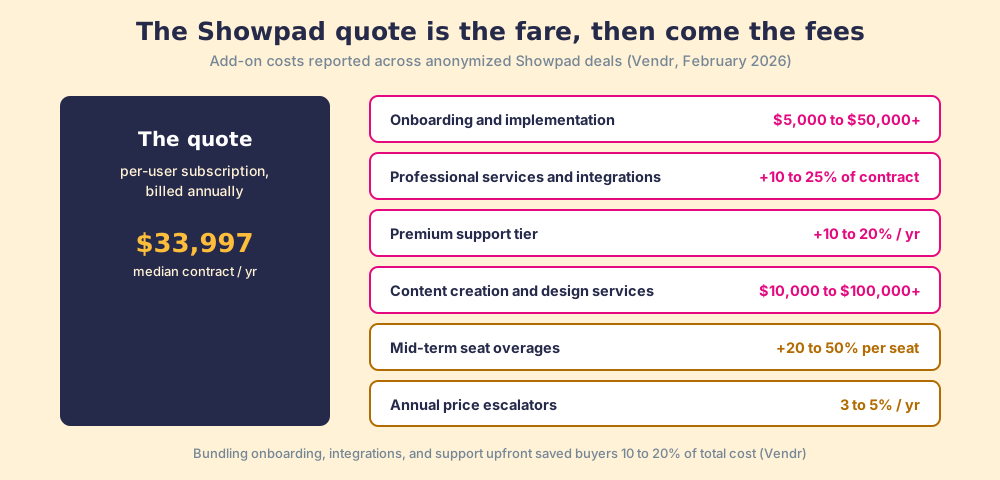
The pattern in the data is plain: what gets negotiated before signature gets discounted, and what gets added after signature gets list-priced. Buyers who pulled onboarding, standard integrations, and support into the original bundle saved 10 to 20 percent of total cost against those who bought the add-ons piecemeal (Vendr).
What does the Bigtincan merger mean for Showpad pricing?
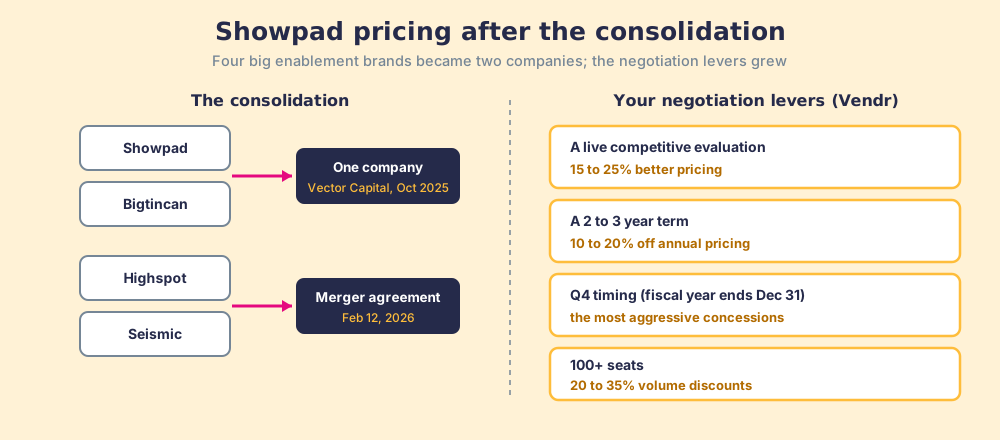
The company you are pricing was reassembled in 2025. Vector Capital, a private equity firm, acquired Bigtincan in April 2025, agreed to acquire Showpad that August, and closed the deal on October 30, 2025, merging the two under the Showpad brand with a new CEO, Apratim Purakayastha (Showpad press release, October 2025). The combined company serves more than 2,000 customers in 50 countries, with around 160 million dollars in revenue and over 600 employees (Enterprise Times, October 2025). Then on February 12, 2026, the category’s two giants, Highspot and Seismic, signed their own merger agreement. Four of the best-known enablement brands are becoming two companies.
For a buyer holding a Showpad quote, this cuts in two directions at once. The risk direction: a private-equity rollup mid-integration carries roadmap uncertainty, and two overlapping product lines usually resolve into one survivor and one migration path. Ask, in writing, which line yours is. The opportunity direction: a PE-owned vendor integrating an acquisition needs retention and bookings while its two biggest rivals are distracted by their own merger, and that is when concessions come easiest. Vendr’s deal data prices the levers: a live competitive evaluation earned buyers 15 to 25 percent better pricing, a 2 or 3 year commitment took 10 to 20 percent off annual pricing, 100-plus seats drew 20 to 35 percent volume discounts, and the sharpest concessions came in Q4 because Showpad’s fiscal year ends December 31.
Fewer independent vendors will, over time, mean less price pressure in the content-suite tier. Right now, mid-integration, the pressure runs your way. Use the window.
Who should pay Showpad’s price, and who should not?
The branch turns on which job is your bottleneck, and the wider field is mapped in our guide to sales enablement software.
- Showpad itself. The right pick for field-selling-centric enterprises whose constraint is content at scale: hundreds of sellers, thousands of assets, formal certification programs. The platform is built for exactly that, and Vendr data shows it pricing 10 to 20 percent below Seismic for similar mid-market scope, with lower contract minimums than Seismic or Highspot (typically 10 to 25 users versus 25 to 50).
- A lighter content tool. The better spend for a team that needs a tidy library and little else. The full field, sorted by job and read against the consolidation, is in our breakdown of Showpad alternatives.
- A behavior tool. The answer when the constraint was never finding content. Forrester’s SiriusDecisions research found roughly 65 percent of sales content is never used by reps (Forrester), and a bigger, better-funded library reorganizes that black hole without closing it.
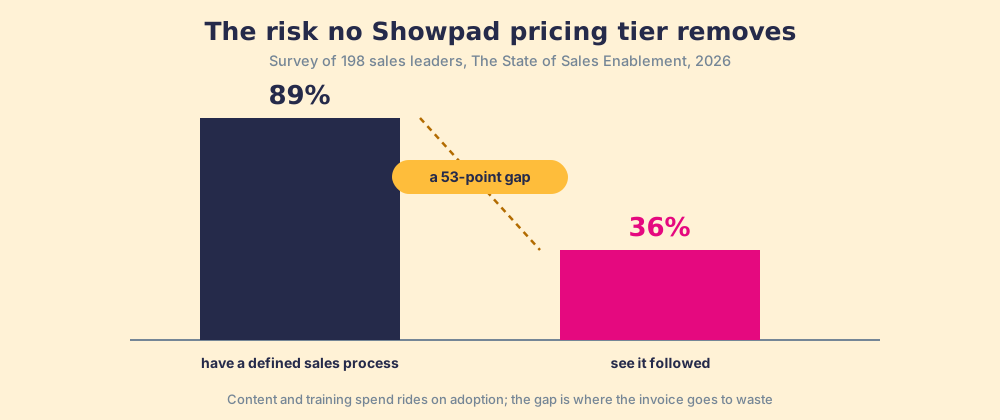
That third branch deserves the last word, because it is where the money goes to die. In our survey of 198 sales leaders for The State of Sales Enablement, 89 percent of teams had a defined sales process and only 36 percent saw it followed. A 53-point gap between what the team wrote down and what the team does. Content-heavy enablement is a depreciating liability against that gap: the decks and courses go stale the moment the process changes, and no pricing tier, at 11,606 dollars or at 137,320, makes a rep open the library at the moment a deal turns.
Closing that gap is a different job with a different mechanism: the guidance has to reach the rep in the flow of work, inside the CRM and the tools they already use, at the instant the question arises, with adherence measured deal by deal. That is what Supered is built for. It is the Business Logic Layer, the piece a Showpad contract does not include at any price, and you can see it run in a demo.
So here is what we recommend. Buying Showpad for a field-selling enterprise with a content bottleneck is a defensible spend: anchor on the Vendr median of 33,997 dollars, run a live competitive evaluation, bundle Content and Coach, pull onboarding and support into the contract, and close in Q4 against a vendor that needs the bookings mid-integration. Get the product-line survivorship answer in writing before you sign. And if your bottleneck is the 53-point gap between the process you defined and the process your reps run, stop pricing libraries. The comparison worth your next twenty minutes is Showpad alternatives read alongside the Highspot and Seismic merger, because the category you are buying into is consolidating, and the job it consolidates around is the one AI already solved.
Frequently asked questions
How much does Showpad cost in 2026?+
Does Showpad publish its pricing?+
Is Showpad still an independent company?+
How do you negotiate a better Showpad price?+
Is Showpad worth the price?+
Everything we have written on Showpad
More on Showpad
Your process, running itself.