Freelance to Agency: Logan Armstrong on Hiring for the Load in Your Head
Logan Armstrong ran Empty Cup on his brain, Apple Notes, Gmail and a lot of coffee. What he learned going from Upwork freelancer to HubSpot agency: hire for the mental load, price the result, and never skip the end state.
Going from freelance to agency means turning work one person delivers from memory into a service a team can deliver from a shared, written process, priced on the result instead of the founder's hours.
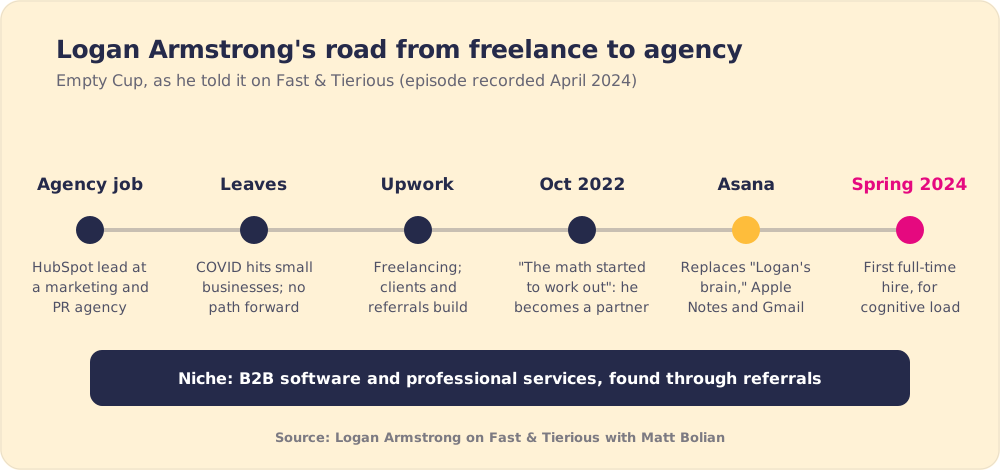
Ask Logan Armstrong where the name Empty Cup comes from and he will tell you it “means that I have a caffeine addiction.” Ask about his tech stack for the first stretch of the business and you get the rest of the joke: “Logan’s brain, Apple Notes and, you know, Gmail,” plus, he added later, “exorbitant amounts of caffeine.” On that stack he went from freelance to agency, taking a solo HubSpot practice from Upwork gigs to Platinum in about 18 months, with a roster of contractors and no full-time employees.
Logan came on Fast & Tierious in April 2024, the same week he made his first full-time hire, and we talked through the move from freelance to agency while it was still fresh. He told me why he hired, how he changed his pricing, how his clients picked his niche for him, and the two mistakes he will not make again.
He had been the HubSpot lead at a small digital marketing and PR agency when COVID hit. It “took a toll on a lot of small businesses,” he said, and he could not see a path forward there. He left and started freelancing. “If it wasn’t for Upwork, I probably would not be here today.” Demand for HubSpot help was steady, clients kept asking for work that needed more HubSpot products, and in October 2022 he joined HubSpot’s partner program so he could offer them more.
He drew a hard line on what Empty Cup would be. “We are not a marketing agency. We don’t do any marketing, any content, any copy.” What he liked was the back end: “solving puzzles and solving problems all day every day.” The year before the episode, Empty Cup brought in roughly $110,000 to $115,000, and the goal for 2024 was $200,000.
Why did Logan’s first full-time hire have nothing to do with workload?
Logan got fast by doing the same kind of work over and over. “I’m just in HubSpot basically all day every day,” he said, “so you start to see the same problems, and you start to be able to solve them much faster than you did the first time.” Speed carried him a long way. So did nights and weekends. The one thing he liked less than turning down revenue, he said, was giving a client anything less than stellar service.
Then the client list outgrew “Logan’s brain.” He could no longer keep every project straight in his head. He moved the work into Asana to make sure “nothing’s slipping through the cracks,” and then, the week of the recording, made his first full-time hire. His reason was specific: “not even from a work volume standpoint, just from like a cognitive load standpoint.”
Psychologists have measured the load he felt. E. J. Masicampo and Roy Baumeister found that unfinished goals “caused intrusive thoughts during an unrelated reading task” and hurt performance on an unrelated anagram task, and that letting people “formulate specific plans for their unfulfilled goals eliminated the various activation and interference effects” (Masicampo and Baumeister, Journal of Personality and Social Psychology, 2011). In their studies, a written plan for the unfinished goal was enough to stop the distraction. Logan’s move to Asana did the same job for his client list before he hired anyone.
The usual advice on a first agency hire is about cash. Preston Lee, founder of Millo, tells founders to “hire for revenue-generating positions” (Millo), and he is right that cash comes first. Logan hired for a different reason, and the hire forced a change of its own. A new person cannot read your mind, so every project had to be written down in Asana where both of them could see it. Our post on institutional knowledge covers why the written version outlasts any one person.
Why does hourly pricing punish a freelancer who gets faster?
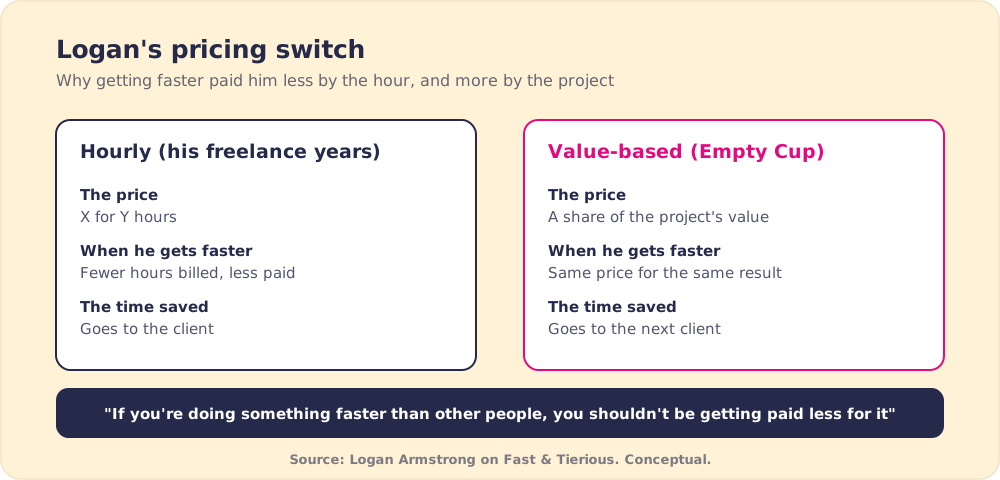
Logan billed by the hour through his freelance years, and his speed started working against him. “I’m a proponent of, if you’re doing something faster than other people, you shouldn’t be getting paid less for it,” he said, “especially if you’re doing it at the same quality.”
So Empty Cup stepped away from the hourly model and toward value-based pricing. He describes it as asking “what is the value that’s coming out of this project, and let’s price it at a percentage of that.” The price becomes X for the project instead of X for a set number of hours. When the team finishes in fewer hours than X would have bought, the saved time goes to another client. He said the change helped “in terms of growing revenues as well as just consolidating time.”
I told him how I heard it: you start hourly because you have to earn the experience, and once you are faster, an hour stops being a fair measure of what the client gets. Logan did not claim to have invented the idea. He spent the freelance years reading “successful solo consultant content” while deciding whether he even wanted to scale.
How do you find a niche when going from freelancer to agency?
Logan did not pick his niche. Early on he took nearly every client he could, to pay the bills. Then “the clients we were getting would then send referrals, and those referrals often tended to be in the same sorts of markets or adjacent markets.” The work settled into B2B software companies and professional services firms, many near healthcare, including behavioral health.
Those clients had budget for projects and a need to do them, and they were busy people who did not need to be “handheld,” in his word. Their problems repeated, so Empty Cup kept getting faster at them, which is what made value pricing pay. “I don’t know if I just got lucky,” Logan said.
My version on the call was “you get one client and then you niche in that industry.” Each new client in Logan’s niche came recommended by a company that had already paid Empty Cup and liked the result. That matters in a crowded field. Upwork’s 2023 Freelance Forward study counted 64 million Americans who freelanced that year, 38% of the U.S. workforce (Upwork, 2023). A buyer choosing among that many people leans hard on a referral from a company like theirs.
What would Logan never do again?
He gave two answers, one “hand wavy” and one “concrete.”
The first: never take a client “that I didn’t think I would be excited about working with, or that wasn’t a good fit, just to bring revenue in.” He allows for the months when a freelancer has to pay the bills. Past that stage, he said, a bad-fit client “hurts a lot more than it helps.”
The second: “I would never go into a project again without a clearly defined scope for what’s going to be done and what is not going to be done.” He learned it when Empty Cup was only him, with no payroll. “I kind of dug my own grave, so I kind of, you know, dug myself out of it.” With people on payroll, he said, the same mistake is a surefire way to get yourself “completely underwater.”
Project managers see the same problem at scale. PMI’s 2018 Pulse of the Profession found 52% of projects completed in the prior 12 months experienced scope creep or uncontrolled changes, up from 43% five years earlier (PMI). I added one piece to his rule: an end state that both sides agree to at the start. Logan agreed. Without it, he said, a partner who stops at the edge of a fair scope “looks to the customer like you’re just trying to, you know, dip out early.”
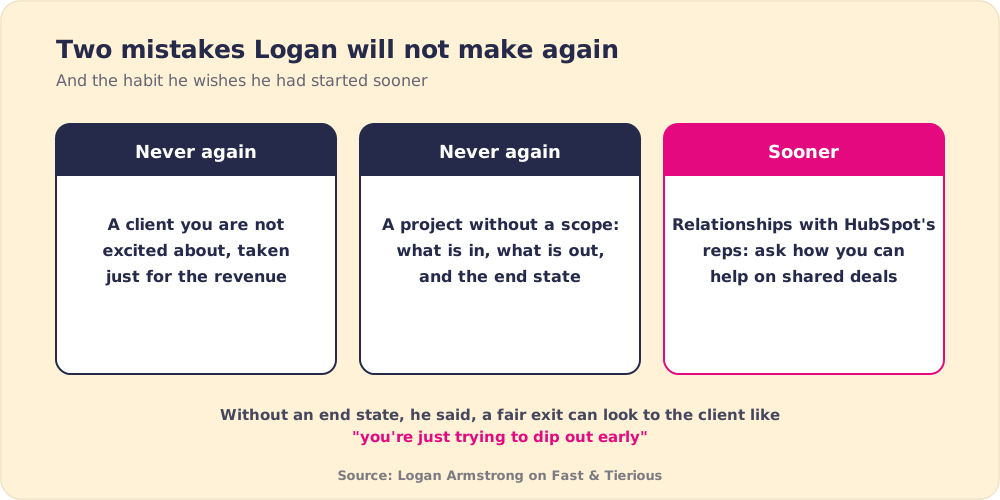
His one regret about timing: “I wish I would have started building relationships with internal HubSpot team a little earlier.” He built them by showing up on shared deals and asking the HubSpot rep, “is there anything that we can do to help you on this?” He also took care not to claim credit where the rep had done the legwork: “I want to be respectful of that.” Reps do not want customers to churn or have bad experiences either, he pointed out, because that reflects on them, so a partner they trust “goes a long way.”
Logan Armstrong’s freelance to agency lessons
- A hire for the head. Logan hired when he could no longer track every project in his head, and moved the work into Asana first.
- A price tied to the result. He charges a share of the value a project produces, so finishing sooner frees time for the next client.
- A niche the referrals chose. Referrals from early clients pulled Empty Cup into B2B software and professional services.
- A scope with an end state. What is in, what is out, and what done looks like, written before work starts.
- Relationships with the vendor’s reps. He offers help on shared deals and does not take credit for a rep’s legwork.
Where does a freelancer go from here?
Write the process down before you hire. Raising prices and staying solo keeps life simple, but it caps the business at one set of hands. Adding contractors while the process lives in your head works until your memory becomes the ceiling, which is where Logan hit it. He got past it by putting the work on the page, pricing on results, and hiring people who could run from the page. As HubSpot moves upmarket and customers get more technical, he thinks HubSpot’s own onboarding “is just not going to be the way that most HubSpot customers go,” which leaves more high-touch technical work for partners who can deliver it the same way twice.
If you are building a HubSpot practice, Supered’s partner program helps agencies turn a client’s process into a service they can run and measure. For the next step, read our guide to writing an SOP, then our post on tribal knowledge, which covers what it costs when the process stays in one person’s head.
Frequently asked questions
When should a freelancer become an agency?+
Should my first agency hire be billable?+
How should a new agency price its work?+
How do I stop scope creep when moving from freelance to agency?+
How do freelancers find a niche?+
Your process, running itself.
Turn the playbook into rep behavior.
More from Fast & Tierious

Veteran Entrepreneur Lessons From a Marine Who Bet on Himself
Daniel Peterson
Agency Partnerships: Devin Bellamy on Why the Best Agencies Share the Rolodex
Devin Bellamy