Tribal Knowledge: Your Best Rep's Motion, Trapped in Their Head
Tribal knowledge is the winning motion locked in your best reps' heads. Documenting it is half the job; getting every rep to run it is the half that counts.
Tribal knowledge is the unwritten, hard-won expertise your best reps carry in their heads, the order of the questions and the feel for when to push, and it is a risk because it is never captured, rarely shared, and walks out the door when they do.
Ask a great cook for the recipe and you get something useless: a list that says “season to taste” and “bake until it looks right.” The knowledge that makes the dish is in their hands, not the card. They could no more write it all down than you could write down how to ride a bicycle. The card is accurate. It is also missing the part that matters.
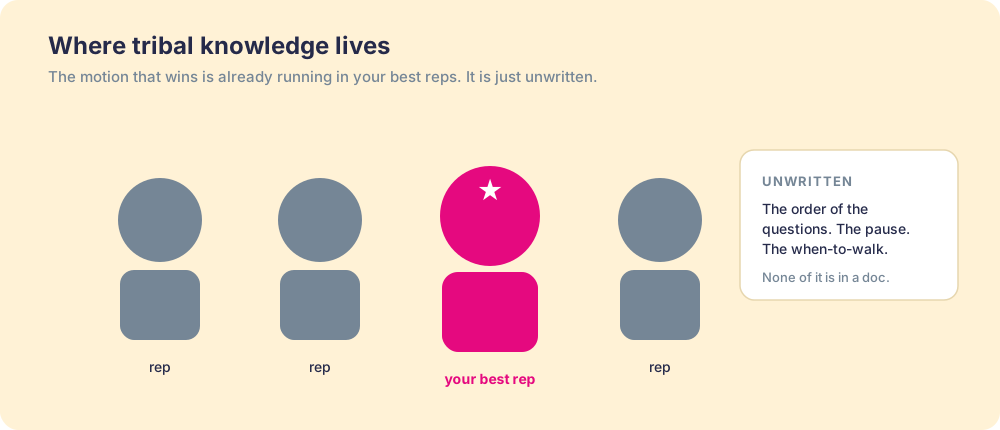
Your best sales rep keeps a recipe exactly like that. The order they ask questions in. The pause they leave after the price. The instinct that a deal has gone silent for a reason. None of it is written anywhere. It is tribal knowledge, the unwritten motion that makes them your best rep, and it has a habit of leaving when they do.
The usual response is to treat it as a documentation chore: get it out of their heads, into a doc, done. That is half the job, and the easier half. Our position, and the throughline here: capturing the motion is the start, but tribal knowledge only pays off when every rep runs it in the moment, not when it is filed.
What is tribal knowledge?
Tribal knowledge is the expertise a team carries informally, passed by demonstration and osmosis rather than written down. The philosopher Michael Polanyi gave it its sharpest definition in 1966: “we can know more than we can tell” (Polanyi, The Tacit Dimension). The skilled rep knows more about closing than they could ever dictate into a document, which is exactly why the document, when someone finally writes it, feels thin next to the person.
That gap carries a real cost, and it shows up in two places. The first is ramp. A new hire is handed the explicit half, the pricing and the slide deck, and left to reconstruct the tacit half by trial and error, which is slow and expensive. The second is loss. When a strong rep resigns, the explicit half stays and the tacit half leaves with them. Panopto’s workplace knowledge study put a number on the everyday version of this drain: employees lose around 5.3 hours every week waiting on knowledge held by a colleague or rebuilding expertise that already existed somewhere (Panopto, Valuing Workplace Knowledge). A day and a half a month, spent fetching what someone already knew.
There is a deeper reason this matters to us. The best process on your team is not a thing a consultant will sell you. It already exists, running inside your top performer, proven on real deals. The job is not to invent a motion. It is to find the one that already works and make it the standard the whole team runs.
What are examples of tribal knowledge in sales?
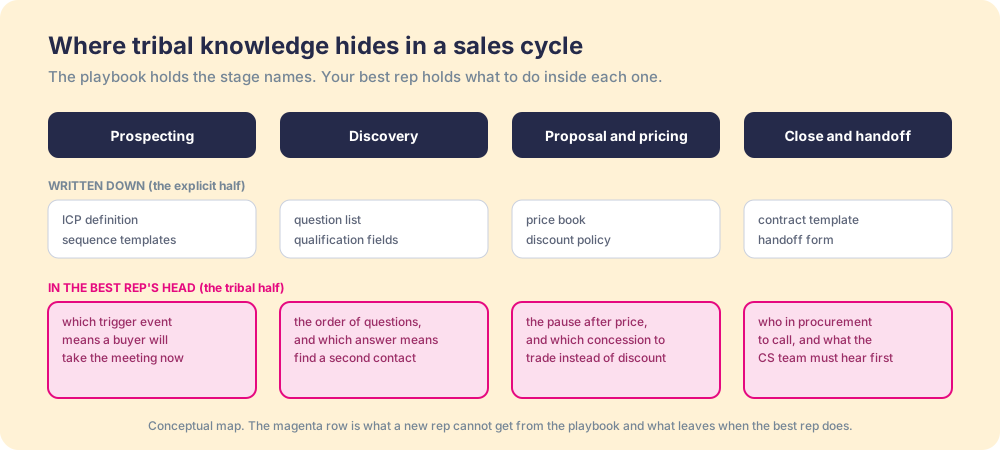
Examples of tribal knowledge in sales are the moves your best rep makes inside each deal stage that the playbook never names. The playbook holds the stage names, the price book, and the question list. The best rep holds what to do with them:
- Prospecting timing. Which trigger event (a new VP of Sales, a funding round, a failed implementation with a competitor) means a buyer will take the meeting this month, and which means “check back next year.”
- Discovery order. The sequence of questions, and the answer that means the champion cannot sign alone and you need a second contact before the next call.
- The price moment. The pause after stating price, and which concession to trade (a longer term, a case study, a phased start) instead of reaching for a discount.
- Procurement routes. Who in a given customer’s legal or procurement team moves a redline in two days, and who sits on it for three weeks.
- Handoff context. What the customer success team must hear first so the buyer does not repeat their requirements at kickoff.
- CRM workarounds. Which field triggers the commission report, which stage the forecast ignores, and the fix that keeps a renewal from double-counting.
Outside sales the pattern is identical: the machinist who knows a press runs hot after lunch, the support lead who knows which error message means a billing bug. The explicit half is written down. The tacit half, the part a new hire needs most, lives in one head. Panopto’s research found new hires get about 2.5 months of formal training but take up to 6 months to reach proficiency, with 3.5 months spent learning on their own (Panopto, 2018). Those self-taught months are the cost of tribal knowledge that was never handed over.
Why does documenting tribal knowledge fail?
Because writing it down moves it one step, and teams mistake that step for the finish. The motion goes from one person’s head into a document, which feels like progress, and in one sense it is: the knowledge now survives the person. But a document is not a behavior. The captured motion sits in a file, and the other reps go on selling the way they always did, because nothing reached them at the moment they were working.
A sales knowledge base hits the same wall. The answer exists, it is findable, and the rep on a live call still does not use it, because using it means stopping the work to go look. A documented motion has no advantage here. It is one more thing in the library that the busy rep drives past.
The doc was never the obstacle.
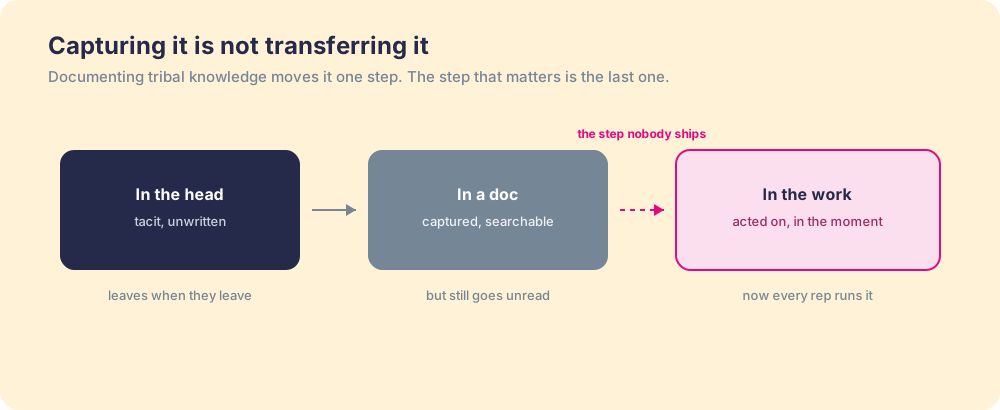
Forgetting finishes the job. Even the rep who reads the new motion in a training session sheds most of it within days, not from carelessness but from being human. So the captured knowledge sits in a doc, the rep half-remembers a worse version, and real tribal knowledge transfer never happens, because transfer is not telling someone once. It is the right move arriving when they need it.
When the motion does not spread, the cause is the system, not the people. Reps are not ignoring the playbook out of arrogance; the playbook never reached them where the work happens. As we argue in the sales execution gap, the fix is to deliver the motion into the flow, not to lecture harder about discipline.
How do you capture tribal knowledge from your best reps?
You capture tribal knowledge by watching the motion at the moment it matters and naming it as a trigger and an action, because your best rep cannot dictate it. Interviews fail here for Polanyi’s reason: ask a top performer what they do and you get the explicit half back. Six steps work instead:
- The moment that matters. Pick one deal moment where your top rep’s results split from the median: the first discovery call, the price conversation, the stall after a proposal. One moment, not the whole cycle.
- The recordings. Pull call recordings or deal notes of that moment from the top rep and from a median rep. Gong, Chorus, or a stack of Zoom recordings all work; the point is to watch the motion, not ask about it.
- The difference, named as a trigger. Write what the top rep does that the median rep does not, in the form “when X happens, do Y.” Peter Gollwitzer’s research on implementation intentions found plans phrased this way (“Whenever situation x arises, I will initiate the goal-directed response y”) produce a medium-to-large effect on follow-through, d=0.65 across a 94-study meta-analysis (Gollwitzer and Sheeran).
- The rep’s check. Show the named move to the top rep. They could not have described it, but they will recognize it, correct it, and often add the exception that matters.
- Delivery at the trigger. Put the move where the trigger fires: inside the CRM record, the inbox, the call prep, so the rep meets it in the work.
- Inspection. Check deal by deal whether the move ran, then coach the misses.
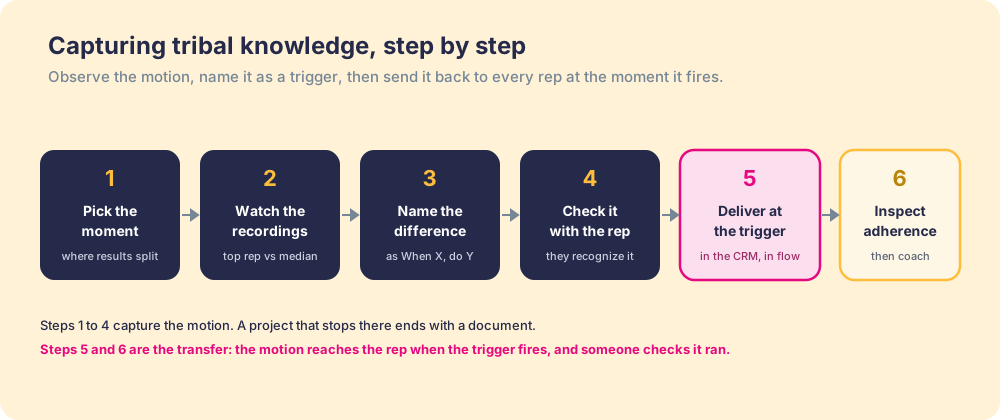
The trigger format is what turns capture into a system. “Build rapport with the CFO” is advice. “When a deal enters proposal with one contact, add the economic buyer before sending price” is a rule a CRM can watch for and a manager can inspect.
How do you turn tribal knowledge into a standard?
Capture the motion from the people who already run it, then deliver it back to the whole team at the moment of the work. The sequence is concrete, and none of it depends on willpower:
- The motion, not the memo. Capture what the best rep does, using the steps above, rather than a summary of what they say they do. The same method scales to the company-wide memory in institutional knowledge, and it is the fastest way to take down the walls described in knowledge silos.
- One next action. Strip the captured motion to the single next move a rep needs, not a forty-page binder. One clear step beats a complete manual left unopened.
- Delivery in the flow of work. Surface that next step inside HubSpot, Salesforce, the inbox, wherever the rep already sells, so running the motion costs no detour.
- Inspection of the run. Measure adherence to the captured motion, then coach the gap. You cannot spread a standard you do not inspect, and inspection is what turns a good example into a team habit.
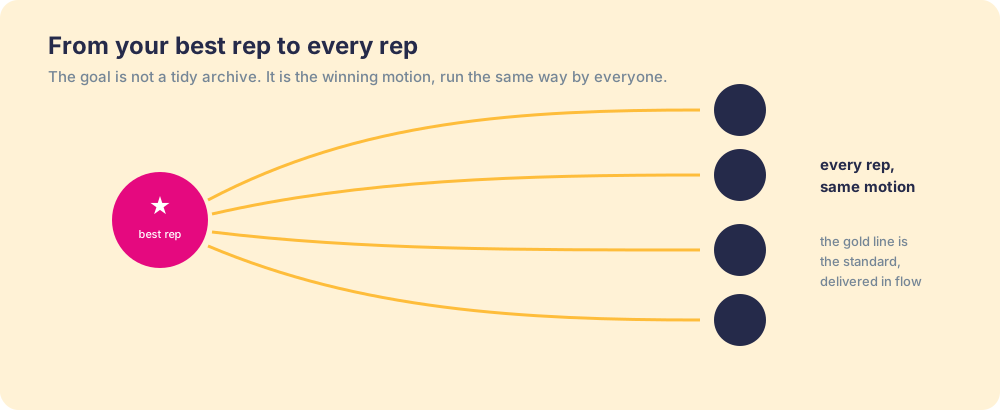
Knowledge sharing efforts die at that last step. A motion posted to a wiki and never inspected changes nothing; a motion delivered in the moment and measured for adherence becomes how the team sells. The difference is not the quality of the document. It is whether anyone built the path from the doc back into the work.
The payoff shows in the data. Our State of Sales Enablement found teams whose guidance lives in the flow of the work hit quota at 49 percent against 15 percent for teams whose knowledge sits in a separate destination (The State of Sales Enablement). The motion was the same; what changed was whether it reached the rep where they stood. When a century of tacit-knowledge research and our own field data agree that delivery in the moment is the deciding variable, that is the case worth betting on.
What we recommend
Leaving tribal knowledge tacit has a known price: six-month ramps, a playbook that leaves with each resignation, and hours a week spent rebuilding what someone already knew. Capturing it into a document cuts the walkout risk and leaves the ramp untouched, because the document waits to be read.
Capture the motion as triggers, deliver each one at the moment it fires, and inspect whether it ran. Expertise that stays tribal is fragile and leaks hours every week, while a captured motion delivered in the moment more than triples quota attainment over knowledge parked in a separate tool. Writing it down is step four of six. Getting the next rep to run it, while the work is in motion, is the result.
So find the motion that already works, capture it from the rep who runs it, and put it back in each rep’s hands at the moment they need it. Start with where that captured knowledge should live in the sales knowledge base, the daily discipline of it in sales process adoption, and the broader pattern in the sales execution gap.
Frequently asked questions
What is tribal knowledge?+
Why is tribal knowledge a problem?+
How do you capture tribal knowledge?+
What are examples of tribal knowledge in sales?+
How do you systematize tribal knowledge in a sales org?+
What is the difference between tribal knowledge and a knowledge base?+
How is tribal knowledge transfer different from training?+
Your process, running itself.