Agency Partnerships: Devin Bellamy on Why the Best Agencies Share the Rolodex
Devin Bellamy went from a GeoCities hit counter to HubSpot's partner enablement team. His case for agency partnerships: eat your own dog food, share the lead, and price the specialist in.
Agency partnerships are working arrangements between agencies, or between an agency and a software or app partner, in which each brings the skill the other lacks so a client's whole problem gets solved under one plan.
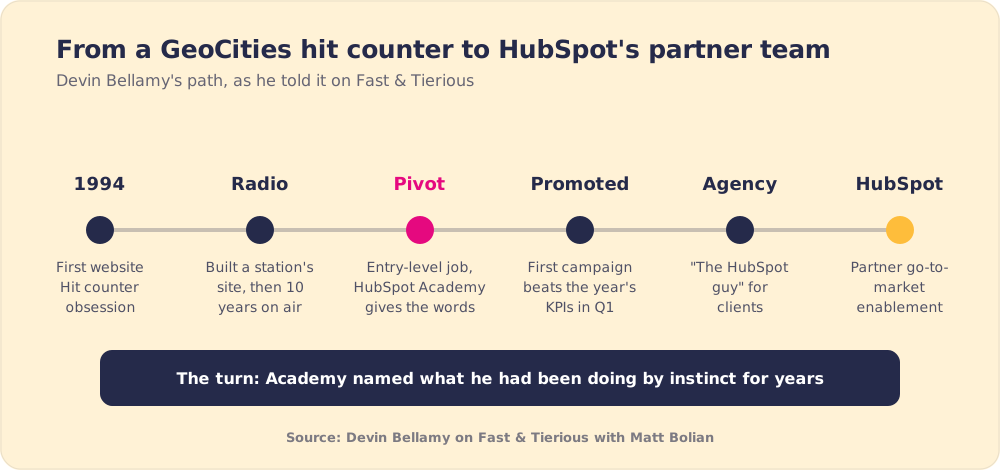
In 1994 Devin Bellamy built his first website and got hooked on the hit counter at the bottom of the page. “I became obsessed with getting people to visit my GeoCities site,” he said. When he came on Fast & Tierious thirty years later, he was a senior marketing manager on HubSpot’s partner go-to-market enablement team, and most of what he wanted to tell agencies was about agency partnerships. The firms he watched land the biggest work were the ones willing to hand part of it to someone else.
He got there by a crooked road. Devin says he has “an extensive collection of hair nets and name tags” from manual labor jobs. At 14, working at McDonald’s, he saw a calendar on the wall announcing the Big and Tasty months before launch, then watched the bags and wrappers show up on schedule. “I was fascinated,” he said. He designed a website for a radio station, they had him record commercials, and that turned into ten years in broadcasting.
After a move, he took an entry-level marketing job at a company that was rolling out HubSpot, and he found HubSpot Academy. It gave him names for work he had been doing by feel. “I didn’t know anything about multichannel marketing or brand uniformity or brand voice or conversion paths, any of that stuff, until I found HubSpot Academy,” he said. It also taught him how to talk to the people who sign off on budgets: “I didn’t know how to communicate to stakeholders. I didn’t know how to get executive buy-in.” His first HubSpot campaign beat the company’s annual KPIs in the first quarter. He was promoted to director of marketing, became the HubSpot champion at two more companies, then “basically the HubSpot guy” at an agency, and then joined HubSpot.
Why does Devin tell agencies to eat their own dog food?
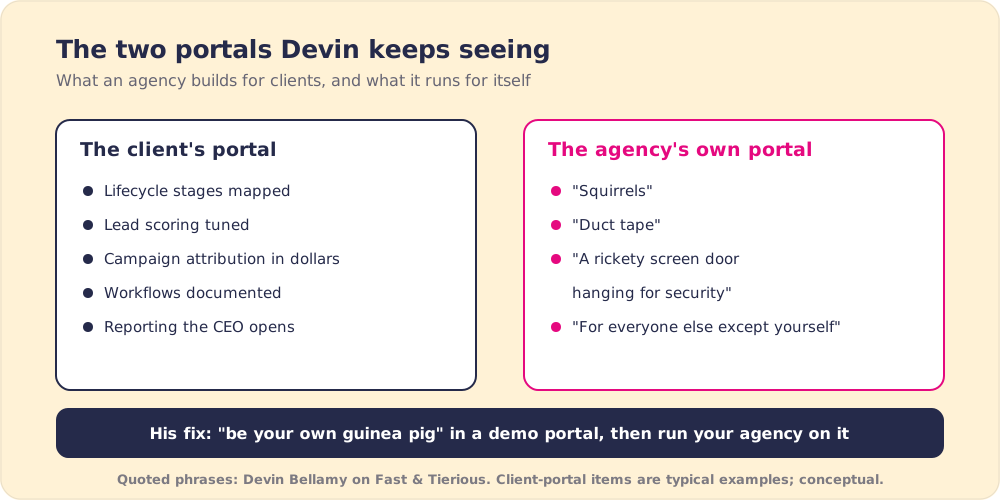
I asked Devin what agencies should start doing sooner. His first answer came from what he had seen inside them. “You got to eat your own dog food,” he said. “You got to do for yourself what you’re doing for your customers, or else you’re just going to exist on word of mouth.”
He described the agency portals he runs into. “There’s so many of us that have these just beautiful engineering masterpieces for their customer HubSpot portals, and then when they look at their own, you just see the squirrels and the duct tape and the rickety screen door hanging for security.” “Come on,” he said. “You have this amazing tool to grow your business and you’re doing it for everyone else except yourself.”
He did not leave himself out: “So many of us are guilty of that.”
The phrase comes from software. In 1988, Microsoft manager Paul Maritz sent a test manager an email titled “Eating our own Dogfood,” pushing the team to use its own product internally, and the term spread from there (Wikipedia, Eating your own dog food). For an agency, running its own growth on its own methods means it hits the broken step before a client does, and it has a working example to show on the next sales call.
Devin’s advice to new partners follows from it: “be your own guinea pig.” Get the demo portal, open the developer sandbox, and “play around and break stuff,” then use what you learn “not just to your customers but to yourself as well.” Break a workflow in your own portal first, and you will know where it fails when a client asks for the same thing.
Why do agency partnerships win work that solo agencies turn down?
Devin’s second answer was about working with other firms. He brought up a line from an earlier show Noah Burke and I did about delighting clients. “If you want to seriously delight someone, help them get a good night’s sleep. Solve the problems that are keeping them up at night, and even if they’re not in your wheelhouse, bring someone in who can solve the problem.”
He knows the pull in the other direction. “We want to hoard our Rolodex, and, oh, this is my lead, you can’t touch it.” His own side business went the other way. His most lucrative consulting client “came from a friend of a friend of someone who I delighted,” and that contract was bigger than what many of the agencies he works with see from a single retainer.
A well-known sociology study fits his story. In Mark Granovetter’s research on job seekers, of the 54 people who found work through a personal contact, 16.7% saw that contact often, 55.6% occasionally and 27.8% rarely (Wikipedia, Interpersonal ties). The introduction that pays off often comes from someone you helped once and rarely see. People also act on those introductions: Nielsen’s 2015 global trust survey found 83% of respondents completely or somewhat trust recommendations from friends and family (Nielsen, 2015).
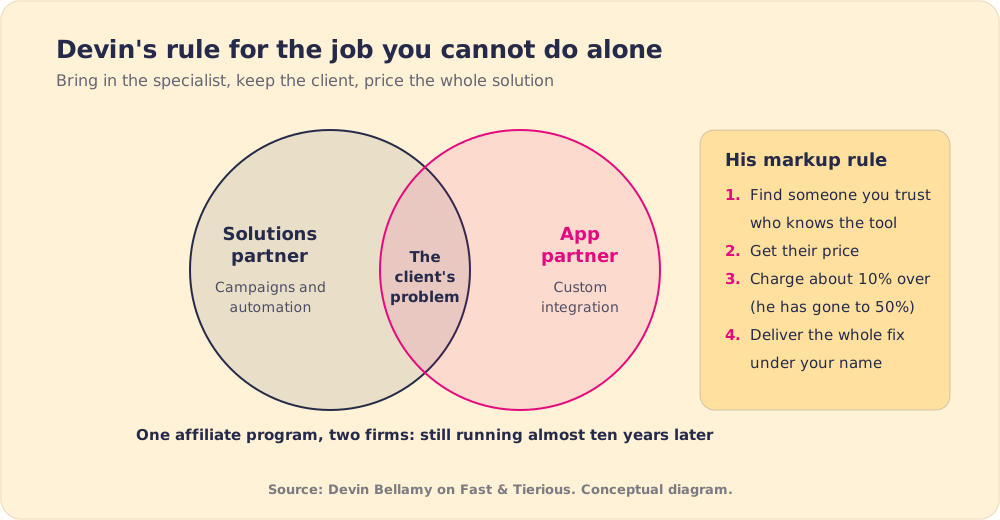
His best example came without names, because he could not share them. A major company, one listeners would know, ran a large affiliate program on HubSpot and other software, and it hired a HubSpot solutions partner for campaign work. The job needed a custom integration between the affiliate tracking software and HubSpot. “They could have immediately turned it down because they don’t handle the integration,” Devin said. The agency brought in an app partner instead, and the two built it together. “This contract was from like almost 10 years ago,” he said, and the agency’s name is still attached to the program.
From watching the firms at the top of the partner program, he drew one conclusion. “If you look at the partner ecosystem and look at the elite partners, the one thing that almost all of them have in common is their willingness and ability to collaborate.”
How should you price work you hand to a partner?
Devin has his own rule for this. When a client brings him something outside his skills, an old Flash site or a broken React build, he does not send them away. “Instead of saying, hey man, sorry, can’t help you, it’s like, all right, so I’m gonna find out how much this person is going to charge for this. I’m going to charge maybe like 10% over.” He added, “Personally I’ve charged up to 50% over.”
The client pays that markup to keep one firm they already trust in charge of the whole job, without vetting a stranger. The specialist still gets their full rate. Devin talks about “Venn diagrams of overlaps in abilities,” for “a project that requires people to come at it from two different angles to solve a problem.”
He also sees partnering as the way into bigger accounts. Partners ask him how to get in front of enterprise buyers. His reply: you might not, but “you might also know someone who can’t do anything in that room because they can’t solve the problems of the people in the room.” Pair up, and both of you get in. A narrow specialty helps here. I mentioned Noah Burke’s firm, which focuses on HubSpot plus NetSuite and sends HubSpot plus Infor work to another agency. Other firms know when to call Noah, and he knows who to call back.
What does a client pay a HubSpot agency partner for?
Devin’s advice to brand-new partners starts with a warning. “People tend to confuse HubSpot with a magic wand,” he said. “It’s a tool just like anything else, and it will work for you if you have a plan.”
I said it the way I have said it for years: “You never sell HubSpot. You sell your services done on HubSpot.” Devin agreed. “HubSpot doesn’t need help selling HubSpot. HubSpot is really, really good at selling HubSpot.” The trouble starts after the signature. “I’ve known so many people who have gotten HubSpot and then signed on the dotted line and that was the end of the conversation. They never even scheduled their onboarding because they didn’t know where to begin.” That, he said, “is where partners come in to save the day like superheroes.”
Software usage data supports him. Pendo’s 2019 Feature Adoption Report found 80% of features in the average software product are rarely or never used (Pendo, 2019). When we asked sales leaders in The State of Sales Enablement 2026 why sales tools go unused, the top reasons were reps not seeing the value (55%), managers not reinforcing the tool (51%) and the tool sitting outside the workflow (48%). The buyer who never scheduled onboarding has all of those problems at once, and a partner working next to the team while it learns the tool can work on each of them. Our guide to CRM adoption covers what that plan looks like.
Devin also pushed partners to keep learning past the basics. It is easy to stay with landing pages, email, workflows and lists, he said, when clients get more out of campaign-level reporting that ties dollars to campaigns. By my count HubSpot shipped more than one product update a day in the year before we recorded, so a partner who keeps up has more to offer each year.
Devin Bellamy’s lessons for agency partnerships
- Your own portal first. Run your agency on the tools and methods you sell, and use a demo portal or sandbox to break things before a client pays for the lesson.
- A shared Rolodex. Bring in someone who can solve the problem keeping your client up at night, even when it sits outside your skills; the referral often comes back through a friend of a friend.
- A clear markup. Get the specialist’s price, charge about 10% over, and own the whole fix; Devin has gone as high as 50%.
- A known specialty. Be known for one thing so peers can refer you and call you into rooms you could not enter alone.
- A plan before the tool. Sell the service and the plan; HubSpot sells HubSpot, and buyers need a partner for what happens after they sign.
Where should a new agency start with partnerships?
A new agency can take every job alone, turn away what it cannot do, and grow at the pace of its own skills. Or it can do what Devin describes: decide what it is known for, run its own business that way, and keep a short list of partners for the work around it, priced with a margin it can defend.
We would do what Devin describes. The affiliate-program contract is still paying close to ten years later because one agency found a partner instead of saying no. His best client came through someone he barely knew. And buyers struggle after the purchase, when most software features go unused, so the firm that shows up with a plan and the right partners gets the renewal.
If you run or are building a HubSpot agency, Supered’s partner program is built for firms that sell adoption as a service, and our HubSpot implementation guide is the next read on what that plan should cover.
Frequently asked questions
What are agency partnerships?+
How do agencies price work they subcontract to a partner?+
Why should an agency use its own tools on itself?+
Where do the best agency referrals come from?+
What does a HubSpot agency partner sell if HubSpot sells itself?+
Your process, running itself.