Veteran Entrepreneur Lessons From a Marine Who Bet on Himself
Daniel Peterson spent eight years as a Marine infantryman, got laid off as a chief of staff, and founded Granite Slopes with no investors and no salary. His lessons on committing, firing before aiming, niching, and hiring.
A veteran entrepreneur is a military veteran who starts or runs a business, often carrying habits from service, such as decision speed, commitment, and written standards, into how the company is built.
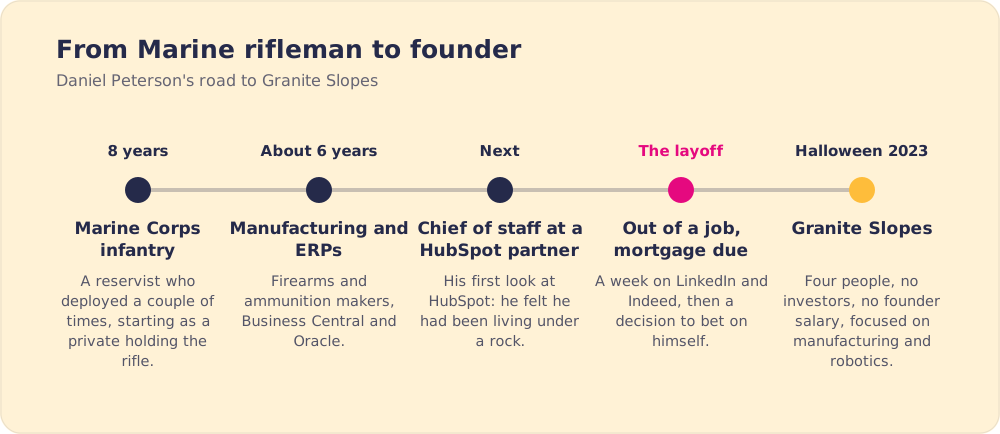
Daniel Peterson was chief of staff at a HubSpot partner when the layoffs came. The company had scaled too fast. One day he had a leadership job he loved; the next he had a mortgage and no paycheck, and he spent about a week scrolling LinkedIn and Indeed, asking himself what to do with his life. “I invested so much of myself into learning this and now I’m back at square one.”
Then he decided.
“I need to stop betting on other people and I need to bet on myself.” He called talented people from the same world, some laid off like him, and on Halloween 2023 founded Granite Slopes, a HubSpot consultancy for manufacturing and technology companies. Granite Slopes joined HubSpot’s partner program in March 2024 and reached Gold a month later.
Dan came on Fast & Tierious about six months after that Halloween launch, already talking like a veteran entrepreneur with a few hard lessons behind him. He would put all of himself into the company, make decisions before they felt safe, pick the customers he already understood, and slow down when hiring. Most of those came from something that went wrong first.
Why did Dan decide to bet everything on Granite Slopes?
Dan spent eight years as a Marine Corps infantryman, a reservist who deployed a couple of times, starting “as a private holding the rifle.” Between deployments he worked full time in manufacturing, mostly for firearms and ammunition makers, running ERP systems like Business Central and Oracle. When a HubSpot partner hired him for his process and leadership experience, the software hit him hard. “I felt like I was living under a rock completely,” he said. Marketing, sales, and service connected in one place, automated, the gaps he had fought in the ERP world closed.
So when the layoff came, he knew what he wanted to build and for whom. Granite Slopes took no investors. Dan took no salary and put everything back into the business. He had been screamed at and worked around explosives as a Marine, and he said the unpaid first months still brought a kind of anxiety he had not felt before.
His rule for that risk is specific. “Obviously don’t get stupid with your money, but be deliberate with your actions,” he said. He would rather exhaust every option and fail “than maybe put half of myself into it,” and then wonder about what he never tried. “I’d rather fail knowing I did everything I could.”
As a veteran business owner, he joined a large company of founders who came from service. The Census Bureau counted 304,823 veteran-owned employer businesses in 2021, about 5.4% of the nation’s employer firms, generating $922 billion in revenue, with the largest share, 52,167 firms, in professional, scientific and technical services (US Census Bureau, 2024). Granite Slopes is one more veteran-owned business in that sector.
How does a Marine avoid analysis paralysis?
Dan describes himself as an operations person, and his instinct was to refine every process before using it. That instinct nearly hurt him. “You’ll get stuck and you’ll kill your business right there,” he said. “Sometimes I had to teach myself to wing it.”
I reached for a military phrase on the episode, fire, aim, and Dan ran with it: fire, check the shot, adjust, fire again, in place of aiming forever. He calls himself “contrarian in the idea that it’s okay to pivot,” as long as the pivot serves the business. The Corps’ own doctrine makes the same case. Its capstone manual, Warfighting, says: “We must not strive for certainty before we act, for in so doing we will surrender the initiative and pass up opportunities” (Marine Corps Gazette, quoting MCDP 1).
His second rule keeps the first from turning sloppy. Do not scale a process until it hurts. “Do the Excel if you have to,” he said: run the minimal version by hand and do not buy software until you have repeated the process 10 to 15 times and know it will pay off.
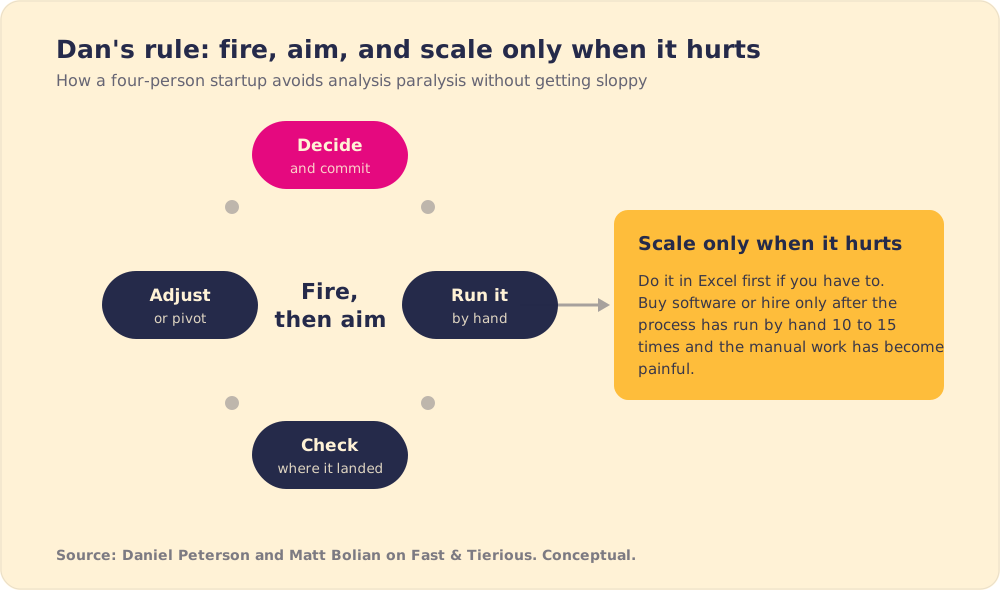
Put the two rules side by side and a founder can check themselves against a real process. A new client handoff you have argued about for a month and never tried is overdue for a first run. A handoff you have done twice does not need software yet; do it by hand another ten times and watch where it breaks. Our guide on how to write an SOP is the next step once a process has earned its way onto paper.
Why does Dan wish he had niched sooner?
His first months as a generalist went badly. As a new provider he did not yet know how to say what Granite Slopes did, so he went broad. “Let’s just go shotgun, and it went so bad,” he said. He lost opportunities and made mistakes. “That first two or three months as a provider hurt, and it hurt bad.”
Around then he came across our Surroundbound approach to go-to-market and started asking himself two plain questions: what am I good at, and who do I know? Both pointed back to the world he came from, manufacturing, robotics, and industrial B2B technology, companies he says are years behind on software and often run their ERP as a CRM. “I need to go help who I know isn’t being helped enough,” he said. I have talked with more than 500 HubSpot partners, and I told him what nearly all of them tell me: niche faster.
A Hinge Research Institute study of over 500 firms found high-growth firms offered 40% fewer services than no-growth firms and were 22% more likely to be highly specialized (Consultancy.uk, 2017). Dan’s own image for the goal is a Marine’s: messaging so focused it works “like sniper fire.”
What did a rushed hire teach Dan about process?
As Granite Slopes grew, Dan was the HR department, the accountant, the salesperson, and the trainer for operations and sales. He became the bottleneck, so he hired fast. He found a salesperson who checked every box, with great personality and great skills, and it was not a fit. “I rushed my hiring process because I felt like I had a need,” he said.

He put the blame on the system around the hire. The person was great, he said; the expectations and processes she needed were missing, and he was the one who had skipped them. He did not ask whether she was the wrong person. He asked himself, “what did I do to ruin this process?”
He is far from alone. Gallup found only 12% of employees strongly agree their organization does a great job of onboarding new employees (Gallup, 2018). A new salesperson at a four-person firm has no one to shadow when the founder is on a call, so the expectations have to be written down and sitting where the work happens before the first day. Our sales onboarding guide covers what that first month should include.
Dan’s broader conclusion reaches past hiring: be deliberate in how you deliver, how you sell, and what you say. His one contrarian bet for the future is market-level. While many partners chase HubSpot’s move upmarket, Dan is betting that HubSpot keeps investing in small and lower mid-market companies, the manufacturers he knows.
What Daniel Peterson learned in his first six months
- Full commitment, managed risk. Put all of yourself in, stay deliberate with money, and and would rather fail having tried everything than make a few bucks half-trying.
- Fire, then aim. Act before every process is perfect, check where the shot landed, and adjust.
- Scaling on pain. Run a process by hand 10 to 15 times before buying software or hiring for it.
- The niche you came from. Manufacturing and industrial companies were the customers Dan understood, and focusing there fixed his messaging.
- Process before people. A rushed hire into a company with no expectations written down fails the hire, and the founder owns that failure.
What should a veteran entrepreneur take from Dan’s first six months?
If you are leaving the service or a layoff and weighing a company of your own, we would follow Dan’s order: commit fully, act before you feel certain and correct as you go, sell to the industry you already know, and write down what a new person needs before you hire one. He moved fast on almost everything, and the one place speed cost him was the salesperson he hired before the company was ready for her.
Supered’s product belongs to that last part of Dan’s story: it puts the process inside HubSpot so a new hire sees the next step while doing the work. Consultancies like his can learn more on our partner page. For the onboarding side, see how teams handle onboarding and ramp.
Frequently asked questions
What is a veteran entrepreneur?+
Who is Daniel Peterson?+
What does fire, aim mean for a startup?+
What mistake did Daniel Peterson make with his first hire?+
Should a new consultancy niche down right away?+
Your process, running itself.
Turn the playbook into rep behavior.
More from Fast & Tierious

A HubSpot Retainer Sold by the Day: Lessons From CRM Squad's Eli Zheleva
Eli Zheleva
Agency Partnerships: Devin Bellamy on Why the Best Agencies Share the Rolodex
Devin Bellamy