Company Research Tools for Sales: The Guidebook Is Cheap, the Map Is Not
Company research tools for sales reps, graded on the four questions a rep needs answered before the first touch: Claude and ChatGPT deep research, Sales Navigator Account IQ, Apollo, ZoomInfo, Crunchbase, and Clay through Supered Prospector, with prices checked October 2, 2026.
Company research tools are the products a sales rep uses to learn about an account before reaching out: what the company does, why it might buy now, who decides, and how to reach them.
Company research tools are the products a sales rep uses to learn about an account before reaching out: what the company does, why it might buy now, who decides, and how to reach them. They range from databases like Crunchbase and ZoomInfo to AI deep research in Claude and ChatGPT and in-page tools like Supered Prospector. (If you came for market research or stock research tools, this page is the sales version.) The short answer, graded in full below:
- Supered Prospector. For teams that already have Clay: company research on the company’s own website, the buying committee by your titles, verified contacts from Clay’s waterfall, and your CRM history, at $45 per rep per month billed annually.
- Claude Research or ChatGPT deep research. For the best written brief per dollar, $17 to $20 a month, with no contacts and no CRM memory.
- Apollo. For a team without Clay that wants research, contacts and CRM sync in one tool, from $49 a seat on annual billing.
A good guidebook tells you everything about a city: its history, its best streets, which neighborhoods are on the rise. What it cannot tell you is where you are standing, which doors you have already knocked on, or who is home. Account research has the same split. Writing the brief on a company is now the cheap part. Salesforce’s 2026 State of Sales, a survey of 4,050 sales professionals, reports that AI agents “are expected to slash research time by 34%” (Salesforce, February 3, 2026), and a $20 chat subscription writes a cited brief in minutes. The expensive part is the map: is this account already ours, who on the committee matters, and how do I reach them. Most company research tools sell the guidebook. This page grades them on the map too.
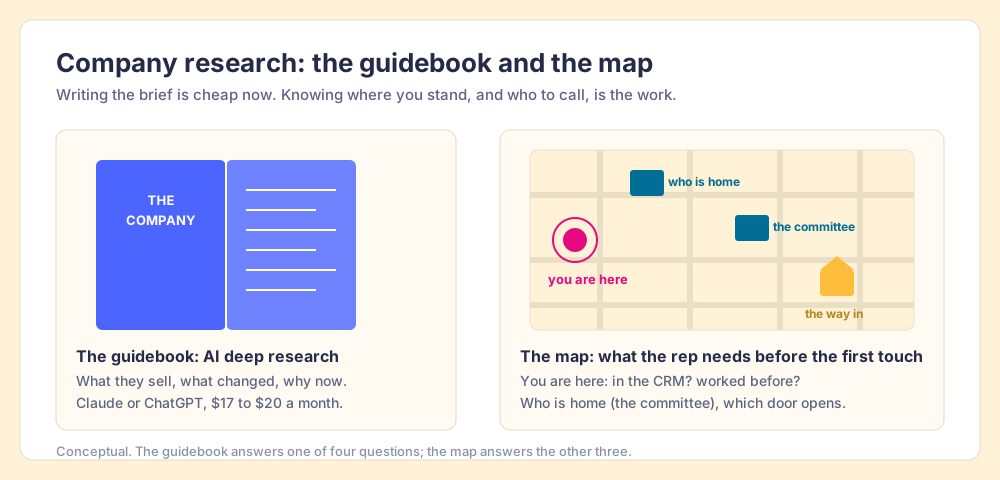
What should a company research tool answer before outreach?
Four questions, in the order a rep meets them on an account page.
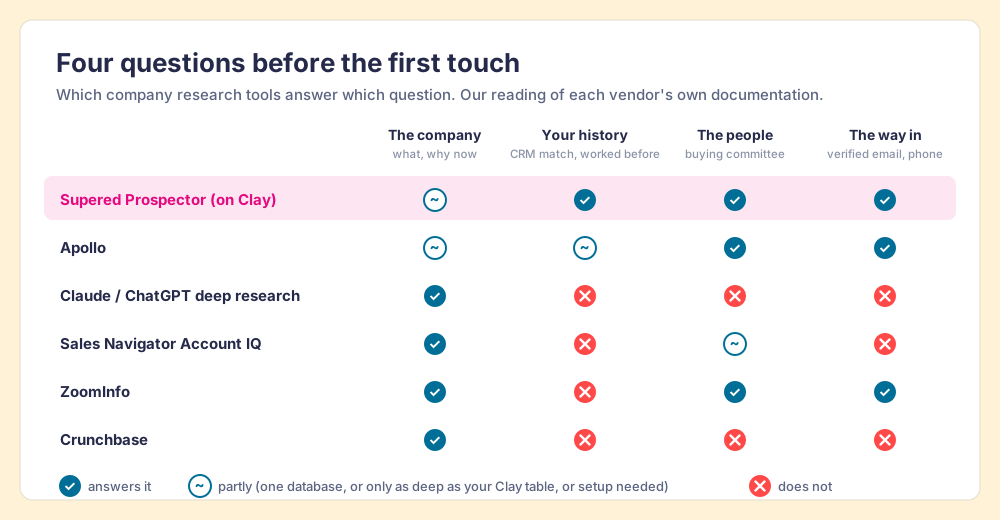
- The company. What they sell, to whom, what changed lately: funding, hiring, a new leader, a product launch. The guidebook covers it, and AI deep research now writes it well.
- Your history. Whether the account is already in your CRM, who owns it, and whether someone on your team worked it before. Skip this one and the rep cold-emails a customer’s VP, or steps on a teammate’s open thread.
- The people. The buying committee for what you sell, by the titles, departments and seniority your team cares about.
- The way in. A verified email and a phone number that connects, synced to the CRM so the next step has somewhere to live.
The first question is about the world. The second is about you, and no outside database can answer it, because the answer lives in your own CRM. The third and fourth are about contact data. A tool that answers only the first leaves the rep with a beautiful brief and three tabs still to open.
Why trust this ranking?
I started RevPartners, a HubSpot partner that did only sales implementations, sold roughly twice as much Sales Hub as any other partner, and reached Elite tier in 13 months. Supered came out of that work and is the #1 sales enablement app on the HubSpot marketplace. That is also the disclosure: we make Supered Prospector, and it sits first on this page for teams that have Clay. Supered holds 4.9 out of 5 from 81 reviews on G2 and 5.0 from 122 on the HubSpot App Marketplace (checked October 1, 2026). The weights below are printed so you can flip them, and the flip for a researcher who never sends an email puts Claude and ChatGPT on top.
The company research tools, graded
A ranking that hides its math is an advertisement. The lens is a mid-market or SMB sales team, ten to fifty reps, researching accounts in order to contact them. Each criterion is scored 1 to 5 and multiplied by its weight, for a maximum of 50.
| Criterion | Weight | What it rewards |
|---|---|---|
| The company brief | 30% (x3) | What they do and why now, with sources a rep can check |
| Where the answer lands | 20% (x2) | On the page the rep is on, or in the CRM record, without a new tab |
| The people | 20% (x2) | The buying committee, plus a verified email or phone |
| Price for ten reps | 20% (x2) | Published, per seat or per result, no platform fee |
| Your own history | 10% (x1) | The CRM match and whether the account was worked before |
| Rank | Tool | Grade | Score | Best fit | CRM integration | Setup effort | Pricing (plan with the feature) | Why it ranks here |
|---|---|---|---|---|---|---|---|---|
| 1 | Supered Prospector (on Clay) | A | 40 | Teams that already have Clay | Native (HubSpot, Salesforce, Pipedrive) | Under a week on an existing Clay account | $45 per rep per month, billed annually, plus your Clay plan | All four questions on the page the rep is on; the brief is only as deep as the team’s Clay table |
| 2 | Apollo | A- | 36 | Small teams without Clay wanting research plus contacts | Native (HubSpot, Salesforce) | A day | AI Research on every plan; CRM integrations from Basic, $49 per seat per month billed annually | Brief, contacts and CRM sync in one seat, from one database |
| 3 | Claude Research / ChatGPT deep research | B+ | 33 | The best written brief per dollar | Connectors, set up per user | Minutes | Claude Pro $17 a month billed annually; ChatGPT Plus $20 a month | Best brief on the card; no contacts, and the brief stays in the chat |
| 4 | Sales Navigator Account IQ | B+ | 32 | Reps who already live in Sales Navigator | Embedded in the CRM on Advanced Plus only | Minutes | Included from Core, US$1,079.88 a year | First-party LinkedIn data on the account page; people without emails or phones |
| 5 | ZoomInfo | B | 31 | North American enterprise depth and intent | Native (HubSpot, Salesforce, Dynamics) | Weeks | Quote only; Vendr median $33,500 a year | Deep firmographics and contacts, priced for a platform contract |
| 6 | Crunchbase | B- | 23 | Funding and growth signals for timing | Not verified for this page | Minutes | Price not rendered to us; Vendr median $20,000 a year | Strong why-now signal, little to contact |
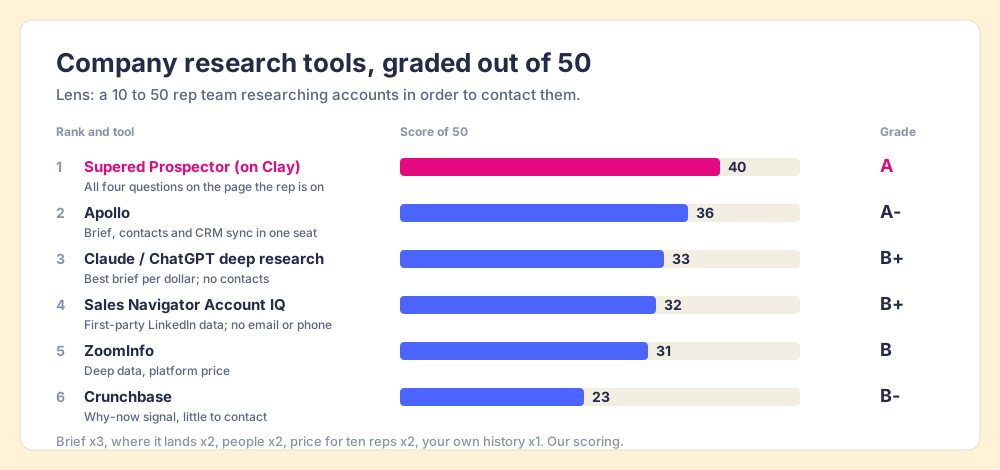
The scores, criterion by criterion (brief, lands, people, price, history): Prospector 3, 5, 5, 3, 5. Apollo 3, 4, 4, 4, 3. Claude and ChatGPT 5, 2, 1, 5, 2. Account IQ 4, 3, 3, 3, 2. ZoomInfo 4, 3, 4, 1, 3. Crunchbase 4, 2, 1, 2, 1. Prospector’s brief score is a 3 on purpose. Its company research runs on the company’s own website and returns what the team’s Clay table is built to return, which is narrower than a twenty-source deep-research memo. If the written brief is the whole job, Claude or ChatGPT wins this page, and costs less.
Clay is not a row in this table. Clay is the row that contains the other rows: its marketplace sells “data from 200+ providers in one place,” and its Claygents “research target companies and people with AI” (clay.com, October 2, 2026). For the GTM engineer researching a whole list in a table, Clay itself is the tool. Prospector is how one rep runs that work on one account, where the rep already is.
Corporate status, checked October 2, 2026. ZoomInfo is public (Nasdaq: GTM), approved a restructuring of about 600 roles in May 2026 “accelerating our move upmarket” (SEC Form 8-K), and acquired DoubleO.ai on September 30, 2026. Apollo, Crunchbase and Clay are independent and private. Sales Navigator is a LinkedIn product, and LinkedIn is owned by Microsoft. Anthropic and OpenAI are private.
Is AI deep research good enough for account research?
For the guidebook, yes, and it is the cheapest strong option on the page. Claude’s Research feature is available “for users with paid Claude plans (Pro, Max, Team, or Enterprise),” “delivers thorough answers in minutes,” and gives “easy-to-check citations so you can trust Claude’s findings” (Claude Help Center). Claude Pro lists at $17 a month with the annual discount ($200 billed up front) or $20 monthly; Team seats are $20 a month billed annually (claude.com/pricing, October 2, 2026). ChatGPT Plus is $20 a month and lists “Deep Research tools (where available)” among its benefits (OpenAI Help Center); OpenAI says deep research usage “varies by plan.”
Salesmotion, which ranks for this term with a list of AI account research tools, grades its field on whether the AI cites its sources (Salesmotion, March 21, 2026). For the brief, citations are the right bar, and Claude now clears it. For the account, they miss the point. A perfectly cited memo on a company your colleague closed last year is a well-sourced embarrassment.
So the deep-research memo is a guidebook read on the plane: excellent, thorough, and left in the seat pocket. It answers the first question and none of the other three, for two plain reasons. A chat window does not know your CRM unless someone connects it, and it does not hold verified mobile numbers. Both are fixable. Claude, for one, connects to HubSpot, and our Claude for sales guide shows the setup. But the research still lives in a chat, one rep at a time, and has to be carried back to the record by hand.
- The brief. Claude Research or ChatGPT deep research, A-grade work for $17 to $20 a month.
- The weak spot. No contacts, no buying committee by your titles, and no memory of your own account history without a connector someone has to set up.
- The fit. A team whose reps already have a chat subscription and a separate way to get contacts into the CRM.
Where does Sales Navigator Account IQ show up, and on which plan?
Account IQ is the most underrated item on this page, because many readers already pay for it. LinkedIn’s help center: “Account IQ is available with all Sales Navigator subscriptions (Core, Advanced, and Advanced Plus). Admins can turn Account IQ on or off for all users on their account.” It summarizes strategic priorities, likely pain points, financials, and “what the company’s employees are talking about on LinkedIn,” drawing on “our first-party LinkedIn data (for example, executive team, headcount growth and decline) and public information” (LinkedIn Help, Account IQ, last updated six months before October 2, 2026). Two caveats sit on the same page: it “isn’t currently available for all companies,” and some sections may not display.
The part the other lists skip is where it appears. Account IQ inside the CRM is a CRM Embedded Experience, and LinkedIn says that version “is available for Sales Navigator Advanced Plus users who are using HubSpot’s Smart CRM, Microsoft Dynamics 365 Sales, Oracle Sales, or Salesforce” (LinkedIn Help, Account IQ in CRM Embedded Experiences). Core costs US$119.99 a month or US$1,079.88 a year; Advanced is US$159.99 a month or US$1,799.88 a year; Advanced Plus is “Request demo for pricing” (LinkedIn compare plans, October 2, 2026). So the same insight is a tab away on Core and on the CRM record only on the quote-only tier. Where the research lands has a price, and LinkedIn charges it.
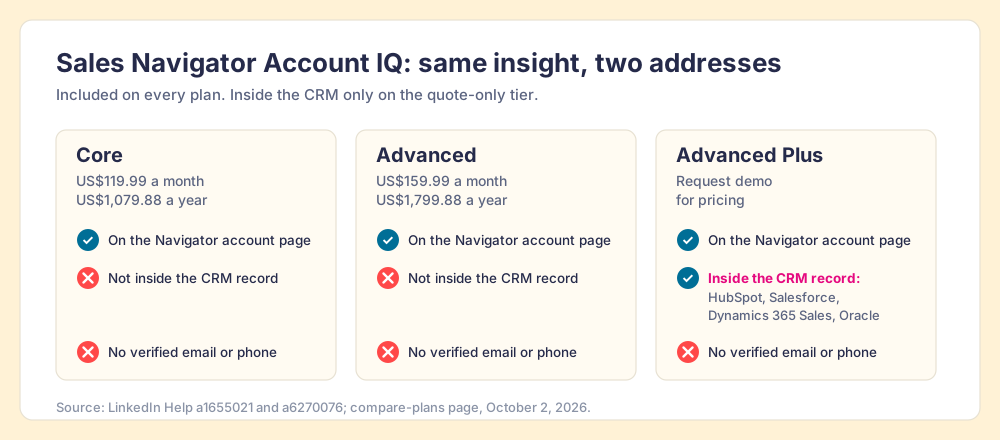
Account IQ also stops at the person. Navigator shows who works at the account; it does not hand a rep a verified email or mobile, and its reviewers say so. “I don’t like the inability to download lead lists to CSV or to CRMs without a third-party add-on,” a mid-market CEO wrote on G2 in February 2026, where Navigator holds 4.4 from 2,211 reviews (G2). The Sales Navigator pricing page walks the plans; the Sales Navigator alternatives page covers what teams add on top.
Which databases help with company research: Apollo, ZoomInfo, Crunchbase?
Three databases, three different shelves.
- Apollo. The most complete single seat for a small team. Apollo’s own plan data, read October 2, 2026, lists “AI Research” and “Pre-meeting AI Insights” on every plan including Free, and “CRM Integrations” and “Waterfall Enrichment” from Basic at $49 a seat a month billed annually, or $65 monthly; an email costs 1 credit and a direct dial 8 (apollo.io/pricing). Its extension runs on LinkedIn, company websites and CRM pages. One database underneath, plus partners for the waterfall. Vendr’s median Apollo contract is $19,000 a year across 101 purchases (Vendr). The Apollo pricing page works the credits out.
- ZoomInfo. The warehouse: “more than 100 million companies, 500 million contacts” by its own August 2026 filing, plus intent data. Vendr puts the median buyer at $33,500 a year across 1,574 purchases, in a range from $7,220 to $155,730 (Vendr, ZoomInfo, October 2, 2026). Deep, priced for a platform, and run by a company that has told the SEC it is moving upmarket. ZoomInfo pricing has the detail.
- Crunchbase. The why-now shelf. Crunchbase reports “455 million predictions generated,” “more than 16,000 Crunchbase predictions” confirmed by real-world events, and “84% funding prediction recall,” across 5 million organizations as of March 2026 (Crunchbase). For timing an outreach around a funding round, it is the sharpest tool here. For calling anyone, it is the weakest. Its checkout did not render prices to our fetch on October 2, 2026; Vendr’s median is $20,000 a year across 71 purchases, from $4,440 to $51,377 (Vendr, Crunchbase).
Most business development software sells one of these shelves well and calls it research. Apollo is the one that sells three at a seat price, which is why it ranks second.
What does company research cost for ten reps?
List prices and Vendr medians, October 2, 2026, for ten reps for a year. The Vendr rows are whole-contract medians, so read them as what a typical buyer pays, not a per-seat quote.
| Option | Ten reps, one year | Basis |
|---|---|---|
| Claude Pro | $2,000 | $200 per seat billed annually |
| ChatGPT Plus | $2,400 | $20 a month per seat |
| Apollo Basic | $5,880 | $49 per seat per month, billed annually |
| Clay Growth + Supered Prospector | $10,752 | Clay $446 a month billed annually, plus $45 per rep per month |
| Sales Navigator Core | $10,798.80 | US$1,079.88 per seat per year |
| Crunchbase | $20,000 | Vendr median contract, 71 purchases |
| ZoomInfo | $33,500 | Vendr median contract, 1,574 purchases |
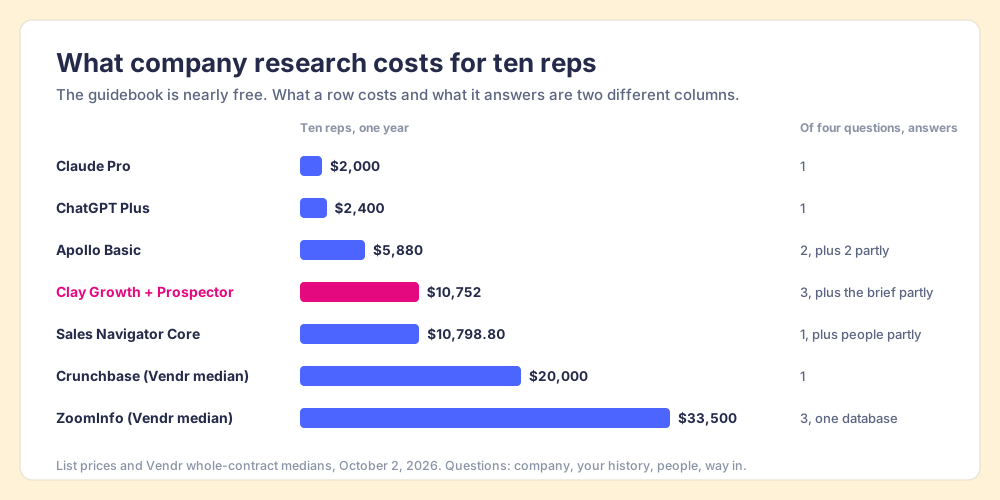
Two readings of that table. The guidebook is nearly free: $2,000 a year puts a cited brief in front of ten reps. And price does not track answers. The dearest row costs almost seventeen times the cheapest, and Crunchbase’s $20,000 median buys one answer, the why-now signal, while the Clay row at $10,752 answers three and the brief in part. Clay’s Growth plan includes CRM sync and lists 6,000 data credits a month, and “if an enrichment returns no result, you’re not charged Data Credits or Actions” (clay.com/pricing, October 2, 2026).
Where does Supered Prospector fit?
Prospector runs inside the Supered Chrome extension, on the team’s own Clay account, and reps never log into Clay. It does not bring its own database. It brings Clay’s waterfall, which is every database, routed. We chose Clay as our only data provider for that reason. Clay governs the data. Supered governs the motion.
What a rep gets when researching an account with it:
- Company research on the company’s website. The rep on acme.com runs research without leaving the site, through the team’s Clay workflow.
- The buying committee, by your parameters. The lookup returns the titles, departments and seniority the team set, not a generic org chart.
- Your own history first. On a LinkedIn profile the rep sees the matching CRM record, and Prospector shows whether the prospect was already worked in the past, before anyone sends a duplicate first touch.
- Contacts that connect. Clay’s waterfall checks provider after provider for a verified email and phone across 200+ vendors, and charges nothing for a miss.
- One click to the CRM. Field mapping is set once; contacts sync to HubSpot, Salesforce or Pipedrive, and a whole list can go into any custom Clay workflow the GTM engineer built. Reps can also start from inside the HubSpot, Salesforce or Pipedrive record.
- The process after the research. The team’s process applies to worked prospects, so the manager sees which researched accounts were worked and which closed, and coaches from what converts.
Put together, the rep has the map, drawn on the page already open, with the dot for where you stand. The research memo is still worth having, and a rep with a Claude subscription and Prospector has both: the guidebook for the plane, the map for the street. How Clay prospecting works for reps shows the full loop, and the sourcing use case shows it from the manager’s side.
Choose something else if you do not have Clay. Prospector runs on the customer’s Clay account and does nothing without one, and a team with no one to build a Clay table will get more from Apollo next month. Choose something else, too, if the job is the written brief alone, for an analyst or an executive who never sends the email: Claude Research is better at that and costs $200 a year.
Which company research tool should you choose?
The choice resolves on two facts about your team: whether you have Clay, and which of the four questions your reps are missing today.
- Claude Research or ChatGPT deep research. The pick for the brief, and a good add to any other row. Buy it if your reps already have contacts and CRM sync sorted.
- Sales Navigator Account IQ. Already paid for if your reps have Navigator, so use it before buying anything. Pay for Advanced Plus only if the research has to sit inside the CRM record.
- Apollo. The pick without Clay: brief, contacts and CRM sync in one $49 seat.
- ZoomInfo. The pick for North American enterprise depth and intent, if the contract size makes sense to you.
- Crunchbase. The pick for timing outreach on funding and growth, paired with something that finds people.
- Supered Prospector. The pick when the team has Clay and you want all four answers on the page the rep is already on.
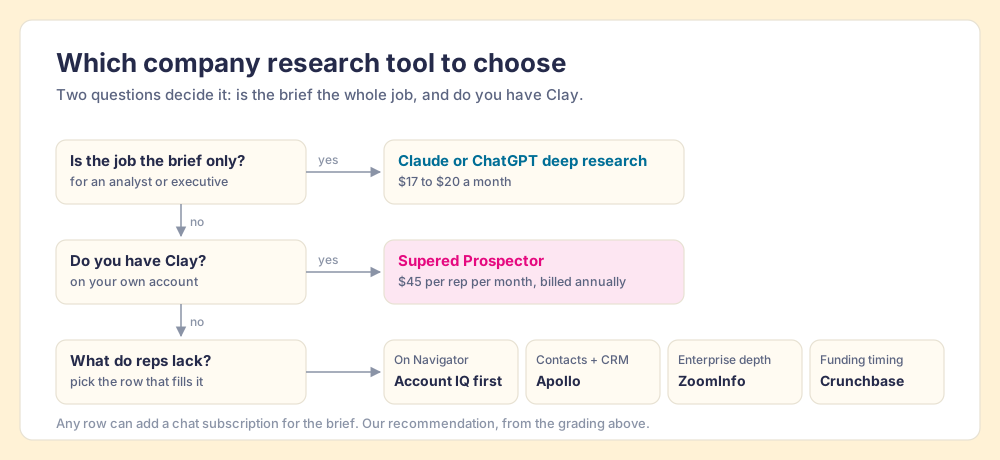
What we recommend: give reps a guidebook, because at $17 to $20 a month it no longer makes sense to have them reading annual reports by hand. Then spend the real money on the map. If you have Clay, put it in the rep’s hands on the account page, with your CRM history and the committee beside the brief, and watch which researched accounts turn into pipeline. If you do not, Apollo is the most map per dollar. The guidebook was never the hard part of getting to the right door, and a Prospector demo on your own Clay account is where you can see the dot that says you are here.
Frequently asked questions
What are the best company research tools for sales reps in 2026?+
Is Sales Navigator Account IQ free?+
Can ChatGPT or Claude replace a company research tool?+
How much does Crunchbase cost for a sales team?+
What is business development software?+
Do I need a Clay account to use Supered Prospector for company research?+
Your Clay waterfall, where reps already work.