Sales Reps Missing Quota: Caleb King and Matt Bolian Argue Whose Fault It Is
On Pardon the POV, Caleb King said a floor full of misses is the system's fault and Matt Bolian said the rep should own it anyway. Both cases in their words, and where they landed.
Sales reps missing quota are reps who close less than their assigned target in a period, and when most of a team misses, the rep still owns the effort while the leader owns the quota, the process and the support around it.
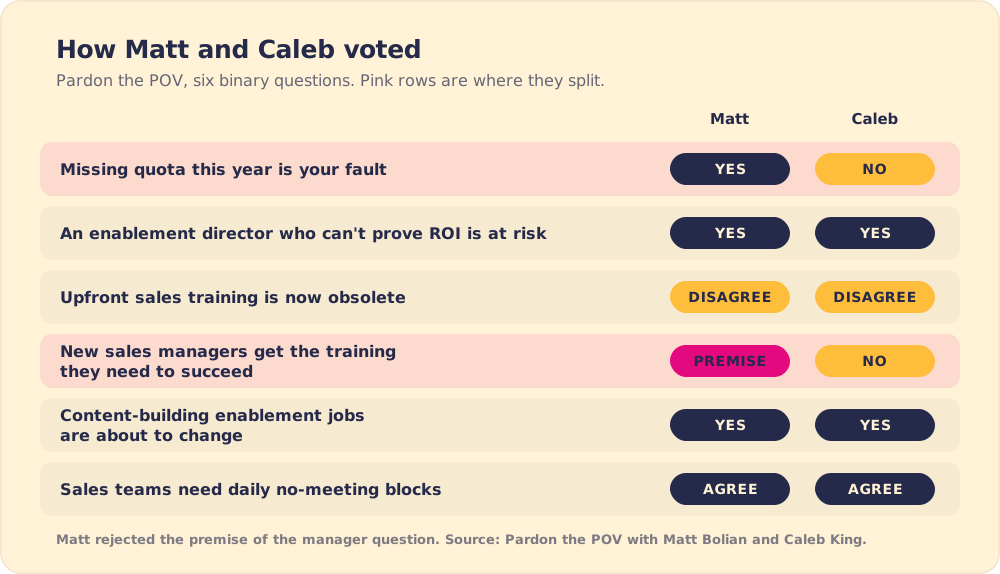
Our host, Rob, opened the round with a number: 69% of B2B sales reps falling short of quota. Then he counted down from three, and on one, Caleb King said no and I said yes. The question was whether it is your fault if you are one of the sales reps missing quota this year. Crispy Barnett had flaked on us that week, so Caleb sat in, and he did not come to be polite.
You can watch the whole argument on Pardon the POV. Caleb sells for Supered, and I kept introducing him as “the real Caleb King.” He has carried a bag at large companies with big enablement teams and at a bootstrapped startup where he now manages three people. He signed off with his philosophy: “the internet is not a place for nuance, so I give binary responses to binary questions.” We argued through six questions, and on the first one we ended up splitting the blame for a missed number between the rep and the leader.
Is it your fault if you are one of the sales reps missing quota?
Caleb went first, and he went straight at the arithmetic.
“Either you’re designing a purposeful system for 70% of your people to fail and it’s on purpose or it’s unrealistic,” he said. “It is literally unrealistic if the majority of your people are not hitting the standard that you’re trying to get them to hit.” He granted personal responsibility in one breath and then took the verdict back: the number “is telling you it is not the salesperson’s fault.”
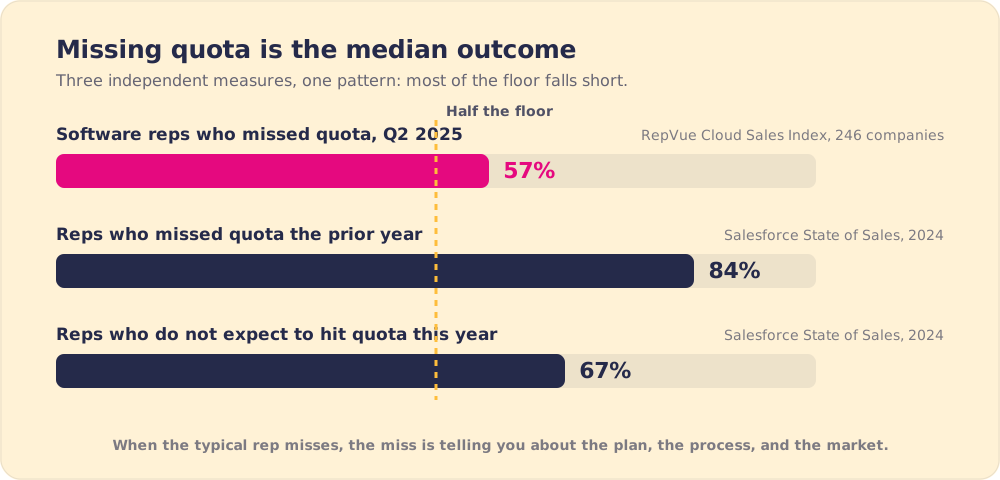
The outside data sides with his arithmetic. RepVue’s Cloud Sales Index for the second quarter of 2025, covering 246 software companies and about 47,000 quota carriers, found 57.31% of reps missed their number (QuotaPath on RepVue, 2025). Salesforce’s State of Sales survey found 84% of reps missed quota the year before and 67% did not expect to hit it in the current one (Salesforce, 2024). By Caleb’s test, numbers like those say the plans are off.
My case came from the other side of the desk. “There’s a mentality in sales where you just have to own it,” I said. “You have to do your absolute best.” I granted that the system might be built so that most of the floor misses. “But guess what? You can always be that 30% that hits. Always be that 30% that hits. And if you don’t believe that, you will not be good at sales.”
Rob said I was giving “a non-binary answer to a binary question,” and I agreed.
Where did Caleb and Matt agree?
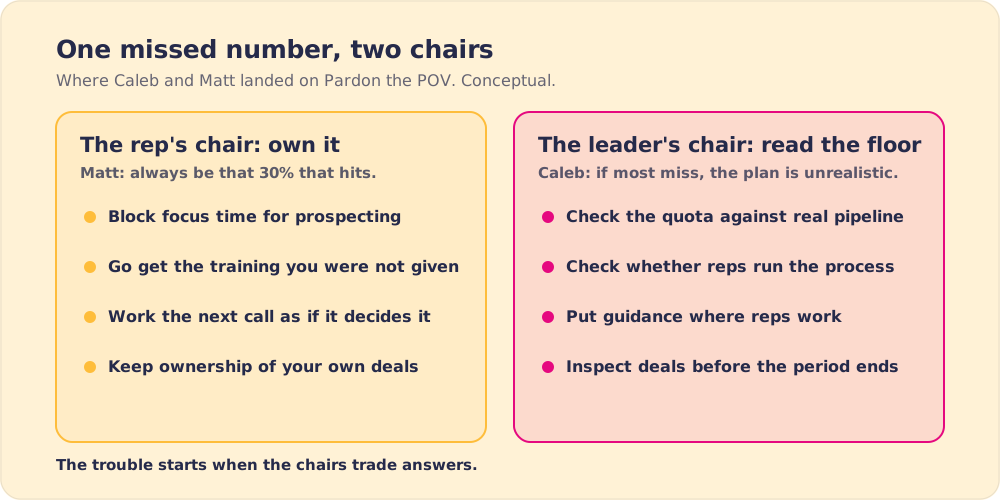
After the vote, Caleb and I were closer than our answers sounded. Caleb was talking about the plan. If most of the team misses, he wants the leader to look at the quota and the system before looking at the people. I was talking about the rep. I want a rep to act as if the next call decides the month, whatever the plan says.
Those two views fit in the same company. A rep who decides the system is to blame has a reason to stop prospecting. A leader who blames the reps for a 57% miss rate has a reason to leave the plan alone. We think the rep should take my view and the leader should take Caleb’s.
Why does more enablement spend not fix missed quota?
Rob’s second question asked whether an enablement director who cannot prove ROI should worry about the job. We both said yes.
I argued that handing reps more inputs has not moved the number, and that enablement leaders “need to think about how are you changing the way people do work on a very practical level that helps them spend more time selling.” Caleb brought the view from inside large companies with well-funded enablement teams, where he estimated 80% of the slide decks and LMS courses were “irrelevant and non-useful because there’s a disconnect between the enablement folks and the salespeople.” He was careful about blame: “I’m not saying it’s their fault.”
The State of Sales Enablement 2026, a survey of 198 sales leaders, found training volume did not differ much between teams in the top and bottom quota bands. Deal-execution consistency did: 3.83 out of 5 for teams in the 76 to 100% quota band, against 3.00 for teams in the 0 to 25% band (The State of Sales Enablement 2026). The top teams had not been trained more. They ran their deals more consistently.
Is upfront sales training obsolete?
Neither of us thought so, and Caleb made the case even though he sells a product built on guidance in the moment. “Just as much as I believe in just in time enablement,” he said, “I just do not see a way to get around the upfront training. You can’t just throw someone into a role and say, ‘Hey, you’ll get the prompts in time.’” His answer was seeding: give a new rep the big picture first, then feed it into the daily work. “I’m not against upfront training. I just don’t think it’s the end all answer. You have to have everboarding.”
I put it as a marriage. “You can’t put an untrained rep in front of a customer,” I said. There is upfront training, and there is the behavior a rep runs on real deals that shapes the buyer’s experience. “When those two marry, they’re a very special program. So training is not gone. It just changes.”
Caleb carried the same thinking into the content question. Asked whether enablement managers who spend their days building content are about to see their jobs change, he said the decks and one-pagers decay, get sent a fraction of the time and read less often than that. What he wants from enablement are tools that take inputs: “pricing calculators or business case builders,” things a rep uses in the middle of a deal.
Who trains a new sales manager?
This was the question with the most story in it, and Caleb told it from his own desk. He had recently been promoted to manage a small team. “Was I given adequate training to succeed? No. I was given no training to succeed and I don’t expect it,” he said. “We’re bootstrap. We’re a couple people.” So he went looking. “I borrowed books from the library and I read them.” Did he feel prepared afterward? “No, I didn’t feel prepared afterwards.”
I rejected the premise. “If you are always prepared for what you’re doing next, you just will never do anything next.” The people who get trained, I argued, are the ones who ask for it and go get it, which is what Caleb did. I added a caution for any company whose only promotion path runs through management: “Some people just should stay really good reps.” And I admitted the same about my own chair. Was I trained to be a CEO? No. “You never feel qualified for what you’re doing so often,” and treating that as normal keeps a leader humble and learning.
Caleb owned the gap and went to the library for what a two-person startup could not give him.
Should sales reps block time to protect selling hours?
The last question asked whether sales teams should have daily blocks with no meetings and no messages. We both said yes, and the talk came back to what a rep owns.
I used Caleb as the example. Look at his calendar and you find big blocks of time set aside every day, because prospecting “becomes essentially impossible” without them. Caleb agreed and put the duty on himself. “I don’t think that the company should enforce it. I think that the rep should have a responsibility to do it themselves.” His reason: “We are trained to want distractions. How many times in a call do you slide over to your Slack and check?”
Gloria Mark’s research at UC Irvine found it takes an average of 23 minutes and 15 seconds to get back to a task after an interruption (Fast Company interview with Gloria Mark). Salesforce found reps spend about 70% of their time on non-selling work, flat since 2022. A rep who lets Slack interrupt a prospecting block a few times loses a good part of the selling time left over.

What the debate taught about a missed number
- The rep’s answer. Own it. Caleb blocks his calendar and learned management from library books; my rule is to “always be that 30% that hits.”
- The leader’s answer. A floor where the majority misses points at the plan. Caleb’s test: if the majority misses the standard, the standard or the system is unrealistic.
- Enablement measured by behavior. Both argued that training completion proves little. Top-band teams in our research ran deals more consistently; they did not train more.
- Training plus in-flow guidance. Neither would drop upfront training. Both want it married to guidance a rep gets while working.
- New managers who go looking. Caleb got no manager training and found his own. My point: you never feel fully qualified, and the managers who grow go get what they lack.
- Protected selling time. Getting back to a task takes about 23 minutes after an interruption, and both of us guard focus blocks for prospecting.
The verdict
Caleb had the numbers on his side, and I still think a rep should answer the way I did. We landed on who should hold which answer.
If you carry a bag, take my side. Own the number, block your calendar, and go get the training your company never handed you, the way Caleb did with a stack of library books. If you run the floor and most of it missed, take Caleb’s side and start with the system: whether the quota was set on real pipeline math, whether reps run the process on their deals, where the guidance lives when they need it, and whether anyone inspects deals against it before the period ends. Coach individuals on what is left after that.
That leader’s half is the work we built Supered to take on. It brings the sales process to reps inside HubSpot and Salesforce while they work and shows managers, deal by deal, where it ran and where it broke. Our guide to sales accountability covers how to hold the standard without landing blame on the wrong desk, and the sales execution gap post covers the distance between having a process and running one.
For the numbers behind healthy attainment and how to set a target most of the floor can reach, read our guide to quota attainment next.
Frequently asked questions
What percentage of sales reps miss quota?+
Is it the rep's fault when they miss quota?+
Why do so many sales reps miss quota?+
Does more sales training fix missed quota?+
How can a rep protect selling time?+
Your process, running itself.
Turn the playbook into rep behavior.
More from Pardon the POV

Is Attribution Fake? Matt Bolian and Crispy Barnett on Word of Mouth and Self-Reported Attribution
Matt Bolian & Crispy Barnett
VP of Sales Responsibilities: Crispy Barnett and Matt Bolian on the Number, the Forecast and AI SDRs
Matt Bolian & Crispy Barnett