Is Attribution Fake? Matt Bolian and Crispy Barnett on Word of Mouth and Self-Reported Attribution
On Pardon the POV, Matt Bolian and Crispy Barnett both voted that marketing attribution is fake, then explained what they meant and why asking the buyer catches what the report misses.
Self-reported attribution means asking each buyer how they heard about you, on a form or in the first sales call, and logging the answer in the CRM, so the word of mouth that attribution software cannot see still gets recorded.
Someone sent Crispy Barnett a LinkedIn message the week before we recorded. “Hey you gave a rose to me at Inbound.” Crispy brought it up when our host asked whether marketing attribution is fake or measurable, because he could not say what that rose was worth. He only knew it mattered because the buyer wrote to tell him, and asking buyers for that on purpose is called self-reported attribution. He had met the buyer at a conference, there had been plenty of other touches since, and now a message had landed in his inbox. “It’s impossible to attribute that entire deal experience or whatever it is back to Inbound.”
Crispy and I argued it out on Pardon the POV, recorded soon after he left Supered to build a business of his own. Our host, Rob Michael Jones, ran eight questions that day. On attribution we voted the same way, which does not happen often. We both said fake, and then each of us explained what we meant by it. The forecasting round at the end of the show came back to the same worry: how much weight a number can carry.
Is marketing attribution fake?
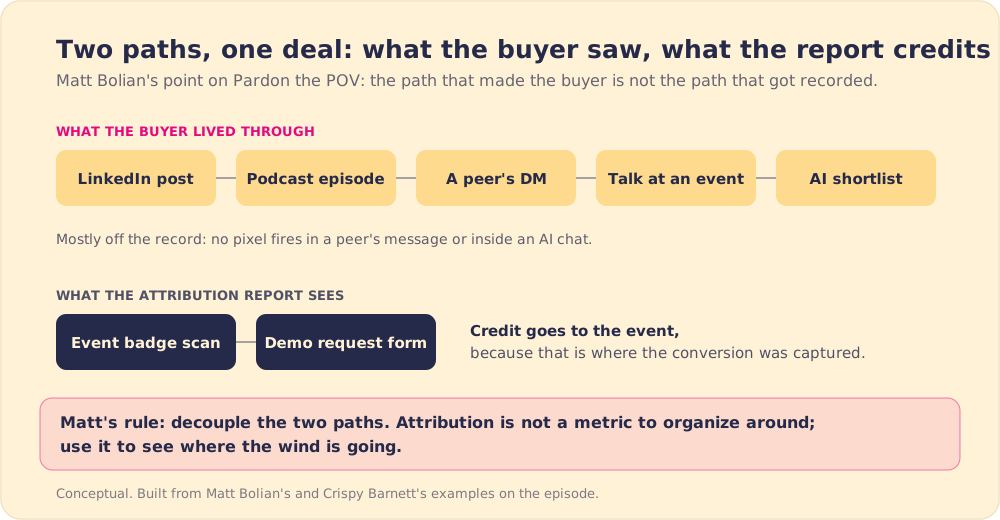
I voted fake and then qualified it in the next breath: “attribution is best optimized under the assumption that it’s fake.” The reason is what I called “a misappropriated causality.” The usual example is an event. We went to Inbound, a buyer went to Inbound, the buyer converted, so the event gets the credit. “And that logic is completely and utterly flawed because they may have seen us on LinkedIn, they may have seen us somewhere else, and the conversion path is different than the capture path, and attribute is almost always by con- uh conversion path. You must decouple those.”
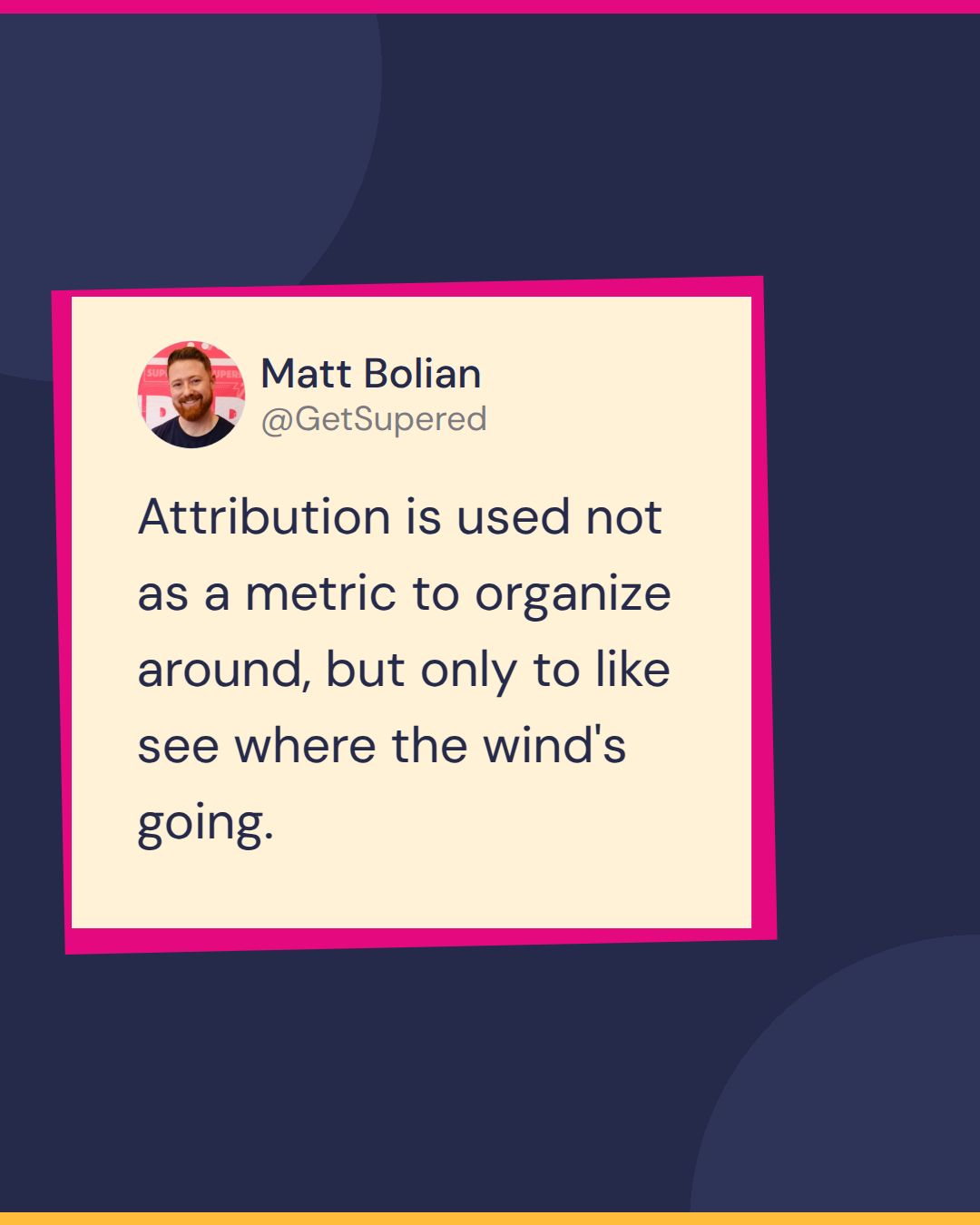
I said how I would use it instead: “Attribution is used not as a metric to organize around, but only to like see where the wind’s going.”
Crispy agreed and went further on the cause. “Word of mouth is the ultimate marketing channel and you can’t really measure that ultimately as attribution.” His second reason was the rose: “experiences that create lasting impact like inbound.” A buyer who remembers you from a conversation at a conference has had “so many other touchpoints along the way” that no report can hand the credit to one of them.
Where I landed was to keep the report and read it for direction, the way a sailor reads a weather vane without asking it to explain the storm.
Why can’t marketing attribution see word of mouth?
Attribution software can only credit the touches it observes, and it observes the ones closest to the moment a buyer identifies themselves, such as the ad clicked, the badge scanned or the demo form filled. The touches Crispy and I were describing happen earlier and off the record, in a peer’s recommendation, a podcast on a commute or a direct message like the one he got. More and more, they also happen when a buyer asks an AI assistant for a shortlist. Gartner’s 2026 survey of 646 B2B buyers found 45% used AI during a recent purchase (Gartner, 2026). Attribution software has no view into that chat.
A multi-touch attribution model spreads credit more evenly across the touches it can see, and Crispy’s rose is not one of them. Google has also stepped back from rule-based credit. In 2023 it removed the first click, linear, time decay and position-based attribution models from Google Ads and moved remaining users to data-driven attribution (Google Ads Help). If your team is still debating first touch against linear, the company that built much of that tooling no longer offers either one in Google Ads.
If attribution is fake, how do you know what works?
The research that best supports my vote comes from eBay. Tom Blake, Chris Nosko and Steven Tadelis switched paid search off in controlled tests and found that “brand-keyword ads have no measurable short-term benefits.” For non-brand keywords, new and infrequent users responded, while frequent users, who drew most of the spend, did not (Blake, Nosko and Tadelis, NBER). The attribution reports had been crediting those ads for sales that would have happened anyway.
eBay could only learn that by switching the ads off for one group, leaving them on for a comparable group, and comparing sales. Attribution reports never run that comparison. Even with it, the answers come back blurry. Randall Lewis and Justin Rao analyzed 25 large advertising experiments with major US retailers and brokerages and found the median confidence interval on return on investment was over 100% wide, and the narrowest was over 50% wide (Lewis and Rao, 2015).
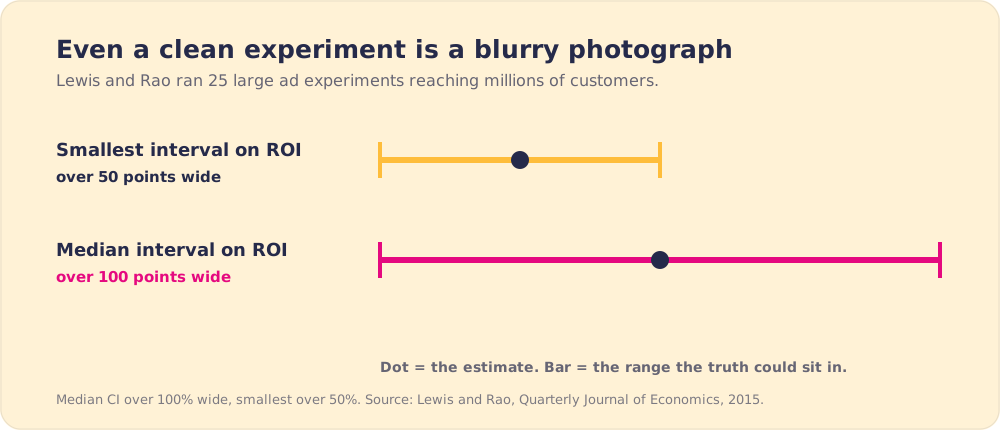
Those experiments reached millions of customers. A B2B team with a few hundred deals a year has far less to work with, which is why I would read attribution for direction and leave it there. Crispy’s story points to a second tool.
How does self-reported attribution work?
Crispy found out about the rose by luck. Self-reported attribution makes it a habit. You ask each buyer how they heard about you and record the answer where the rest of the deal lives.
There are two places to ask. One is the demo or contact form, with an open text box for “How did you hear about us?” An open box gets the buyer’s own words, “my old boss uses you” or “a podcast,” where a dropdown can only offer the channels you already track. The other is the first sales call. The rep asks the same question, gets the longer version of the story, and logs it in the CRM with that deal.
The answers are messy. Buyers forget, name the last thing they saw, or write “Google” when a colleague told them to look you up. So I would read them next to the software report, not instead of it. When the report credits paid search and buyers keep naming a podcast or a peer, that gap is the part of the path the software never saw.
It works only if reps ask on each qualified deal, and our State of Sales Enablement 2026 found 89% of teams have a defined sales process while 36% see reps follow it consistently. A question that belongs in discovery call questions has to reach the rep while the call is happening.
Is forecasting organized lying too?
Rob’s last question of the day was whether forecasting is “just organized lying.” Option A was that every forecast is fiction. Option B was that forecasting discipline builds predictability. We both chose B. My case was that discipline “allows you to understand the indicators and the signals of whether something’s going to close.” The example I used was personal. When Crispy says “I have a commit,” only 50% of those close. When Robert says it, “every single time he says that, it always closes.” I said “that matters a lot, and being able to trust who’s saying that.”
Crispy gave me more credit than I expected. He said I run forecasting “in the most unique and effective way that I’ve ever seen, where you have like the good, better, best modeling out of like the 70%, 40, 10, or whatever brackets you want to pull in.” I described it this way: “here’s a bucket of water, and the question is how much of that water is going to get poured into the other bucket?”
Both rounds came back to checking a number against what happened. For the forecast, that means tracking whose commits closed. For attribution, it means switching channels off to see what still works, and asking buyers what brought them in.
What the attribution debate taught
- Two paths. The path that made the buyer interested and the path where the conversion was recorded often differ. My rule is to decouple them.
- A weather vane. Attribution shows direction. It can’t carry the weight of budget decisions about cause.
- Word of mouth. Crispy’s “ultimate marketing channel” never appears in the report. Self-reported attribution, asking the buyer, is how you see it.
- Experiments for cause. Holdouts like eBay’s answer what attribution can’t, and even they come back blurry.
- Numbers checked against outcomes. I trust a commit based on whose commits have closed before, and a channel after a holdout test.
The verdict
Crispy and I agree that marketing attribution is fake if you treat it as the truth about cause. Crispy puts the weight on word of mouth, which no report will catch. I would keep the report running for direction, test the big channels with holdouts, and ask each buyer what brought them in. Our recommendation is to do all three, and to stop letting the attribution report settle budget arguments on its own.
Supered’s Behavior Layer can put that “how did you hear about us?” question in front of reps inside HubSpot and Salesforce during the first call. Our guide to sales and marketing alignment covers how the two teams can share one set of numbers, and our post on sales forecasting goes deeper on the other number teams ask to carry more certainty than its inputs allow.
Frequently asked questions
Is marketing attribution fake?+
How do you collect self-reported attribution?+
Is self-reported attribution accurate?+
Which attribution model is best?+
Is multi-touch attribution accurate?+
What is self-reported attribution?+
Your process, running itself.
Turn the playbook into rep behavior.
More from Pardon the POV

Sales Reps Missing Quota: Caleb King and Matt Bolian Argue Whose Fault It Is
Matt Bolian & Caleb King
VP of Sales Responsibilities: Crispy Barnett and Matt Bolian on the Number, the Forecast and AI SDRs
Matt Bolian & Crispy Barnett