Sales Prospecting Techniques That Tell You Whether They Worked
Eight sales prospecting techniques a sales leader can run on Monday, each with the steps, the evidence behind it, and the signal that shows within 30 days whether it worked. Sources checked October 2, 2026.
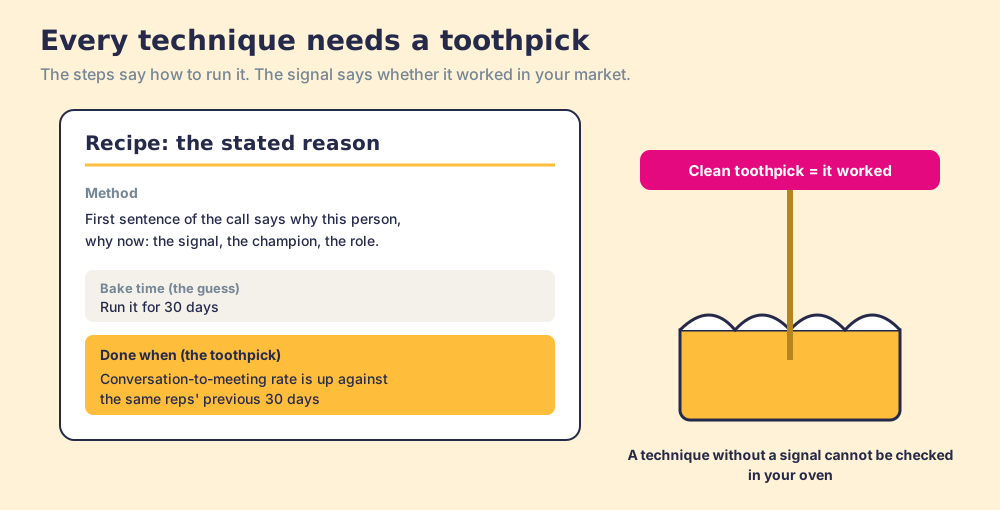
Sales prospecting techniques are the repeatable plays reps use to find buyers and start conversations, and a technique is ready to use only when it names how to run it and the signal that shows it worked.
A cake recipe says to bake for 30 to 35 minutes, “or until a toothpick inserted in the center comes out clean.” The time is a guess, because ovens differ. The toothpick is the test, and it is the line that makes the recipe work in a kitchen the writer has never seen.
Sales prospecting techniques are the repeatable plays reps use to find buyers and start conversations, and a technique is ready to use only when it names how to run it and the signal that shows it worked. Most published lists of sales prospecting tips give you the bake time and no toothpick. Zendesk’s seven techniques and SuperOffice’s ten tips, both on page one for this term, are full of reasonable advice. Neither tells a manager what number to look at in a month to know whether the advice took. SuperOffice’s follow-up advice leans on figures such as “80% of sales require 5+ follow-ups” with no source on the page (checked October 2, 2026), and figures like it have circulated for so long that their original oven is hard to find.
This page gives eight plays, each with the steps, the evidence, and the toothpick.
- List techniques. A protected prospecting block, rep-built lists, two to four people per account, past champions, and signal-timed outreach.
- Touch techniques. The stated reason and the first email that carries the weight.
- The ending. A stopping rule that closes out each contact.
What are the best sales prospecting techniques?
The eight below were chosen on one test: each has outside evidence for the mechanism, and each produces a signal a CRM can count without asking the rep. The table is the whole playbook on one screen. The sections after it give the steps.
| Technique | Run it Monday | The signal it worked (30 days) | Evidence |
|---|---|---|---|
| 1. Protected prospecting block | Two blocks a week on the calendar, written as “when the block starts, I open segment A” | Blocks held per rep; contacts sourced per block | Gollwitzer and Sheeran, 94 studies, d=0.65 |
| 2. Rep-built lists | Each rep sources their own accounts inside an assigned segment | Share of sourced contacts worked, rep-built vs handed lists | Norton, Mochon, Ariely: 63% premium on self-built |
| 3. Two to four people per account | Name the roles per account in the ICP; source them together | Contacts engaged per account on new opportunities | Gong: won deals include 67% more contacts |
| 4. Past champions who moved | Track job changes for closed-won contacts; reach out on the move | Meetings per hundred contacts, champion list vs cold list | UserGems: win rates more than doubled |
| 5. Signal-timed outreach | Trigger the touch on a hiring, funding, or job-change signal | Reply rate on signal lists vs static lists | 6sense: buyers start 79% of first engagements |
| 6. The stated reason | First sentence of the call says why this person, why now | Conversation-to-meeting rate | Gong: 2.1x success when the reason is stated |
| 7. A first email that carries the weight | Under 80 words, one ask, written for this account | Reply rate by step; share from step one | Instantly: 58% of replies from step one |
| 8. A stopping rule and an ending | Four to seven touches, then qualified, recycled, or disqualified | Share of contacts with an ending at 30 days | Gartner: 73% avoid irrelevant outreach |
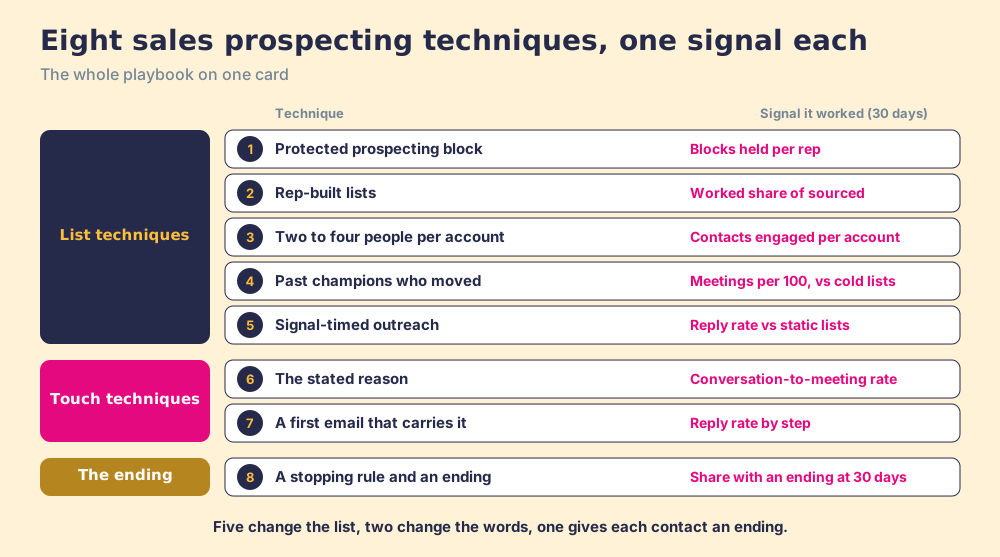
Five of the eight change the list, and only two change the words. That ratio is deliberate. Published prospecting best practices lean toward the message (SuperOffice gives three of its ten tips to emails, content, and video), and the message matters. It can only be as good as the reason the person is on the list in the first place.
How do you run each technique on Monday?
1. A protected prospecting block, written as an if-then plan
Prospecting is the work that loses every calendar fight, because a live deal always feels more urgent than a list. Peter Gollwitzer’s research on the gap between intending and doing found that plans written as “Whenever situation x arises, I will initiate the goal-directed response y!” close much of that gap (Gollwitzer, 1999). His meta-analysis with Paschal Sheeran across 94 studies put the effect at d=0.65, a medium-to-large lift in follow-through (Gollwitzer and Sheeran, 2006).
- The block. Two 90-minute blocks a week, on the same days, owned by the rep and protected by the manager.
- The plan. “When the block starts, I open segment A and source ten accounts” beats “prospect more.”
- The signal. Blocks held per rep per week, and contacts sourced per block. Jeb Blount’s rule in Fanatical Prospecting, as one reader’s notes on the book record it, is that “the prospecting you do in this 30-day period will pay off for the next 90 days,” so a month of skipped blocks shows up in the pipeline a quarter later.
2. Rep-built lists
A list someone else built arrives with no judgment in it. The rep works it in pasted order or not at all, and the cause sits in how the list was made. Michael Norton, Daniel Mochon, and Dan Ariely found people bid $0.78 for a storage box they had assembled against $0.48 for the same box pre-assembled, “a 63% premium,” and that “labor leads to love only when labor results in successful completion of tasks” (Norton, Mochon, and Ariely, 2012).
- The rule. Each rep sources their own accounts inside a segment the manager assigns. Ops keeps the segment definitions and the data; reps choose the rows.
- The tag. Each contact carries its list source in the CRM from the moment it is created.
- The signal. The share of sourced contacts that got worked, comparing rep-built lists against handed lists over the same 30 days.
The lead list guide walks through building one step by step.
3. Two to four people per account
One contact per account is one chair at a long table. Gartner’s research on the B2B buying journey puts typical buying groups at 6 to 10 people, and Gong’s analysis of millions of sales interactions found “closed-won deals include 67% more contacts than closed-lost deals” (Gong). Gong’s finding is a correlation from late-stage deals, and big deals naturally involve more people, so read it as direction for prospecting rather than a promise. The direction is clear enough to act on.
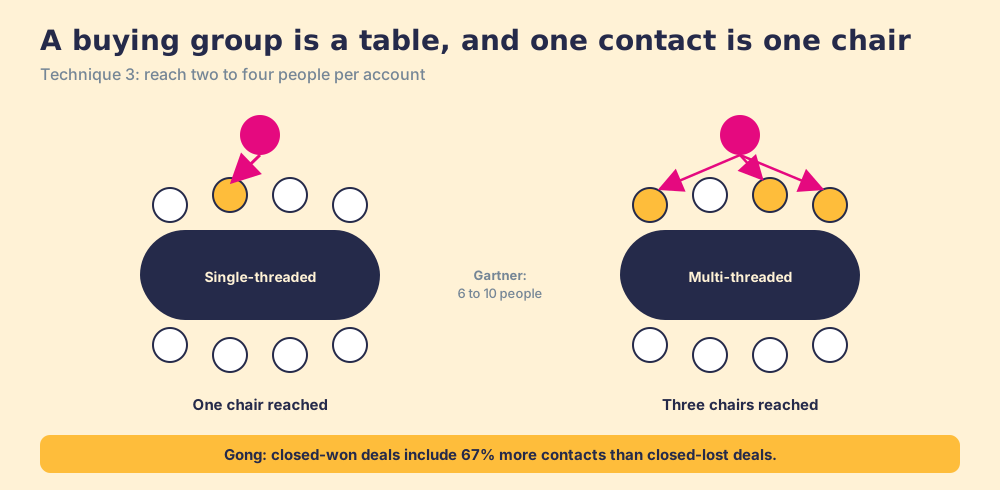
- The roles. The ideal customer profile names the two to four roles per account, for example the department head who owns the problem and the operator who lives with it. The ICP template has a line for this.
- The sourcing. The rep sources the roles together, so the account enters the CRM as a group.
- The signal. Contacts engaged per account on opportunities created in the window. If the number stays at one, the technique did not take.
4. Past champions who changed jobs
A former customer who moves to a new company is the warmest cold contact a rep will ever have. UserGems’ data science team analyzed over 5,000 opportunities and found that when a previous champion was involved, win rates more than doubled, deal sizes ran 54% larger, and sales cycles were 12% shorter (UserGems, updated April 7, 2026). UserGems sells job-change tracking, so treat the figures as vendor data; the mechanism (the buyer already trusts the product) holds without them.
- The list. Export the contacts on your closed-won deals from the last two to three years.
- The tracking. Any job-change tracker works. In Clay, the job change signal needs the contact’s LinkedIn URL and, per Clay University, each check “consumes 1 action plus 0.2 data credits” (Clay University, checked October 1, 2026).
- The signal. Meetings per hundred contacts from the champion list against the same rep’s cold lists.
5. Signal-timed outreach
6sense’s 2025 Buyer Experience Report, a survey of nearly 4,000 B2B buyers, found that “buyers initiated 79% of engagements,” with first contact about 61% of the way through the buying process (checked October 2, 2026). A rep cannot make the buyer call. A rep can be in the inbox in the week something changed, which is when a buyer starts the research that ends in that call. Clay’s outbound page lists the signals worth watching: “Job changes,” “Hiring activity,” “Funding announcements,” “Web visits,” and “Social mentions.”
- The trigger. Pick one signal that matches your ICP’s buying moment, for example hiring for the role your product supports.
- The rule. “When the signal fires on an account in segment A, the owning rep sends the first touch within five working days, and the first line names the signal.”
- The signal. Reply rate on signal-triggered lists against static lists sent by the same reps in the same month.
6. The stated reason
Gong’s recorded-call data shows “a 2.1x higher success rate for salespeople who state their reason for calling,” and that opening with “Did I catch you at a bad time” makes a call 40% less likely to book (Gong, last modified March 4, 2026). The reason is what makes outreach relevant, and Gartner’s 2025 survey of 632 buyers found “73% of B2B buyers actively avoid suppliers who send irrelevant outreach” (Gartner, 2025).
- The line. The first sentence says why this person and why now: the signal, the champion, the role.
- The source of the reason. Techniques 3 to 5 produce it. A rep who built the list knows why each row is there.
- The signal. Conversation-to-meeting rate for the same reps, before and after. Cold calling tips covers the rest of the opener.
7. A first email that carries the weight
Instantly’s Cold Email Benchmark Report 2026, built on billions of cold emails sent through its platform in 2025, found “58% of all replies are generated from step one,” an average reply rate of 3.43%, and a top 10% at 10.7% or more (Instantly, 2026; vendor data). The report’s elite first-touch emails run under 80 words.
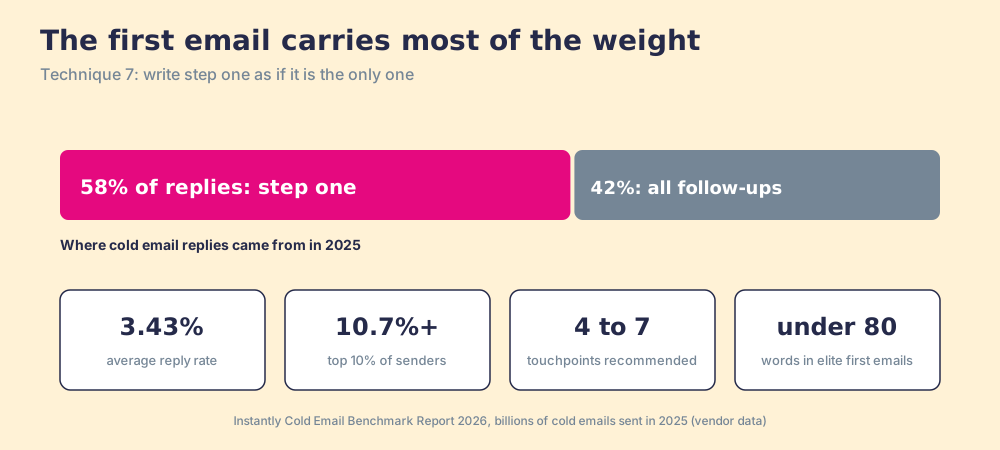
- The draft. Under 80 words, one ask, and the reason from technique 6 in the first line.
- The review. The manager reads five first emails per rep in the weekly one-on-one, which takes ten minutes and catches template drift early.
- The signal. Reply rate by step, and the share of replies from step one. If follow-ups carry most of the replies, the first email is not doing its job.
8. A stopping rule and an ending
The prospecting strategies that fail worst are the ones with no end. A contact who got two emails and silence sits in a sequence, then in a CRM view, then gets a duplicate first touch from a different rep. Instantly’s report recommends a “4-7 touchpoints” range. Past that, persistence starts to look like the irrelevant outreach Gartner’s 73% avoid, and Google asks senders to keep reported spam rates under 0.3% (Google).
- The rule. After the last touch with no reply, the contact gets an ending: qualified, recycled for a date you set, or disqualified with a reason.
- The owner. The rep sets the ending; the CRM blocks a new first touch on a recycled contact before its date.
- The signal. The share of contacts with an ending at 30 days. The sales cadence post covers where the stop should sit.
How do you know which sales prospecting techniques are working?
Read the signals once a month, on one page, with the same reps’ previous 30 days beside each number. Thirty days is long enough for a sequence to finish and short enough to change course before a quarter is gone. Keep the review to the techniques you launched; eight at once makes it impossible to tell which one moved anything.
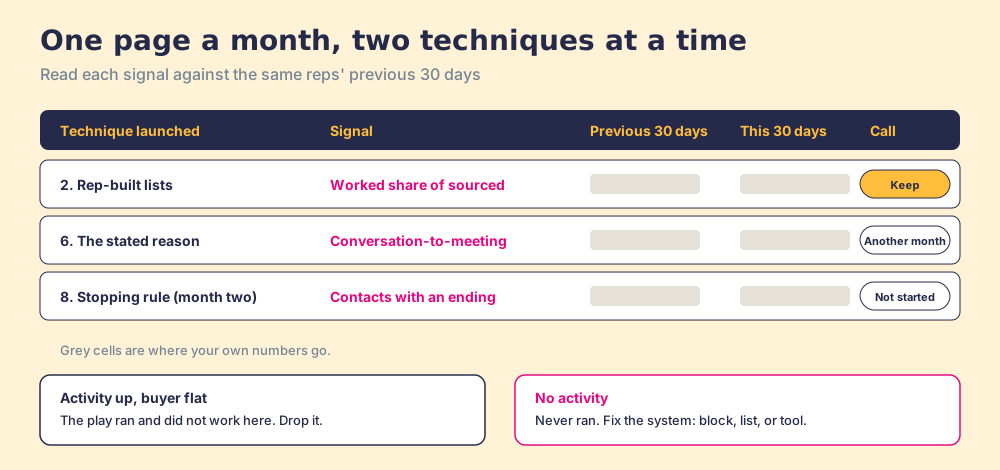
Counting the activity is part of the check, and a necessary part. Blocks held, contacts sourced, and touches sent tell you the play was run, which is the first thing a manager has to know before judging whether it worked. Then read the buyer’s side: replies, meetings, endings. A technique that shows high activity and no buyer movement after 30 days was run and did not work in your market. A technique with no activity was never run, and that is a system question for the manager (the block was not protected, the list was not there), never a verdict on the rep.
Where does Supered Prospector fit with these techniques?
Techniques 2, 3, and 4 all need the rep to source contacts themselves, quickly, from the page they are already on. Technique 8 and the monthly review need a leader to see what happened to each list. For teams already on Clay, that is what Supered Prospector does. It runs on the customer’s own Clay account, inside the Supered Chrome extension, and reps never log into Clay.
- Rep-built lists from anywhere. A LinkedIn profile, a Sales Navigator lead or list, a company’s website, or a HubSpot, Salesforce, or Pipedrive record, with Clay’s waterfall across 200+ vendors (Clay’s homepage count, September 25, 2026) filling the verified email and phone.
- Two to four people per account. A buying-committee lookup tuned to the titles, departments, and seniority your team sets.
- No second first touch. On the profile, the rep sees the matching CRM record and whether the person was already worked in the past.
- The GTM engineer’s flows as buttons. Any custom Clay workflow runs from Supered, including a job-change table for past champions, and a saved list can be pushed into a Clay workflow.
- Found, worked, closed. Found: reps use your tables with no duplicate work. Worked: the leader sees who is working their list and who is not. Closed: each lead ends the way your process says, qualified, recycled, or disqualified.
Supered does not bring its own database. It brings Clay’s waterfall, which is every database, routed, and that is why we chose Clay as our only data provider. Prospector works within LinkedIn’s terms and does not copy search results in bulk; the contact data comes from Clay’s waterfall on the customer’s Clay account. It costs $45 per rep per month, billed annually, from one rep. The leader’s view is on Prospector for sales leaders, and the product is on the Prospector page.
Choose something else if:
- No Clay account. Prospector needs one. A single database such as Apollo is the simpler start for techniques 2 and 3.
- Touch techniques only. If your gap is the opener and the first email, a call-coaching or sequencing tool is the better spend.
- AI-written outreach. Prospector does not draft or send messages; it hands the contact to your CRM and your sales engagement tool.
Why trust this playbook?
Before Supered I started RevPartners, a HubSpot partner that did only sales implementations, sold roughly twice as much Sales Hub as any other partner, and reached HubSpot’s Elite tier in 13 months. Supered is the #1 sales enablement app on the HubSpot marketplace, rated 5.0 from 122 reviews there and 4.9 out of 5 from 81 reviews on G2 (checked October 1, 2026). The disclosure: we make Prospector, and it appears above as one route among several.
What we recommend
Launch two techniques, not eight. Pick one list technique and one touch technique, run them for 30 days, and read the signals against the same reps’ previous month. For most mid-market teams the strongest first pair is rep-built lists with two to four people per account (technique 2 with 3) and the stated reason (technique 6), because the list gives the rep the reason, and the reason is what Gong’s 2.1x and Gartner’s 73% both point at. Add the stopping rule in month two, so the contacts from month one get an ending.
The field’s sales prospecting tips are mostly right about what to do. What they leave out is the toothpick. Write the signal down before you start, and in a month you will know which techniques work in your oven. For why the list decides so much of this, read B2B prospecting, and for the stages a sourced contact moves through after the first touch, read the sales prospecting process.
Frequently asked questions
What are the most effective sales prospecting techniques?+
How do you know if a prospecting technique is working?+
How many people should a rep contact per account?+
How many touches should a prospecting sequence have?+
What is the difference between prospecting techniques and prospecting strategies?+
Where does Supered Prospector fit with these techniques?+
Your Clay waterfall, where reps already work.