B2B Prospecting: Get on the Shortlist Before the Buyer Finishes Writing It
B2B prospecting in 2026 means reaching a buying group that has usually ranked its vendors before anyone calls.
The motion from ICP to closed, the two places it breaks, and the fix for each, with sources checked October 2, 2026.
B2B prospecting is the work of choosing companies that fit your ideal customer profile, finding the several people inside each who will make the decision, and starting a conversation with them before they finish their shortlist.
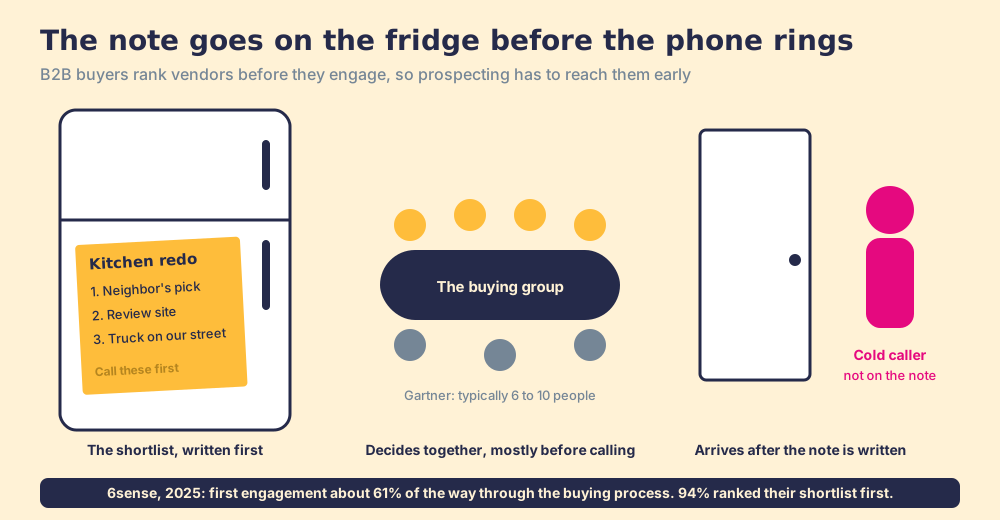
A family decides to redo the kitchen. Before anyone calls a contractor, a sticky note goes up on the fridge with three names on it. One came from the neighbor who had her bathroom done. One came from a review site. One is the firm whose truck sat in the street for a month last spring. The contractor who cold-calls the house the next week is polite, well prepared, and not on the note, and the note is what the family uses when they start making calls.
B2B prospecting is the work of choosing companies that fit your ideal customer profile, finding the several people inside each who will make the decision, and starting a conversation with them before they finish their shortlist. The pages ranking for the term today, Highspot’s ten tactics and SAP’s ten strategies among them, list good activities. They mostly stop at the first touch. The research on how B2B groups buy says the first touch arrives late, and the part of the motion that decides the number is what happens to the list after a rep builds it.
The short version, for a team rebuilding its motion now:
- The timing. Buyers in 6sense’s 2025 survey first engaged sellers about 61% of the way through their process, and 94% had already ranked their shortlist by preference.
- The unit. An account with a group of 6 to 10 people behind the decision, per Gartner, so one contact is one chair at the table.
- The two breaks. Data reps cannot reach without asking someone, and lists that sit unworked once they exist.
- The fix. Rep-built lists from wherever the rep already is, and a report that follows each list to found, worked, and closed.
What is B2B prospecting in 2026?
The definition has not changed much in twenty years. What changed is the clock. 6sense surveyed nearly 4,000 B2B buyers for its 2025 Buyer Experience Report and found that “buyers’ first engagement with sellers shifted from about 69% of the way through the buying journey in 2024 and 2023 to 61% in 2025.” Earlier is better than later, and it is still well past the halfway mark. The same report found buyers initiated 79% of those first engagements, and when asked whether they had ordered their shortlist by preference before talking to sellers, “a resounding 94% of buyers answered yes.” 6sense’s earlier work put the pre-contact favorite as the winner roughly 80% of the time (checked October 2, 2026).
Read those three numbers together and the job of B2B prospecting shifts shape. The family is going to pick up the phone. They are going to call the names on the note. A rep’s outreach does two kinds of work at once: it starts conversations with the few buyers who are early, and it puts the company’s name on the note for the many who will call later. Both count, and both depend on reaching the right house at the right time with something worth hearing.
Gartner adds the warning that keeps this from turning into a volume contest. In a June 2025 survey of 632 B2B buyers, 61% said they prefer an overall rep-free buying experience and “73% of B2B buyers actively avoid suppliers who send irrelevant outreach.” Robert Blaisdell, VP Analyst in Gartner’s sales practice, put it plainly: “Bad prospecting actively damages relationships with potential customers” (Gartner, 2025). The cold caller can do worse than miss the note. Send the family three irrelevant emails and the firm can get crossed off a note it was on.
So B2B prospecting in 2026 is selective by design. Fewer accounts, chosen on evidence. More people per account. A reason for every touch. And a way to know which of those choices worked.
How is B2B prospecting different from B2C sales prospecting?
B2B sales prospecting borrows its vocabulary from consumer selling (leads, lists, outreach) and almost none of its arithmetic. The table sets the two side by side.
| What changes | B2C prospecting | B2B prospecting |
|---|---|---|
| The unit you target | A person | An account, then the people inside it |
| Who decides | Usually one person | A buying group, typically 6 to 10 people (Gartner) |
| When the seller enters | Often at the start | About 61% of the way through, usually at the buyer’s call (6sense, 2025) |
| What a list holds | Names and contact details | Accounts, their buying group, and a reason to reach each |
| What “worked” means | One person reached | Enough of the group reached that a decision can move |
| How it ends | Bought or not | Qualified, recycled, or disqualified by your process |
The second row does the most damage when it is ignored. Gartner’s research on the B2B buying journey puts the typical buying group at 6 to 10 people, spending about 17% of their buying time with all potential suppliers combined, and 77% of them describe the purchase as complex or difficult. A rep who reaches one of ten has reached one chair. In a small-business deal that one chair may be the owner, and it is enough. In a mid-market deal it rarely is, which is why the ideal customer profile has to name the roles as well as the company size.
What does the B2B prospecting motion look like from ICP to closed?
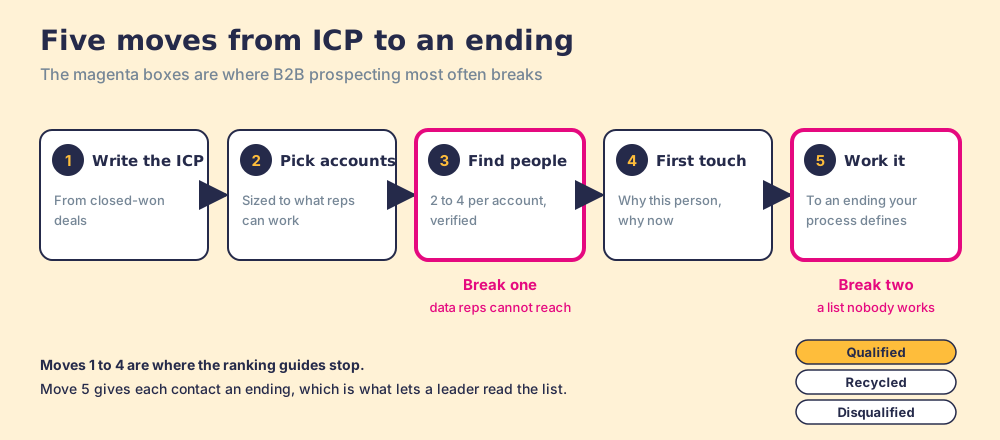
Five moves, in order. The first four are the ones the ranking guides cover. The fifth is the one that turns a list into a number a leader can manage.
| Move | What it produces | Where it most often breaks |
|---|---|---|
| 1. Write the ICP | One sentence built from closed-won deals: industry, size, trigger, disqualifiers, roles | Written from aspiration, so it never filters anything out |
| 2. Choose accounts | A list of companies that fit, sized to what reps can work while the data is fresh | Too long to finish, so the best accounts sit at row 400 |
| 3. Find the people | Two to four members of the buying group per account, each with a verified email and phone | The data lives in a tool the rep cannot open without help |
| 4. Make the first touch | A message or call that states why this person, why now | Generic copy sent to the whole list at once |
| 5. Work it to an ending | Each contact ends the way your process says: qualified, recycled, or disqualified | The list sits unworked, and the leader cannot see that it did |
The sales prospecting process post covers the inspection signal for each stage in detail, and the outbound lead generation guide covers the sending rules for the first touch. Two of the five moves need more room here, because the B2B version of each is harder than it looks.
Move 3 is where the buying group becomes real. A rep with an account and no names has a building and no doorbells. The useful target is two to four people per account, chosen from the roles the ICP names, each with a verified email and a phone number. That is a data problem, and B2B data decays: vendor sources quoted by Apollo put the decline at about 2.1% a month, roughly 22.5% a year (a vendor estimate, so treat it as direction, not a measurement). A list built in January is a different list by June.
Move 5 is the one that decides whether prospecting is a process or a pile. A contact that got two emails and silence has no ending. It sits. Six months later it sits in a different rep’s view, gets a duplicate first touch, and makes the buyer one of Gartner’s 73%. Give each contact an ending your process defines, qualified, recycled for later, or disqualified, and the list becomes something a manager can read.
Where does B2B prospecting break?
In two places, and both are about access more than effort.
Break one: data reps cannot reach
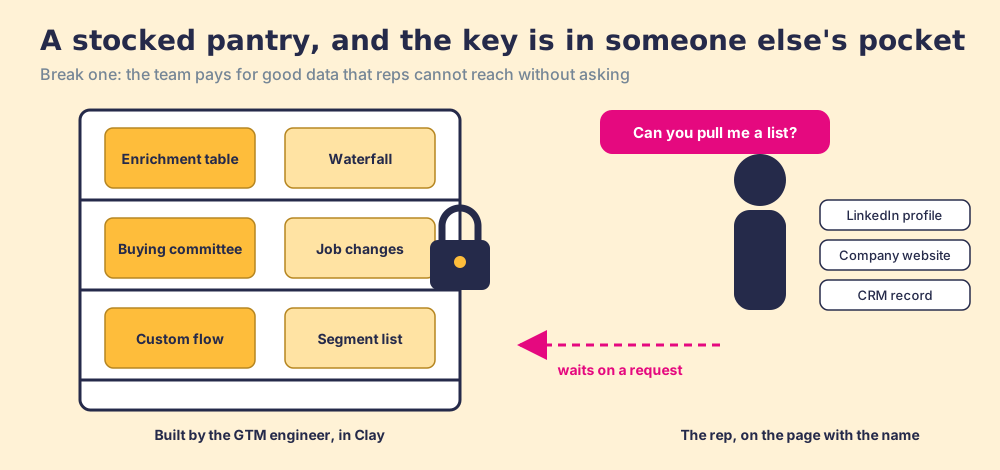
A team on Clay already pays for good data. The trouble is where it lives. A GTM engineer or RevOps lead builds enrichment tables in Clay, routes them through a waterfall of providers, and maintains them carefully. The rep, meanwhile, is on a LinkedIn profile or a company’s website with a name and no number. To use what Ops built, the rep has to ask. GTM engineers we talk to describe the other end of the same rope: they built great Clay tables, and reps still message them for every list.
It looks like a well-stocked pantry with the key in someone else’s pocket. The food is there. The cook is hungry. Dinner waits on a text message.
The cost shows up in the rep’s day. The Bridge Group’s 2025 SDR report, built from 351 B2B companies, puts the median SDR at 112 activities a day: 44 phone, 41 email, 19 LinkedIn, and 8 text or other, against 4.1 quality conversations (The Bridge Group, 2025). That is about 27 activities for each real conversation. A rep at that pace does not have an afternoon to wait on a list request, so the rep improvises: a personal Apollo seat, a spreadsheet, a copy and paste into the CRM. The duplicate record arrives soon after.
Break two: lists that sit unworked
The second break is stranger, because the list exists and the data is good. It does not get worked. A list built by someone else arrives with no judgment attached. The rep did not choose the accounts, does not know why row 12 is there, and works it in the order it was pasted, or not at all.
Behavioral research has a name for the opposite effect. Michael Norton, Daniel Mochon, and Dan Ariely ran the experiments behind “The IKEA effect: When labor leads to love” (Journal of Consumer Psychology, 2012). People who assembled a plain storage box bid $0.78 for it, against $0.48 for the same box pre-assembled, “a 63% premium.” The catch in their abstract matters as much as the premium: “labor leads to love only when labor results in successful completion of tasks.” Build the box and finish it, and you value it. Hand someone a finished box and they treat it like furniture.
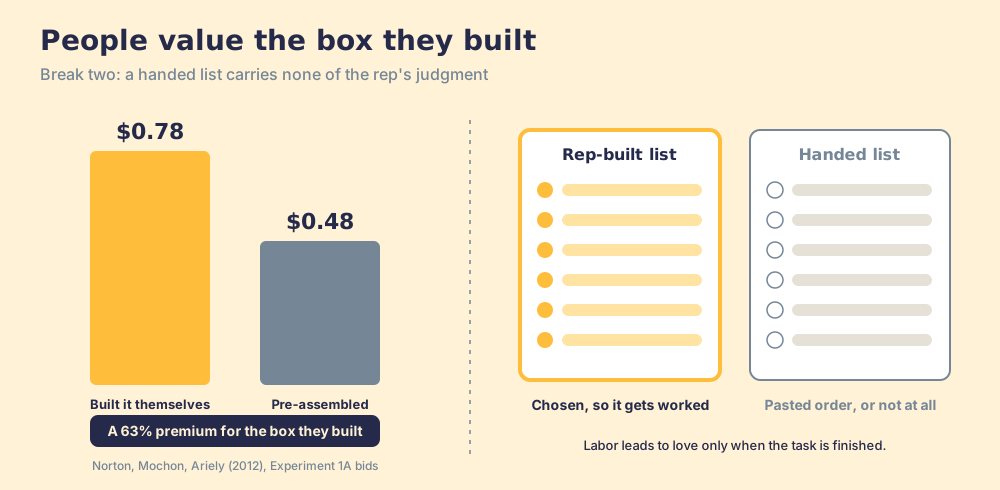
A prospect list is a box. A rep who picked the accounts from pages already open, who saw the buying group and chose who to reach, has a list with their reasoning in it, and a rep works the list they reasoned about. When reps skip Ops-built lists, the fault sits with the system that handed them the wrong kind of list, never with the reps.
Which B2B prospecting strategies work in 2026?
The ranking pages offer ten or fifteen strategies each, and most of the advice is sound. Four have measured evidence behind them, and all four make the list smaller and the reason sharper. The full Monday playbook, with how to run each and the signal that tells you it worked, lives in sales prospecting techniques. Here are the four B2B prospecting strategies in brief.
- Past champions who changed jobs. UserGems’ data science team analyzed over 5,000 opportunities and found that opportunities involving a previous champion more than doubled win rates, ran 54% larger, and closed with 12% shorter sales cycles (UserGems, updated April 7, 2026; vendor data). A former customer at a new company is the neighbor who recommends you.
- Several people per account. Gong’s analysis of millions of sales interactions found “closed-won deals include 67% more contacts than closed-lost deals” (Gong). Win and loss both involve groups; the winners reached more of them.
- A stated reason for the touch. Gong’s call data shows “a 2.1x higher success rate for salespeople who state their reason for calling” (Gong). The reason is what separates relevant outreach from the kind Gartner’s 73% avoid. More on the opener is in cold calling tips.
- A first email that carries the weight. Instantly’s Cold Email Benchmark Report 2026, built on billions of cold emails sent in 2025, found “58% of all replies are generated from step one,” with an average reply rate of 3.43% (Instantly, 2026; vendor data). Follow-ups still matter. The first message matters most.
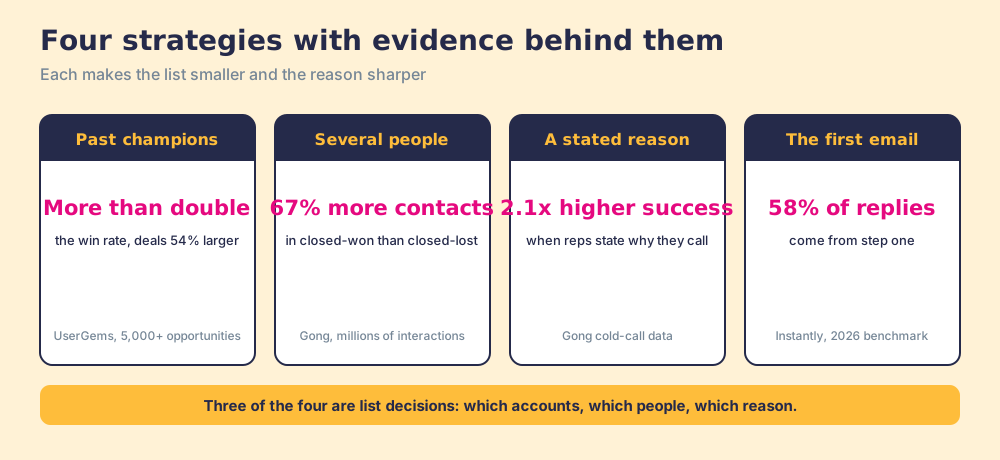
Three of the four strategies are list decisions before they are messaging decisions. Which accounts (the ones where a champion landed), which people (several, not one), which reason (the one that fits this account now). So list-building belongs with the rep. The person writing the first touch is the person who knows why the account is on the list.
How do you fix the two breaks?
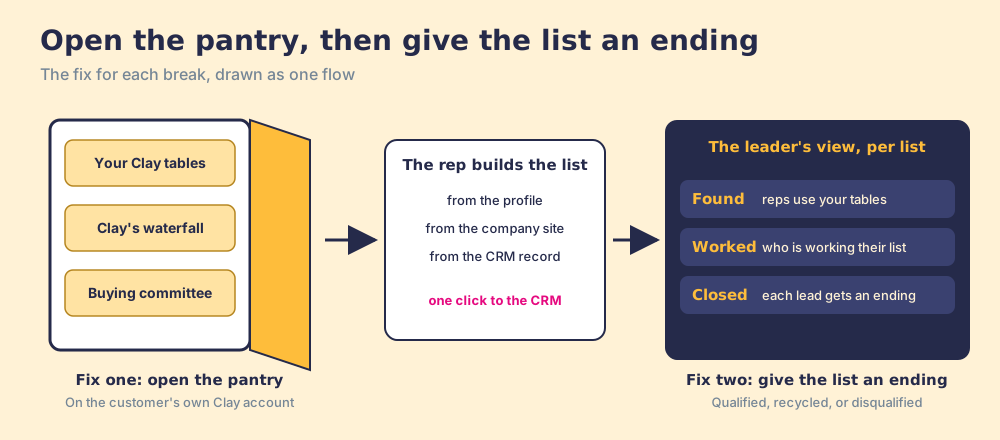
The fix for break one is access. Put the data the team already pays for one click from the page the rep is looking at, so a list never waits on a request. The fix for break two is authorship plus an ending. Let reps build the lists they will work, then follow each list to found, worked, and closed so the manager watches the list become pipeline and coaches from what is converting.
Any stack can do a version of this. A team with one database can give every rep a seat, set a rule that reps source their own accounts within an assigned segment, and tag the list source on every CRM record so the closed-won report can be cut by list. That gets you most of break two. It leaves break one half-fixed, because one database returns what it has and stops.
Where Supered Prospector fits in B2B prospecting
For teams already on Clay, Supered Prospector is built for both breaks. Clay’s waterfall asks provider after provider until one returns a verified email or phone, across a marketplace Clay counts at 200+ vendors on its homepage (checked September 25, 2026). Supered does not bring its own database. It brings Clay’s waterfall, which is every database, routed, and that is why we chose Clay as our only data provider. Prospector runs on the customer’s own Clay account, inside the Supered Chrome extension, and reps never log into Clay.
- The rep’s starting point. A LinkedIn profile, a Sales Navigator lead or list, a company’s website, or a HubSpot, Salesforce, or Pipedrive record.
- The buying group. A buying-committee lookup tuned to the titles, departments, and seniority your team sets, so move 3 finds the chairs your ICP names.
- The duplicate check. On the profile, the rep sees the matching CRM record and whether the person was already worked in the past, before anyone sends a second first touch.
- The GTM engineer’s tables as buttons. Any custom Clay workflow runs from Supered, and a whole saved list can be pushed into a Clay workflow.
- One click to the CRM. Ops sets the field mapping once, and the contact lands with the list it came from.
- Found, worked, closed. Found: reps use your tables with no duplicate work. Worked: a leader sees who is working their list and who is not. Closed: each lead ends the way your process says, qualified, recycled, or disqualified.
Prospector works within LinkedIn’s terms and does not copy search results in bulk; the contact data comes from Clay’s waterfall on the customer’s Clay account. Clay governs the data. Supered governs the motion. Prospector costs $45 per rep per month, billed annually, from one rep, and the details are on the Prospector page.
Choose something else if:
- No Clay account. Prospector needs one. A single database such as Apollo or Lusha is the simpler start, and the lead list guide covers building lists that way.
- Ops builds every list by design. If reps never source and only work what lands in the CRM, Clay’s own CRM sync does the job without a rep-side layer.
- AI-written outreach. Prospector does not draft or send messages. It hands the contact to your CRM and your sales engagement tool.
Why trust this guide?
Before Supered I started RevPartners, a HubSpot partner that did only sales implementations, sold roughly twice as much Sales Hub as any other partner, and reached HubSpot’s Elite tier in 13 months. Supered is the #1 sales enablement app on the HubSpot marketplace, rated 5.0 from 122 reviews there and 4.9 out of 5 from 81 reviews on G2 (checked October 1, 2026). The disclosure: we make Prospector, and it appears above as one route among several.
What we recommend
We recommend letting reps build their own lists on the data the team already pays for, and reporting each list to an ending. Adding volume to the current motion is the tempting alternative, and Gartner’s 73% says it costs you names on future shortlists. Buying a single database and giving every rep a seat fixes access to one source and leaves unworked lists where they were.
Four findings back the choice. Buyers rank vendors before they call, so the list has to be chosen with judgment, account by account. Buying groups run 6 to 10 people and won deals reach more of them, so the list has to hold the people inside each company. People value and finish what they built, so the rep should build it. And a list without endings cannot be managed, so give every contact one.
Start this week with one segment. Write the ICP sentence from your last ten closed-won deals, let each rep source twenty accounts in that segment with two to four contacts apiece, tag the source on every record, and look at found, worked, and closed in thirty days. The sales prospecting guide has the long version of why this works, and sales prospecting techniques has the plays your reps can run on the list once it exists.
Frequently asked questions
What is B2B prospecting?+
How is B2B prospecting different from B2C prospecting?+
What are the steps of B2B prospecting?+
What are the best B2B prospecting strategies in 2026?+
Why do B2B prospecting lists go unworked?+
Does Supered Prospector replace a B2B data provider?+
Your Clay waterfall, where reps already work.