Sales Enablement Salary in 2026: What Each Level Earns, and Why the Sources Disagree
Five salary sites agree on what a sales enablement manager earns to within about $5,000.
On specialists and directors they disagree by more than $40,000. The gap tells you how to benchmark your own pay.
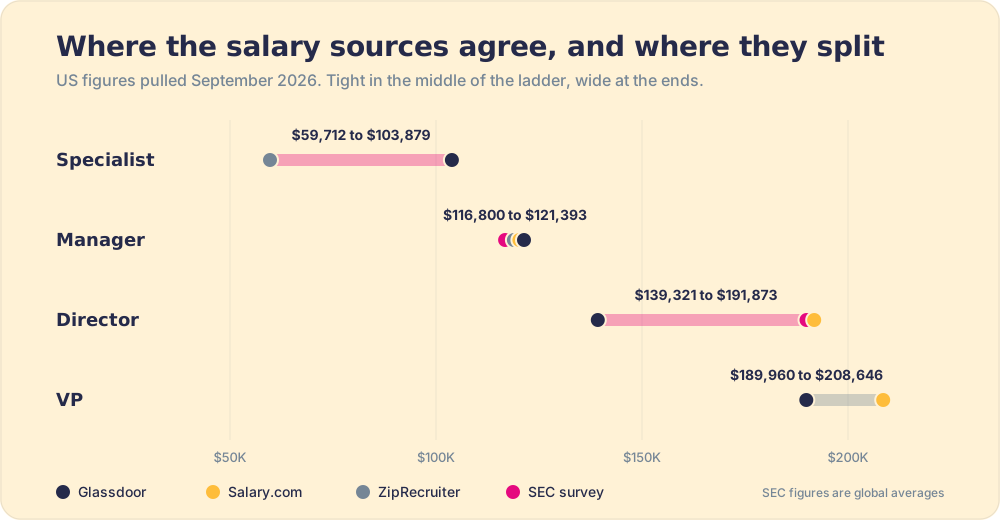
A sales enablement salary is the pay for the people who onboard, equip, and coach sellers; in September 2026, US sources put a sales enablement manager at $116,800 to $121,393 and a director at $139,321 to $191,873, with scope and title moving pay more than tenure.
Ask five salary sites what a sales enablement manager earns and they agree to within about $5,000. Ask the same sites what a sales enablement specialist earns and they disagree by $44,167. Ask about a director and the gap is $52,552. Same profession, same month, same country.
That pattern is the most useful thing in this whole guide, so we will start there instead of with a single average. A sales enablement salary is the pay for the people who onboard, equip, and coach sellers. In September 2026, public US sources put a sales enablement manager between $116,800 and $121,393, and a director between $139,321 and $191,873. The middle of the ladder is well measured. The ends are where titles stop meaning one thing, and that is where your own number gets decided.
The ranking guide on this query today is the Sales Enablement Collective’s salary guide, and it is good: it rests on a real practitioner survey and we cite it throughout. What it does not do is set its figures next to the salary sites, show where they split, and explain why. The sections below do that. Supered has no salary data of its own, so every figure below is someone else’s, linked, dated, and caveated. We never average them into a house number.
What is the average sales enablement salary in 2026?
One average would mislead, because “sales enablement” covers a coordinator building a content library and a VP who owns onboarding for four hundred sellers. The table below breaks it out by level, with source type and caveat. US figures unless marked, pulled September 25, 2026.
| Level | Figure | Source (type) | Caveat |
|---|---|---|---|
| Coordinator | $80,198 avg total pay | Glassdoor (self-reported) | Range $63,000 to $104,000 |
| Specialist | $103,879 avg total pay | Glassdoor (self-reported) | Includes bonus |
| Specialist | $59,712 avg | ZipRecruiter (job postings) | As of Aug 26, 2026 |
| Entry level (all titles) | $75,517 avg, $69,000 median | SEC 2025 survey (practitioner survey) | Global |
| Manager | $120,289 median | Salary.com (employer-reported model) | 25th to 75th pct $111,497 to $130,213 |
| Manager | $121,393 avg total pay | Glassdoor (self-reported) | Includes bonus |
| Manager | $118,941 avg | ZipRecruiter (job postings) | As of Sep 7, 2026 |
| Manager | $116,800 avg, $122,000 median | SEC 2025 survey | Global; North America median $125,000 |
| Senior manager | $161,229 median | Salary.com | Employer-reported model |
| Head of enablement | $188,305 median | Salary.com | SEC head level: $147,000 |
| Director | $191,873 median | Salary.com | 25th to 75th pct $177,450 to $210,282 |
| Director | $139,321 avg total pay | Glassdoor (self-reported) | Range $109K to $180K |
| Director and above | $190,000 avg, $186,000 median | SEC 2025 survey | Global |
| VP | $208,646 median | Salary.com | Employer-reported model |
| VP | $189,960 avg total pay | Glassdoor (self-reported) | Based on 14 salaries |
Salary.com figures are as of September 1, 2026. The SEC figures come from the Collective’s 2025 practitioner survey, published November 20, 2025; the public pages do not disclose a respondent count (the report page says “100+ of your peers”), and the numbers are global, which pulls them below US-only sources. The SEC’s all-level average is $131,413, median $125,000, down from $137,032 the year before.
Why do salary sites disagree about the same job?
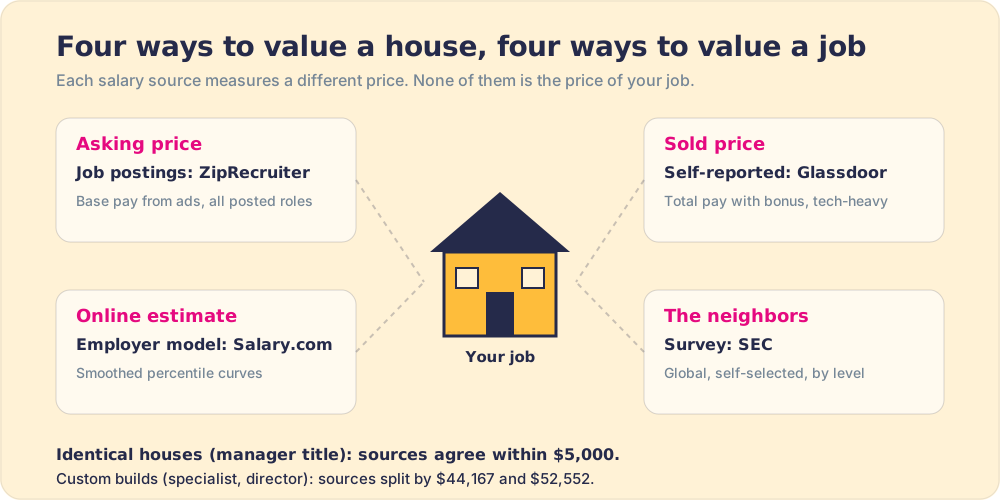
Think about how a house gets valued. The listing shows the asking price. The county records show what it sold for. An online estimate runs a model on the neighborhood. And the neighbors, if you ask them at a barbecue, will tell you what they think their own houses are worth. Four fair numbers, four different methods, and none of them is the price of your house.
Salary sites are the same four people.
- Job postings (ZipRecruiter). The asking price. It reads the pay employers post in ads, usually base only, across any listing that carries the title, junior and contract roles included. Those junior and contract listings are the likeliest reason it runs low for specialists.
- Self-reported pay (Glassdoor). The sold price, reported by the seller. It counts total pay, bonus included, and its contributors skew toward tech companies, where Glassdoor shows a sales enablement manager averaging $150,635.
- Employer-reported models (Salary.com). The online estimate. It blends HR survey data and postings into a smoothed percentile curve, which is why its ranges look tight: a 25th to 75th spread of under $19,000 for managers.
- Practitioner surveys (the SEC). The neighbors at the barbecue. It is the only source that asks enablement people directly and splits by level, title, and certification, but it is global and self-selected.
The appraisal comparison explains the split. In a subdivision of identical houses, all four methods agree, because the houses are the same. Sales enablement manager is that subdivision: the title describes roughly the same job wherever it appears, so the sources land within $5,000 of each other. Specialist and director are custom builds. “Specialist” covers someone scheduling training sessions and someone running the whole onboarding program at a 40-person startup. “Director” at a 60-person company can be a team of one. The house varies, so the appraisals do.
A house does not negotiate, though. You do, and the job description is partly yours to write.
What does each level earn, from specialist to VP?
Take the ladder one rung at a time, reading the sources against each other.
- Coordinator and specialist. The sales enablement specialist salary is the least reliable number in the field. Glassdoor’s $103,879 and ZipRecruiter’s $59,712 describe two different jobs wearing one badge. The SEC’s entry-level average of $75,517 (North America median $85,000) sits between them. Own a program end to end, benchmark against Glassdoor; support one, benchmark against the SEC. Our sales enablement specialist guide covers what separates the two.
- Manager. The sales enablement manager salary is the most agreed-upon figure: Salary.com $120,289, Glassdoor $121,393, ZipRecruiter $118,941, SEC $116,800 globally and $125,000 in North America. Salary.com’s job profile assumes five years as an individual contributor and one to three years supervising. The market is paying for that experience.
- Senior manager. Salary.com’s $161,229 median is a $40,940 step up from manager, the largest jump on the ladder, and it usually buys a program area and a direct report or two.
- Head of enablement. Salary.com $188,305; the SEC’s head level averages $147,000 globally. Some heads are a first enablement hire with a big title, which explains the spread.
- Director. The sales enablement director salary splits between Salary.com’s $191,873 and the SEC’s $190,000 average on one side, and Glassdoor’s $139,321 on the other. Two of three sources agree near $190,000; Glassdoor’s self-reported pool likely includes directors at small companies where the title outruns the scope.
- VP. Salary.com’s median is $208,646. Glassdoor shows $189,960, with a wide $44K to $81K in additional pay, but on 14 salaries, too few to lean on.
The job behind the middle rung is in what a sales enablement manager does. The market pays for the job description, and the description is where you get to argue.
How much more does revenue enablement pay?
The largest gap in the dataset sits between two titles. The SEC’s survey found that professionals with “revenue enablement” in their title averaged $163,870, against $112,879 for “sales enablement” and $139,158 for “GTM enablement.” That is a $50,991 gap between two titles that often describe overlapping work.
One survey could be an artifact of who answered, so we checked it against a source with a different method. On Glassdoor, a revenue enablement manager averages $137,005 against $121,393 for a sales enablement manager, a $15,612 gap, or about 13%. Different people, different method, same direction. The premium is real, even if its size depends on level.
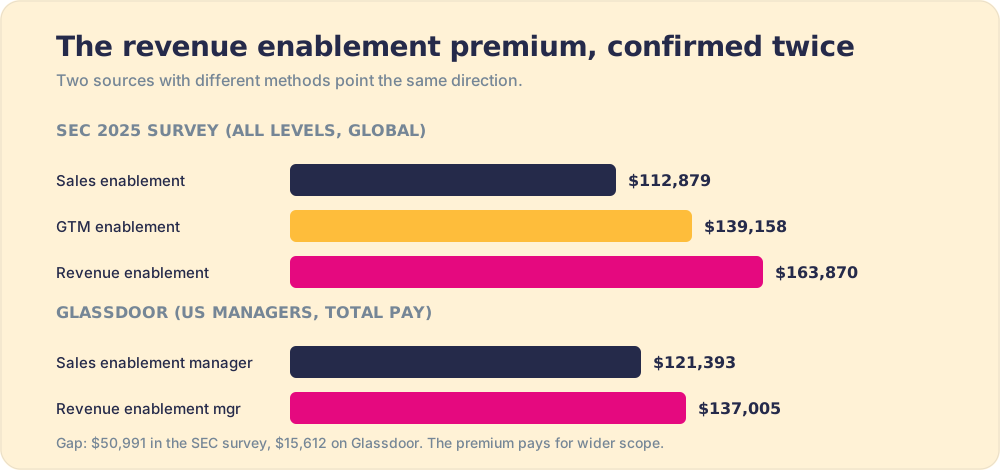
The premium follows scope. Revenue enablement usually covers customer success, partners, or the whole go-to-market team, reports closer to the CRO, and gets measured on revenue outcomes instead of training completions. The title is a label on a bigger job. Renaming your role without widening it will not move the number.
How do company size and location change pay?
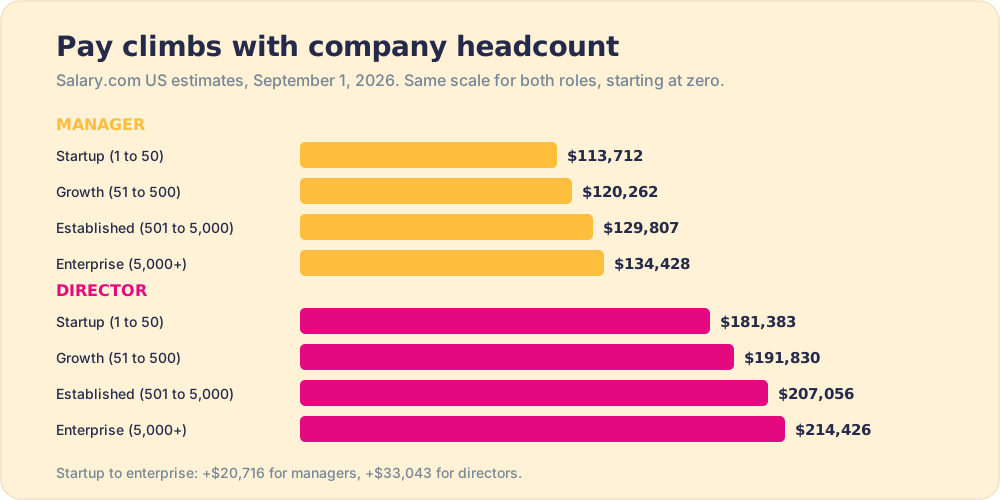
Salary.com splits both manager and director pay by company headcount, and the slope is steady.
| Company size | Manager | Director |
|---|---|---|
| Startup (1 to 50 employees) | $113,712 | $181,383 |
| Growth stage (51 to 500) | $120,262 | $191,830 |
| Established (501 to 5,000) | $129,807 | $207,056 |
| Enterprise (5,000+) | $134,428 | $214,426 |
Source: Salary.com, as of September 1, 2026. The manager spread from startup to enterprise is $20,716, about 18%. For directors it is $33,043. Bigger companies pay more partly because the job is bigger: more sellers to onboard, more tools to own.
Location moves pay about as much as company size. Salary.com puts a sales enablement manager in San Jose at $151,721, San Francisco at $150,059, and New York at $138,500. Across borders the gap widens: the SEC’s survey shows a North American average of $142,400, Europe $110,000, and the rest of the world $97,000. At the manager level, the North American median is $125,000 against $87,000 in Europe. Working remotely for a US company from a lower-cost region, ask which location band applies before you name a number.
What drives a sales enablement salary up?
Within a single job, these are the levers the evidence supports.
- Scope of ownership. A role that owns onboarding, ongoing coaching, and the enablement tool stack is a different job from one that produces content. Scope is what separates the $80,198 coordinator from the $161,229 senior manager, and it is what the revenue enablement premium is paying for.
- Direct reports. The SEC found each additional team member adds roughly $8,000 to $15,000 to average pay, and the progression is close to linear.
- Certification. Certified practitioners in the SEC survey averaged $146,529 against $124,114 without, a $22,415 difference (about 18%). Read it as correlation: certification may follow promotion as often as it earns one.
- Variable pay. 73% of SEC respondents receive a bonus, and those with variable pay also carry higher base salaries, $129,037 against $112,870.
- AI and tooling skill. PwC’s 2026 Global AI Jobs Barometer, built on more than one billion job ads, found an average 62% wage premium for roles requiring AI skills (PwC, June 2026). It spans all occupations, so read it as a direction; no source yet prices AI skill inside enablement alone.
- Proof of outcome. Only 23% of SEC respondents feel enablement salaries reflect the value the function delivers, and only 43.8% say they are aligned with senior leadership on metrics (SEC report). Pay follows what leadership can see.
The government’s wage data draws that last lever for us. The Bureau of Labor Statistics has no occupation code for sales enablement. The nearest codes sit on two different staircases. On one, training and development specialists earn a median of $69,280 and training and development managers $133,000. On the other, sales managers earn a median of $148,270. All three are May 2025 medians across every industry, so treat them as bookends, never as an enablement benchmark.
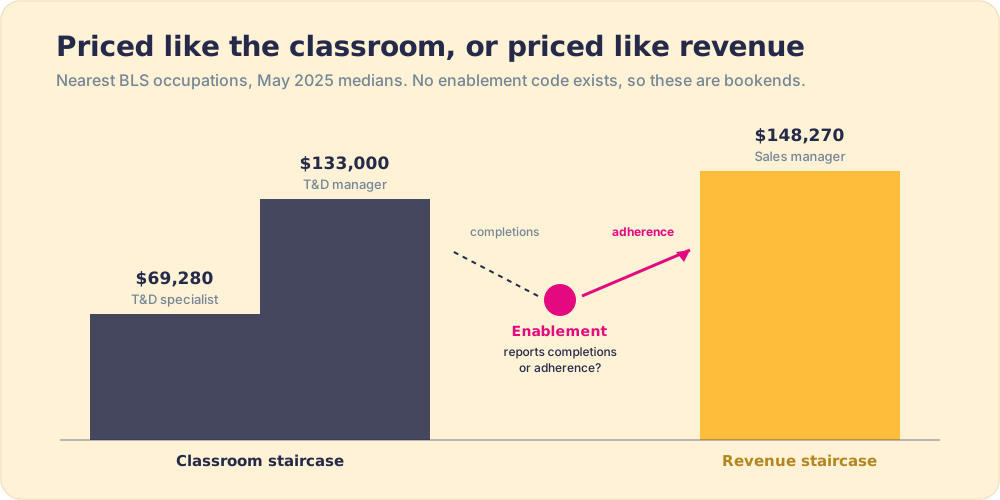
Enablement people get priced on whichever staircase the company believes they are standing on. If the function reports completions, courses built, and assets shipped, the company files it next to training. If it reports whether reps ran the process and what that did to ramp and attainment, the company files it next to revenue. Supered’s State of Sales Enablement 2026 found that 89% of teams have a defined sales process and only 36% see reps follow it, and that teams whose process lives inside the CRM workflow hit quota at 49% against 15% for teams whose process lives in docs, wikis, or an LMS. An enablement leader who can move that first gap, and show it moving, is standing on the revenue staircase.
How should you benchmark and negotiate your pay?
The SEC advises negotiating with market data rather than the employer’s range. Right, and incomplete, because the market data disagrees with itself. Match the source to the question.
- Base salary. Compare against employer-reported models (Salary.com) and job postings, since both measure base. For a manager, that is a $111,497 to $130,213 middle band.
- Total compensation. Compare against Glassdoor, which includes bonus. A manager’s total pay range there runs $97K to $154K.
- Level and title premiums. Use the SEC survey, the only source that splits by level, title, direct reports, and certification. Adjust up for North America.
- Scope match. Before you pick a row in the table, list what you own: onboarding, coaching, the tool stack, reporting to leadership. Match the job, then the title. A “specialist” who owns the onboarding program is priced like a manager.
- Outcome evidence. Bring two or three numbers you moved, drawn from your sales enablement KPIs: ramp time, process adherence, win rate on a target segment. A sales enablement charter that names those metrics in advance turns them into a promise leadership already agreed to measure.
- Variable pay tied to outcomes. If the base will not move, ask for a bonus tied to one of those metrics. It costs the company nothing unless the number moves.
One warning from the SEC data: pay shows a dip at the four-to-five-year mark, which the Collective reads as people who have outgrown junior roles but have not yet reached management. If you are in that window, the fastest raise usually comes from adding a direct report or a program you own outright, not from waiting.
What is the career path in sales enablement?
Enablement people mostly start somewhere else: the SEC found 59.4% of respondents worked in sales, sales management, or sales leadership first. The usual ladder runs coordinator or specialist, then manager, senior manager, head or director, and VP, with revenue enablement as a branch that pays better at every rung it touches.
Two forks decide the slope. The first is whether you take on people, the most linear lever in the SEC data. The second is whether your work gets measured on inputs or outputs. The first fork raises your level. The second decides which staircase your level sits on.
Match on scope, then prove the output
Price yourself on the scope you own, and start measuring the output of your function before the next review: whether reps run the process, deal by deal, and what that does to ramp and attainment.
The evidence above points one way. Title premiums track scope, company-size premiums track scope, and only 23% of the SEC’s respondents feel their pay reflects the value they deliver, in a field where only 43.8% are aligned with leadership on metrics. The cost of staying on inputs shows up in the government’s own bookends: a training and development manager’s median of $133,000 against $148,270 for a sales manager. Enablement that reports completions gets filed with training. Enablement that can show the process running gets filed with revenue.
Measuring that does not need a data team. We count how often each rep gets their open items to zero, and the count becomes a rate you can bring to a comp conversation:
From the field
Once you start counting that, it’ll give you a percentage. This percent of the time they follow the process. So it gets you a proxy for that.
That measurement is the job Supered was built for: it puts the process inside HubSpot and Salesforce, in the moment of work, and shows leaders whether it got followed. If you are building that case now, the next read is the sales enablement KPIs that prove the function’s value.
Frequently asked questions
What is the average sales enablement salary in 2026?+
How much does a sales enablement manager make?+
How much does a sales enablement specialist make?+
What does a sales enablement director earn?+
Does revenue enablement pay more than sales enablement?+
How do I benchmark and negotiate a sales enablement salary?+
Your process, running itself.