Revenue Intelligence: What It Tells You, and What Makes Reps Act on It
Revenue intelligence reads calls, email and the CRM, then scores deals and forecasts revenue.
Of the nine pages that rank for it, none lists the team's written process as an input or says who makes sure reps act.
Revenue intelligence is software that captures sales activity from calls, email, calendars and the CRM, then uses AI to score deal risk, forecast revenue and suggest next steps to reps and managers.
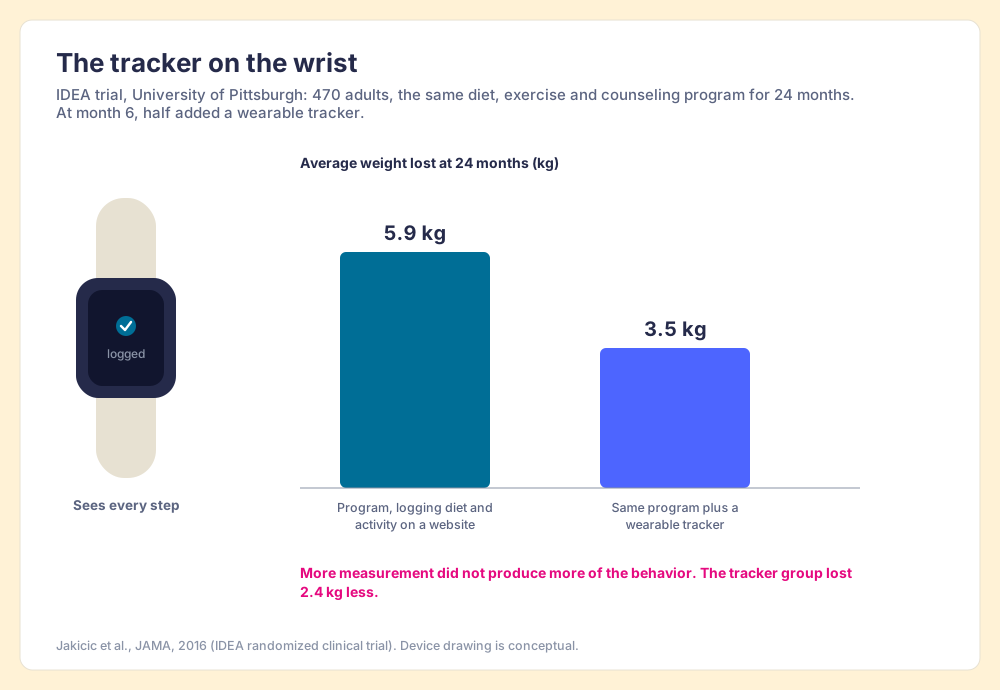
A team at the University of Pittsburgh once ran a trial that should have embarrassed the fitness tracker business. They put 470 young adults through the same weight-loss program: a low-calorie diet, more exercise, group counseling, then phone calls and text prompts. At month six, half the group started logging their diet and activity on a website. The other half got a wearable device that tracked their activity automatically. Two years later the website group had lost 5.9 kg on average. The tracker group had lost 3.5 kg (Jakicic et al., JAMA, 2016).
The tracker saw more and asked less of its wearers. They lost 2.4 kg less.
Revenue intelligence is software that captures sales activity from calls, email, calendars and the CRM, then uses AI to score deal risk, forecast revenue and suggest next steps to reps and managers. It is the tracker on the wrist of a sales team, and a good one. We read the nine pages that rank for the term on Google, and none of them lists the team’s own written process as an input, and none says who makes sure a rep acts on what the software found. Intelligence tells you. Enforcement makes it happen. You need to know which one you are buying.
What is revenue intelligence?
Gong was selling a “Revenue Intelligence Platform” by 2019, and its pitch set the terms for the category. Announcing its Series C in December 2019, it wrote that “revenue intelligence brings the power of true customer reality to revenue organizations, instead of relying on biased opinions of salespeople manually entering information into their CRM system,” and called its platform “the next big evolution after CRM” (Gong, December 2019). The slogan was “goodbye opinions, hello reality.”
That complaint was fair, and it still is. In a 2020 Gartner survey, 45% of sales leaders and sellers had high confidence in their forecast, and 47% said their data was high quality (Gartner, February 2020). Four years later, Xactly found that 4 in 5 sales and finance leaders had missed a quarterly forecast in the past year (Xactly, July 2024). A forecast built from what reps remember to type is a forecast built on sand.
Revenue intelligence software answers that by capturing what happened instead of asking reps to report it. The work runs in three stages.
- Capture. It records and transcribes calls and meetings, reads email threads and calendars, and pulls CRM fields and stage history.
- Model. It joins those signals by account and deal and compares open deals with the patterns of deals that closed and deals that were lost.
- Predict and recommend. It scores each deal’s risk, rolls up a forecast by rep and team, surfaces calls worth coaching, and suggests a next move.
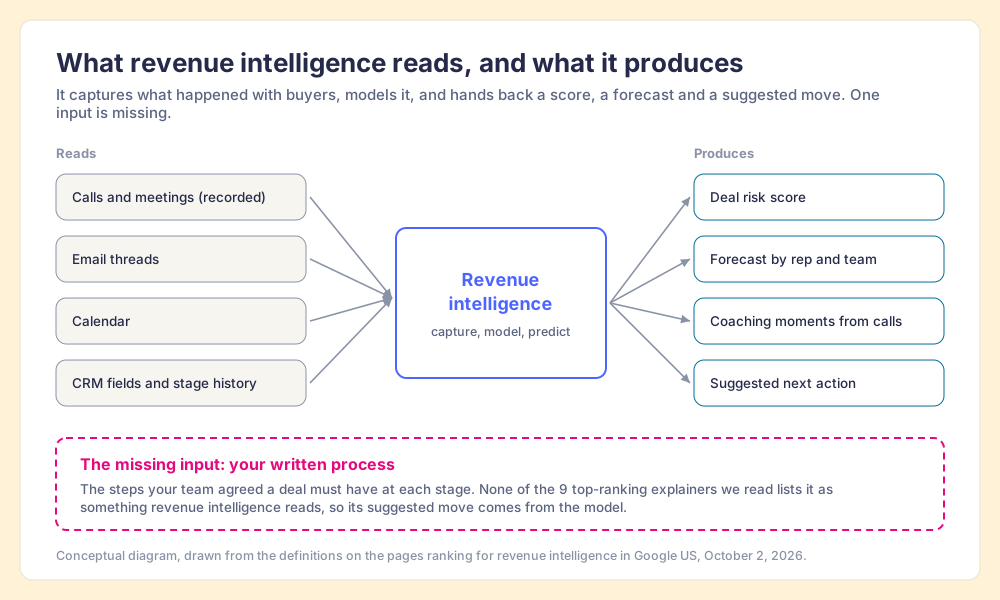
The vendor definitions line up. Salesforce: revenue intelligence “uses data and AI to uncover risks and opportunities in deals throughout the sales pipeline.” Salesloft: it uses “automation and machine learning algorithms to extract insights from sales calls, CRMs, and other sales data sources.” Aviso, which sells a platform, says it produces a close-probability score, a forecast with a confidence interval and “an explanation for each number that survives a sales manager’s pushback” (Aviso, May 2026). Each one describes a strong instrument for seeing.
How did revenue intelligence become a category?
In six years the idea went from one vendor’s slogan to an analyst category, and the category has already been renamed.
- 2019, the slogan. Gong announced its Series C with more than 700 customers and the “customer reality” pitch.
- The platforms multiply. Clari sold Clari Forecast, Salesforce added a Revenue Intelligence add-on to Sales Cloud, and Aviso, People.ai and Terret (formerly BoostUp) followed.
- December 2025, the merger of categories. Gartner published its first Magic Quadrant for Revenue Action Orchestration, which, in Gong’s words, “is emerging from the convergence of previously separate sales engagement and revenue intelligence markets.” Gong’s CEO, Amit Bendov, described the goal as “turning intelligence into action” (Gong via PR Newswire, December 2025). Gong now counts more than 5,000 customers.
- September 2026, consolidation. Salesloft announced it now operates as one company with Clari, with Clari Forecast keeping its name (GlobeNewswire, September 2026).
The new category name carries the industry’s own diagnosis. After six years of better seeing, the vendors and the analysts agree the hard part is the action.
What do the top revenue intelligence pages leave out?
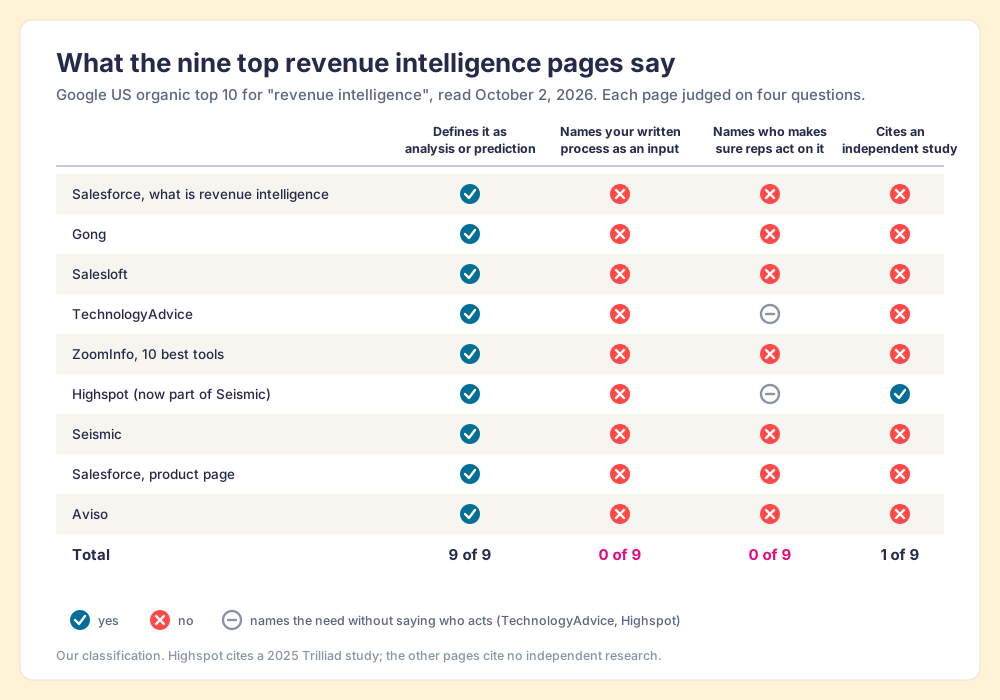
We read every organic result in the Google US top 10 for “revenue intelligence” on October 2, 2026: nine pages from Salesforce (two), Gong, Salesloft, TechnologyAdvice, ZoomInfo, Highspot (now part of Seismic), Seismic and Aviso. We asked each page four questions.
| Question we asked each page | Pages that say yes |
|---|---|
| Defines revenue intelligence as analysis or prediction | 9 of 9 |
| Names the team’s written process as an input | 0 of 9 |
| Names who makes sure reps act on what it finds | 0 of 9 (2 name the need) |
| Cites an independent study | 1 of 9 |
Two pages come close, and they deserve credit. TechnologyAdvice says teams need “a shared process for acting on the information,” and Highspot writes that “a well-built sales methodology is wasted if reps aren’t applying it consistently.” Salesforce says sales ops can use the insights to “define best practices, and set them into motion across the entire team.” Each page then stops. None says where those practices are written, what checks that a rep followed them, or who sees the result.
The suggested actions show the gap from the other side. Salesforce’s own tool, its page explains, recommends moves such as “Log Activity” and “Identify Executive Sponsor.” A team that requires an executive sponsor before a proposal already has that step. The model has rediscovered a rule the team wrote, and nothing in the definition connects the two.
Why doesn’t more intelligence produce more of the behavior?
Back to the wrist. The Pittsburgh researchers were careful about what their trial showed: devices that monitor and give feedback “may not offer an advantage over standard behavioral weight loss approaches.” Both groups improved fitness and diet. The program did the work; the tracker did not add to it. The comparison has limits. A sales team is not a dieter, and a revenue intelligence platform does far more than count steps. Still, the trial isolates the variable that matters here: more measurement, same plan, no more behavior.
Medicine learned the same lesson at a larger scale. The World Health Organization’s 2003 review of chronic disease found that “adherence to long-term therapy for chronic illnesses in developed countries averages 50%,” and concluded that better adherence “may have a far greater impact on the health of the population than any improvement in specific medical treatments” (WHO, 2003). The scan and the blood test got far better over those decades. Half the prescriptions still went untaken.
Our own research found the sales version. In The State of Sales Enablement 2026, 89% of teams had a defined process and 36% saw reps run it, a 53-point gap. Teams that inspect deals against a defined process at the highest frequency hit quota at 6.3x the rate of the lowest band. The top reason reps skip the process was that managers do not enforce it (29%), and adherence fell from 47% on teams with one to five reps per manager to 23% at six to eight.
- Diagnosis. Revenue intelligence is excellent at it. It finds the stalled deal, the missing champion and the call where pricing went sideways.
- Adherence. It belongs to someone else. A risk alert lands in a manager’s inbox; whether the rep books the meeting depends on that manager having the hour to chase it.
- Blame. The WHO’s review has a heading for this: “patients need to be supported, not blamed.” The common belief that patients alone are responsible for taking their treatment “is misleading,” it says. Reps are no different. When a rep skips a step, the system made skipping easier than doing.
A manager with eight reps cannot read eight reps’ deals every night, and the alerts hand that job straight back to the manager.
Revenue intelligence vs process enforcement: what is the difference?
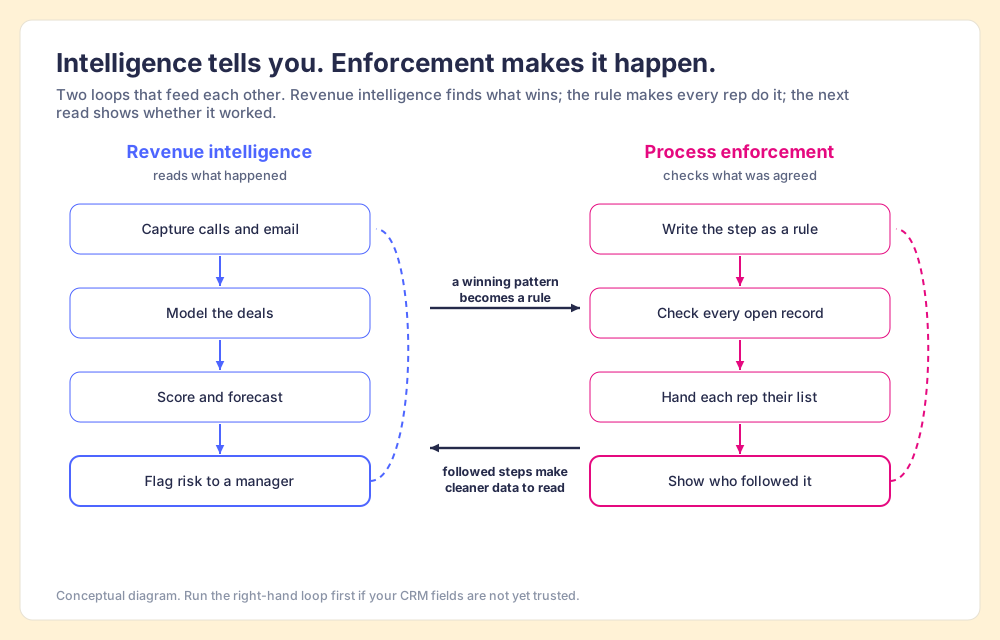
Process enforcement is the other loop. You write the steps your team agreed a deal must have as rules (“past Discovery, the deal has an amount”; “a recap goes out within a day of every meeting”), software checks every open record against them, each rep gets the list of their own records that break one, and the manager sees who followed them.
| Revenue intelligence | Process enforcement | |
|---|---|---|
| Question it answers | What is happening, and what will close? | Did each deal get the steps we agreed on? |
| Main input | Calls, email, calendar, CRM activity | Your written rules, checked against CRM records |
| Output | Risk scores, forecast, coaching moments, suggestions | A list of records that break a rule, each with an owner |
| Who acts | A manager reads it, then chases | The rep clears their own list |
| Example price | Salesforce add-on $220 per user per month; Gong median $55,346 a year; Clari median $76,000 a year | Supered Process Compliance $40 per user per month |
Prices: Salesforce Revenue Intelligence, billed annually, checked October 2, 2026; Gong and Clari medians from Vendr (Gong, Clari), October 2026; Supered pricing, paid yearly.
The two loops feed each other. Revenue intelligence notices that deals with a second contact by the second meeting close more often. You write that down as a rule. Enforcement makes every rep run it. The next forecast reads cleaner data, because the fields reps were skipping are now filled in.
Do you need a revenue intelligence platform?
It earns its cost when three things are true.
- Volume past one person’s reach. Enough recorded calls and open deals that no manager can review them by hand. Gong and Clari are rated 4.7 out of 5 (6,679 reviews) and 4.6 out of 5 (5,610 reviews) on G2 as of October 2, 2026; one Clari reviewer credits it with bringing “structure and consistency to forecasting.”
- A forecast call that matters. A board, a finance team or a parent company that needs a number with a confidence range.
- CRM data reps keep current. The model reads stage, amount and close date. If those are guesses, the forecast inherits the guesses with a confidence interval attached.
Wait if your stages mean different things to different reps. Revenue intelligence will model that inconsistency faithfully and hand it back to you as a score. Our post on CRM hygiene covers the rules that make the fields trustworthy, and pipeline review covers the meeting where the forecast gets argued.
What we recommend
There are three ways to run this.
- Revenue intelligence alone. Leaders see further and forecast better. Reps still decide which suggestions to take, and managers chase the rest by hand.
- Process enforcement alone. Every open record gets checked against your rules every night and reps clear their own lists. You see who follows the process; you do not get call analysis or a modeled forecast.
- Rules first, then intelligence. The approach we recommend for a mid-market team.
Start with the rules. The State of Sales Enablement shows inspection is the lever, at 6.3x quota attainment for the most-inspected teams, and the WHO and Pittsburgh findings show what happens when measurement improves and adherence does not. Write your process as rules, check every open record against them, and once reps are clearing their lists, add revenue intelligence to find the patterns worth turning into the next rule.
Supered does the right-hand loop. Your rules live as Process Rules inside a Process Ruleset, and a Process Board lists every record in HubSpot, Salesforce or Pipedrive that breaks one, with its owner. Reps clear their lists where they already work, in the CRM or in Claude, and managers see which rules fire most and on whose deals. Process Compliance is $40 per user per month paid yearly, with a 5-user minimum (pricing). Supered is rated 4.9 out of 5 from 81 reviews on G2 (October 1, 2026).
Choose something else if your problem is the forecast itself or call coaching at scale. Supered does not record calls or model close probability; Gong, Clari and Salesforce’s add-on do, and our Gong alternatives and Clari alternatives posts grade them by job.
If your leaders read a dashboard every week and nothing on it changes, read sales dashboards next; it pairs each chart with the list of records that fixes it. The sales expectations use case shows a board going from rules to a morning summary, and sales process adoption has the evidence on why reps drift. Or book a demo and bring the one insight your team keeps getting and not acting on.
Frequently asked questions
What is revenue intelligence?+
What does a revenue intelligence platform do?+
What is the difference between revenue intelligence and conversation intelligence?+
How much does revenue intelligence software cost?+
Do you need revenue intelligence?+
Your process, running itself.