Clari Alternatives: What the Salesloft Merger Changed
Clari merged with Salesloft in December 2025, and that changes the alternatives question. Here is what the merger means, who the real Clari alternatives are, and the job neither side was built to do.
Clari alternatives are the forecasting and revenue-intelligence tools teams weigh against Clari, a list reshaped in December 2025 when Clari merged with Salesloft, turning a standalone forecast platform into half of a sequencing-plus-forecast suite still years from being unified.
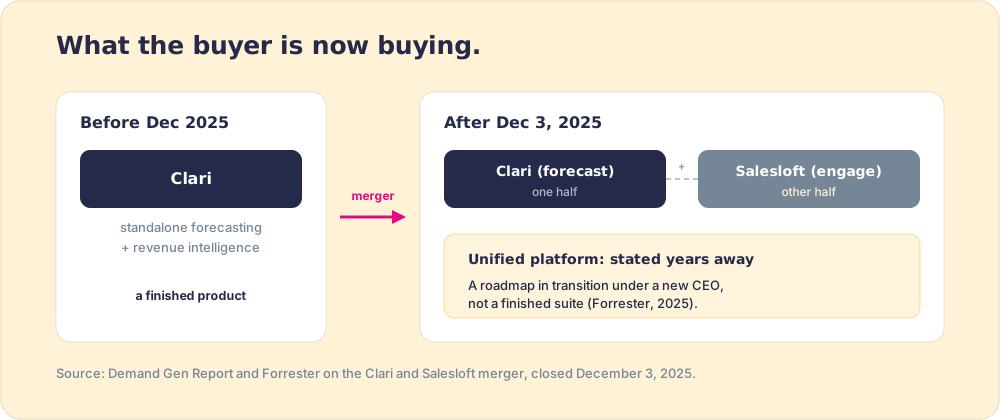
Clari alternatives is a search that changed meaning in December 2025, and most lists have not caught up. The company that owns this category as a standalone forecast platform stopped being standalone: on December 3, 2025, Clari closed its merger with Salesloft, the sales-engagement vendor, folding a forecasting tool and a sequencing tool into one company (Demand Gen Report on the Clari-Salesloft merger). So before we list options, the honest first move is to say what you are weighing them against, because it is no longer the thing it was a year ago.
Clari alternatives are the forecasting and revenue-intelligence tools teams weigh against Clari, a list reshaped by that merger, which turned a standalone forecast platform into one half of a sequencing-plus-forecast suite still years from a unified product. Hold that phrase, still years from a unified product, because it is the reason the comparison is worth doing carefully rather than copying last year’s roundup.
What did the Salesloft merger change about Clari?
It changed what the product is, and therefore what the alternatives are for. Clari built its name as best-of-breed revenue intelligence: ingest the CRM and the activity data, model the pipeline, and predict the number with more discipline than a spreadsheet roll-up. Salesloft built its name on the other end of the motion: cadences, sequencing, the mechanics of reps reaching out. The merged company now holds both, and its stated ambition is one platform that runs from first touch to closed forecast.
That ambition is real, and the data behind it is genuine scale. The combined entity claims to ingest more than ten billion revenue actions and a trillion data signals, and Forrester called the deal a high-stakes bid for go-to-market dominance (Forrester on the Clari-Salesloft merger). The catch sits in the timeline. The joint product is not shipped. Leadership has framed unification as a multi-year effort, and a new chief executive took the seat without founding context in either platform. A buyer in 2026 is not choosing a finished suite; they are choosing a bet on one being built.
This is worth sitting with, because it is the honest case for looking elsewhere, and also the honest case for staying. If you want the forecast horsepower Clari already has and you can wait out the integration, the merger may hand you a broader platform over time. If you want a settled product today, the transition is a reason to weigh alternatives now.
Who are the real Clari alternatives?
Sort the options by the job, not the logo. Most lists of Clari competitors line up the usual forecasting software side by side and let you count features. There are two jobs hiding inside the phrase Clari alternatives, though, and which one is yours decides the shortlist far more than any feature grid.
- Forecasting and revenue intelligence as its own discipline. If you genuinely want a better model of where the number lands, the closest like-for-like options are Gong, whose deal and forecast analytics have widened well past call recording, and BoostUp, a focused revenue-intelligence challenger. Both predict and inspect at the roll-up level the way Clari does.
- Native CRM forecasting. For mid-market teams, the forecast tools already inside HubSpot and Salesforce cover more ground than buyers expect, without a second contract or a second source of truth. The gap is rarely the math; it is the inputs.
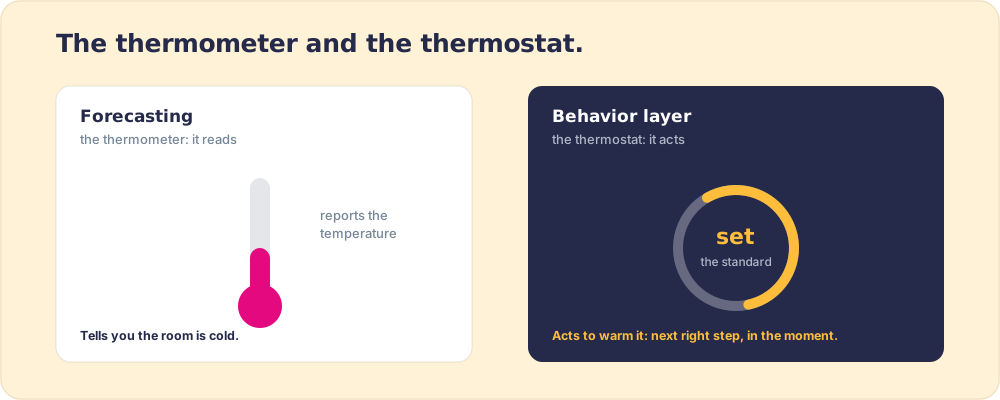
- The behavior job in disguise. Many teams reach for Clari because the forecast keeps missing, and assume the cure is a sharper forecast. The miss usually traces to what reps did or skipped, not to the model. That is a behavior problem, and it belongs to a different category entirely.
The third bullet is the one most roundups never name, so it is the one worth drawing out. A forecast is a reading of a system you have already run. Make it ten percent more accurate and you still have the same deals, run the same way, landing the same place. The lift is upstream, in whether the process was followed at all. Better revenue intelligence software reads the system; it does not change it.
Why do most teams shop Clari alternatives for the wrong reason?
Because the forecast is where the pain shows up, so it looks like the place to fix it. The pain is real: in the State of Sales Enablement, the gap between what top and average reps do on the same process is the single largest performance variable, far larger than any modeling improvement. When the number comes in soft, the instinct is to instrument the prediction harder. But you cannot inspect your way to a different result, you can only inspect your way to seeing it sooner.
There is a named idea underneath this. The economist W. Edwards Deming spent his career arguing that you cannot improve an outcome by managing the outcome; you improve it by managing the process that produces it, and that quality comes from the system, not from inspecting defects at the end (Deming, on the system of profound knowledge). A forecast is end-of-line inspection. It tells you the part is defective after it is made. The lift Deming spent fifty years on lives upstream, in the system that made the part. For a revenue team, the system is the process reps run on each deal, and whether they run it at all.
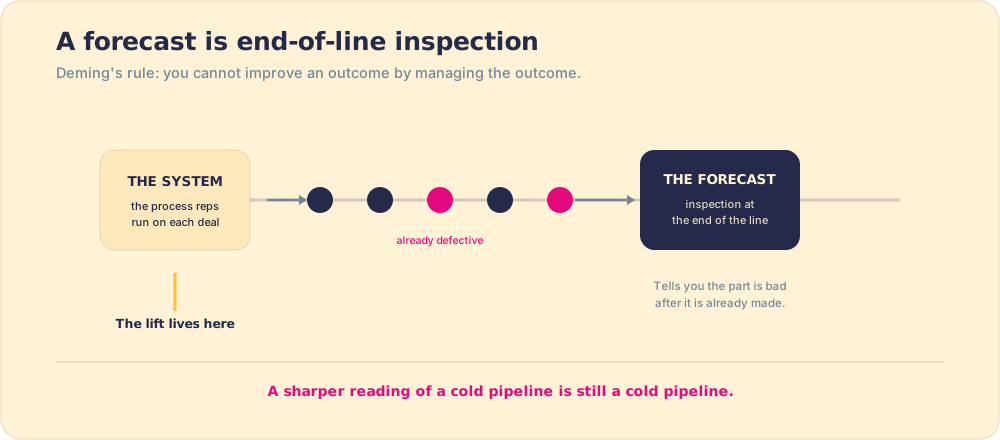
That is the clean branch. If your problem is that you cannot see where the number lands, you want forecasting, and Clari vs Gong is the right fight. If your problem is that the number keeps landing short because deals are run inconsistently, you do not have a forecasting problem, you have an adoption problem, and no forecast tool was built to fix it. This is the same divide we draw in revenue intelligence and in where should your sales process live.
How to choose, and what we recommend
Start with the honest table, then make the branch on the job.
| Clari (post-merger) | Gong / BoostUp | Native CRM forecasting | Behavior layer (Supered) | |
|---|---|---|---|---|
| Core job | Forecast + revenue intelligence | Forecast + deal analytics | Forecast from CRM data | Change what reps do, then measure |
| Best for | Large orgs that can wait out integration | Teams wanting standalone forecast depth | Mid-market on HubSpot or Salesforce | Teams whose forecast misses on adoption |
| Status (2026) | Merged with Salesloft, unifying over years | Gong independent; BoostUp independent | Native to your CRM | Runs inside your CRM |
| What it does not do | Change rep behavior in the moment | Change rep behavior in the moment | Drive adoption of the process | Replace a dedicated forecast model |
Choose Clari if you run a large, complex sales org, you want serious forecasting horsepower, and you can tolerate a multi-year platform integration as the merger plays out. Choose Gong or BoostUp if you want standalone forecast depth without the transition risk. Choose your native CRM forecasting if you are mid-market and the model was never the bottleneck.
Choose a behavior layer if your forecast keeps missing not because the math is wrong but because the deals underneath it were run inconsistently, with discovery skipped and steps missed. That is the case where a better prediction changes nothing and a better-run process changes everything. The merger made the standalone forecasting market noisier and less certain; it did not change the underlying truth, which is that the number is set upstream, by what reps do, before any tool gets to forecast it.
From here: the live moment versus the after-the-fact analysis in conversation intelligence, the home for the process itself in where should your sales process live, and the data on the gap in the sales execution gap.
Frequently asked questions
What are the best Clari alternatives in 2026?+
Why does the Clari Salesloft merger matter when choosing an alternative?+
Is Clari worth it for a mid-market team?+
What is the difference between Clari and a behavior layer like Supered?+
Your process, running itself.