What a CRM Admin Does, According to the First Admin Arena Champion
Crispy Barnett won the first season of the Admin Arena, a competition for HubSpot admins, by playing a better social game and then out-building everyone in the finale. On Becoming Admin he explained what the job of a CRM admin takes, from alliances to keeping builds simple.
A CRM admin is the person who builds and maintains a company's CRM, its properties, workflows, objects and permissions, and who works with sales, marketing and service leaders to turn their requests into systems that still hold up as the company grows.
Crispy Barnett posted on LinkedIn eight seconds after he won the first season of the Admin Arena. “Hate me or love me, you watched me win,” he said. He wears the title “like a badge.” The chain that came with it got stolen, and the hosts brought that up about a minute in.
The Admin Arena is a competition where HubSpot admins solve live challenges in front of each other and vote players out. Lindsey Smith and Cameron Conner had Crispy on Becoming Admin, in the episode “Villain or Visionary?”, and most of what he told them about winning is also about working as a CRM admin: how fast you build, who backs you when a build breaks, and when to keep a build simple.
How did Crispy Barnett become the first Admin Arena champion?
Crispy built and sold his first company, then ran revenue operations and go-to-market work at startups, scale-ups and private equity-backed companies. The hosts’ introduction said his work “centers around simplifying complexity and creating scalable revenue motion that actually holds as companies grow.” These days he builds AI-driven operational systems.
He was rusty going into season one. He had been working on the app partner side and was not in HubSpot every day. “I had to brush off a lot of my previous expertise and kind of revive my own skill set to a certain degree in season 1, and I still beat everyone, which is just like awesome,” he said.
For most of that season he got by on relationships. “I coasted by, where I relied upon my social game to to carry me, and it worked all the way until the end.” On the last day he switched to the build. The finale was an escape-room style challenge, his favorite of the season, and he said it showed “my velocity and how I can operate in HubSpot with speed uh in the right way.”
He came out of it a better admin, by his own account. He is back working with clients inside HubSpot, and he has “directly applied” the systems from season one “to customer use cases and problem sets.” His summary: “you leave the competition as a better admin with the ability to solve greater problems.”
Why does a CRM admin need a social game?
The hosts asked how a reality-show social game carries over to a day job. Crispy started with how admins get treated. “Being an admin is often you you almost get abused to a certain degree in certain business scenarios,” he said. “The thing people point at when something goes wrong is often what the role of an admin is.”
His answer is to build support before anything breaks. “It’s a lot of understanding context, and like the strategic relationships that you build both in the admin arena and in the business world,” he said. You “want to rally troops behind you in whatever setting you’re in to support your own growth, or a business goal, or winning the admin arena.”
Organizational researchers would recognize the advice. In 1993 David Krackhardt and Jeffrey Hanson wrote in Harvard Business Review that “much of the real work of companies happens despite the formal organization,” carried by informal networks of advice and trust that the org chart never shows (Harvard Business Review, 1993). Rob Cross and his co-authors later reported that, in most cases, 20% to 35% of value-added collaborations come from only 3% to 5% of employees (Harvard Business Review, 2016). A CRM admin often lands in that small group, because requests from sales, marketing and service end up on the same desk.
He thinks season two raises the stakes on this. In season one, he said, the social game “was kind of optional,” and the players who lurked in the background got eliminated anyway. In season two, “you have to play the social game. It’s no longer optional.” He also expects his own team to turn on him and lose a challenge on purpose to get him out. “You should be afraid of me,” he said.
What does “be ruthless and curious” mean for an admin?
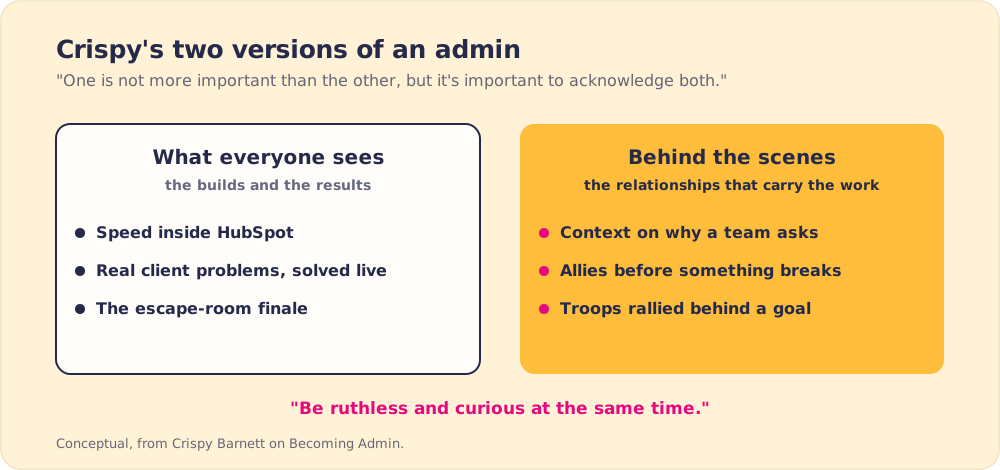
Asked what he would tell someone who wants to play in season three, Crispy said “be ruthless,” laughed along with the hosts, and then added to it: “Be ruthless and curious at the same time.”
He described two versions of yourself in the games. “There’s what the audience and everyone else sees and then there’s the behind the scenes of what the alliances and your relationships look like as well. One is not more important than the other, but it’s important to acknowledge both.”
The hosts brought up that in season one Crispy made a Photoshopped message to convince another player they were on the same team. Crispy pointed to a different record. People often tell him he helped their careers, which he credits to his old job with us or “just like genuine niceties.” Then he undercut himself: “I’m a very nice person generally. But I feel like all villains would say that at the same time.”
One host added a story from our team offsite in Utah, where Crispy and I played something like 20 rounds of ping pong because neither of us would accept losing.
Should a CRM admin build a custom object or a simple workflow?
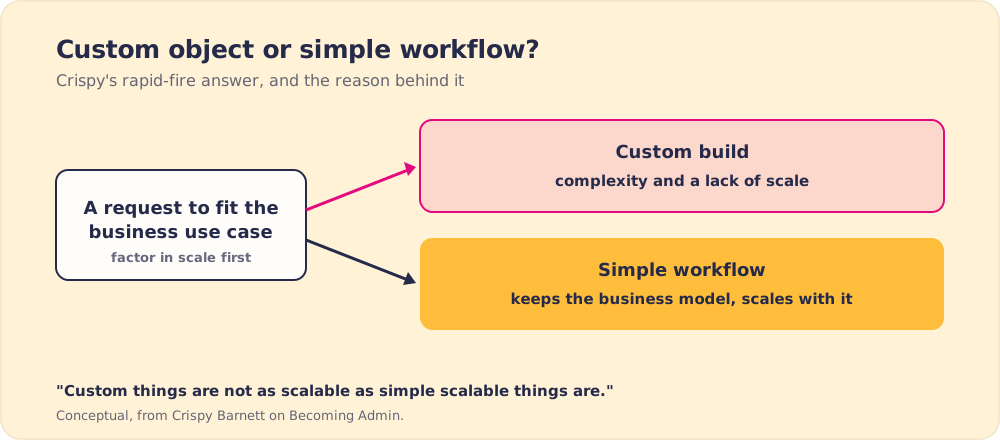
The last question in the rapid-fire round was custom object or simple workflow. “Simple workflow,” Crispy said, and the hosts asked him to explain.
“I think most customers want to over customize uh to fit their business use case and it leads to complexity and lack of scale,” he said. “And I’m not saying sacrifice whatever your business model is, I’m saying factor in scale as you make your decisions and custom things are not as scalable as simple scalable things are.”
There is a price tag, too. In HubSpot, custom objects require an Enterprise subscription (HubSpot Knowledge Base). And a build only helps if reps know it is there. In The State of Sales Enablement 2026, 12% of sales leaders said reps skip the process because they do not know it exists (The State of Sales Enablement 2026). Our guide to CRM adoption goes further into why the simpler system is usually the one people use.
He did ask HubSpot for one big thing. Given a magic wand, Crispy picked CPQ: “an actual quoting engine that has the ability to configure, price, and quote things in real time that has conditional logic built into it.” He has not liked the workarounds he has seen.
“HubSpot, build this,” he said.
What does a CRM admin do, according to the champion?
HubSpot Academy, job boards and agency explainers list the formal duties of a CRM admin: users, properties, workflows, reports, data. Crispy’s answers add these:
- Speed on real problems. The finale rewarded velocity, and his clients do too.
- Allies before the failure. When something breaks, people point at the admin, so the support has to exist already.
- Context first. He wants to know why a team asks for a build before he builds it.
- Simple builds. He factors in scale before any custom object.
- Public proof. He uses the title in his own sales conversations.
The last one came from his answer on what winning means. Crispy said a buyer who hears about a partner badge thinks, “I don’t know what it means to be a partner with HubSpot.” Winning “in a competition against all other major admins in my ecosystem” is something the same buyer understands at once. “That holds weight to it,” he said. “I’ve proven it publicly against others, and I’m going to do it again.”
Who does the champion think could beat him?
He named names. For season two he backed Chris Bryant, a freelancer he has known for about seven years. They used to bid against each other for contracts, and Chris won a lot of them. For season three he picked Jennifer Nixon, now at HubSpot Academy: “Jen is 10 times the person that I am, easily.”
He also wants the format to get harder. His pitch for season three is bracket-style, head-to-head challenges plus open audience voting, “American Idol style,” so a player has to win the crowd as well as the build. “I want to be challenged,” he said.
What should a new CRM admin copy from Crispy?
New admins usually spend their first months proving they can build. Crispy’s season one ran in a different order. He knew the people first, learned what they needed, kept his builds simple, and showed his speed on the day it counted.
That order works outside the games. Meet the sales, marketing and service leads before they have a complaint. Ask why before you build. Pick the workflow over the custom object unless scale says otherwise. Then build fast, and let people see it.
A good share of the questions that land on an admin’s desk come from reps who are not sure what to do next. Supered answers those inside the CRM, showing reps the process the admin built at the step they are on. For the rest of the admin’s job, start with our CRM best practices, and read our piece on tribal knowledge for what happens when the context Crispy talks about stays in one person’s head.
Frequently asked questions
What does a CRM admin do?+
What skills does a CRM admin need?+
Should a HubSpot admin use a custom object or a simple workflow?+
What is the Admin Arena?+
How can a CRM admin prove their skill?+
Your process, running itself.
Turn the playbook into rep behavior.
More from Becoming Admin

Agency vs Freelancer: Erik Hooijer's Case for the HubSpot Collective in Between
Erik Hooijer
CRM Change Management From the HubSpot Kitchen: Kasey Chan's Menu for Admins
Kasey Chan