Amplemarket Review 2026: A Well-Built Car With a Dial for How Much It Drives
Amplemarket earns its 4.6 on G2, and its complaints gather where Duo, its AI, takes the wheel.
An Amplemarket review checked October 2, 2026: ratings by site, the autonomy dial, how to read its numbers, pricing, 2026 changes, and who should buy it.
This Amplemarket review grades Amplemarket, the all-in-one outbound platform that sells a B2B database, multichannel sequences, a deliverability kit and Duo AI from $600 a month for 2 users, on one question: how much of the driving should you hand it.
Most new cars ship with a small dial for how much the car drives itself. At one end, it warns you when you drift and leaves your hands on the wheel. At the other, it holds the lane, keeps the distance and changes speed while you watch. The car is the same at both settings. What changes is how often you need to look up, and who answers for the scrape on the bumper.
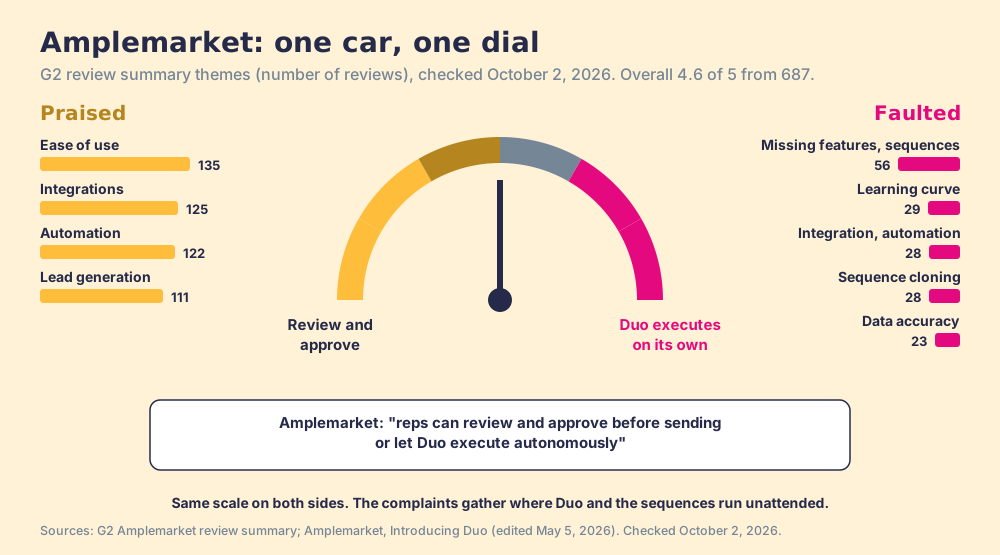
Amplemarket is a well-built car with that dial. It sells a B2B database, multichannel sequences, a deliverability kit and Duo, its AI copilot, in one annual plan that starts at $600 a month for 2 users (amplemarket.com/pricing, October 2, 2026). Duo’s dial is written into Amplemarket’s own launch post: “reps can review and approve before sending or let Duo execute autonomously depending on their preferred level of control” (Amplemarket, introducing Duo). Its reviews are strong, and the complaints gather near the autonomous end. The quick answer, checked October 2, 2026:
- Amplemarket itself. A good buy for a team that wants data, sending and AI in one annual contract and will keep a human reading Duo’s drafts. $7,200 a year for 2 users on Startup.
- Supered Prospector. The pick for a team that already pays for Clay and whose problem is the data half: Clay’s waterfall across 200+ vendors from where reps sell, beside your sales engagement tool. $45 per rep per month, billed annually.
- Apollo. The like-for-like bundle at a lower list price, from $49 a seat a month billed annually.
This Amplemarket review grades Amplemarket, the all-in-one outbound platform that sells a B2B database, multichannel sequences, a deliverability kit and Duo AI from $600 a month for 2 users, on one question: how much of the driving should you hand it.
What do Amplemarket reviews say?
Mostly that the car is pleasant to drive. G2’s review summary tags 135 reviews for ease of use, 125 for integrations, 122 for automation and 111 for lead generation (G2, Amplemarket reviews, October 2, 2026). The recent praise is about signals and drafting. “The signals feature is where it really shines,” an enterprise business developer wrote on September 3, 2026. An SDR, a week later: “now I can describe the campaign and get a fully drafted cadence.” A team leader in August: “spam and bounce numbers went down like crazy.”
The complaints come from the same reviewers, often in the same review, and they sit where the human hands over the wheel.
- Sequences that misbehave. G2’s summary tags 56 reviews for missing features and sequence management and 28 for “sequence issues with cloning, automation failures, and inactivity settings.” The enterprise developer who praised signals added: “Sometimes, the messaging settings and Duo Copilot sequences needs to be reviewed.”
- Signals that need tuning. “Sometimes the signals are off,” the SDR wrote. The team leader: “The configuration of the signals…the prompting is a bit tricky.” G2’s summary quotes reviewers who find messages “a bit robotic, so better to check.”
- Data the rep cannot find. The summary tags 23 reviews for incorrect phone numbers. A senior business developer in July 2026 named “Not finding an email or phone number” as his complaint. A Capterra reviewer was blunter: “Bad data quality, cannot rely on the database” (Capterra, Amplemarket).
- A learning curve and thin support. “There can be a bit of a learning curve when first getting started,” an EMEA business development lead wrote in July 2026. A small-business user the same month: “Customer support is not as good…they do not do trainings often.”
Why are there so few Amplemarket reviews outside G2?
Because nearly all of them live on G2: 687 of the 715 reviews across these four sites. Amplemarket on each, all checked October 2, 2026:
| Where | Rating | Reviews | Note |
|---|---|---|---|
| G2 | 4.6 of 5 | 687 | The record: G2’s summary is built on these |
| TrustRadius | 8.3 of 10 | 21 | ”sometimes it’s wrong” on ICP selection, October 2025 |
| Capterra | 4.6 of 5 | 7 | Customer service 5.0 |
| Trustpilot | none | 0 | Unclaimed profile |
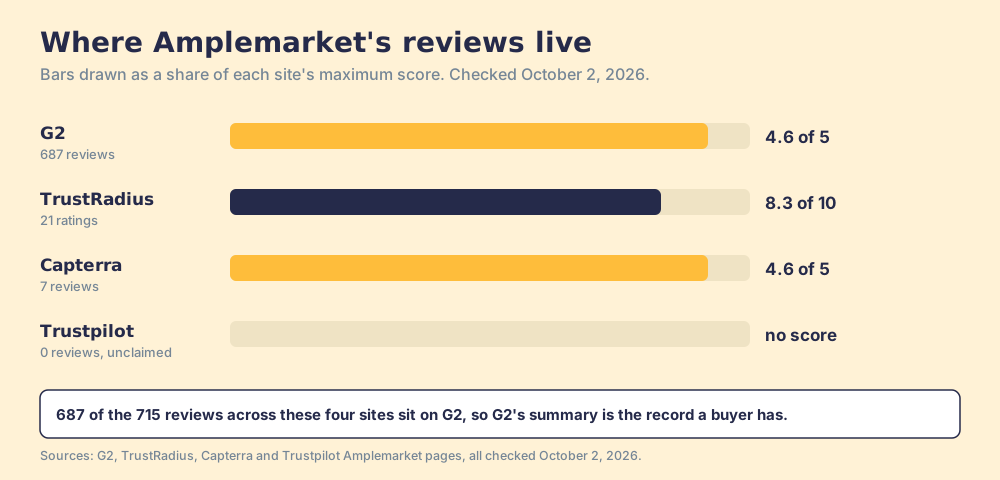
Two readings follow. The scores agree: 4.6 on G2 and Capterra and 8.3 out of 10 on TrustRadius tell one story. And the record is thin outside one site, so G2’s own counts are the evidence a buyer has. Read the three-star reviews there before the five-star ones; they carry the operating detail. The empty Trustpilot page is also a difference worth noting beside the data brokers on the LeadIQ review and the Lusha review, where the people inside the database leave the one-star reviews.
What does Amplemarket Duo do, and how much should you let it drive?
Amplemarket’s own list for Duo is long. It “scans dozens of relevant signal types,” from prospects “evaluating another product in your space” and “people writing bad G2 reviews about one of your competitors” to “past customers who have moved to new companies.” It “drafts multi-channel outreach plans personalized to each prospect.” And it “can automatically: Find your best-fit accounts and prospects; Send emails; Schedule meetings; Handle objections; Push follow-ups; Create AI voice messages.” Duo Copilot, Copywriter, Signals and Competitive Intelligence are on every plan; Duo Voice starts on Growth; Duo Inbox is an Elite add-on.
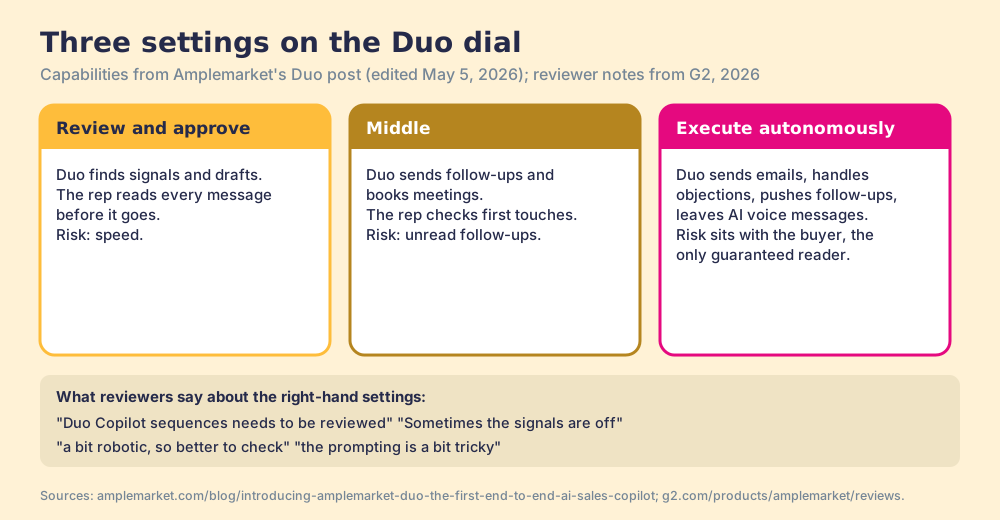
The dial is where the buying decision sits, and the reviews show why. At the review-and-approve end, Duo is a research assistant with good taste in signals, and the rep’s judgment rides along on every message. Turn the dial and the rep reads less. At the far end, the buyer is the only person guaranteed to read every email Duo sends, and a G2 reviewer has already told you some of them come out “a bit robotic.” The car picture has an edge here. A car’s lane assist answers to physics and a painted line. Duo answers to your prompts, your signal settings and your ICP, which reviewers describe as “a bit tricky” to configure.
So the useful question for a trial is narrow. Can a manager see, buyer by buyer, which messages Duo wrote and sent, which a rep approved, and which ones turned into meetings? AI earns more of the wheel only when you can inspect what it did at the level of the single buyer interaction. Ask Amplemarket to show that view in the trial, with your own sequences. The AI SDR page walks the same question across the category.
How should you read Amplemarket’s numbers?
Carefully, the way you read the fuel-economy sticker on a new car: as a figure measured under conditions you will never drive in. Amplemarket’s homepage, read October 2, 2026, says “Boost opportunity rates 3x,” “Reduce bounce rates by 50%,” “5x increase in interest rates,” “Get up to 100% more replies,” “Boost meetings booked by 60%” and “Save 10 hours on research” (amplemarket.com). The page gives no study, sample or baseline next to those figures. Its Apollo comparison page claims a “<3% email bounce rate” against 25 to 35 percent for Apollo (amplemarket.com/competitors/apollo). Those are a vendor’s claims about itself and a rival.
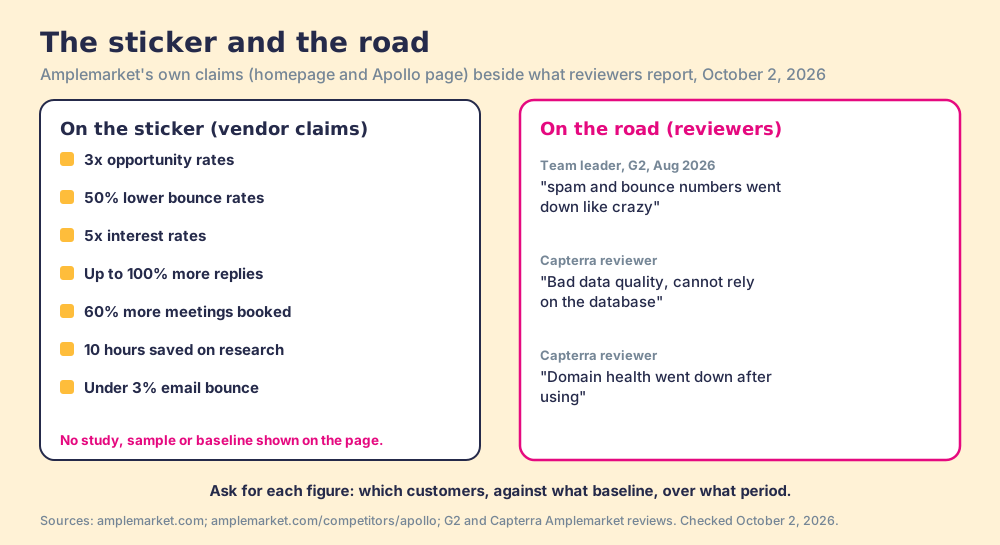
The reviews on the road point both ways. The team leader saw bounces fall. A Capterra reviewer wrote that “Domain health went down after using, you have to keep a close eye on that.” Both can be true on different domains with different lists. Before you sign, ask for each headline figure’s customers, baseline and time period, then run the trial on one of your own segments and measure bounce, reply and meeting rates against your current tool.
What does Amplemarket cost?
Startup is “$600/mo annual term” with 2 users, 27,000 contacts, 13,500 email credits and 600 phone credits per user per year and 2 mailboxes per user. Growth (4 users, 5,000 phone credits per user per year) and Elite (10 users, 9,600) are custom. “All plans include a free trial,” and an MCP that lets you “Prospect, research, and take action in Claude or ChatGPT” is an add-on. Vendr puts the median contract at $16,608 a year, in a range from $11,678 to $35,946, and its notes say the company “only offers upgrades (not downgrades)” (Vendr, Amplemarket).
At list, Startup is $3,600 per user per year, and 600 phone credits is 50 numbers a month per user. The Amplemarket alternatives page works the per-phone and team arithmetic in full and sets it against Apollo’s $49 seat.
What changed at Amplemarket in 2026?
Amplemarket is private and independent; its last announced raise was “$12M in back-to-back Seed and Series A” in April 2022 (Amplemarket), and a news search on October 2, 2026 found no acquisition. Its product notes for August 2026, published September 18, added a Grok connector, a Parallel Dialer that “calls several prospects at the same time,” contact edits that sync back to Salesforce or HubSpot, tasks you can manage through its MCP, CRM sync for one-off emails, and a Gong integration (Amplemarket, August 2026 updates).
The integration list matters for fit. Amplemarket’s integrations page lists a two-way Salesforce sync and a HubSpot sync; for Pipedrive it says “Connect via Zapier for lead sync and workflow triggers” (amplemarket.com/integrations). It also lists Clay, under automation and middleware.
Why trust this Amplemarket review?
I started RevPartners, a HubSpot partner that did only sales implementations, sold roughly twice as much Sales Hub as any other partner, and reached Elite tier in 13 months. Supered came out of that work and is the #1 sales enablement app on the HubSpot marketplace, rated 5.0 from 122 reviews there and 4.9 from 81 on G2 (both checked October 1, 2026). The disclosure: we make Supered Prospector, which competes with Amplemarket’s data half for teams on Clay, and it ranks first below for that job only.
How does Amplemarket compare with the alternatives?
The lens is a team of ten to fifty reps that wants contact data reps will use where they sell, and a leader who can see which lists turn into pipeline. Each tool is scored 1 to 5 and weighted: coverage (x3), rep-side delivery (x2), price structure (x2), what the leader sees after the export (x2), bundled outreach (x1), out of 50. The scores match the Amplemarket alternatives page.
| Rank | Tool | Grade | Score | Best fit | CRM integration | Setup effort | Pricing | Reason to switch from Amplemarket |
|---|---|---|---|---|---|---|---|---|
| ref | Amplemarket | B+ | 30 | Teams wanting data, sending and AI in one annual contract | Native (Salesforce two-way, HubSpot); Pipedrive via Zapier | Days, with onboarding | $600 a month for 2 users, annual; Growth and Elite custom | Stay if one handle and Duo are the point |
| 1 | Supered Prospector | A | 44 | Teams on Clay whose problem is the data half | Native (HubSpot, Salesforce, Pipedrive) | Under a week on an existing Clay account | $45 per rep per month, billed annually, plus your Clay plan | 200+ vendors per lookup, Pipedrive native, lists followed to closed |
| 2 | Apollo | A- | 36 | The like-for-like bundle at a lower list price | Native (HubSpot, Salesforce) | A day | $49 / $79 per seat per month, billed annually | A sixth of the per-user list price |
| 3 | Instantly | B | 26 | The sending half on a small budget | API and integrations | A day | Outreach plans from $47 a month | Cheap sending, unlimited mailboxes and warmup |
Amplemarket’s 30 is coverage 3, rep-side delivery 3, price 2, what the leader sees 3, outreach 5. The outreach 5 is earned: sequences, a dialer and a deliverability kit on every plan. The price 2 is the 2-user floor, the annual term and custom tiers. Prospector’s coverage score is Clay’s waterfall, credited to Clay, and its outreach score is the lowest on the card on purpose: it sends nothing.
Where does Supered Prospector fit?
Clay plus Supered is the best way for a sales team to prospect: GTM engineers build in Clay, reps never open Clay. Prospector runs inside the Supered Chrome extension, on the team’s own Clay account. It does not bring its own database. It brings Clay’s waterfall, which is every database, routed, across 200+ data and AI vendors (clay.com, checked October 2, 2026), and “If an enrichment returns no result, you’re not charged Data Credits or Actions” (clay.com/pricing). We chose Clay as our only data provider for that reason.
In the car picture, Prospector is the fuel line, not a second car. It fills the tank from 200+ pumps and hands the contact to whatever you drive, the CRM and your sales engagement tool.
- The GTM engineer. Builds named flows once, each a Clay table or function with a destination, and stops being the list desk. Start from the Supered Clay template or bring your own tables.
- The rep. The table as a button on a LinkedIn profile, a company website or a HubSpot, Salesforce or Pipedrive record. Before pushing, the rep sees the matching CRM record, its owner and whether the prospect was worked before.
- The leader. Found, Worked, Closed: which lists reps found, who is working theirs, and how each lead ended the way your process says, Qualified, Recycled or Disqualified. The manager watches the list become pipeline and coaches from what is converting.
Prospector works within LinkedIn’s terms and does not copy search results in bulk; the contact data comes from Clay’s waterfall on the customer’s Clay account.
On price, Clay Growth lists at $495 a month, or $5,940 a year, and Prospector is $45 per rep per month billed annually (Prospector). Two reps come to $7,020 a year, against $7,200 for Amplemarket Startup, and adding Instantly’s $47-a-month sending plan brings it to $7,584. At two reps the bundle and the split cost about the same. What the split buys is every source behind each lookup and lists you can follow to closed; what it gives up is Duo.
Choose something else if you do not have Clay; Prospector does nothing without a Clay account, and someone has to build the tables. RevPartners, a Clay Elite Studio Partner that I founded, does that work, as do other Clay partners. Choose something else, too, if your reps live in Amplemarket’s sequences and the data is fine. Prospector sends no email, warms no mailbox and drafts nothing. The sourcing use case shows how a team on Clay sets it up.
Which should you choose?
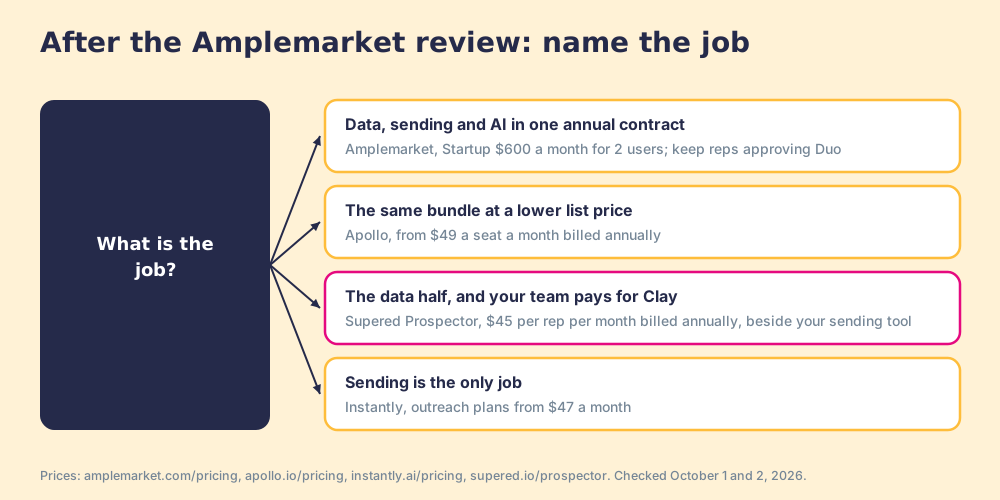
- Amplemarket, bought. The pick for a team that wants data, sending and Duo in one annual contract and will keep reps approving Duo’s first touches until the trial proves otherwise. Negotiate in December, January or March, by Vendr’s notes.
- Apollo. The pick for the same bundle at a lower list price. The Apollo alternatives page grades it.
- Supered Prospector. The pick when the team already pays for Clay and the data half is the problem, with sending left to the tool you already run.
- Instantly. The pick when sending is the only job.
My recommendation follows the dial. Amplemarket earns its 4.6: reviewers like the car, and the complaints are the ordinary ones of a platform that does a great deal, plus the ones that come from letting AI write to buyers. If you buy it, buy it for the review-and-approve end first, and turn the dial only as far as you can inspect what Duo sent, buyer by buyer. If the reason you are reading Amplemarket reviews is the phone number that never arrives, a better car will not help. Fill the tank from 200+ sources, let reps reach them from the page they are on, and follow each list to closed. A Prospector demo on your own Clay account shows how.
Frequently asked questions
Is Amplemarket any good?+
What is Amplemarket Duo?+
How much does Amplemarket cost?+
Does Amplemarket have a Chrome extension?+
Does Amplemarket integrate with HubSpot, Salesforce and Pipedrive?+
Is there a better option than Amplemarket for a team on Clay?+
Everything we have written on Amplemarket
More on Amplemarket
Looking past Amplemarket? See Supered Prospector on your own Clay accountYour Clay waterfall, where reps already work.