Amplemarket Alternatives in 2026: Which Blade on the Knife Went Dull?
Amplemarket sells data, sequences, deliverability and AI as one annual knife. Here are the Amplemarket alternatives graded for a mid-market team, Amplemarket pricing worked out per rep and per phone, Amplemarket vs Apollo in numbers, and the unbundled route for teams on Clay.
Amplemarket alternatives are the tools teams weigh against Amplemarket's all-in-one outbound platform (data, sequences and Duo AI from $600 a month for 2 users): bundles like Apollo and ZoomInfo, or Clay's waterfall across 200+ vendors run from Supered Prospector.
A Swiss Army knife is a lovely thing to carry and a strange thing to cook dinner with. The blade, the corkscrew, the scissors and the little saw all fold into one red handle, which is the point of it. And when the blade goes dull, you do not send the blade out for sharpening. You buy another knife, or you buy a kitchen knife and keep the corkscrew in the drawer.
Amplemarket alternatives come up for the same reason. Amplemarket is a well-made knife: a B2B database, multichannel sequences, a deliverability kit and Duo, its AI, folded into one annual plan that starts at $600 a month for 2 users (amplemarket.com/pricing, October 2, 2026). Teams start looking when one blade dulls, and the right alternative depends on which one. The short answer, graded in full below:
- Supered Prospector. For teams that already have Clay and whose problem is the data: Clay’s waterfall across 200+ vendors, run by reps from a LinkedIn profile, a Sales Navigator list, a company website or the CRM record, at $45 per rep per month billed annually, beside your sales engagement tool.
- Apollo. The closest like-for-like bundle, with data, sequences and a dialer from $49 a seat a month on annual billing.
- Instantly. For a team whose problem is the sending half, with outreach plans from $47 a month.
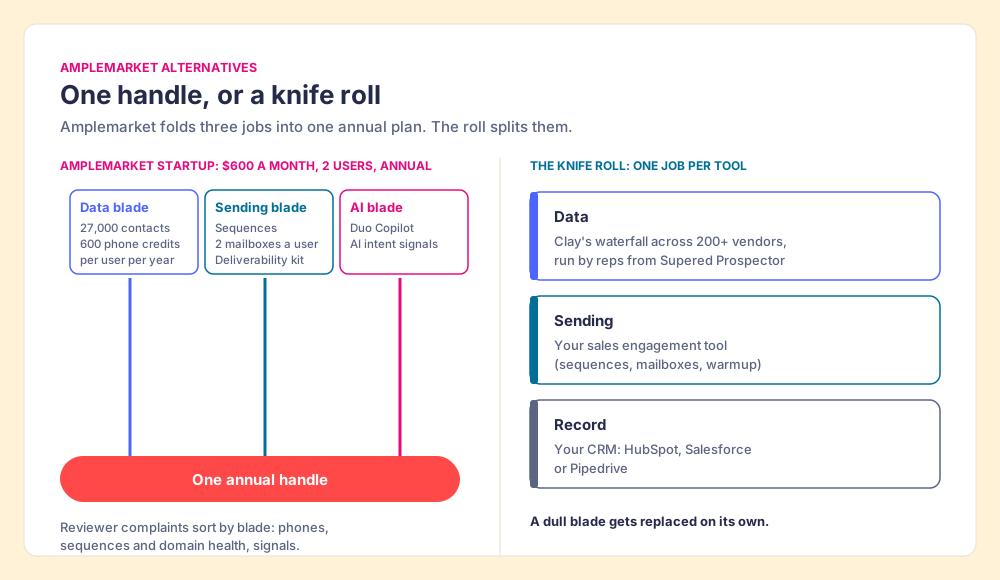
Amplemarket alternatives are the tools teams weigh against Amplemarket’s all-in-one outbound platform. They come in two shapes. Other knives: bundles like Apollo and ZoomInfo that sell data and sending together. Or a knife roll: the data job handed to Clay’s waterfall across 200+ data and AI vendors (clay.com, September 25, 2026), run by reps from Supered Prospector, and the sending job handed to a sales engagement tool. This page grades both shapes on the same jobs as the Apollo alternatives page and the LeadIQ alternatives page, works Amplemarket pricing out to the price of one phone number, and sorts the alternatives by the blade that went dull.
Why do teams look for Amplemarket alternatives?
Amplemarket holds 4.6 out of 5 from 687 reviews on G2, checked October 2, 2026 (G2, Amplemarket reviews), which is a good score for a product that does this much. G2’s review summary groups the complaints by theme, and they sort neatly by blade.
- The data blade. G2’s summary tags 23 reviews for “incorrect phone numbers,” and a Capterra reviewer wrote “Bad data quality, cannot rely on the database” (Capterra, Amplemarket). One database has one set of gaps, and a rep who hits one has nowhere else to look inside the plan.
- The sending blade. The summary tags 28 reviews for “sequence issues with cloning, automation failures, and inactivity settings.” A Capterra reviewer: “Domain health went down after using, you have to keep a close eye on that.” An enterprise BD reviewer on G2 in September 2026: “Unable to detect profiles #opentowork, and being targeted in sequences.”
- The AI blade. “Sometimes the signals are off,” an SDR wrote on G2 in September 2026, and a team leader in August: “The configuration of the signals…the prompting is a bit tricky.” The summary quotes reviewers finding messages “a bit robotic, so better to check” before sending.
- The handle itself. The summary tags 56 reviews for missing features, 29 for the learning curve and 24 for “integration issues with CRM.” And the handle is sold by the year: Startup is “$600/mo annual term,” and Vendr’s buyer notes say Amplemarket “only offers upgrades (not downgrades)” (Vendr, Amplemarket).
A knife with a dull blade is still a good corkscrew. If the sequences work and the data is the trouble, the cheapest fix may be a new blade beside the handle you already own, which is a different purchase from a new knife.
Why trust this comparison?
I started RevPartners, a HubSpot partner that did only sales implementations, sold roughly twice as much Sales Hub as any other partner, and reached Elite tier in 13 months. Supered came out of that work and is the #1 sales enablement app on the HubSpot marketplace, with 4.9 out of 5 from 81 reviews on G2 and 5.0 from 122 on the HubSpot App Marketplace (October 1, 2026). That is also the disclosure. We make Supered Prospector, and it sits first on this page for teams that have Clay and a data problem. The grading states its weights so you can flip them, and the flip for a team that wants one tool for everything puts Apollo and Amplemarket on top.
The Amplemarket alternatives, graded
A ranking that hides its math is an advertisement. The lens is a mid-market or SMB team, ten to fifty reps, that needs contact data reps will use where they already work and a leader who can see which lists turn into pipeline. Each criterion is scored 1 to 5 and multiplied by its weight, for a maximum of 50. The scores for Apollo, ZoomInfo, LeadIQ and Prospector are the ones used on the Kaspr and Apollo pages, so the pages read together.
| Criterion | Weight | What it rewards |
|---|---|---|
| Coverage of the contact you need | 30% (x3) | Verified emails and mobiles when the first source misses |
| Rep-side delivery | 20% (x2) | Works on the profile, the company site, the CRM record; no new tab or login |
| Price structure for mid-market | 20% (x2) | Published, per-result or per-seat, no seat floor, no lock-in past the term |
| What the leader sees after the export | 20% (x2) | Which sourced lists were worked and which closed, by your definitions |
| Bundled outreach | 10% (x1) | Sequencing, mailboxes, dialer, drafting in the same plan |
| Rank | Tool | Grade | Score | Best fit | CRM integration | Setup effort | Pricing (plan with the feature) | Reason to switch from Amplemarket |
|---|---|---|---|---|---|---|---|---|
| ref | Amplemarket | B+ | 30 | Outbound teams that want data, sending and AI in one annual plan | Native (Salesforce two-way, HubSpot); Pipedrive via Zapier | Days, with onboarding | $600 a month for 2 users, annual; Growth and Elite custom | Stay if the sequences and deliverability are what you pay for |
| 1 | Supered Prospector | A | 44 | Teams that already have Clay | Native (HubSpot, Salesforce, Pipedrive) | Under a week on an existing Clay account | $45 per rep per month, billed annually, plus your Clay plan | 200+ vendors per lookup, any page the rep is on, lists you follow to closed |
| 2 | Apollo | A- | 36 | Small teams wanting data plus outreach in one | Native (HubSpot, Salesforce) | A day | $49 / $79 per seat per month, billed annually | Same bundle, a fraction of the per-seat price |
| 3 | ZoomInfo | B | 28 | North American enterprise depth and intent | Native (HubSpot, Salesforce, Dynamics) | Weeks | Quote only; Vendr median $33,500 a year | US depth, for teams with the seats for a platform fee |
| 4 | LeadIQ | B | 27 | SDRs capturing straight into Outreach or Salesloft | Native | A day | Free; Pro and Enterprise by quote or slider | Capture-to-sequencer workflow |
| 5 | Instantly | B | 26 | Cold email at volume on a small budget | API and integrations | A day | Outreach from $47 a month | Unlimited mailboxes and warmup for less than one Amplemarket seat |
| 6 | Outreach | C+ | 22 | Enterprise sequencing with your own data | Native | Weeks | Quote only; Vendr median $45,600 a year | The sending blade at enterprise grade, no database |
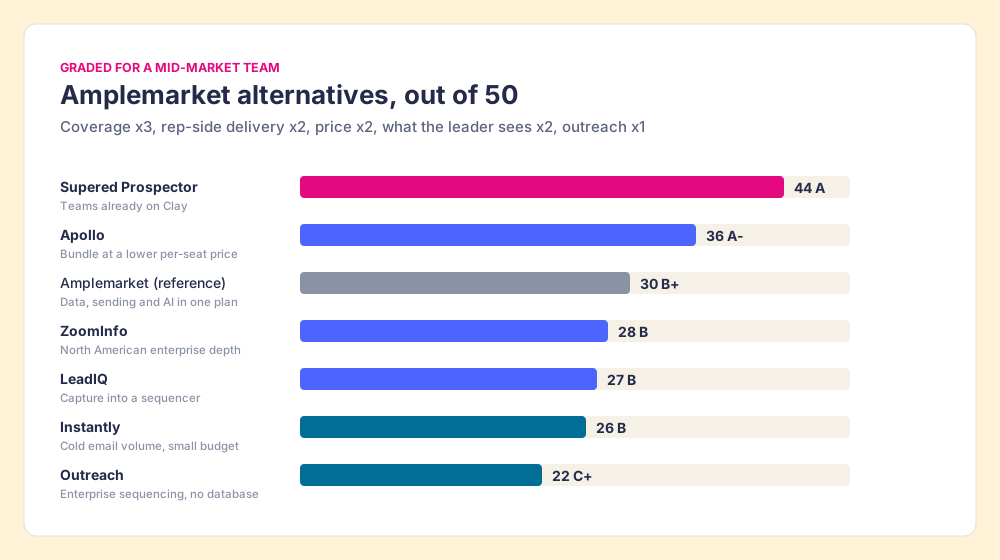
Amplemarket’s 30 breaks down as coverage 3, rep-side delivery 3, price 2, what the leader sees 3, outreach 5. The outreach 5 is earned: sequences across channels, a dialer, “Domain Health Center,” warmup, a spam checker and mailbox recommendations sit on every plan. The leader’s 3 is the outbound analytics, which a G2 reviewer called “a little clunky.” The price 2 is the 2-user floor, the annual term, and custom pricing above Startup. Prospector’s coverage score is Clay’s waterfall coverage, credited to Clay, and its outreach score is the lowest on the card on purpose: it sends nothing. If one tool for everything decides it for you, this page’s ranking is not your ranking.
Corporate status, checked October 2, 2026. Amplemarket is private and independent; its last announced raise was “$12M in back-to-back Seed and Series A” co-led by Comcast Ventures and Armilar (Amplemarket, April 2022), and no 2026 acquisition was found. Outreach is independent. Salesloft and Clari now operate as one company under the Salesloft name (GlobeNewswire, September 2, 2026). ZoomInfo is public (Nasdaq: GTM) and in May 2026 approved a restructuring of about 600 roles to accelerate “our move upmarket” (SEC Form 8-K). Apollo, LeadIQ and Instantly are independent.
What does Amplemarket cost in 2026?
Amplemarket pricing is published for one plan and quoted for two. The page says “All plans include a free trial,” and every plan runs on an annual term. Captured October 2, 2026:
| Plan | Price | Users included | Contacts | Email credits per user per year | Phone credits per user per year | Mailboxes per user | Job change alerts |
|---|---|---|---|---|---|---|---|
| Startup | $600 a month, annual term | 2 | 27,000 | 13,500 | 600 | 2 | 500 contacts |
| Growth | Custom | 4 | 140,000 | 35,000 | 5,000 | 4 | 1,000 contacts |
| Elite | Custom | 10 | 400,000 | 40,000 | 9,600 | 8 | 2,000 contacts |
Growth adds Duo Voice and a dedicated CSM; Elite adds Duo Inbox. An MCP for Claude or ChatGPT is listed as an add-on. Three things in the numbers change the arithmetic.
- The per-user price on Startup. $600 a month for 2 users is $7,200 a year, or $3,600 per user. Additional users are “available to purchase” at a price the page does not print.
- The phone allowance. 600 phone credits per user per year is 50 numbers a month. The Bridge Group’s 2025 SDR report, 351 companies, puts the median SDR at 44 dials a day (Bridge Group, 2025). Suppose, for the arithmetic only, that each dial needed a freshly revealed number: Startup’s month would last a little over one working day. Reps redial, so the real burn is slower, and Growth’s 5,000 a year (about 417 a month) and Elite’s 9,600 (800 a month) change the picture. Amplemarket’s own pricing explainer lists extra phone credits at “$0.50 each” (Amplemarket pricing blog, March 5, 2026).
- The numbers move. That same March explainer lists Startup at 15,000 email credits and 480 phone credits per user per year. The live page in October lists 13,500 and 600. Neither is wrong for its date. Get your allowance in the order form.
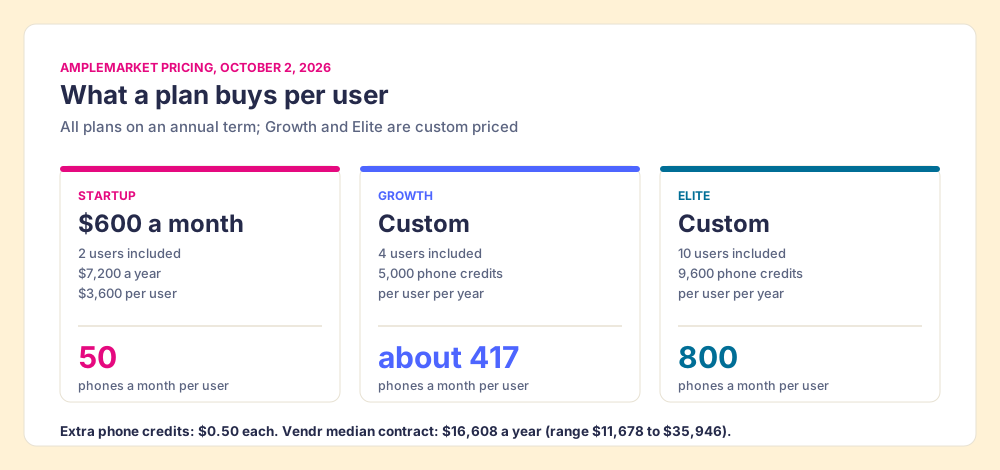
What buyers pay sits on Vendr: a median contract of $16,608 a year, in a range from $11,678 to $35,946, from what Vendr labels 2025 pricing data. The best months to negotiate, by Vendr’s notes, are December, January and March. Amplemarket’s own pricing page carries the pitch that explains the price: customers “migrated off Apollo,” “off Outreach,” “off ZoomInfo + Outreach,” and one director says consolidating into Amplemarket “cut tooling costs by about 56%.” Consolidation is the product. The question for a buyer is whether one vendor’s database is the blade you want to consolidate onto.
Amplemarket vs Apollo: which bundle is the better buy?
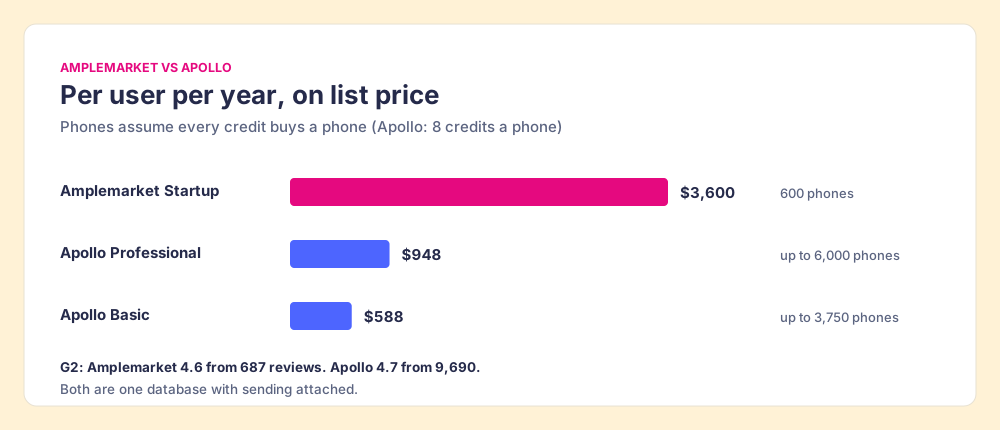
These are the two most similar knives in the drawer, and Amplemarket knows it: its competitor page for Apollo claims a “<3% email bounce rate” against 25 to 35 percent for Apollo, and “$0 credit traps,” while Apollo phone reveals “cost 5 to 8 credits each” (amplemarket.com/competitors/apollo). Those are a vendor’s claims about a rival, and the credit-trap line sits oddly beside Amplemarket’s own 600 phone credits per user per year and its $0.50 top-ups. What each vendor publishes about itself, side by side:
| Amplemarket Startup | Apollo Basic | Apollo Professional | |
|---|---|---|---|
| List price per user per year | $3,600 (2 users, $7,200) | $588 | $948 |
| Phones per user per year (if every credit bought a phone) | 600 | 3,750 | 6,000 |
| Emails per user per year | 13,500 | Up to 30,000 credits, 1 per email | Up to 48,000 credits, 1 per email |
| Sequences and dialer | Yes, plus deliverability kit | Yes | Yes |
| G2 | 4.6 from 687 | 4.7 from 9,690 | same |
| Source | amplemarket.com/pricing, Oct 2, 2026 | apollo.io/pricing, Oct 1, 2026 | same |
Apollo’s numbers come from its pricing page, where Basic is $49 and Professional $79 a seat a month billed annually, with 30,000 and 48,000 credits per seat per year, an email at 1 credit and a phone at 8 (apollo.io/pricing, October 1, 2026). Apollo’s credits “are pooled across your entire team” and “do not roll over if unused.” Apollo’s own pricing calculator plans on an 88% email match rate and an 81% phone match rate, which are planning assumptions it publishes, not measured results.
On price, Apollo wins by a factor of six per user. On sending, Amplemarket’s case is the deliverability kit and the contact-level signals it ships on every plan. Neither changes the shape of the purchase: both are one database with sending attached, and when the number you need is not in the database, the rep is stuck inside the same handle. The Apollo alternatives page grades Apollo in its own lane.
The other Amplemarket competitors, one at a time
- Instantly. The sending blade on its own, cheap and sharp. Outreach plans start at $47 a month with unlimited email accounts and unlimited warmup, 5,000 emails and 1,000 uploaded contacts a month on Growth, and a separate lead database of “450M+ B2B Leads” with waterfall work-email enrichment across “5+ providers” (instantly.ai/pricing, October 2, 2026). Its 2026 benchmark report found that “58% of all replies are generated from step one” (Instantly, 2026), which says something about where outbound results come from: the list and the first touch. Read the Instantly and Clay integration page for the pairing.
- Outreach. The enterprise sequencer, 4.3 out of 5 from 3,643 G2 reviews (October 1, 2026), a Vendr median of $45,600 a year across 917 purchases (Vendr, Outreach), and no database of its own. Salesloft is the same lane, now merged with Clari.
- ZoomInfo. The warehouse club: deep North American data, intent, quote-only, a Vendr median of $33,500 a year across 1,573 purchases (Vendr, ZoomInfo), and a company that has told the SEC it is moving upmarket.
- LeadIQ. Built for the SDR who captures on LinkedIn and pushes straight into Outreach or Salesloft. Its pricing page lists a Free plan with 50 credits, an email at 1 credit and a phone at 10 (leadiq.com/pricing, October 2, 2026). The LeadIQ alternatives page grades it on its own.
Where does Supered Prospector fit?
Clay plus Supered is the best way for a sales team to prospect: GTM engineers build in Clay, reps never open Clay. That is our claim, and it rests on what Clay is.
Clay is a knife roll: 200+ blades from different makers, and a rule for using them. A waterfall is a list of instructions the GTM engineer writes down: ask this provider first, then that one, stop when a verified email or phone comes back. “Clay’s signature data waterfalls check multiple providers to return the most verified emails (lower bounce rate) and phone numbers (higher connect rate)” (Clay, rep prospecting, September 25, 2026). And “If an enrichment returns no result, you’re not charged Data Credits or Actions” (clay.com/pricing, October 1, 2026). The blade that finds nothing costs nothing, and the roll reaches for the next.
Prospector does not bring its own database. It brings Clay’s waterfall, which is every database, routed. We chose Clay as our only data provider for that reason, and it is why Clay is not a row in the tables above. Clay is the row that contains the other rows. Of course, a knife roll is only a picture. Somebody has to build the waterfall and the tables, and the roll does nothing in a drawer the reps never open. Prospector is how the reps reach it, on the team’s own Clay account, from inside the Supered Chrome extension.
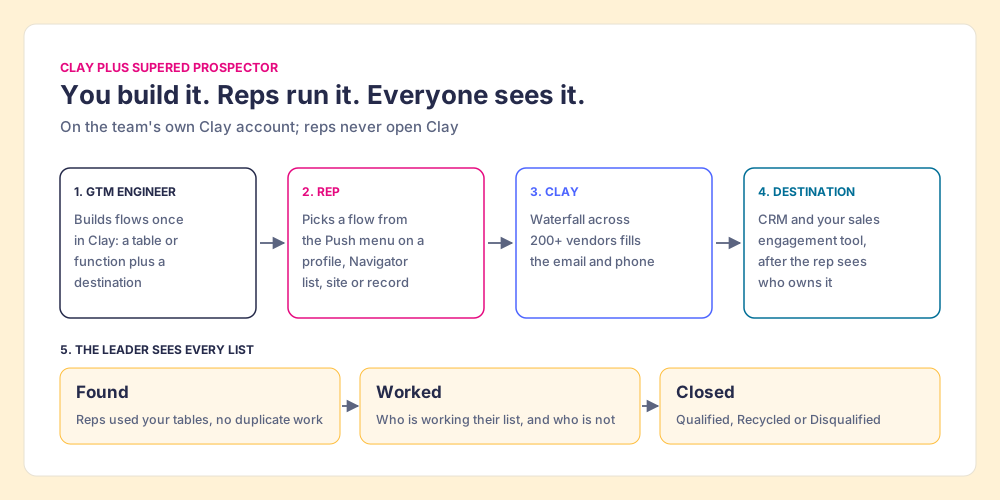
What changes, by the three people who touch it:
- The GTM engineer. Builds named flows once, each mapped to a Clay table or function (person enrichment, a buying committee) and a destination (the CRM on the account, or a sequence). “Your logic stays yours: waterfalls, tiers, tags, and sequence variables.” Start from the Supered Clay template or bring your own tables. The engineer stops being the list desk.
- The rep. Gets the team’s table as a button on a LinkedIn profile, a company’s website, or a HubSpot, Salesforce or Pipedrive record, picks the flow from a Push menu, and sends the result to the CRM and the sales engagement tool. On Sales Navigator, the rep adds leads to a prospect list and pushes the list to a Clay table. Before pushing, the rep sees the matching CRM record, who owns it, and a “Prospected 1 other time” style flag, so two reps do not work the same person.
- The leader. Sees every list as Found, Worked and Closed. Found: reps used your tables, with no duplicate work. Worked: who is working their list, and who is not. Closed: every lead ends the way your process says, Qualified, Recycled or Disqualified. The Clay budget grows from there.
The plays map onto what Amplemarket users already run. Research on a target account pulls everyone who signs off, using the buying committee your team defined. New logos: the rep picks the campaign on any lead and the table loads the sequence. Expansion finds the rest of the team at a customer. Job changers, the play Amplemarket sells as job change alerts on 500 contacts at Startup, pushes a past champion and their new team into a sequence (Clay lists job changes among its outbound signals, beside hiring, funding and web visits; see job change tracking). Stalled deals: add the economic buyer and two peers before the forecast call.
On LinkedIn’s terms, ask every vendor what it reads, ours included. Prospector works within LinkedIn’s terms and does not copy search results in bulk; the contact data comes from Clay’s waterfall on the customer’s Clay account.
The arithmetic, at two reps and at ten
“Consolidation” is a slogan until it has numbers in it, and Amplemarket’s consolidation is a fair deal at small team sizes. Clay’s Growth plan lists at $495 a month, $5,940 a year, with CRM sync (Clay pricing). Prospector is $45 per rep per month billed annually, from one rep (Prospector).
- Two reps. Amplemarket Startup is $7,200 a year with sending included. Clay Growth plus two Prospector seats is $7,020, and adding Instantly’s $47-a-month Growth outreach plan brings the roll to $7,584. Apollo Basic for two is $1,176. At two reps, the knife and the roll cost about the same, and Apollo is the cheapest by far.
- Ten reps. Clay Growth plus ten Prospector seats is $11,340 a year. Ten Apollo seats are $5,880 on Basic and $9,480 on Professional. Amplemarket’s 10-user Elite plan is custom priced, so the comparable public figure is Vendr’s median Amplemarket contract of $16,608. Outreach’s Vendr median, for the sending half alone, is $45,600.
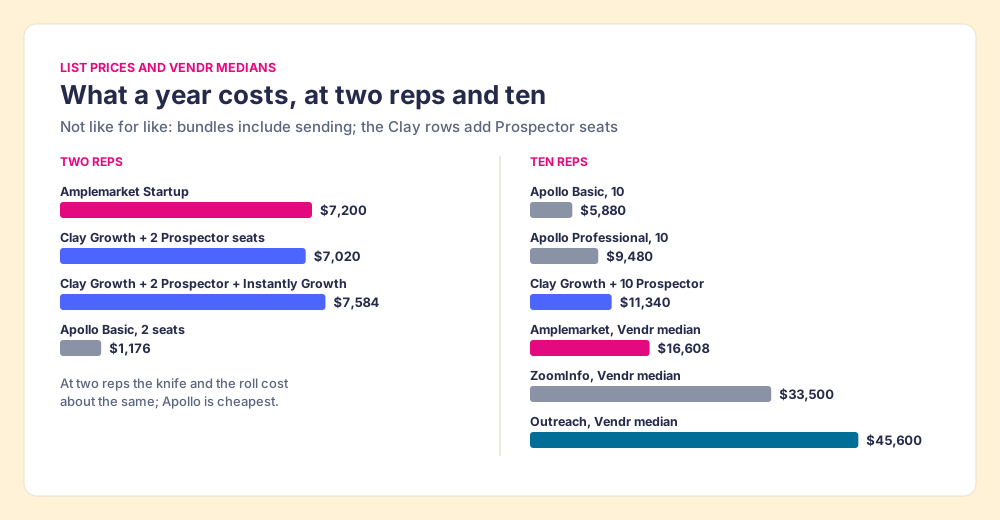
Apollo is cheaper than both, and the page should say so plainly. The case for the roll over either knife is three things a single database cannot sell: the number the first database did not have, because the waterfall asks the next vendor; the prospect found from the company site or the CRM record when they are not on LinkedIn at that moment; and the list a leader can follow from Found to Closed. “Skip the extra seats. Get more out of the Clay you already pay for.”
Choose something else if you do not have Clay. Prospector runs on the customer’s Clay account and does nothing without one, and a team that has never built a waterfall needs someone to build it. RevPartners, the company I founded, is a Clay Elite Studio Partner that builds and tunes the tables with you (revpartners.io/allbound); so are other agencies, and the Clay agency page covers how to pick one. Choose something else, too, if your reps live inside Amplemarket’s sequences and the data is fine. Prospector sends no email, warms no mailbox and drafts nothing. Keep the knife.
Which blade went dull, and which alternative fixes it?
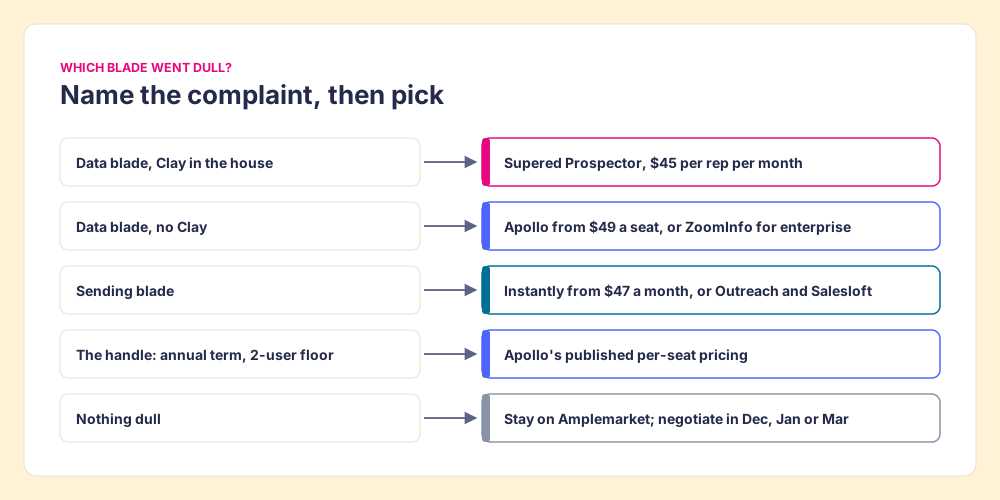
Sort the complaint first and the alternative follows. The ways forward:
- A dull data blade, with Clay in the house. Supered Prospector. The waterfall asks 200+ vendors per lookup, reps run it where they work, and Amplemarket’s sequences can stay or go.
- A dull data blade, no Clay. Apollo if you want another bundle at a sixth of the per-user price, ZoomInfo if you sell to North American enterprise and can sign a platform contract.
- A dull sending blade. Instantly for volume on a small budget, Outreach or Salesloft for enterprise sequencing, each fed by whatever data source you choose.
- A dull handle. The annual term, the 2-user floor and the custom tiers are the complaint. Apollo’s published per-seat pricing is the cleanest exit.
- No dull blade. Stay. Amplemarket at 4.6 from 687 reviews is a good product for a team that wants one handle, and the negotiation months are December, January and March.
What we recommend depends on one fact about your stack. If you do not have Clay and you like having one handle, price Apollo against your Amplemarket renewal before you sign it; at $588 a seat against $3,600, the conversation is worth an afternoon. If the sequences are the trouble, keep your data and buy a better sending blade. If you have Clay, stop buying a second database. Put the waterfall in your reps’ hands where they already work, send the result to the sales engagement tool you trust, and follow each list to Qualified, Recycled or Disqualified. A Swiss Army knife tells you nothing about what you cut with it. The roll, used this way, does. Start with the Clay Chrome extension guide for how reps run Clay without opening it, the sourcing use case for the whole motion, or a Prospector demo on your own Clay account.
Frequently asked questions
What are the best Amplemarket alternatives in 2026?+
How much does Amplemarket cost in 2026?+
Amplemarket vs Apollo: which is cheaper?+
Who are Amplemarket's main competitors?+
Does Amplemarket integrate with Pipedrive?+
Do I need a Clay account to use Supered Prospector?+
Your process, running itself.