The Sales Playbook: Why Most of Them Never Get Run
A sales playbook captures how your team should sell.
Most are polished documents nobody opens. Here is what a playbook is, what goes in it, and how to make it a thing reps run instead of a thing they ignore.
A sales playbook is a documented guide to how a team should sell (the process, plays, messaging, and criteria for each stage), and its value depends entirely on whether reps run it, not on how well it is written.
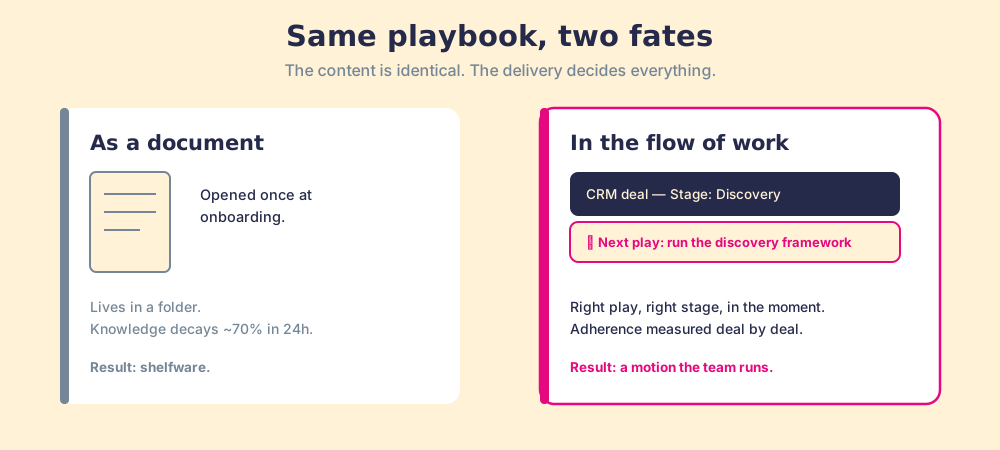
A sales playbook is a strange artifact: almost every team has one, and almost none of them run it. The playbook gets built in a burst of effort, usually by enablement or a sales leader on a quarter when there is finally time, polished into a handsome document, presented at a sales kickoff to nods all round, and then it goes where playbooks go. It moves into a folder, gets opened once during onboarding, and is never read again. The content is fine. The trouble is that a document is a place you have to travel to, and the deal is happening somewhere else, with three tabs open and a buyer waiting on the line.
So here is what a sales playbook is, what belongs in it, and the part nearly everyone gets wrong, which is not the writing but the running. A sales playbook is a documented guide to how a team should sell, the process, plays, messaging, and criteria for each stage, and its value depends entirely on whether reps run it, not on how well it is written. That sentence is the whole argument. A beautiful playbook nobody runs is worth nothing, and a plain one every rep follows is worth a number on the board.
What is a sales playbook, and what goes in it?
It is the captured version of how your best reps sell, written down so the rest of the team can run the same motion. A good one is specific, current, and short enough to use under pressure. If you are working out how to create a sales playbook from scratch, start with the sections, which are stable across teams, and if you want a structure to fill, the sales process template gives you the skeleton.
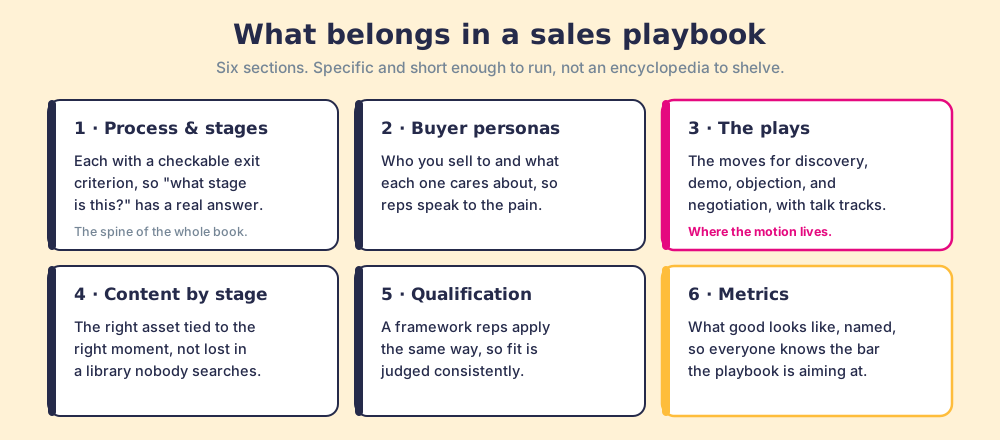
- The process and its stages. Each stage carries a checkable exit criterion, so “what stage is this deal in?” has a real answer instead of a hopeful one. This is the spine, covered in sales process steps.
- Buyer personas and pains. Reps know who they are selling to and what each persona loses sleep over, so the pitch meets a real pain rather than a generic one.
- The plays. The specific moves for discovery, demo, objection handling, and negotiation, with talk tracks for the moments that recur on most deals (each one a sales play with its own trigger).
- Content mapped to stages. The right asset stays tied to the right moment instead of drowning in a library nobody searches mid-deal.
- The qualification framework. Reps judge fit the same way, deal to deal; see lead qualification.
- The metrics. Everyone knows what good looks like and what bar the playbook is aiming at.
The sections are the easy part. Most teams can write a competent playbook from a blank sales playbook template in a week of focused work. Almost none can get the thing run, deal by deal, a quarter later, and that gap, between a playbook that exists and a playbook that operates, is the entire subject of this post.
Why do most sales playbooks go unused?
Because they live as documents, and documents lose to the flow of work every time. A playbook in a PDF or a wiki asks the rep to stop selling, go find it, locate the relevant section, and apply it from memory afterward. That is friction stacked on friction, and friction wins the argument by default. Worse, the knowledge inside it decays. Hermann Ebbinghaus mapped the forgetting curve in 1885, and the replications have held since: in a 2015 replication, relearning a list one day later saved only 32% of the original effort, and 4% after a month (Murre and Dros, PLOS ONE, 2015). A rep who read the playbook during onboarding has lost most of it by the deal that needs it, and reaching for the document mid-call is a thing nobody does.
This is the same failure that turns content libraries into shelfware, and the scale of it is documented. Studies of B2B sales content have found that around 65% of the material teams create is never used by reps, in part because it is too hard to find and tailor in the moment (Dock). A playbook is the most ambitious piece of that unused pile, the master document meant to govern all the rest, and it goes unread for the same reason: the value sits in a destination, and the work happens elsewhere.
Set against that, our own field data names the lever precisely. In The State of Sales Enablement 2026, teams whose enablement reached reps in the flow of the work hit quota at 49%, against 15% for those whose tools sat in separate destinations (The State of Sales Enablement). A playbook is, by default, the most separate destination there is, a document, which is why writing a better one rarely changes what reps do. Playbooks fail on delivery and adherence, not on prose.
What do the playbook experts get right, and what do they miss?
The people who own this topic are right about the half they emphasize, and the failures happen in the half they assume. Jacco van der Kooij and Winning by Design built a following on the argument that revenue should run as a documented, repeatable scientific process rather than a set of heroics, and that is correct: capturing the motion is the precondition for scaling it. Force Management’s MEDDICC gave teams a rigorous qualification standard that thousands of playbooks now codify, and HubSpot, Salesforce, and most enablement vendors ship clean playbook templates that cover every section above. The orthodoxy on what to write is mature and mostly sound.
Where it goes thin is on what happens after you write it. The standard advice treats the playbook as a knowledge artifact: build it well, train the team on it, and adoption is assumed to follow from quality. It does not. The CSO Insights research that Korn Ferry now runs found that organizations with a formal, dynamic sales process, one codified in the CRM and inspected rather than written and filed, posted win rates around 17.9 points higher than teams running an informal one (CSO Insights, via Highspot). Read that carefully and it is not a finding about better content. It is a finding about a process that is enforced where the work happens versus one that is merely documented. The experts get the writing right and tend to wave a hand at the running, which is the part that decides whether any of it shows up on a deal.
How do you make a sales playbook reps run?
Move it from a document to the flow of work, and inspect adherence. The shift is from “here is the playbook, please remember it” to “here is the next play, right now, where you are already working.” Concretely:
- The play in the moment. The right play for the current stage appears inside the CRM where the rep already is, so running it is the path of least resistance instead of a detour. This is the job of sales playbook software.
- A checkable exit criterion per stage. The playbook becomes enforceable instead of advisory, and a deal cannot claim a stage it has not earned.
- Adherence measured deal by deal. You can only expect what you inspect. A playbook nobody inspects is a suggestion with nice formatting.
- Coaching off the gaps. The playbook improves and adherence rises together, because the manager is working from what reps did, not what they were supposed to remember.
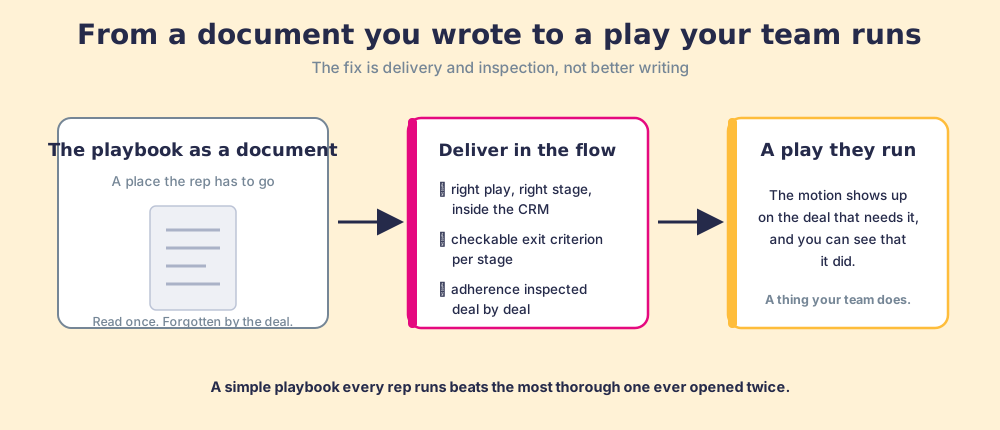
This is the business logic layer a playbook needs to come alive. A tool like Supered runs the playbook inside HubSpot and Salesforce, surfaces the right play at the right stage in the flow of the work, and measures whether reps ran it, turning a document into a process that executes. The playbook stops being a thing you wrote and becomes a thing your team does.
What we recommend
A sales playbook is not a writing project; it is an adoption project wearing a writing project’s clothes. The reason yours underperforms is almost never the content. It is that the content lives in a document and the selling lives in the deal, and the forgetting curve guarantees the gap between the two only widens after kickoff.
So write the playbook, and write it well: clear, specific, short, with the six sections above and a real exit criterion on every stage. Then do the part that decides the number. Deliver it in the flow of the work so the right play reaches the rep at the moment of the work, define each stage so adherence can be checked, and inspect whether reps run it, deal by deal, then coach off the gaps. The experts who built the modern playbook are right that capturing your best motion is the foundation. They tend to stop one move short. The motion has to reach the rep where the work is, and someone has to watch whether it took. A simple playbook your team runs every day beats the most thorough one ever opened twice, and that is the difference between a document and a process.
From here: the tool that delivers it in sales playbook software, the structure to fill in the sales process template, the stages it is built on in sales process steps, the methodologies it can encode in sales methodologies, and the adoption system underneath in sales process adoption.
Frequently asked questions
What is a sales playbook?+
What should a sales playbook include?+
Why do sales playbooks fail?+
How do you make a sales playbook reps use?+
Your process, running itself.