Sales Plays: Examples That Fire When the Deal Changes
A sales play is a repeatable response to a specific moment in a deal. Bain found 70% of companies struggle to wire their plays into the CRM, where that moment happens. Here is the anatomy, eight examples written as CRM triggers, and how to measure them.
A sales play is a repeatable, agreed response to a specific trigger in a deal or account (a proposal out with no economic buyer attached, a champion who changed jobs), written as steps, content, and an exit condition so any rep runs it the same way.
The sales kickoff went well. Enablement unveiled twelve new sales plays in a tidy deck, each with a name, a talk track, and a slide of content links, and the room nodded along. Six weeks later a rep sends a proposal to a director of operations who has never once mentioned a budget holder. There is a play for exactly this. It is called Missing Economic Buyer, and it lives on slide 31. The play existed. The moment arrived. They never met.
That miss is where the usual advice on sales plays goes soft. Guides describe a play as a bundle of content: what to know, what to say, what to show. That is half the story. A play has two halves, a trigger and a response, and the field pours its effort into the response while the trigger gets one sentence in a document. So the play waits in the deck while the situation happens in the CRM. Bain’s April 2025 survey of more than 1,200 senior commercial executives found that 70% of companies struggle to integrate their sales plays into CRM and revenue technology, and that while over 80% run structured, repeatable sales activities, only 20% report getting full value from them (Bain & Company).
Write the trigger as a CRM condition and the play can find the rep. Leave it as prose and the rep has to find the play.
What is a sales play?
A sales play is a repeatable, agreed response to a specific trigger in a deal or account, written as a few steps, the content those steps need, and a condition that says when you are done. The trigger is the part that makes it a play. “Handle pricing objections well” is advice. “When a deal enters the proposal stage and no contact carries the economic buyer role, run these four steps” is a sales play.
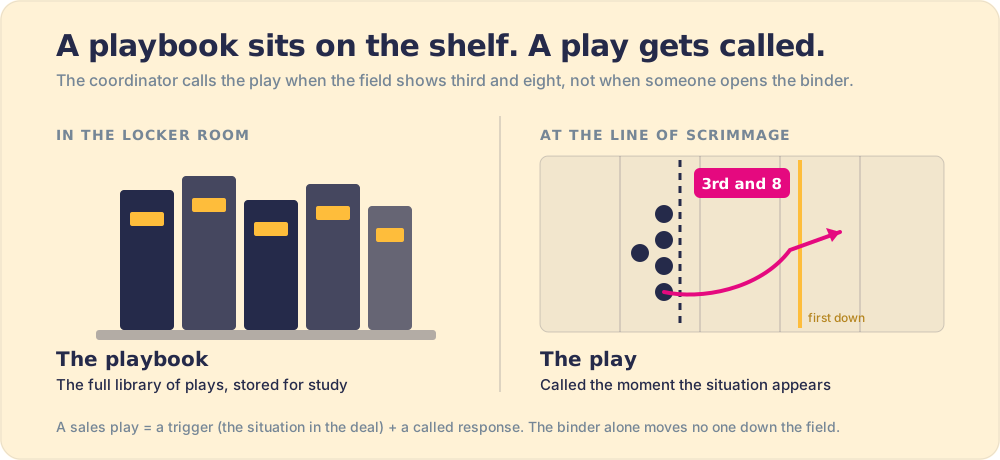
The word comes from football, and football gives the clearest picture of it. A team’s playbook is a thick binder in the locker room, studied all week and left on the shelf on game day. The offensive coordinator looks at the field, sees third down with eight yards to go, and calls one play from memory into a headset. The situation (third and eight) selects the play. The binder holds a hundred plays; the call is one play, matched to one moment, run by eleven people at once.
Sales works the same way, with one inconvenient difference. The coordinator watches the field full time. In sales, the person who has to notice third and eight is the rep, who is also running the play, carrying the rest of the book, and answering the buyer.
What is the difference between a sales play and a sales playbook?
A sales playbook is the library: who you sell to, the stages a deal moves through, your methodology, your messaging, and the full set of plays. A sales play is one entry in it. We cover the library end to end in the sales playbook guide; here the distinction that matters is timing. You study a playbook. You call a play.
| Sales playbook | Sales play | Sales sequence (cadence) | |
|---|---|---|---|
| What it is | The library of how you sell | One response to one situation | A timed series of touches |
| Starts when | Onboarding, or a rep goes looking | A trigger condition becomes true | A rep or rule enrolls a contact |
| Scope | Every stage and segment | One moment in a deal or account | One contact’s inbox |
| Ends when | It does not; it gets revised | The exit condition is met | The last step sends or they reply |
| Measured by | Adoption of the process overall | Fired, run, exited, and outcome | Opens, replies, meetings |
A sequence can serve as one step inside a play (“enroll the new stakeholder in the executive sequence”). On its own, it has no idea why it started.
Why do sales plays fail to run?
Psychology has a precise name for a sales play, and it predates sales enablement by decades. Peter Gollwitzer called them implementation intentions: plans written in the form “Whenever situation x arises, I will initiate the goal-directed response y!” (Gollwitzer, 1999). They work. A meta-analysis by Gollwitzer and Paschal Sheeran across 94 independent studies found a medium-to-large effect on goal attainment, d = 0.65 (Gollwitzer and Sheeran, 2006). The mechanism is the useful part. An if-then plan hands control of the behavior to the situation. When the cue shows up, the response follows with little deliberation.
Follow that one step further and the failure mode of sales plays falls out on its own. An if-then plan only fires if the person perceives the “if.” A rep with a full book of open deals, a buyer on the phone, and an inbox refilling is poorly placed to spot the one deal that has crossed into proposal with no budget holder attached. The play was sound. The cue went unseen, and the rep is rarely the reason:
From the field
They’re actually not lazy. They’re gonna do whatever is the least amount of friction, and sometimes it’s difficult to navigate HubSpot and know where to click things.
The failure belongs to the system, and it is a fixable one, because the CRM sees the cue perfectly. It knows the stage changed. It knows which contacts carry which role.
A sprinkler head and a fire-safety binder hold the same instructions for a fire. The binder sits on a desk two rooms from where the fire starts. The sprinkler holds a single instruction at the ceiling over the spot, and it needs no one to remember it. The fire is the trigger.
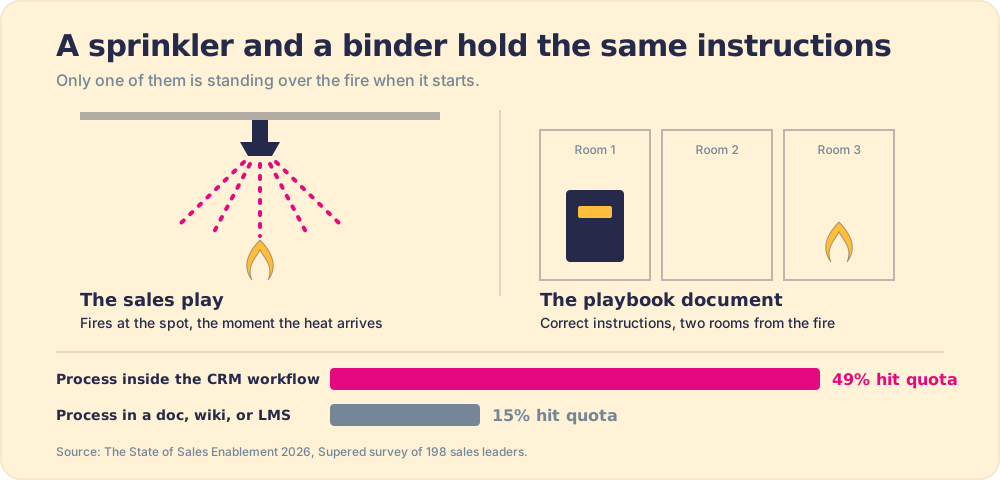
In the State of Sales Enablement 2026, 89% of sales leaders said they have a defined sales process and 36% said reps follow it as designed. Where the process lived explained most of that spread. A play is a small piece of process, and it obeys the same law:
From the field
It’s great to have a document. I might even have a dashboard, but sales reps don’t look at dashboards. So the question is, how do I take this document and turn it into a process they can follow?
What is the anatomy of a sales play?
The best-known anatomy comes from Highspot, published on the Sales Enablement Collective: a hook, then what to know, what to say, what to show, and what to do. (Highspot has since merged with Seismic, a deal that closed on 18 August 2026; we covered the Highspot and Seismic merger separately.) It is a strong content anatomy, and if your plays have no talk tracks, start there. It has two gaps. Nothing in it says when the play starts, and nothing says when it is finished. Those are the two parts a document cannot do by itself.
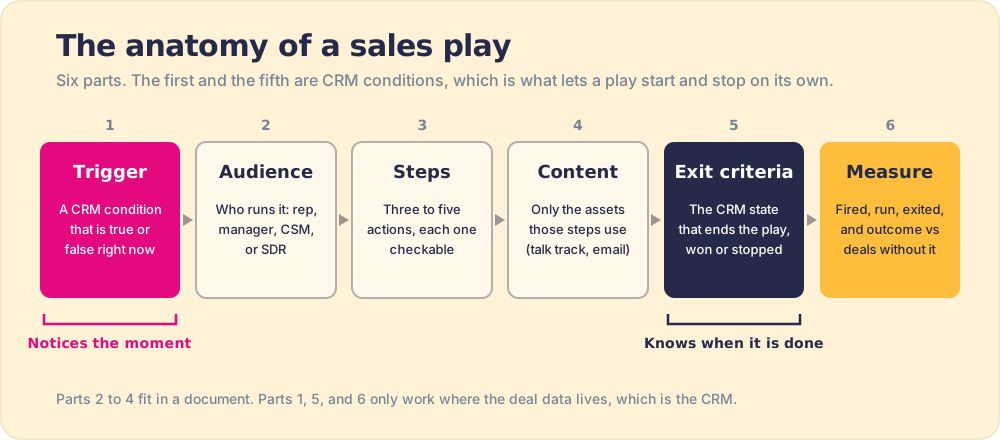
We use a six-part anatomy, with the trigger and exit written as conditions a system can evaluate.
- The trigger. A CRM condition that is true or false right now: “Stage = Proposal AND no contact with buying role = Economic buyer.” If you cannot write it as a condition, you have a tip, and a tip depends on memory.
- The audience. Who runs it. Usually the deal owner, sometimes a manager, a CSM, or an SDR. A play with two owners gets run by neither.
- The steps. Three to five actions, in order, each one checkable. “Build rapport” fails the test. “Ask the champion who signs off on spend above their limit” passes.
- The content. Only the assets those steps use: the email template, the talk track, the one-page business case. The content serves the steps, and anything the steps do not call for stays in the library.
- The exit criteria. The CRM state that ends the play, whether it worked or not: “Economic buyer associated and a meeting logged,” or “Deal closed-lost.” Without an exit, a play never ends and never gets counted.
- The measure. How often it fired, how often it ran, how often it reached the exit, and what happened to those deals compared with deals that did not run it.
Sales play examples: eight plays written as CRM triggers
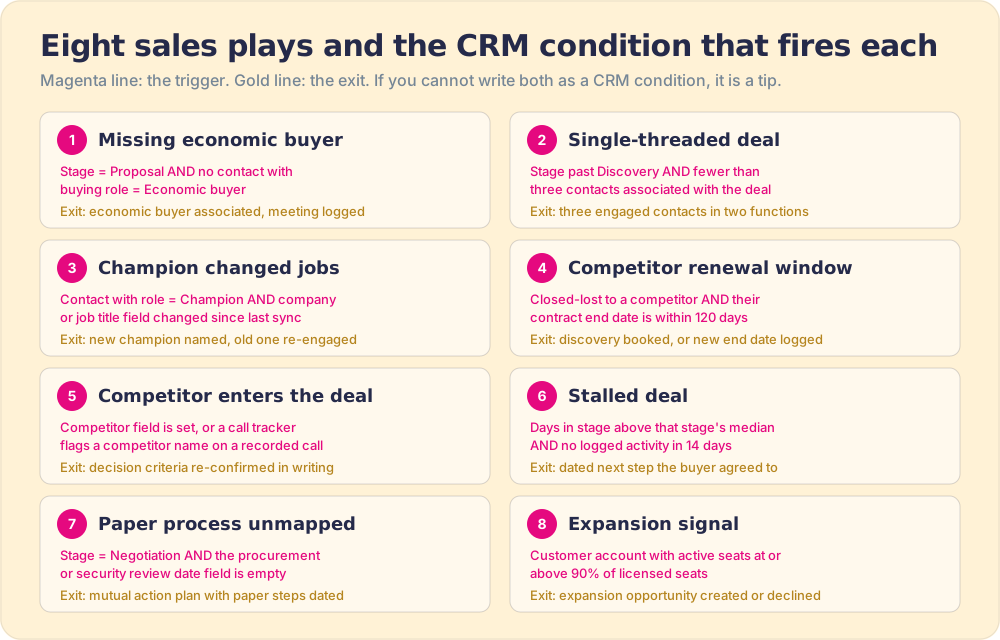
Below are eight sales plays examples for a mid-market team on HubSpot or Salesforce. Each one names the trigger as a condition you could build as a report filter tonight. Field names vary by CRM; the logic does not.
1. The missing economic buyer play
- Trigger. Stage = Proposal AND no associated contact has buying role = Economic buyer.
- Steps. Ask the champion who approves spend at this size; send the champion a one-page business case written for that person; request a 20-minute review with them before the proposal is final.
- Exit. An economic buyer contact is associated and a meeting with them is logged, or the deal is marked closed-lost.
Gartner puts the typical B2B buying group at six to ten people, with buyers spending about 17% of their buying time with all suppliers combined (Gartner). A proposal sent without the budget holder is a proposal read by someone who cannot say yes. The play is the Economic buyer letter of MEDDPICC, turned from a checkbox into a response.
2. The single-threaded deal play
- Trigger. Stage is past Discovery AND fewer than three contacts are associated with the deal.
- Steps. Map the buying group with your contact; name the two missing functions (often finance and the end user’s manager); ask for an introduction to each with a specific reason to meet.
- Exit. Three engaged contacts across at least two functions, each with a logged activity.
Gong’s analysis of sales interactions recorded on its platform found that closed-won deals include 67% more contacts than closed-lost deals (Gong).
3. The champion job change play
- Trigger. A contact with role = Champion has a changed company or job title field since the last enrichment sync.
- Steps. Two plays in one. At the old account, find and qualify the successor before the renewal conversation. At the new company, the champion’s owner reaches out within the first weeks, congratulates them, and asks what they inherited.
- Exit. A new champion is named at the old account, and the former champion has a logged conversation at the new one.
Median tenure with a current employer was 4.1 years in January 2026 (Bureau of Labor Statistics). Over a multi-year customer relationship, a champion moving on is close to a scheduled event, which makes it a trigger you can plan for.
4. The competitor renewal window play
- Trigger. Deal closed-lost with reason = Competitor AND the competitor contract end date (captured at loss) is within 120 days.
- Steps. Review the loss notes and the original decision criteria; send a short, specific note on what has changed since then; offer a comparison session timed for their renewal review.
- Exit. A discovery meeting is booked, or a new contract end date is logged for next time.
This play only exists if the loss was recorded with a reason and a date. It is the payoff of doing win-loss analysis properly: the loss becomes a dated future opportunity.
5. The competitor enters the deal play
- Trigger. The competitor field is set, or a conversation intelligence tracker flags a competitor name on a recorded call.
- Steps. Pull the matching sales battlecard; re-confirm the buyer’s decision criteria in writing; set a trap question that surfaces your differentiator in their words.
- Exit. Decision criteria are re-confirmed and logged, with the competitor noted.
6. The stalled deal play
- Trigger. Days in current stage is above that stage’s median for your pipeline AND no activity has been logged in 14 days.
- Steps. Send a direct note that names the last agreed next step; offer the buyer an easy exit (“if this has moved down the list, tell me and I will close it out”); ask the manager to review the deal.
- Exit. A dated next step the buyer agreed to, or a closed-lost status with a reason.
The median comes from your own CRM, so the trigger adapts to your cycle and the stall surfaces before the forecast call. Clean pipeline management keeps it trustworthy.
7. The paper process play
- Trigger. Stage = Negotiation AND the procurement or security review date field is empty.
- Steps. Ask who else signs and what reviews apply; send your security package before it is requested; add the paper steps with dates to a mutual action plan.
- Exit. A mutual action plan with the procurement and legal steps dated and agreed.
8. The expansion signal play
- Trigger. A customer account has active seats at or above 90% of licensed seats (use whatever threshold fits your contracts).
- Steps. Confirm usage with the admin; ask which teams are waiting for access; bring a pricing option before the customer hits the wall. If the waiting team needs a different product, use one of these cross sell emails tied to the same signal.
- Exit. An expansion opportunity is created, or the customer declines and the reason is logged.
None of the eight asks a rep to remember a slide. Each names a CRM state a system can watch, so the play can appear the moment the state does.
Do triggered sales plays work? Two measured cases
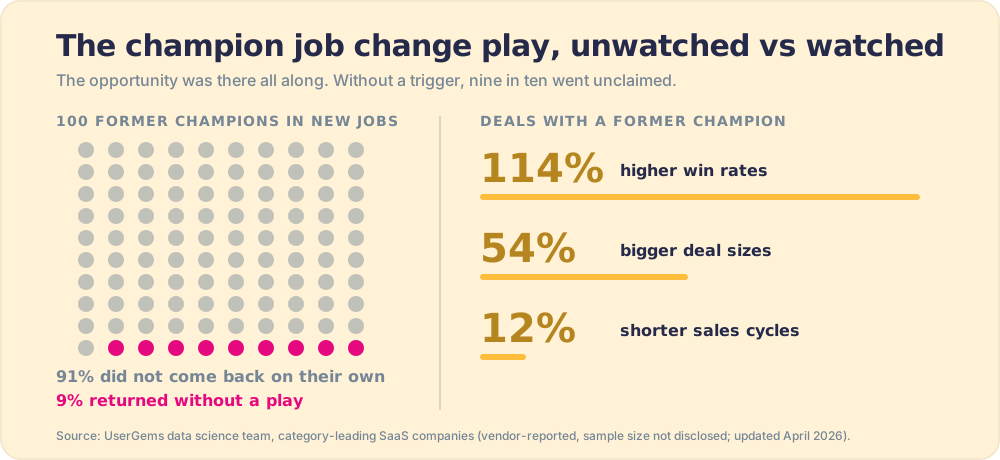
The champion job change is the best-measured trigger in B2B selling, because the vendors who sell the signal have a reason to count it. The UserGems data science team looked at category-leading SaaS companies with strong NPS scores and found that 91% of former champions who had started a new job more than three months earlier “didn’t come back on their own,” even after 90+ days in the role. The other 9% did. In the same series, UserGems reports that deals involving a former champion show 114% higher win rates, 54% bigger deal sizes, and 12% shorter sales cycles (UserGems, updated April 2026). These are vendor-reported figures with no disclosed sample, so hold the multiples loosely. The shape is sturdier than the numbers: the opportunity sat there the whole time, and with nothing watching for the trigger, nine in ten went unclaimed.
One of their customers describes the before state in plain words. Rob Kiser of Diligent: “We noticed our SDRs were having a lot of success by identifying past users and buyers who had moved to new roles in new companies.” Then: “But we didn’t have a formal process in place.” Reps searched LinkedIn by hand and created the contacts in Salesforce themselves (UserGems customer story). A winning play was living in a few reps’ heads. Diligent turned it into a trigger feeding a routed workflow and reports a 30x return in pipeline generated, again vendor-reported.
The second case is larger and comes from a consultancy. Bain describes an industrial manufacturer that ran workshops to surface more than 100 candidate plays, cut the list to about 20, and launched them one at a time: the first within a month, then a new play every two weeks, with play performance tracked in dashboards built into its Salesforce and Power BI stack. Bain reports that 100% of sales managers adopted the new pipeline review routines and puts the run-rate impact at $12 to $14 million over the following 12 months (Bain & Company client result).
- The trigger is the multiplier. In the UserGems data, the play existed in the best reps’ habits; watching for the trigger is what turned an occasional win into a pipeline source.
- Curation is the discipline. Bain’s client kept about one play in five from its long list and staggered the launches, so managers could inspect each one.
- Inspection lives where the deal lives. Both cases measured the play in the CRM, which is where adherence and outcome can be compared.
How do you measure a sales play?
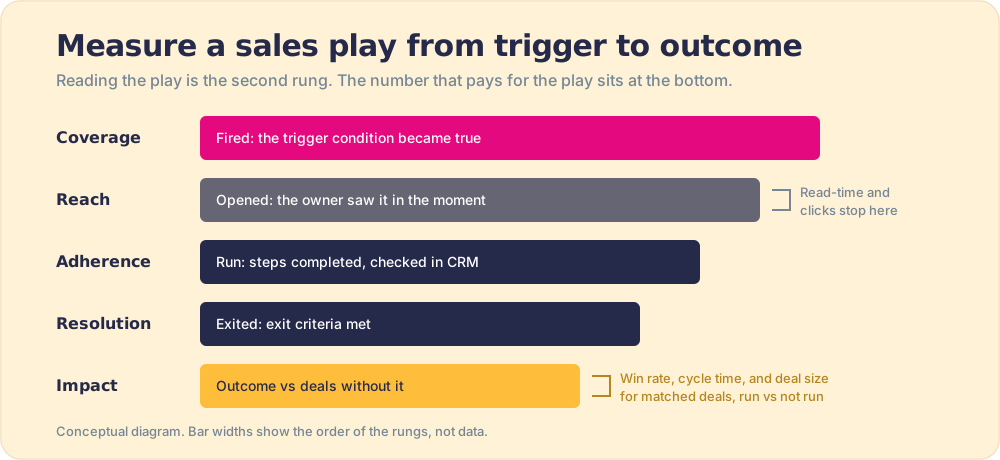
Measure it like a sprinkler system: did it go off at the heat, did water come out, did the fire go out. For a sales play, that is a ladder of five rungs.
- Coverage. How often the trigger condition became true. A play that fires on half the pipeline is a stage requirement.
- Reach. Whether the owner saw the play when it fired. Read-time and completion rates live here, and they stop here.
- Adherence. Whether the steps were completed and recorded in the CRM. It is the rung that tells you the play ran.
- Resolution. Whether the exit condition was met: the economic buyer attached, the third contact engaged, the renewal meeting booked.
- Impact. Win rate, cycle time, and deal size for deals that ran the play, against matched deals (same stage, segment, and size band) that fired the trigger and did not run it.
The Highspot guide measures adoption through reading completion and time spent, paired with manager observation. We would move the weight onto the observation. A rep who read the missing economic buyer play and still sent the proposal without a budget holder has adopted nothing. Adherence needs someone looking: in the State of Sales Enablement, teams whose managers inspect process compliance weekly with a real number hit quota at 6.3 times the rate of the least-inspected teams. Automate that inspection and the manager spends the saved hours coaching reps through the play. Which of these numbers to report upward is covered in sales enablement KPIs.
Where should sales plays live?
Put each play in the CRM as a trigger and an exit, and deliver it to the rep the moment the trigger fires. Every piece of evidence above points the same way: Gollwitzer’s if-then plans only work when the “if” is perceived, the UserGems champions went unclaimed nine times in ten when nothing watched for the change, Bain’s client measured its plays inside Salesforce, and teams with process in the CRM workflow hit quota at 49% against 15%. The other homes for a play still fit narrower jobs:
| Where the play lives | Who notices the trigger | What it fits |
|---|---|---|
| A deck or document | The rep, from memory | Onboarding study and talk tracks |
| A sales engagement sequence | The rep, then the tool times the touches | One timed step inside a larger play |
| CRM workflows and tasks | The CRM, though the rep still hunts for the steps | Single-step plays with no content |
| In-the-moment guidance | The CRM, with the steps and content shown in place | Multi-step plays you want run and measured |
Write each trigger and exit as a CRM condition before you write a word of talk track; if you cannot, it is a tip, and it belongs in coaching. Start with three to five plays, chosen from your stage-to-stage conversion report where the drop is steepest, then inspect adherence weekly and compare outcomes against matched deals. The plays that work earn more room, and the rest get rewritten or retired.
We built Supered to do this: it watches for the trigger inside HubSpot or Salesforce, puts the play in front of the rep when the condition becomes true, and records whether it ran, deal by deal. It is one way to build the sprinkler; the principle holds whatever you use.
If you are building the library these plays belong to, how to create a sales playbook walks through it from the first interview with your best rep, and sales playbook examples shows finished ones you can borrow from.
Frequently asked questions
What is a sales play?+
What is the difference between a sales play and a sales playbook?+
What are some examples of sales plays?+
How many sales plays should a sales team run?+
How do you measure a sales play?+
Your process, running itself.