How to Create a Sales Playbook: Reverse-Engineer It From Your Own Wins
Most sales playbooks are built top-down from a framework and reps ignore them. The playbook that works is reverse-engineered from your own won deals and your best reps' behavior, then run in the flow of work.
To create a sales playbook, you reverse-engineer it from your own won deals and best reps rather than writing it top-down from a framework, codify their winning moves as behavior-level plays, surface those plays in the flow of work, and measure whether reps run them.
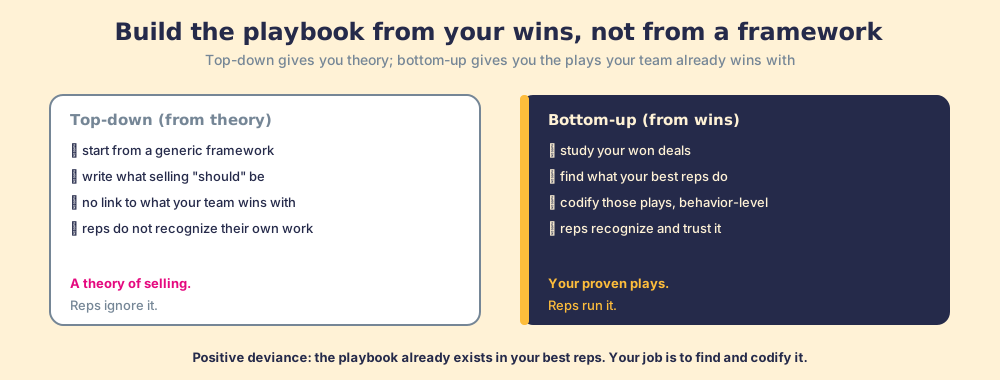
Most teams create a sales playbook the same way, and it is the wrong way: they start from a framework, write down what selling should be in theory, and produce a polished document that their reps ignore. The reps ignore it for a good reason. They do not see their own winning work in it, because it was written from a generic theory rather than from how your team wins. The playbook that works is built the other way around. It is reverse-engineered from your own won deals and your best reps, so it codifies the plays your team already uses to win, which reps recognize, trust, and run. Creating a playbook is less an act of authorship than an act of excavation: the winning playbook already exists in your best reps, and your job is to dig it out.
To create a sales playbook, you reverse-engineer it from your own won deals and best reps rather than writing it top-down from a framework, codify their winning moves as behavior-level plays, surface those plays in the flow of work, and measure whether reps run them. Build it from your wins, and reps run a playbook that is recognizably theirs.
Why build a sales playbook from your wins instead of a framework?
Because the plays that win your deals already exist in your team, and a framework cannot supply them. This is the principle of positive deviance, developed by Jerry and Monique Sternin: in almost any group, a few members already achieve better outcomes using available resources, and the fastest path to improvement is to find what those positive deviants do and spread it, rather than importing an outside solution (on positive deviance). Your top reps are positive deviants. They already run the moves that win, the way they qualify, the questions they ask, the objections they handle, and that behavior is the real playbook, distributed across your best performers and waiting to be documented. A framework, by contrast, describes a generic theory of selling that has no connection to your buyer, your product, or your wins, which is why reps treat a framework-built playbook as a corporate document rather than a working tool.
The recognition test is the giveaway. When reps read a playbook built from your wins, they recognize the moves as the ones that work, including their own, and they trust it. When they read one built from a framework, they see a theory imposed from outside and tune it out. The same content that earns adoption is the content drawn from your team, which is precisely the content a framework does not have.
Positive deviance has a track record outside sales worth borrowing, because it is the reason this is more than a nice slogan. In the 1990s, working on child malnutrition in Vietnam with almost no budget, the Sternins did not import a Western nutrition program. They went village by village and found the poor families whose children were somehow well-fed, watched what those mothers did differently (they added tiny shrimp and crab from the rice paddies and fed children more often), and spread that one existing behavior. Malnutrition fell sharply in the communities that ran the program, and follow-up work found the gains held (Tufts, on the Vietnam positive-deviance work). The lesson transfers cleanly: the solution that sticks is the one already working inside the system, surfaced and spread, because the people around it already believe it and it already fits their real constraints. A consultant’s template fails the same way an imported nutrition program failed, by arriving from outside the world it is meant to fix.
What are the steps to create a sales playbook?
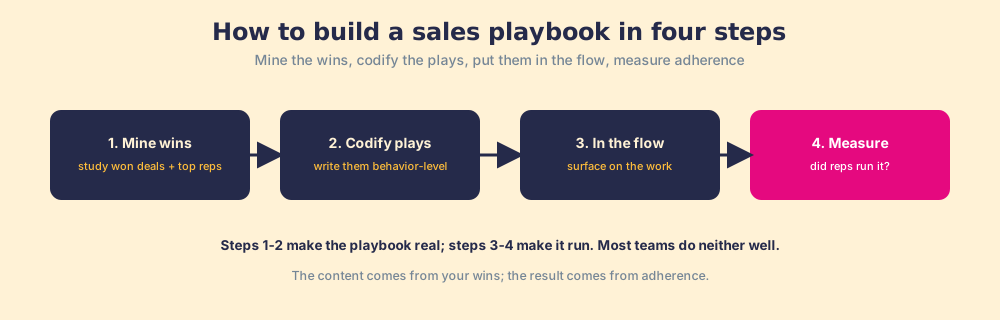
Four steps, in order: mine the wins, codify the plays, put them in the flow, measure adherence. The first two make the playbook real; the last two make it run, and most teams do neither half well. Start by mining your wins, studying won deals, call recordings, and your top reps to surface the specific moves that work. Then codify those moves as behavior-level plays, “open discovery by surfacing the cost of the status quo,” not “do good discovery,” because a play vague enough to be generic is too vague to run. Then put the plays in the flow of work, surfacing the right one where reps work so they meet it on the job rather than in a document. Then measure adherence, tracking whether reps run the plays, so the playbook is a managed behavior and not a hopeful file. The structure to hold all of this is the sales playbook template, and what good plays look like is in sales playbook examples.
- Mine the wins. Study won deals and top reps to find what works. The content comes from here.
- Codify the plays. Write them at the behavior level, specific enough to run. Vague advice is not a play.
- Put them in the flow. Surface the right play where reps work, not in a drive they never open.
- Measure adherence. Track whether reps run the plays. A playbook you do not measure is a document, not a behavior.
The codify step is where most playbook creation fails, and there is a named mechanism for getting it right. The behavioral scientist Peter Gollwitzer spent a career studying the gap between intending to do something and actually doing it, and found that vague goals (“do better discovery”) rarely change behavior, while a specific if-then plan (“if the buyer mentions budget, then I ask who else signs off”) does. His meta-analysis with Paschal Sheeran, pooling 94 studies, put the effect of these implementation intentions at a medium-to-large d of about 0.65, meaning the people who scripted the exact trigger and the exact move acted on it far more often than the people who merely meant to (Gollwitzer & Sheeran, 2006). A play written at the behavior level is an implementation intention for your whole team: it names the situation and the move, so a rep facing that situation already knows the next action. “Do good discovery” is a goal nobody can run. “When the prospect downplays the problem, quantify the cost of the status quo before showing a feature” is a play, because it tells a rep what to do the instant the trigger appears.
How do you keep a sales playbook from being ignored?
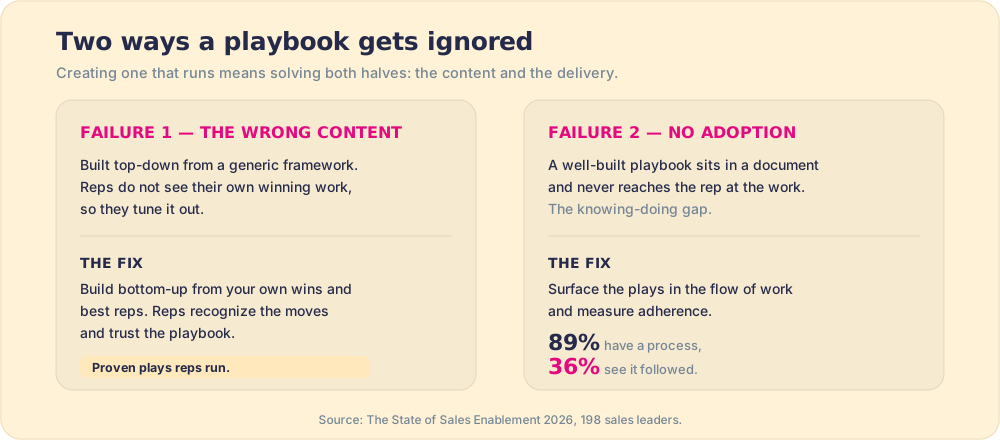
Build it from your wins so reps trust it, and run it in the flow so reps meet it. The two reasons playbooks get ignored map exactly to the two halves of the build. A playbook gets ignored first because reps do not recognize their own winning work in it, which you solve by building bottom-up from your wins rather than top-down from a framework. It gets ignored second because it lives in a document reps never open, which you solve by surfacing the plays in the flow of work and measuring whether they happen, the sales process adoption problem that decides whether any playbook is worth building. Get the content from your team and the delivery into the flow, and a playbook stops being a document people ignore and becomes the behavior they run.
This second failure has its own name in the management literature, and it is worth knowing because it explains why so much sales playbook creation ends in a polished file nobody uses. Stanford’s Jeffrey Pfeffer and Robert Sutton called it the knowing-doing gap: organizations are full of people who know what to do and do not do it, and the gap is rarely caused by ignorance. It is caused by systems that reward talk over action, by knowledge that lives in documents instead of routines, and by the simple fact that knowing a thing and doing it are different muscles (Pfeffer & Sutton, The Knowing-Doing Gap). A playbook is pure knowing. Until the play reaches the rep at the moment of the work, the knowing-doing gap swallows it whole, which is why the knowing-doing gap is the real subject under every ignored playbook. Our own field data sizes it: across 198 sales leaders, 89 percent reported a defined process and only 36 percent saw reps follow it (The State of Sales Enablement). That 53-point gap is not a content problem. The content existed. It is a delivery-and-measurement problem, which is exactly the half a document cannot solve on its own.
There is an honest objection here, and it deserves a fair hearing. Frameworks are not worthless, and a brand-new team with no won deals to mine has nothing to reverse-engineer yet. True. A framework is a reasonable scaffold when you genuinely have no signal of your own, and MEDDIC or SPIN can give a green team a shared vocabulary on day one. The point is not that frameworks are bad. It is that the moment you have wins, the wins are the better source, and most teams keep deferring to the framework long after their own data has grown into the stronger teacher. Start with the scaffold if you must. Replace it with your wins as fast as the wins arrive.
What we recommend
Create your sales playbook by excavation, not invention: the plays that win already exist in your best reps, so find them and write them down rather than importing a generic theory your reps will not recognize. Mine your won deals and top performers for the specific moves that work, codify them as behavior-level plays precise enough to run, surface those plays in the flow of work so reps meet them where they work, and measure whether reps run them so the playbook is a managed behavior. The reason this beats the usual top-down build is that it solves both failure modes at once: reps trust a playbook drawn from their own wins, and reps run a playbook that appears where they work. A framework gives you a theory of selling. Your wins give you the playbook, and your wins are already sitting in your CRM and your best reps, waiting to be codified.
From here: the structure to start from in the sales playbook template, what good looks like in sales playbook examples, the pillar in the sales playbook guide, and the adoption underneath in sales process adoption.
Frequently asked questions
How do you create a sales playbook?+
Where do the plays in a sales playbook come from?+
Why do most sales playbooks fail?+
What are the steps to build a sales playbook?+
Your process, running itself.