Sales Rules of Engagement: A Template Your CRM Can Enforce
Sales rules of engagement settle who owns which lead, account, and deal.
Most live in a PDF no rep opens before claiming a record. Here is a full template, and how to turn each rule into a CRM rule that fires at the moment of the claim.
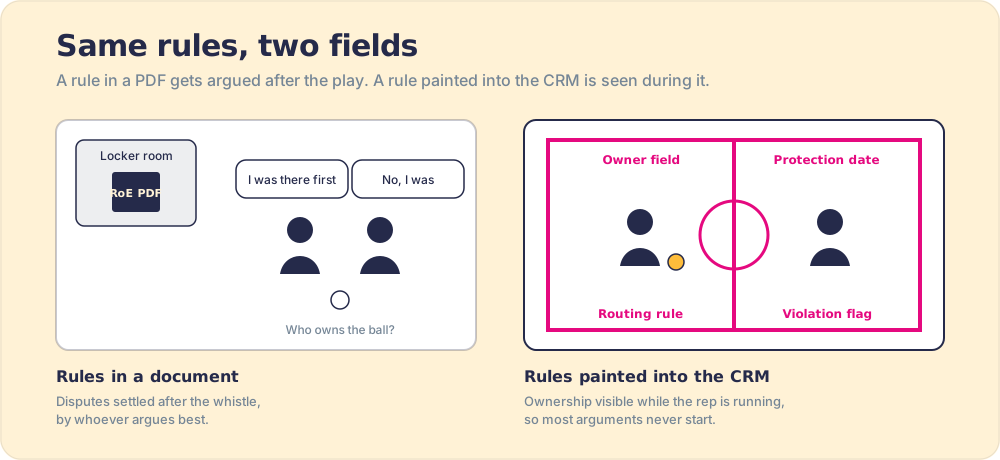
Sales rules of engagement are the agreement that decides who owns each lead, account, and opportunity, when that ownership transfers, how long a claim holds, and how disputes get settled, and they work only when the CRM checks them at the moment a rep claims a record.
C.S. Lewis opens Mere Christianity with people quarreling, and the first line he picks is “That’s my seat, I was there first.” The man saying it is doing more than complaining. He is appealing to a rule, and he expects the other man to know it.
A sales floor has the same quarrel with money attached. An SDR works an account for three weeks. A demo request arrives from the same company, and round robin hands it to an AE who has never heard of it. Both reps say “I was there first,” and both can cite a rule. The rules live in a PDF from last year’s kickoff, and neither rep opened it before claiming the record.
Sales rules of engagement exist to settle that quarrel before it starts. The guides ranking for this topic get the content mostly right. Where they stop is delivery. A rule a rep reads after the fight is a verdict. A rule the CRM checks at the moment of the claim is a fence. Below is a complete sales rules of engagement template, then how to compile each rule into HubSpot or Salesforce so it enforces itself.
What are sales rules of engagement?
Sales rules of engagement (RoE, or “rules of engagement sales” as plenty of people search it) are the property law of your pipeline. The sales process template says what should happen to a deal. The rules of engagement say whose deal it is. They answer four questions, and a good RoE document answers nothing else:
- Ownership. Who owns this lead, contact, account, or opportunity right now, and on what evidence.
- Transfer. Which event moves ownership: a meeting held, a contract signed, a territory redrawn, a rep leaving.
- Protection. How long a claim holds without activity, and what counts as activity.
- Disputes. Who decides when two people claim the same record, how fast, and on what evidence.
That narrow scope is a position. The Sales Enablement Collective’s widely read version also folds in discount approvals and rules like “limit cold call attempts to X times per week” (Sales Enablement Collective). Good rules, and they belong in your deal desk policy and sales playbook. Ownership rules reduce to fields and timestamps, so a machine can check them. Keep the document to what a machine can check, and you can enforce all of it.
Why do sales rules of engagement break down?
They break in two ways. The first is ambiguity: the document says “active account” and never defines active. Gradient Works’ toolkit attacks this well with its who, what, when, why, and how questions, and warns that “bad ROE will destroy your team’s morale and efficiency” (Gradient Works). The second failure gets less attention. The rules are invisible at the moment they matter.
A football pitch with the touchlines scrubbed off the grass shows the problem. The rulebook still defines out of bounds to the centimeter, back in the locker room. Each throw-in becomes an argument, settled after the whistle by whoever argues best. Now paint the lines back on. The rule has not changed. A player sprinting down the wing can now see it without breaking stride, so the argument mostly never happens.
A rules of engagement PDF is the rulebook in the locker room. The CRM is the grass. Owner fields, protection dates, and routing logic are the paint. I put the same point to an ops lead on a reverse demo in plainer terms:
From the field
Now anytime you’re not sharing your screen on Zoom with me, any of your employees will be able to quickly see, on any record they’re on, exactly the things that they should be doing. So it’s impossible for them to tell you they didn’t know.
Our own research puts numbers on the pattern. In a 2026 survey of 198 sales leaders, 89% said they have a defined sales process and 36% said reps follow it as designed, a 53-point gap. Teams whose process lived in the CRM workflow hit quota at 49%; teams whose process lived in a doc, wiki, or LMS hit quota at 15% (State of Sales Enablement 2026). That survey measured sales process broadly, not ownership rules. RoE sit at the extreme end of it, because an ownership rule matters for about ten seconds: the moment a rep clicks “assign to me.”
So cherry-picking is a system problem before it is a character problem. When ownership is invisible and the rule is vague, grabbing the warm inbound lead is the rational move, and the rep who hesitates loses the commission. Reps respond to the system you show them, as we argue in sales accountability. Fix the field, and the behavior follows.
The sales rules of engagement template
Copy this into your own doc and replace the bracketed values. The numbers are starting defaults for a mid-market team with a 30-to-90-day sales cycle, not benchmarks. Each section ends with the CRM mechanic that enforces it.
1. Definitions
- Lead. A person who raised a hand or was sourced, and is not yet tied to an open opportunity.
- Account. The company record, matched on primary domain, with [child companies rolled up to the parent].
- Opportunity. A deal record, created when a discovery meeting is held with a buyer who clears your lead qualification bar.
- Qualifying activity. A logged two-way interaction: a held meeting, an email reply, a connected call over [2] minutes. Unanswered sequence steps do not count.
- Named account. An account on a rep’s assigned list for the fiscal year.
- Owner of record. Whoever the CRM owner field names. If the CRM does not show it, it is not owned.
Enforced by: owner fields and an activity-type property.
2. Ownership rules
- Named accounts. Owned by the assigned AE for the fiscal year, whatever the lead source.
- Unnamed accounts. Open to claim. A rep claims by setting themselves as owner and logging a qualifying activity within [5] business days, or the claim lapses.
- Customers. Owned by the assigned account manager or CSM. New-business reps engage only with the owner’s approval.
- Contacts. Follow the account owner. A rep cannot own a person inside someone else’s account.
- Claim cap. A rep holds at most [150] claimed unnamed accounts at once, so a claim reflects work rather than a land grab.
Enforced by: owner field, claim date, claimed-account count per rep.
3. Lead routing
- Inbound from a named account. To the account owner, with an alert.
- Inbound tied to an open opportunity. To the opportunity owner.
- Inbound, unnamed, in ICP. Round robin across [the inbound SDR team] by [region or segment], skipping reps marked away.
- Response SLA. First human touch within [1] business hour.
- SLA miss. A lead untouched after [2] business hours re-routes to the next rep in rotation.
The one-hour SLA has evidence behind it. When researchers sent test web leads to 2,241 U.S. companies, 37% responded within an hour, and the average among those replying within 30 days was 42 hours. Firms that tried to reach the lead within an hour were nearly seven times as likely to qualify it as firms that tried an hour later (Oldroyd, McElheran and Elkington, HBR). A lead that sits in a queue while two reps argue over it forfeits that hour.
Enforced by: routing rules and a first-touch timer.
4. Account protection windows
- Outbound claim. Protected for [30] days from the claim, renewed by each qualifying activity, capped at [90] days without an opportunity.
- Open opportunity. Protected while open with a future next step date. Protection lapses if the close date passes by [30] days with no update.
- Closed-lost. Returns to the open pool after [60] days, unless the rep logs a dated re-engage plan.
- Churned customer. Returns to new business after [90] days.
A protection window works like a parking meter. You hold the space as long as you keep feeding it, and the coins are qualifying activity. A note on the windshield saying “back soon” does not count, and neither does a traffic cone set down in March. When the meter runs out, the space opens for the next driver, and there is nothing to argue about, because both drivers can read the meter.
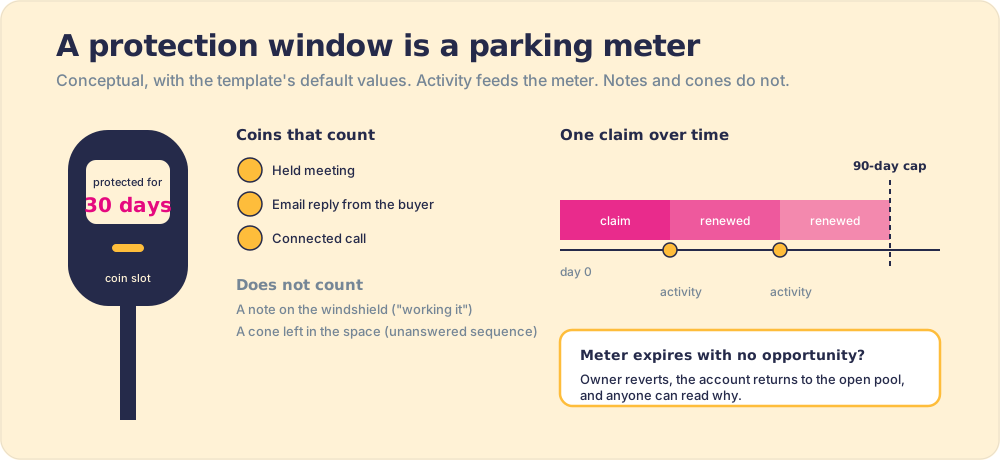
Enforced by: a “protection expires on” date, reset by qualifying activity.
5. Inactivity and reclaim
- Warning. The owner gets an alert [7] days before protection lapses.
- Reclaim. At lapse, the owner field reverts to [an unassigned holding user] and the account re-enters the open pool.
- Rep departure. The manager reassigns the departing rep’s book within [5] business days; open opportunities go to [a named successor].
- Territory change. Opportunities with a close date inside [60] days stay with the current owner through close; everything else moves on the effective date.
Enforced by: a scheduled workflow and manager-only bulk reassignment.
6. Partner and channel rules
- Deal registration. A partner-registered opportunity is protected for [90] days from approval. The first approved registration wins.
- Direct conflict. If a direct rep already has an open opportunity at the account, the registration is declined, and the partner sees the date the direct opportunity was created.
- Partner-influenced deals. The direct rep keeps ownership. The partner goes in a source field so credit is visible.
Partners have no manager inside your company to argue for them. Crossbeam reports that deals are 53% more likely to close, and close 46% faster, when a partner is involved (Crossbeam). A partner who loses a registration to an invisible direct claim takes the next deal elsewhere.
Enforced by: registration fields and a conflict check at approval.
7. Handoffs
- SDR to AE. Ownership moves when the AE marks the discovery meeting held and accepts it. The SDR keeps credit in a “sourced by” field. A rejected meeting returns to the SDR with a reason within [2] business days. The roles themselves are laid out in BDR vs SDR.
- AE to customer success. At closed-won, the account owner changes to the CSM once the handoff meeting is held, within [5] business days. The sales to customer success handoff covers what has to travel with it.
- AE to AE. Only through a manager-approved reassignment logged in the CRM.
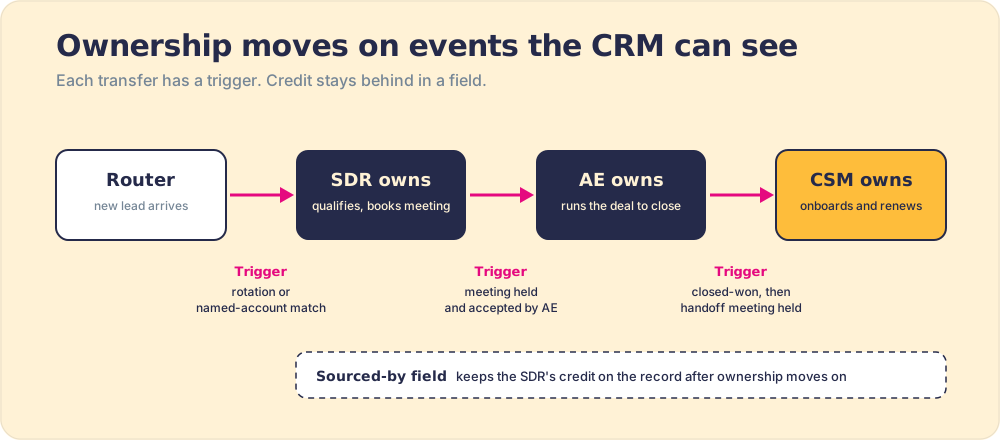
Enforced by: stage-triggered owner changes and a required “sourced by” field.
8. Disputes and escalation
- Evidence. CRM timestamps and owner history decide. A claim that exists only in email, Slack, or memory carries no weight.
- First step. The two reps try to settle it within [2] business days.
- Second step. Their frontline managers decide within [3] business days.
- Final step. [The head of RevOps or VP of Sales] decides, and the decision is final.
- Split default. [50/50] when both reps show qualifying activity inside a valid window.
- Log. Every decision goes in a dispute record with the rule it applied.
Enforced by: a dispute ticket type and the CRM’s owner history.
9. Exceptions
- Authority. Only [the CRO] grants exceptions, in writing, with a reason and an expiry date.
- Strategic accounts. Listed by name, owned by [the enterprise team], reviewed at each planning cycle.
Keep the list short, because requests for exceptions arrive constantly once the rules have teeth. A sales ops lead at a multi-location hospitality operator told us why her team kept refusing them: “We need to have baseline metrics and expectations for every single club, and it be the same.”
Enforced by: an exception flag with an expiry date.
10. Review cadence
- Quarterly review. RevOps reviews the dispute log, reclaim counts, and SLA misses, and proposes changes.
- Notice. Rule changes take effect [30] days after announcement, with a changelog at the top of the doc.
- Section owners. Each section names an owner and a last-updated date, a habit Jeff Ignacio recommends for any RevOps process document (RevOps Impact).
Enforced by: a violations-by-rule report.
How do you enforce rules of engagement in your CRM?
The “enforced by” lines fall into four mechanics. Build these four and the rules of engagement template becomes a running system.
- The field. Owner, sourced by, registration, protection expiry. A field is the record’s deed; a blank deed means the account is open.
- The router. HubSpot’s “Rotate record to owner” workflow action assigns records round robin, load balanced, or at random, and can skip users marked away (HubSpot Knowledge Base). Salesforce assignment rules evaluate entries in order, and “when a match is found, Salesforce assigns the item and stops evaluating” (Salesforce Help), so order entries most specific first. Edition requirements vary; check yours.
- The timer. A scheduled workflow that warns the owner, then reverts ownership when the protection date passes.
- The flag. A workflow or validation rule that fires when a record breaks a rule, such as a non-owner creating an opportunity on a protected account.
| Template rule | CRM field | Automation | What the rep sees |
|---|---|---|---|
| Inbound from named account goes to owner | Account owner | Router checks account owner before rotation | Lead arrives already assigned, with an alert |
| Outbound claim protected 30 days | Protection expiry date | Recalculated on each qualifying activity | Days left on the account record |
| Reclaim at lapse | Owner, expiry date | Scheduled workflow warns at 7 days, reverts at 0 | A warning, then the account in the open pool |
| SDR to AE on held meeting | Owner, sourced by | Stage change reassigns owner and keeps credit | AE becomes owner; SDR credit stays visible |
| Partner registration wins if first | Registration date and status | Check for open direct opportunity on approval | Partner sees approval or the conflicting date |
| No opportunity on a protected account | Account owner, expiry date | Flag on opportunity creation by a non-owner | A notice before the record is saved |
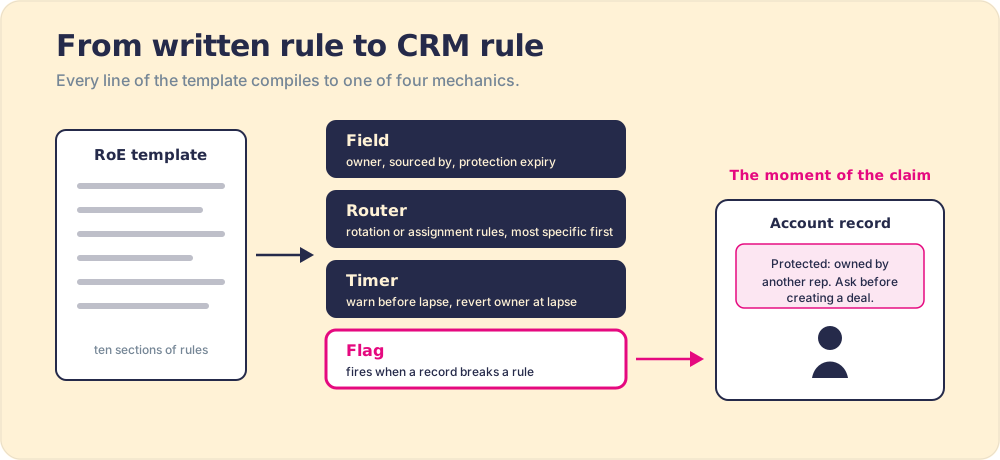
The flag is the part to get right. A violation report emailed to managers at week’s end is the locker-room rulebook again, delivered faster. The flag has to appear as the rep opens or changes the record, so the rule shapes the claim instead of judging it afterward. The weekly report then shows which rules break most, which usually points to a vague rule or a window that is too tight. Expect that tuning in the first weeks:
From the field
There’s a little bit of “let’s make sure this rule’s right.” You gotta look at them. And once it’s a rule, it won’t happen again.
How do you settle a rules of engagement dispute?
With evidence, fast, the same way each time. In a Sales Enablement Collective community thread on inbound versus outbound ownership, Nick Ziech put it plainly: “If you do something like ‘last rep to touch’ then there will be times where it goes the other way as well” (Sales Enablement Collective). Any rule produces losers. What reps will not tolerate is a rule applied differently depending on who complains.
Yochi Cohen-Charash and Paul Spector’s meta-analysis of 190 samples covering 64,757 people found that procedural justice, the fairness of how a decision gets made, was the type of fairness most tied to job performance and to counterproductive behavior at work (Cohen-Charash and Spector, 2001). People can live with losing a split. They stop cooperating when the process that decided it looks improvised.
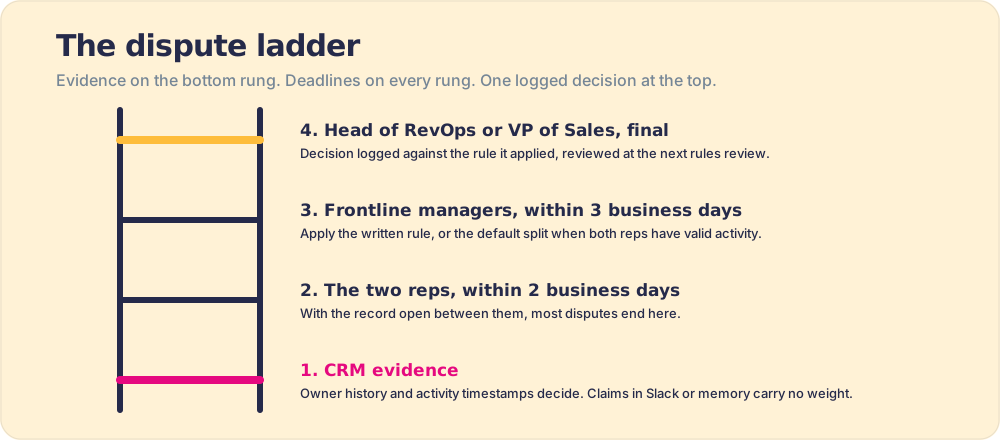
Evidence on the bottom rung ends most arguments before a manager hears them. The rest become data: a log sorted by rule shows which rule to rewrite next.
What do we recommend?
Compile each rule into the CRM as a field, a router, a timer, or a flag, and look at the violations every week. Keep the document too, as the place the rules get argued out and signed off.
Three findings in this piece point that way. Qualification odds fall within the hour, per the HBR audit, so routing cannot wait on an argument between two reps. Process in the CRM workflow outperformed process in documents, 49% to 15% quota attainment, in our survey. And Cohen-Charash and Spector found procedural fairness tied to performance and to counterproductive behavior, so a rule a system applies the same way each time earns cooperation a judgment call cannot. Leaving the rules in a PDF has a measurable price: the average company in the HBR audit took 42 hours to answer a web lead, and a lead caught between two claims waits longer still.
Supered was built for this work. Supered process rules show a rep a notification inside HubSpot when a record breaks a condition you define, with analytics on how often it happens (Supered Help Center), and Process Boards show directors whether the process is being run across the team (Process Boards for Directors). We call that delivery the Behavior Layer: the rule reaches the rep in the moment of the work, and the manager sees whether it held. To see your own rules of engagement running that way, book a demo.
The rulebook still matters. Write it, argue over it, sign off on it. Then paint the lines on the field. For what the owner has to do once the deal is theirs, read the sales process template.
Frequently asked questions
What are sales rules of engagement?+
What should a sales rules of engagement template include?+
How long should an account protection window be?+
Who owns an inbound lead from an account an SDR is already prospecting?+
How do you enforce rules of engagement in HubSpot or Salesforce?+
How do rules of engagement work for channel partners?+
Your process, running itself.