Sales Playbook Template: The Empty Container Is the Easy 10%
A sales playbook template gives you section headers and placeholders. That is the easy 10%. The hard, valuable 90% is filling it with your winning plays and getting reps to run them on real deals.
A sales playbook template is a reusable structure for documenting a team's sales plays, and it is only the container; the value is in filling it with your specific winning behaviors and getting reps to run them on real deals, not in the template itself.
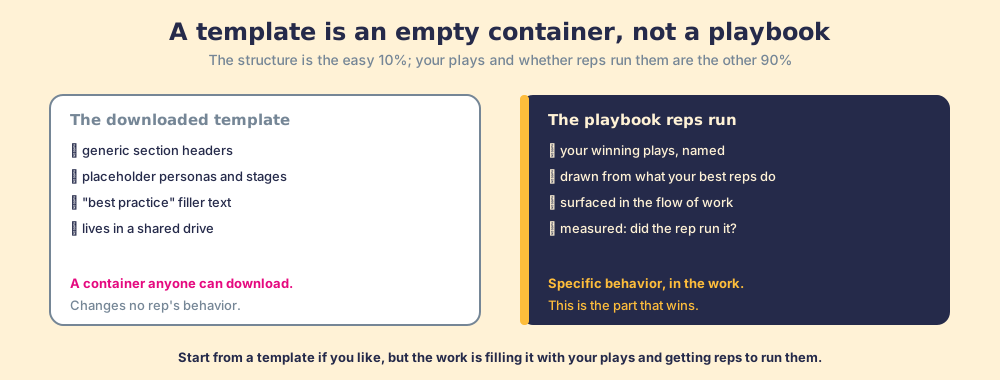
Search “sales playbook template” and you will find a hundred free downloads, each promising a ready-made playbook in a tidy document. Download one and you will have exactly what it offers: a structure. Section headers for personas, stages, qualification, messaging, objections, next steps. That structure is genuinely useful, and it is the easy 10% of building a playbook. The hard, valuable 90%, the part no template can give you, is filling those sections with your specific winning plays and getting reps to run them on real deals. A team that mistakes the downloaded template for the playbook has confused the empty container for the meal.
A sales playbook template is a reusable structure for documenting a team’s sales plays, and it is only the container; the value is in filling it with your specific winning behaviors and getting reps to run them on real deals, not in the template itself. Treat the template as step one of four, and you will build a playbook that works.
Why is a sales playbook template only the easy part?
Because structure is generic and your winning plays are specific, and only the specific part wins deals. A template can supply the skeleton because skeletons are the same across teams: every playbook has personas, stages, and objection sections. But the content that makes a playbook valuable, the move your best rep makes on a stalled deal (Gawande, on the checklist), the exact question that unlocks a discovery, the objection response that lands with your buyers, is unique to your team and cannot be downloaded. It lives in the heads and behavior of your top performers. A template hands you the parts that do not matter and leaves you the part that does, which is why a generic template, filled with best-practice filler, produces a generic playbook that changes no one’s behavior.
There is a deeper reason templates disappoint, and it is the same reason most playbooks fail: a document is not a behavior. Even a perfectly filled template is a file in a drive, and a file in a drive changes nothing until a rep runs what it describes on a real deal. The template addresses the documentation problem (what should the playbook say) and ignores the adoption problem (will reps do it), which is the knowing-doing gap that decides whether any playbook is worth the file it is stored in.
Stanford’s Jeffrey Pfeffer and Robert Sutton gave this gap its name in their book The Knowing-Doing Gap, after studying why companies that clearly know what to do so often fail to do it. Their conclusion was blunt: “knowing what to do is not enough,” and the organizations that win are the ones that close the distance between knowledge and action, not the ones that accumulate the most knowledge (Pfeffer & Sutton, on the knowing-doing gap). A filled-in playbook template is pure knowledge, the most articulate, well-organized knowledge a sales team can produce. And knowledge, on its own, has never closed a deal. The template solves the half of the problem that was never the hard half.
The asymmetry is worth naming plainly, because it is where the value lives. The structure of a playbook is commodity: any team can download it, and it looks the same whether you sell payroll software or industrial pumps. Your plays are proprietary: they are the specific moves your best reps have learned the hard way, on your buyers, in your market, and they exist nowhere on the internet. A template gives you the commodity for free and leaves you the proprietary part to build, which is exactly backwards from how it feels when you hit download and the document looks finished. It looks finished because the easy 10 percent is done. The hard 90 percent has not started.
How do you turn a template into a real playbook?
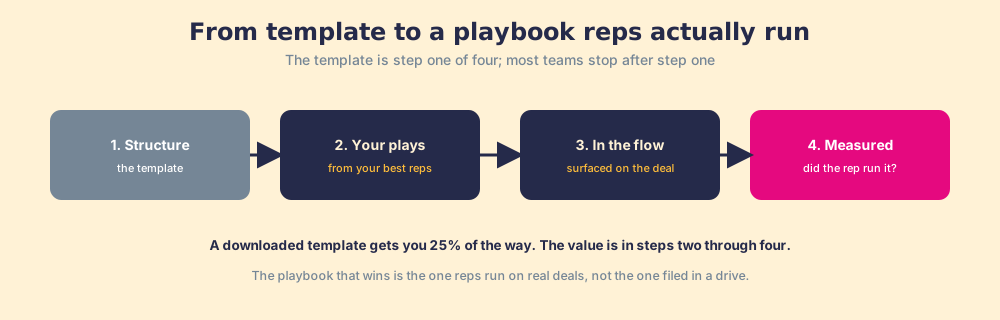
Run it through the three steps the template skips: your plays, in the flow, measured. The template is step one, structure. Step two is filling it from your best reps’ real behavior rather than from filler, documenting the specific moves that separate your top performers, the questions, the qualification, the objection handling, as named plays. That is the build covered in the sales playbook guide and the discipline behind the sales playbook. Step three is surfacing those plays in the flow of work so reps see the right move when they need it rather than in a document they never open. Step four is measuring whether the play was run, so the playbook is a managed behavior rather than a hopeful document.
- Step one, structure: the template. Useful, generic, and the easy 10%. Start here, do not stop here.
- Step two, your plays: from your best reps. Document the specific winning behavior, not best-practice filler. This is what makes it yours.
- Step three, in the flow: surface it where reps work. A play in a drive is unused; a play in the flow of work gets run.
- Step four, measured: did the rep run it? A playbook you do not measure is a document; one you measure is a behavior.
Where do the plays that fill a template really come from?
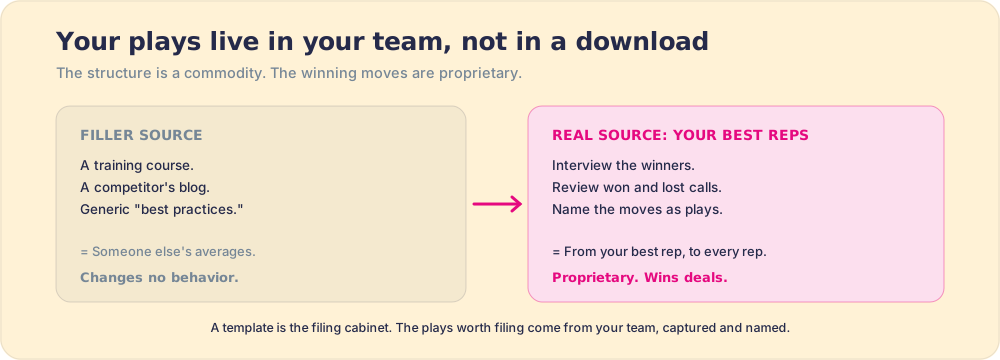
From your best reps, not from best-practice filler, and this is the single most important thing a template cannot do for you. There is a strong instinct, when a template hands you an empty “objection handling” box, to fill it with the generic objection responses you half-remember from a training course. Resist it. Those responses are someone else’s averages. The responses that work are the ones your top performers already use on your buyers, and the job is to capture and spread them, from your best rep to every rep, which is the whole logic of a playbook in the first place.
The mechanism here is the same one Atul Gawande found in surgery and aviation: experts carry knowledge they cannot fully articulate until something forces them to write it down, step by step (Gawande, The Checklist Manifesto). Your best closer does not know, consciously, why she always asks one particular question before sending a proposal. Sit with her, watch three deals, and you will find the play hiding in the behavior. That extraction work, interviewing winners, reviewing won and lost calls, naming the moves, is the part a template skips entirely, and it is the part that turns a downloaded outline into something proprietary and worth running.
A free sales playbook template is a fine place to put those plays once you have found them. It is a poor place to look for them, because they are not in the template; they are in your team. So treat any sales playbook template free download as a filing cabinet, not a source of content. The same goes for a b2b sales playbook template specifically: the B2B label tells you the structure assumes multiple stakeholders and longer cycles, which is useful, but it still cannot tell you which two stakeholders actually kill your deals or which question unlocks your particular buying committee. That is yours to discover and yours to write in.
What should a sales playbook outline contain?
It should mirror your real sales motion, not a generic list of sections. The outline should map to how your team sells: your ideal customer profile and personas, your process stages with exit criteria, your qualification framework, the messaging and value propositions that land with your buyers, the objections you hear most with the responses that work, and a named play for each stage. The difference between a useful template and a useless one is whether the sections correspond to your motion or to a vendor’s idea of a generic one. But even the right outline is still an outline: the moment it holds your specific plays and those plays are run on real deals, it stops being a template and becomes a playbook.
The sections are necessary scaffolding and worthless on their own, which is the recurring lesson here, the container is not the content.
What we recommend
Use a sales playbook template for what it is, a free head start on structure, and then do the actual work, which the template cannot do for you. The structure is the easy 10%: every playbook needs the same sections, and a download supplies them fine. The valuable 90% is filling those sections with your specific winning plays, drawn from what your best reps do rather than from generic filler, and then getting reps to run those plays on real deals by surfacing them in the flow of work and measuring whether they happen. A beautifully filled template that sits in a drive changes nothing, because a playbook is not a document, it is a behavior. So download the template, then spend your effort where it counts: on your plays, in the flow, measured. The template is the beginning of a playbook. It is nowhere near the end.
From here: the full build in the sales playbook guide, the playbook discipline in the sales playbook, the stages it documents in sales process steps, and the adoption that makes it real in sales process adoption.
Frequently asked questions
What is a sales playbook template?+
Is a downloaded sales playbook template enough?+
How do you fill in a sales playbook template?+
What should a sales playbook template include?+
Your process, running itself.