Sales Kickoff Ideas: Run a Behavior Event, Not a Party
Most sales kickoff ideas lists are about the theme, the speaker, and the party.
Here are the ideas worth running, sorted by whether they change behavior or just entertain, plus the after-plan that makes the energy survive Monday.
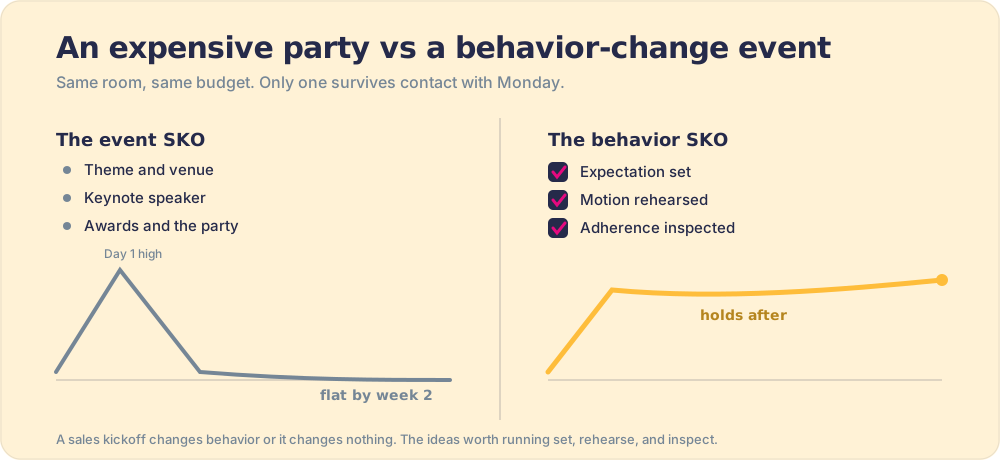
Sales kickoff ideas are the agenda choices that decide whether your SKO changes behavior or just entertains; the ones worth running set a clear expectation, rehearse the actual selling motion, and come with a plan to inspect adherence the week after.
Picture the close of a sales kickoff. The theme banner is gorgeous, the keynote speaker landed a standing ovation, the awards were handed out, and the party ran late. Three hundred reps fly home tired and inspired. Now follow one of them to her desk the next Monday. A real buyer pushes back on price in a way she has not seen, and she does what she did the week before the kickoff: alt-tabs to a folder, guesses, and promises to follow up. The room was electric. The behavior did not move an inch.
That gap is the subject of this post, and almost no list of sales kickoff ideas names it. The market treats the SKO as an event to be decorated: pick a theme, book a speaker, choose a venue, plan the ice-breakers, throw the party. All of that is the easy part, and none of it is the point. Here is our point of view, and it is the test every idea below has to pass: a sales kickoff is a behavior-change event or it is an expensive party. Knowing better is not doing better. An SKO that only informs changes nothing, because the reps already had access to the information. What they lacked was the rehearsed motion and someone checking whether they ran it. So the ideas worth running set a clear expectation, rehearse the actual motion, and come with a plan to inspect adherence the week after, so the energy survives contact with Monday.
That last clause is where most kickoffs fail without anyone noticing, so it is where we will spend the most time. First, the definition. Sales kickoff ideas are the agenda choices that decide whether your SKO changes behavior or just entertains, and the ones worth running set a clear expectation, rehearse the actual selling motion, and come with a plan to inspect adherence the week after. Everything else is staging.
Why do most sales kickoffs fade by the following week?
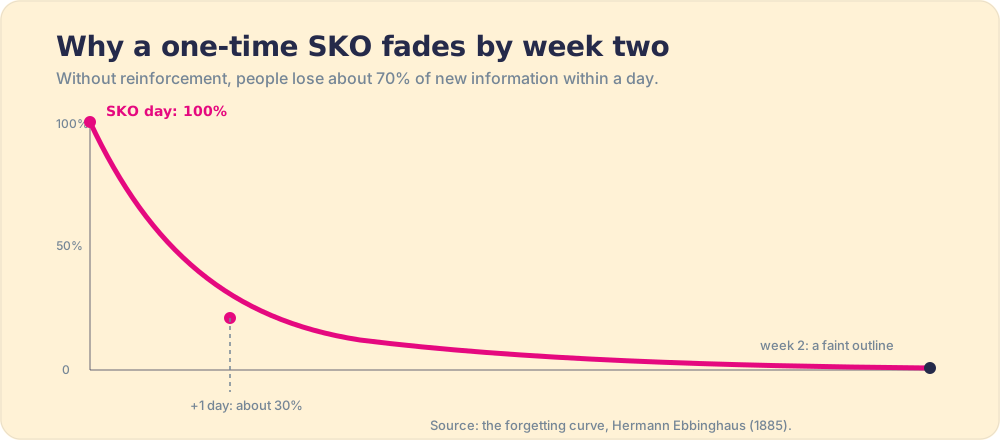
Because a kickoff is a one-time event, and one-time events are exactly what human memory is built to discard. In 1885 Hermann Ebbinghaus ran the first experiments on memory and found the forgetting curve. He measured memory as savings, the share of the original learning effort he could skip when relearning a list, and after one day only about a third was saved. A 2015 replication found the same shape: savings of about 47% after 20 minutes, 32% after a day, and 4% after a month, from one subject learning nonsense syllables (Murre and Dros, PLOS ONE, 2015). The decay is steepest right after learning. So the brilliant framing your VP delivered from the main stage is a faint outline two days later, and the new playbook you unveiled in the opening session is mostly gone before the first deal of the new quarter tests it.
This is not a discipline problem with your reps, and it is not a sign the content was weak. It is how memory works. Pour a year’s worth of strategy into two days, with no spacing and nothing to attach it to, and most of it runs straight through. The fix that memory research points to is the opposite of the firehose: distributed practice, the same material met again at the moment it is relevant, so each encounter resets the curve. A kickoff with no plan to resurface its core message in the weeks after is a kickoff designed to be forgotten.
The field knows this, sort of. The Sales Enablement Collective and most kickoff guides will tell you to “reinforce after the event,” and they are right. Where the popular advice goes soft is in treating reinforcement as a nice-to-have you bolt on if you have time, rather than the load-bearing wall the whole event rests on. We go further: the after-plan is not the follow-up to the kickoff. It is the kickoff. The two days on stage are the launch; whether anything changes is decided by what happens in the four weeks after, and you should design those weeks before you book the venue.
What sales kickoff ideas actually change behavior?
Here is the list, and it is sorted, because sorting is the argument. Most lists of SKO ideas treat a keynote and a deal clinic as equals, two line items on a sales kickoff agenda. They are not equals. One rehearses the motion reps will run on Monday; the other is a great forty minutes that the forgetting curve erases by Wednesday. So every idea below is filed under what it changes: behavior, belief, or just the mood in the room. Use the mood ideas. Just never mistake them for the work.
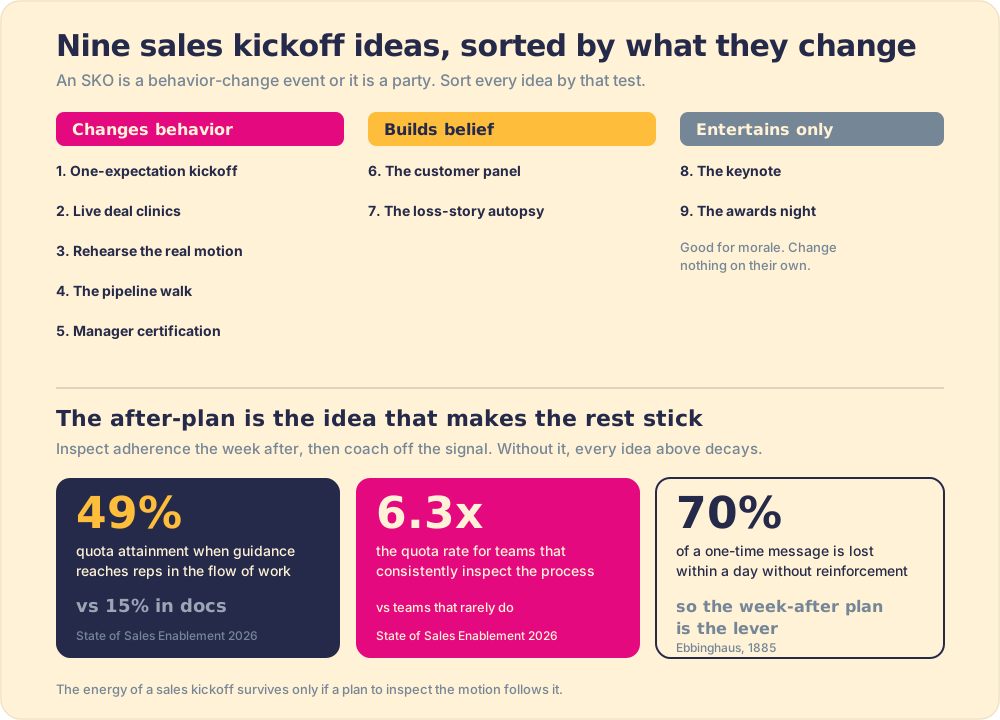
These five are the ones that move what a rep does on a real deal.
- One-expectation kickoff. Build the entire agenda around a single change you want in what reps do this year, not a parade of nine topics. A new discovery framework, or one stage that stops getting skipped. The reason is curation: too many places to act is dizzying, and a rep who leaves with one clear, checkable expectation will run it, where a rep who leaves with nine will run none. Name the one thing, and inspect it.
- Live deal clinics. Put a real, stuck deal on the screen and work it as a room, with the rep who owns it in the chair. This rehearses judgment on the actual motion, not a hypothetical, and it surfaces the real objections your team hits. Skip the polished case study; the messy live deal is where reps see the move and copy it.
- Rehearse the real motion (role-play). Reps practice the new motion against a tough buyer persona until it is muscle memory, not a slide. This is the single most under-used kickoff block, and it is the one that matters most, because selling is a motion and motions are rehearsed, not narrated. More on the mechanism below.
- The pipeline walk. Walk real, current pipeline as a group against the process you are launching, deal by deal, asking where the motion was run and where it was skipped. It makes the new expectation concrete on deals the room already knows, and it doubles as the first inspection, which is the bridge to the after-plan.
- Manager certification. Certify every frontline manager to run and inspect the new motion before reps leave the building. Reps adopt what their manager reinforces in the weeks after, so a kickoff that trains reps and leaves managers as spectators has built a fire with no one to tend it. The manager is the reinforcement mechanism; equip them deliberately.
Two more build belief, which is real and worth the agenda time, even though they do not by themselves change a motion.
- The customer panel. Put two or three real buyers on stage to describe what the buying experience felt like, where reps helped, and where they vanished. This grounds the process in the buyer’s reality, which is the reason to run one at all. Gartner has found that 77% of B2B buyers describe their most recent purchase as complex or difficult (Gartner), and hearing that from a customer lands harder than hearing it from a VP.
- The loss-story autopsy. Walk one recent, painful loss in honest detail, with the rep who lived it, naming where the motion broke. Owning a failure out loud buys more trust and teaches more than any win celebration, and it makes the case for the new process without a single slide of theory.
And two that belong in the room but change nothing on their own.
- The keynote. A strong outside speaker lifts the mood and is worth doing. Just hold it for what it is: morale, not behavior. The forgetting curve will erase the content within days, so never build the year’s strategy on a keynote and expect it to survive.
- The awards night. Recognition matters and the party is good for the team. It is also the part of the SKO that has zero relationship to whether a single deal runs differently next month. Enjoy it; do not let it become the thing the budget was really for.
That is nine ideas, not a padded ten, because the defensible list is nine.
Why does rehearsing the motion beat teaching it?
Because selling is a motion, and motions are not learned by listening. You would not certify a pilot by seating them in a lecture hall, quizzing them on aerodynamics, and then handing them a real aircraft full of passengers. You put them in a simulator and make them rehearse the actual motion, hands on the controls, until it holds under pressure. Yet most sales kickoffs are the lecture hall: two days of strategy and slides, then a sudden plunge into live buyers with the deck already forgotten.
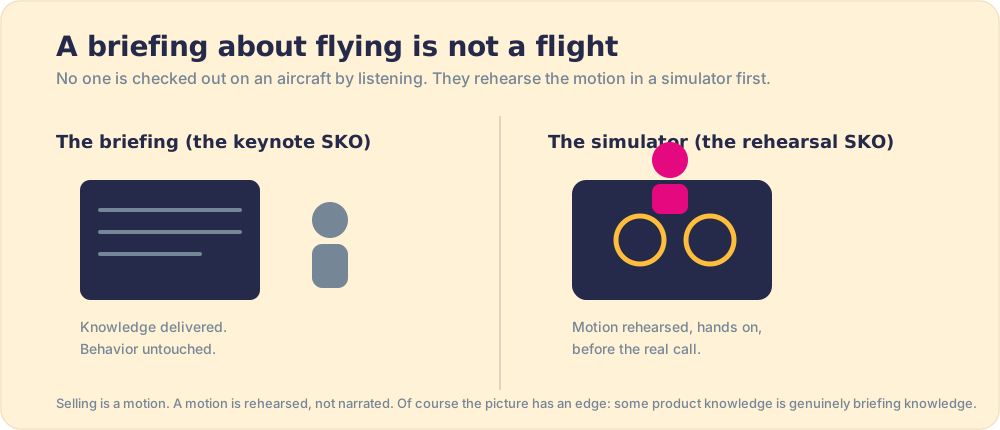
Of course the picture has an edge, and it is worth naming. Some knowledge genuinely is briefing knowledge. A rep should learn the new product and the new positioning in a room, up front, and that part of a kickoff earns its place. The argument is not that the main stage is useless. It is that the behavior, the discovery question asked at the right time, the stage not skipped, the multi-threaded deal handled the new way, cannot be installed by a slide. It has to be rehearsed, then run on real deals with guidance arriving at the moment of the work. The keynote builds the vocabulary. The role-play and the deal clinic build the seller.
This is why our own field data and the memory science point the same direction. The State of Sales Enablement 2026 found that teams whose guidance reaches reps in the flow of the work hit quota at 49%, more than triple the 15% of teams whose guidance lives in docs, wikis, and a separate tool. Same content. Different moment of delivery. The kickoff is one moment; the flow of the work is the other, and the second is where the behavior actually forms.
Teams whose guidance is embedded in the flow of work hit quota at 49 percent. Teams whose guidance lives in docs, wikis, and a separate tool hit quota at 15 percent. Same content. The moment of delivery is the lever.
How do you make a sales kickoff stick after the event?
Build the after-plan before the event, and treat it as the main act. A kickoff resets the curve once; the weeks after are where you reset it again and again until the motion holds. That means deciding, before you book the room, who inspects adherence to the new motion in the four weeks following, and how the right next step reaches reps when they need it rather than living in a deck they forget.
The lever there is inspection, and the data on it is the most striking thing we have measured. In the State of Sales Enablement 2026, teams that consistently inspect deals against a defined process hit quota at 6.3 times the rate of teams that rarely do, the single largest effect in the survey. A kickoff that launches a new motion and never inspects whether reps run it has done the launch and skipped the only thing that makes a launch matter. You can only expect what you inspect.
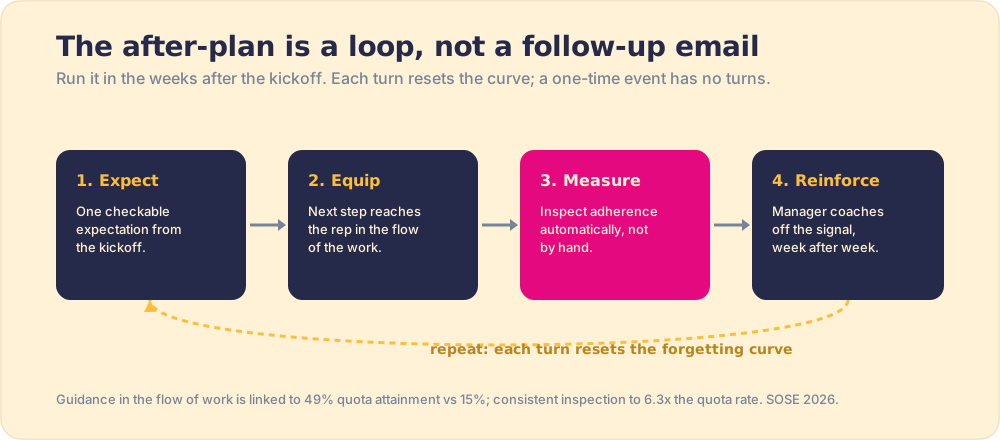
There is a trap here worth naming, because it is why inspection so often gets dropped. Done by hand, inspection is tedious, and it eats exactly the manager hours that should go to coaching the new motion. So the after-plan is not “managers, go audit deals.” It is to lift the inspection burden off the manager so the checking happens on its own and the human time goes to coaching, not chasing field updates. The reinforcement and the inspection are not two chores. They are one loop, run in the weeks after the kickoff, and the manager you certified on stage is the person who runs it. (For why measurement, not more content, is what makes a habit stick, the knowing-doing gap lays out the mechanism, and the broader sales coaching guide covers how managers run that loop without drowning in it.)
What sales kickoff themes work, and what makes a theme work?
This is where sales kickoff themes earn or lose their keep, and it is the question most SKO planning starts with, backwards. The theme gets picked first, in a room with a designer, and the agenda gets built to fit the banner. Run it the other way. Decide the one behavior you want reps running by March, then choose the words that name it. A theme like Win the First Call is only as good as the rehearsal and the inspection underneath it. A theme with a behavior under it is a strategy; a theme with only a banner under it is a slogan.
The reason this matters is in our own field data. The State of Sales Enablement 2026 found that 89% of teams have a defined sales process and only 36% see reps run it, a 53-point gap between the process on paper and the process on deals. A kickoff theme is a chance to close a slice of that gap, one motion at a time, and the test of a theme is whether you could measure adherence to it thirty days later. Here are eight that pass, each with the behavior it names and the signal a manager inspects at day 30:
- Win the First Call. Behavior: run the discovery framework on every first call. Inspect: the share of first calls with the qualification fields filled within 24 hours.
- No Deal Advances Alone. Behavior: two or more contacts on every deal before stage three. Gartner puts the typical B2B buying group at six to ten people (Gartner), so a single-threaded deal is a deal you cannot see. Inspect: contacts per open opportunity.
- Earn the Next Step. Behavior: every call ends with a scheduled meeting, not a promise to follow up. Inspect: the share of opportunities with a future-dated next step.
- Name the Number. Behavior: a quantified metric on every qualified deal, the M in MEDDIC. Inspect: opportunities with the metric field filled, and whether the number came from the buyer.
- Champion Every Deal. Behavior: a named champion by stage three, tested by asking them to do one thing for you. Inspect: the champion field filled, and one ask completed.
- Own the Paper. Behavior: procurement, legal, and security steps dated before a deal enters commit, the P in MEDDPICC. Inspect: commit deals with dated paper steps.
- Ask Before You Tell. Behavior: the discovery questions come before the pitch. Inspect: a weekly sample of call reviews scored against the question list.
- Run It Every Time. Behavior: stage-exit criteria met on every deal, the plainest theme and the one that names the 53-point gap directly. Inspect: exit-criteria completion rate by stage.
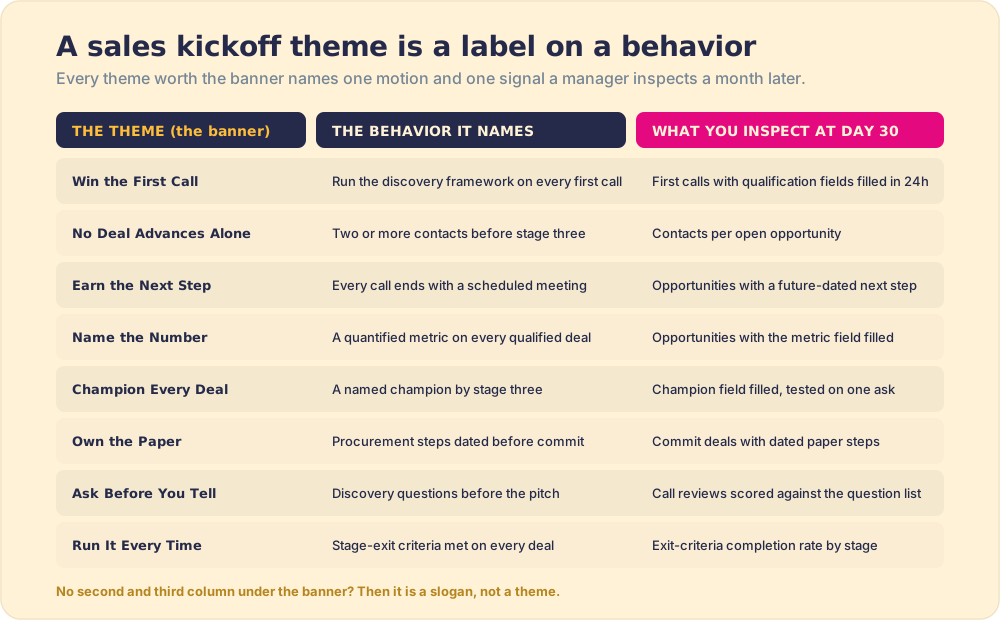
Notice what the list refuses to do. None of these themes is about attitude (Hungry, Unstoppable, All In), because attitude cannot be inspected and the forgetting curve treats a mood exactly the way it treats a slide. Each one is a sentence a manager can hold a deal up against a month later. That is the whole test. Pick the theme you can measure, put it on the banner, and build the two days to rehearse it.
What we recommend
Strip it back and a clear choice sits underneath every kickoff, and it is not about how good your theme or your speaker is. You can run the SKO as an event: a great theme, a strong keynote, an awards night, and a room that goes home inspired and unchanged. Or you can run it as a behavior-change event: one expectation, the real motion rehearsed, and a plan to inspect adherence the week after, with managers certified to run that loop.
We recommend the second, and the evidence is why. The forgetting curve says a one-time message will not survive to the first deal. Our own data says guidance in the flow of the work more than triples quota outcomes and that inspection is the largest lever there is, at 6.3 times the quota rate. Those two point the same way: the main stage is necessary, and it is not where the kickoff is won. It is won in the weeks after, in the flow of the work, with someone checking whether the motion took hold.
So keep the party. Hand out the awards, book the speaker, enjoy the night. Then stop calling any of that the kickoff. The kickoff is the motion you rehearsed and the plan to inspect it, and you can see it on the chart at the top of this post: the line that holds its level because a plan to inspect it followed the event, instead of the spike that goes flat by week two. If you want the system that puts the playbook itself in order before you launch it, start with sales enablement strategy; if you want to make a new rep’s first kickoff actually ramp them, sales onboarding covers onboarding as behavior; and if you want the numbers to judge whether the after-plan is working, sales enablement KPIs names the ones that predict the next quarter.
Frequently asked questions
What are good sales kickoff ideas?+
What should a sales kickoff agenda include?+
What are some sales kickoff themes that actually work?+
How do you make a sales kickoff stick after the event?+
How long should a sales kickoff be?+
Your process, running itself.