MQL vs SQL: Where a Marketing Qualified Lead Gets Lost
An MQL and an SQL are two judgments about the same person, made by two teams.
The definitions are easy; leads get lost in the handoff between them. Definitions, conversion benchmarks, CRM setup, and the four rules that make the handoff hold.
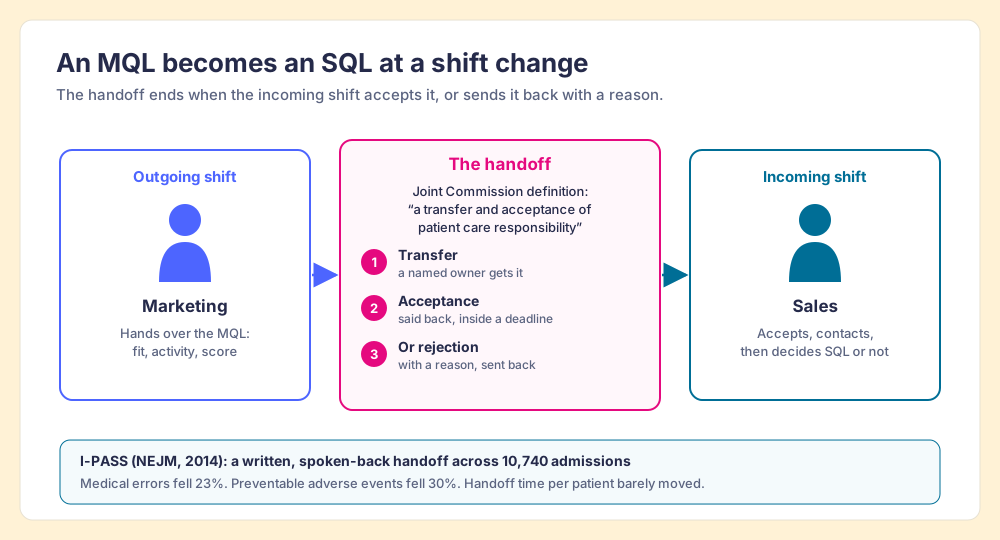
A marketing qualified lead (MQL) is a lead that marketing judges ready for sales based on fit and engagement, and a sales qualified lead (SQL) is one a salesperson has accepted, contacted and confirmed is worth pursuing as a deal.
A hospital shift change is a few minutes long and carries more risk than the eight hours on either side of it. The night nurse knows the patient. The day nurse will be responsible for the patient. In between, a sheet of paper and a short conversation have to carry everything, and when something goes wrong in a hospital, the investigators often find it went wrong right there.
A marketing qualified lead (MQL) is a lead that marketing judges ready for sales based on fit and engagement, and a sales qualified lead (SQL) is one a salesperson has accepted, contacted and confirmed is worth pursuing as a deal. Those two definitions are not hard, and the pages that rank for them explain them well. The lead gets lost in the handoff between them, in a step that HubSpot, Salesforce and Pipedrive do not model by default. Published MQL to SQL benchmarks range from 12% to 38%, and the most quoted figure, 13%, has no original source (Gradient Works). In a test of 100 companies, one in four never answered an inbound lead at all (Conversica via Business Wire, May 2023). A lead that no one called counts in your conversion rate as a lead that failed.
Medicine fixed its version of this problem with a rule about the handoff itself, and the fix carries over to sales almost line for line.
What is a marketing qualified lead (MQL)?
HubSpot’s default lifecycle stage defines a marketing qualified lead as “a contact or company that your marketing team has qualified as ready for the sales team” (HubSpot Knowledge Base, updated July 17, 2026). The definition is short because the judgment is local. Each company decides what “ready” means, and it usually decides on two kinds of evidence:
- Fit. The company and the person match your ideal customer profile: industry, size, region, role, seniority. A student who downloads your guide is engaged and does not fit.
- Engagement. The person did something that signals interest: filled in a form, attended a webinar, visited the pricing page twice, replied to an email. A perfect-fit VP who has never touched your site fits and has not engaged.
- A threshold. A common setup combines the two in a lead score and marks the MQL when the score crosses a line. Our post on HubSpot lead scoring covers how to weight fit and engagement.
The trouble with the MQL is the word “ready.” Forrester analysts Amy Hawthorne and Terry Flaherty put it bluntly: ask three people in your organization for the definition of an MQL “and we guarantee that you’ll get three different answers” (Forrester, October 30, 2023). The same post reports that fewer than 1% of leads make it from the top of the funnel to closed business. Marketing says sales ignores the leads; sales says the leads are junk. Both are describing the same gap from opposite banks.
What is a sales qualified lead?
HubSpot defines a sales qualified lead as “a contact or company that your sales team has qualified as a potential customer,” and adds that the stage includes sub-stages stored in the Lead Status property (HubSpot Knowledge Base). Pipedrive frames the same moment as converting a lead into a deal: “A lead should be converted to a deal when you are confident that lead could result in a sale or other business success” (Pipedrive Knowledge Base, updated September 23, 2026).
So what is a sales qualified lead in practice? It is a lead a person in sales has talked to. The evidence changes from what the lead did to what the lead said: a problem they confirmed, a reason to act now, someone with a say in buying. Which questions establish that is the job of a qualification framework (BANT, MEDDIC, SPICED), and our guide to lead qualification covers the choice. The SQL is the output of that conversation. A score cannot produce one.
MQL vs SQL: what is the difference?
The two labels describe the same person at two moments, judged by two teams on two kinds of evidence.
| MQL (marketing qualified lead) | SQL (sales qualified lead) | |
|---|---|---|
| Who decides | Marketing, by rule or score | A salesperson, after contact |
| Evidence | Fit plus behavior (forms, pages, events) | Need, timing and a reason to talk |
| Typical signal | Downloaded, attended, visited pricing | Confirmed a problem on a call |
| Owner | Often unassigned | A named rep |
| Next stage | Accepted or rejected by sales | Opportunity, recycled or disqualified |
| HubSpot default stage | Marketing Qualified Lead | Sales Qualified Lead |
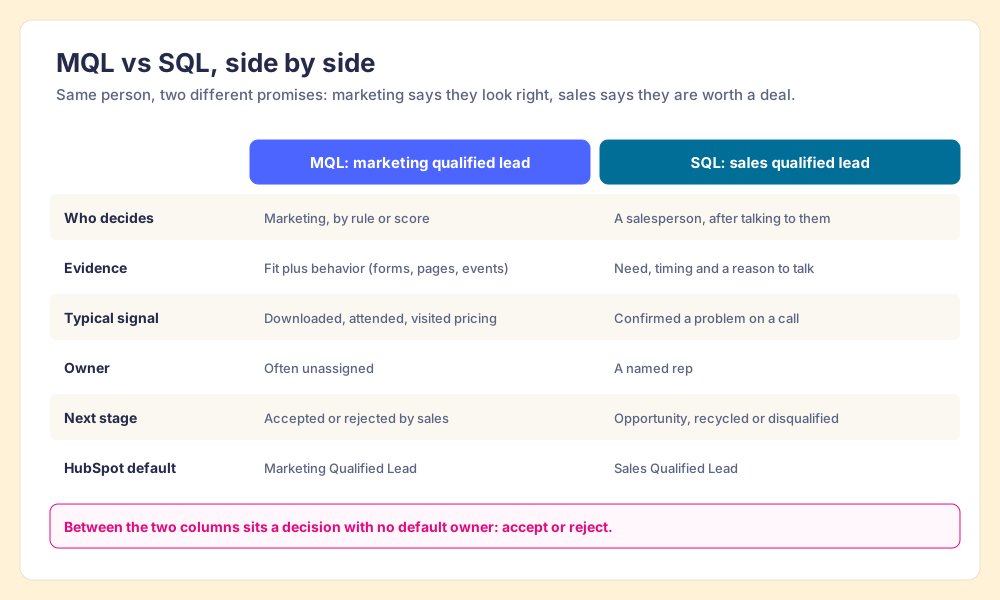
Read the “Owner” row twice. Somewhere between the two columns, a lead passes from a team to a person, and in the CRM that moment either has a rule or does not.
Where do leads get lost between MQL and SQL?
SiriusDecisions, the research firm Forrester bought in 2019, put a stage in that gap when it launched its Demand Waterfall in 2006 (Forrester, May 17, 2018). It called the stage the sales accepted lead (SAL), and its own blog calls acceptance the most important and most overlooked step in demand creation. The rules it set for the SAL read like a nurse’s handoff protocol (SiriusDecisions blog, via Forrester):
- A deadline. “With acceptance, sales is obligated to follow up with the lead in a specific timeframe (no more than 72 business hours is advisable; 24 hours is a best practice).”
- Three reasons to reject. Leads should be rejected only for procedural reasons (routed to the wrong person), clerical ones (the record is incomplete or wrong) or definitional ones (the lead does not meet the agreed thresholds).
- A target. “Organizations should strive for lead acceptance rates that are 90 percent or better.”
- A line between rejecting and disqualifying. Rejection happens before contact. Disqualification “should happen only after the rep has contacted the lead and learned that there is no interest, need, budget, etc.”
That last rule carries more weight than it looks. A rejected lead goes back to marketing as a data problem. A disqualified lead is a sales decision based on a conversation. When both land in one status called “Unqualified,” the team loses the ability to tell bad leads from unworked ones.
Medicine learned the same lesson in hospital wards. The Joint Commission’s 2017 Sentinel Event Alert defined a handoff as “a transfer and acceptance of patient care responsibility achieved through effective communication” (AHRQ PSNet summary of Sentinel Event Alert 58). Transfer, then acceptance. The night nurse going home completes the first half. The handoff ends when the day nurse has said, in effect, “she’s mine.”
The I-PASS program built that into a routine. Its last step is the receiver repeating the handoff back (AHRQ PSNet, I-PASS mnemonic). Starmer and colleagues rolled it out to resident teams at nine hospitals and tracked 10,740 admissions: the medical error rate fell 23%, from 24.5 to 18.8 per 100 admissions, and preventable adverse events fell 30% (NEJM, November 2014). Oral handoffs took 2.4 minutes per patient before and 2.5 after. The doctors were the same doctors. The handoff got a rule.
Leads are not patients. A webinar attendee who waits a day comes to no harm, and a lead, unlike a patient, can be sent back. The structure still matches: one party with the context, one party with the responsibility, and a short exchange between them that decides whether anything happens next.
Sales has its own evidence for what happens when that exchange has no rule. When HBR’s researchers audited 2,241 US companies, 37% responded to an online lead within an hour, and 23% never responded at all (Harvard Business Review, March 2011). The causes they named were all system design: “retrieving leads from CRM systems’ databases daily rather than continuously; sales forces focused on generating their own leads rather than reacting quickly to customer-driven signs of interest; and rules for distributing sales leads among agents and partners based on geography and ‘fairness.’” No one in that list is lazy. The process had no step that made acceptance happen.
What is a good MQL to SQL conversion rate?
Here are the published benchmarks, as collected by Jenn Deering Davis at Gradient Works. The spread is the first finding.
| Stage | Source and year | Published rate |
|---|---|---|
| Lead (inbound) to MQL | Winning by Design, 2023 | 11 to 15% |
| Lead (inbound) to MQL | Gartner, 2018 | 12 to 25% |
| Lead (inbound) to MQL | RevOps Squared, 2022 | 33% |
| Lead (inbound) to MQL | First Page Sage, 2021 | 39% |
| MQL to SQL | Gartner, 2018 | 12 to 26% |
| MQL to SQL | Winning by Design, 2023 | 16 to 20% |
| MQL to SQL | RevOps Squared, 2022 | 20% |
| MQL to SQL | TOPO/Gartner, 2019 | 21% |
| MQL to SQL | First Page Sage, 2021 | 38% |
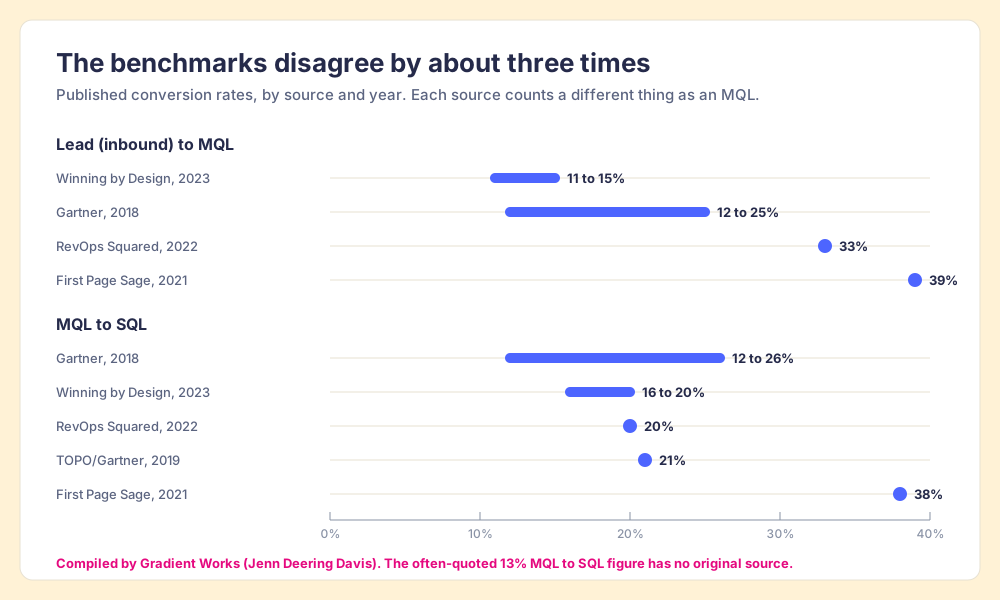
A lead to MQL conversion rate of 11% and one of 39% cannot both describe the same thing. They describe different definitions. A company that marks anyone who downloads a guide as a lead will convert a small share to MQL. A company that only counts demo requests as leads will convert most of them. Salesforce’s explainer cites the 21% figure (Salesforce, January 2024), which is a fair reference point and a poor target until your definitions match the source’s.
There is a second problem with the number, and it sits in the denominator.
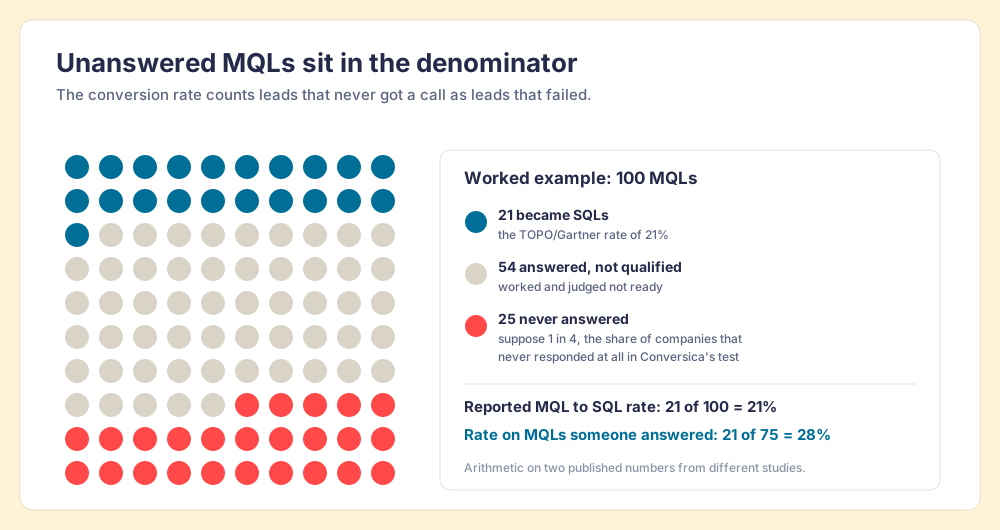
An MQL to SQL rate mixes two numbers into one: the share of MQLs sales answered, and the share of answered MQLs that qualified. The first is about follow-through. The second is about lead quality. When the rate drops, marketing hears “your leads got worse,” even if the change is that a rep went on leave and their leads sat untouched for a week.
Split it. Report the rate on all MQLs, the rate on MQLs that got a first touch, and the count that never did. A teacher who counts the exams that were never handed out as failed papers is grading the copy room along with the class.
How do you set up MQL and SQL stages in HubSpot, Salesforce and Pipedrive?
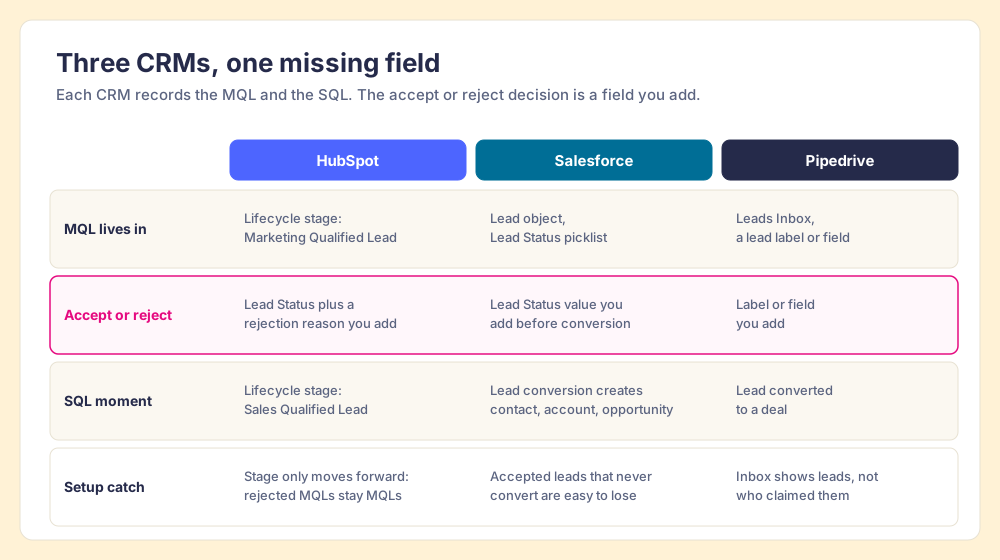
The three CRMs model the gap differently, and each has one behavior that matters for the handoff.
- HubSpot. Lifecycle stage carries Lead, Marketing Qualified Lead, Sales Qualified Lead and Opportunity by default. The catch is direction: the property “can only be moved forward by HubSpot tools” such as imports, forms and workflows, and you have to clear the value before a tool can set an earlier one (HubSpot Knowledge Base). A rejected MQL stays an MQL unless someone resets it, so your MQL count fills with leads sales already sent back. Record the accept or reject decision in Lead Status, which HubSpot describes as the property that shows where a contact is “within a buying cycle as a lead” (HubSpot default contact properties), and add a rejection reason property with the three SiriusDecisions values.
- Salesforce. The Lead object has a Lead Status picklist (“for example, Open, Contacted, Qualified,” with values set by an administrator) and a Rating picklist (Salesforce Help, lead fields). The SQL moment is usually lead conversion, which creates the contact, account and opportunity. Put the acceptance step in Lead Status before conversion, so an accepted lead that never converts is visible.
- Pipedrive. Leads live in the Leads Inbox, separate from deals, and an SQL is a lead converted to a deal. Pipedrive’s guidance is to convert when you are confident the lead could result in a sale (Pipedrive Knowledge Base). Use a lead label or field for accepted and rejected, so the inbox shows which leads someone has claimed.
In all three, the same gap shows up: the CRM records where a lead is, and no default field records whether the person who now owns it agreed to.
What rules should govern the MQL to SQL handoff?
Four rules cover it. Write each one as the bad state, the condition that should never be true, so a list of matches is a list of work.
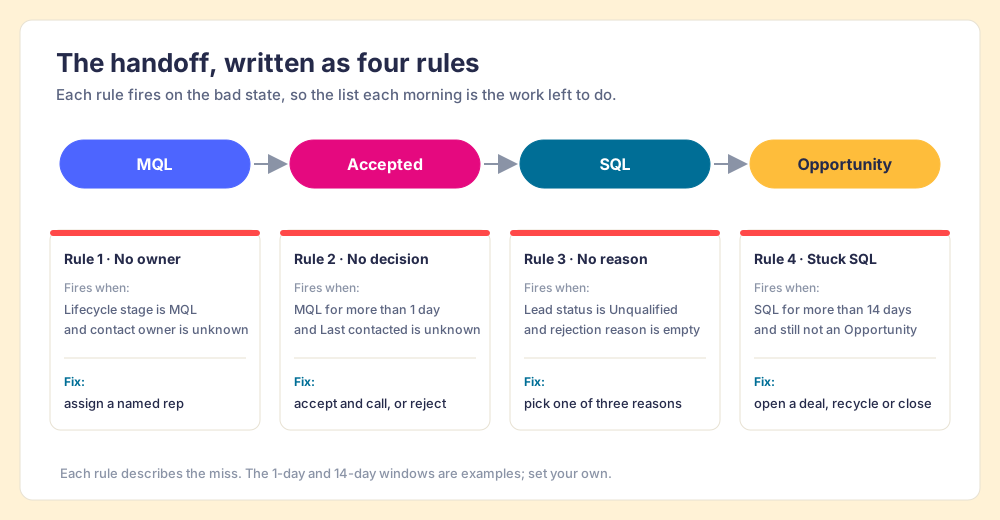
- The owner rule. No MQL without a named owner. If the lifecycle stage is MQL and the owner field is empty, the handoff has not started. Our post on lead routing covers how to pick the owner.
- The decision rule. No MQL older than one business day without a decision. The owner accepts it and makes contact, or rejects it with a reason. SiriusDecisions’ best practice is 24 hours and its ceiling is 72. The minutes clock for hot inbound requests is a separate, faster rule, covered in speed to lead.
- The reason rule. No rejection without one of three reasons: procedural, clerical, definitional. The reason is what marketing needs to fix the next batch, and an acceptance rate under 90% is the signal to look at the reasons.
- The movement rule. No SQL that sits for weeks without becoming an opportunity, being recycled to marketing, or being disqualified with a reason. HubSpot’s Opportunity stage means the contact is associated with a deal, so an SQL that stays an SQL for 14 days has no deal and no next step.
None of these rules is new. The SAL has been in the Demand Waterfall since 2006. They fail because they live in a slide from the alignment offsite, and the CRM never hears about them.
Are MQLs dead, now that buyers buy in groups?
Forrester’s position is that they should be retired. Terry Flaherty wrote in 2023 that “for most companies, it’s no longer a question of IF they leave MQLs behind, but WHEN and HOW” (Forrester, April 5, 2023). The case is strong. Buying decisions are made by groups, and Forrester’s client story on Palo Alto Networks reports that opportunities with several people attached were eight times more likely to advance in the pipeline, and that dropping MQLs for buying groups produced a 17% higher closed-won rate (Forrester client story, October 2025). Our post on the B2B buying committee covers who is in the group.
I agree with the direction and disagree with one implication people draw from it. Moving to buying groups changes the unit marketing hands over: a group of people attached to an opportunity, instead of one person who downloaded a guide. It does not remove the handoff. Someone in sales still has to accept the buying group, by a deadline, or send it back with a reason. A team that drops the MQL label without writing that rule has moved the shift change to a different ward and kept the same paper.
Where does Supered fit, and where does it not?
Supered is where the four rules live and get checked. You write each one as a Process Rule describing the bad state (lifecycle stage is MQL and the owner is unknown; the MQL date is more than 1 day ago and Last contacted is unknown), the way the Supered help center describes building rules. The rules run against contact and lead records in HubSpot, Salesforce or Pipedrive. Records that break a rule land on a Process Board that reps open inside their CRM, and managers get a daily or weekly summary by email or in Slack. If the rep works in Claude, the same rules are readable there, and Claude can draft the first-touch email or fill in the rejection reason from the call notes for the rep to review.
Checking is the part that moves results. In The State of Sales Enablement, teams that inspect deals against a defined process at the highest frequency hit quota at 6.3x the rate of the lowest band (The State of Sales Enablement). A handoff agreement in a slide deck is a process without inspection.
Choose something else if your problem is upstream of the handoff. Supered does not score leads or assign them, and its relative date conditions run in days, so it will not alert a rep at minute four. For scoring, use your marketing automation or HubSpot’s scoring tools. For assignment and the first five minutes, use your CRM’s assignment rules or a dedicated router. Use Supered for the rules that say the handoff happened.
Process Compliance, which includes Process Rules and Process Boards, is $40 per user per month paid yearly ($45 monthly), with a five-user minimum (Supered pricing). Supered started inside RevPartners, the HubSpot partner I founded, and it is rated 4.9 on G2 from 81 reviews (checked October 2, 2026). The sales expectations use case shows a board running, and you can book a demo to see the four handoff rules on your own MQLs.
What we recommend
Write the handoff agreement as rules your CRM checks every night, and start with the decision rule: no MQL older than one business day without an accept or a reject. It is the rule that turns an MQL into a person’s job.
The two common alternatives each leave a hole:
- Definitions only. Marketing and sales agree on what an MQL and an SQL are and leave the step between them to good intentions. The conversion rate then mixes lead quality with follow-through, and the two teams argue about a number neither can read.
- A written SLA, checked at the quarterly review. The SiriusDecisions terms are right: an owner, a 24-hour decision, three rejection reasons, a 90% acceptance target. Checked once a quarter, they find the misses after the leads are cold.
Two fields back this. SiriusDecisions has told B2B teams since 2006 that acceptance decides whether marketing’s leads get worked, and I-PASS showed that a handoff with a spoken-back acceptance cut medical errors by 23% without making the handoff longer.
If your leads are reaching an owner but not reaching an ending, read our post on lead routing next. It picks up where this one stops, after the SQL has a name on it.
Frequently asked questions
What is a marketing qualified lead?+
What is a sales qualified lead?+
What is the difference between an MQL and an SQL?+
What is a good MQL to SQL conversion rate?+
What is a good lead to MQL conversion rate?+
Are MQLs dead?+
Your process, running itself.