Highspot Pricing in 2026: The $50,000 Floor, the Merger, and Your Renewal
Highspot pricing in 2026: the $66 per user starting rate and $50,000 yearly minimum on its AWS listing, the $60,004 Vendr median, the costs beyond the quote, and what the Seismic merger does to your renewal.
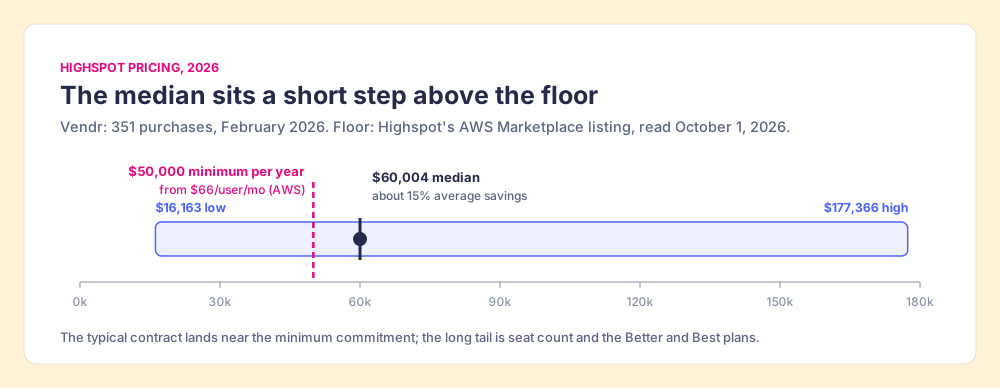
Highspot pricing is quote-based and per user: the only vendor-stated figures sit on its AWS Marketplace listing, plans from $66 per user per month with a $50,000 minimum per year, and Vendr's data on 351 purchases puts the median contract at $60,004.
Some restaurants will seat a large party in the back room only against a minimum spend. Book the room for twenty and the bill is the room’s minimum, whether twenty people eat or sixty. The menu prices are real. They stop mattering until the table fills up.
Highspot sells the same way, and it prints the minimum in one place only. Highspot pricing is quote-based and per user: the only vendor-stated figures sit on its AWS Marketplace listing, plans from $66 per user per month with a $50,000 minimum per year, and Vendr’s data on 351 purchases puts the median contract at $60,004 (AWS Marketplace, read October 1, 2026; Vendr, February 2026). At $66 a seat, $50,000 buys about 63 seats. Below that headcount, the per-user price is decoration. And since August 18, 2026, Highspot is part of Seismic, which removes the one competitor its buyers used to quote at renewal.
If you are pricing Highspot, the short answer by who it fits:
- Highspot (now part of Seismic). Upper mid-market and enterprise teams that want content, training, and coaching on one platform. From $66 per user per month, $50,000 yearly minimum, Vendr median $60,004.
- Supered. HubSpot and Salesforce teams of 10 or more whose gap is reps following the process while they work. Published price: $40 per user per month paid yearly for Process Compliance, 5-user minimum.
- HubSpot Sales Hub playbooks. HubSpot teams that need a few call guides and already pay for Sales Hub Professional, $90 per seat per month billed annually.
How does Highspot pricing compare with the alternatives?
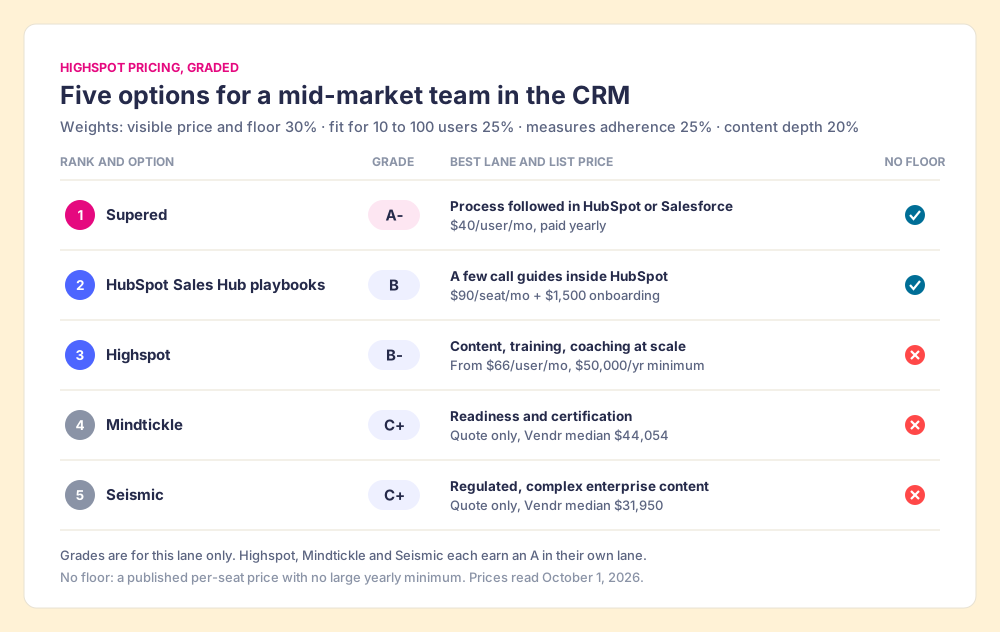
Prices were read from each vendor’s pricing page, its AWS listing, or Vendr on October 1, 2026. The grades use one lens, stated so you can flip it: a mid-market team on HubSpot or Salesforce deciding what to buy. Weights: price you can see before a sales call and the floor you must clear (30%), fit for a 10 to 100 person team in the CRM (25%), measures whether reps followed the process (25%), content and training depth (20%). Each tool earns an A in its own lane; the grade is for this lane only.
| Rank | Tool | Grade | Best fit | CRM integration | Setup effort | Pricing (plan with the feature) | Reason to switch |
|---|---|---|---|---|---|---|---|
| 1 | Supered | A- | Teams of 10+ running a process in HubSpot or Salesforce | Native in HubSpot and Salesforce; Chrome extension on other web apps | Live in under a week | Process Compliance $40/user/mo paid yearly, 5-user minimum | Published price, no $50,000 floor, adherence measured by rep and rule |
| 2 | HubSpot Sales Hub playbooks | B | HubSpot teams needing a few call guides | Native (it is HubSpot) | Already installed | Sales Hub Professional $90/seat/mo billed annually, $1,500 onboarding | Already in the bill |
| 3 | Highspot | B- | Upper mid-market content, training, and coaching | Native CRM integrations, no added fee | About 2 months (G2 via Flowla) | From $66/user/mo, $50,000/yr minimum; Vendr median $60,004 | Stay if one platform for content and training is the job |
| 4 | Mindtickle | C+ | Sales readiness and certification | Integrations | An implementation project | Quote only; Vendr median $44,054 | Training depth |
| 5 | Seismic | C+ | Regulated, complex enterprise content | Integrations | About 4 months (G2 via Flowla) | Quote only; Vendr median $31,950 | Same company as Highspot since August 2026 |
Why trust this breakdown?
I started RevPartners, a HubSpot partner that reached Elite tier in 13 months and sold roughly twice as much Sales Hub as any other partner, and Supered grew out of that work. We compete with Highspot when a team’s problem is reps running the process inside the CRM, so read this page knowing we sell one of the options. Every Highspot figure here links to the vendor’s own listing, Vendr’s transaction data, or G2, with a date. Highspot holds 4.7 out of 5 from 1,206 reviews on G2, and Supered holds 4.9 out of 5 from 81 reviews on G2 (both read October 1, 2026).
How much does Highspot cost in 2026?
Highspot’s pricing page lists three plans and no prices. It also now carries a line it did not have last year: “Highspot is part of Seismic.”
- Good, “Equip and engage.” Content organization and AI search, Sales Plays, Digital Sales Rooms, CRM integration, analytics, and Highspot Agents.
- Better, “Train and practice.” Adds skills and competencies, training authoring, role play with AI feedback, and automated nudging.
- Best, “Coach and reinforce.” Adds meeting intelligence, meeting recaps, coaching analytics, an MCP server, and integrations with Agentforce, Microsoft Copilot for Sales, and Slack AI.
The prices live elsewhere, in three places that do not agree.
| Source | What it says | Date |
|---|---|---|
| Highspot on AWS Marketplace | ”Plans starting at $66/user/month”; Highspot Minimum Deal Price $50,000 per 12 months | Read October 1, 2026 |
| Vendr, 351 purchases | Median $60,004 a year; range $16,163 to $177,366; about 15% average savings | February 2026 |
| Buyer comments via Flowla | $45 to $65 per user per month, plus a one-time $5,000 implementation fee | Updated March 2026 |
| Flowla’s sample deals | 30 users for 24 months at $76k; 260 users for 12 months at $117k | 2025 deals |
The AWS line is the one to anchor on, because Highspot wrote it. It also explains the shape of Vendr’s data. A $60,004 median sitting a short step above a $50,000 floor says the typical buyer signs near the minimum commitment, and the long tail up to $177,366 is large seat counts and the Better and Best plans. Vendr’s tier names (Core, Advanced, Enterprise) predate the current Good, Better, Best packaging, so read Vendr by contract size rather than plan name. The AWS listing adds that CRM integrations cost nothing extra, so the Highspot Salesforce integration and the HubSpot one ride along with the seat, and that “adding capabilities like training, coaching, or meeting intelligence can affect your final per-user rate.”
What does Highspot pricing per user come to for a smaller team?
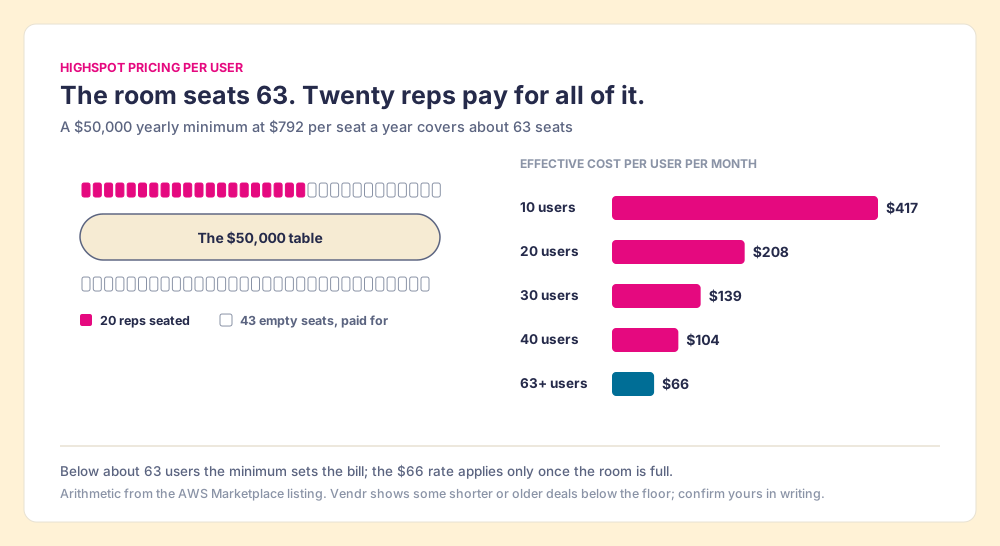
Divide the floor by the starting rate and you get the room size. $66 a month is $792 a year per seat, and $50,000 divided by $792 is about 63 seats. A team of 63 or more pays the rate. A team below it pays the room.
| Team size | Annual at the $50,000 minimum | Effective Highspot cost per user per month |
|---|---|---|
| 10 users | $50,000 | $417 |
| 20 users | $50,000 | $208 |
| 30 users | $50,000 | $139 |
| 40 users | $50,000 | $104 |
| 63+ users | $792 per user and up | $66 and up |
This math rests on the AWS listing, and your quote may differ. Vendr’s range starts at $16,163, and Flowla’s sample includes a 7-month deal for 90 users at $26k, so shorter terms and older contracts land under the floor. Ask your rep in writing which minimum applies before you compare per-user numbers, because for a 20-person team the Highspot cost per user is $208 a month, not $66.
What does Highspot pricing leave off the quote?
The subscription is the visible line. Vendr and G2 price the rest.
- Onboarding fees. $10,000 to $50,000 or more, per Vendr. Flowla puts implementation and migration at $15,000 to $45,000 depending on content volume and integrations.
- Training services. $5,000 to $25,000 (Vendr).
- Total cost of ownership. Vendr’s estimate runs 15 to 30 percent above the initial subscription once services land.
- The renewal escalator. Annual increases of 3 to 7 percent are typical, and negotiated caps often sit at 3 to 5 percent (Vendr).
- Modules. The Better and Best plans and add-ons change the per-user rate. One G2 reviewer, a CX marketing manager at an enterprise, put the frustration plainly: “I’d rather pay a slightly higher price for all the content updates and AI updates to be included at the base price point.”
- Time. G2 buyer data reported in Flowla’s Highspot pricing guide puts implementation at about 2 months and time to ROI at about 15 months, with buyers negotiating around 18 percent off the first quote.
At the median, a $60,004 subscription plus 15 to 30 percent puts the Highspot cost for year one between about $69,000 and $78,000, before a single rep has changed what they do.
How does the Seismic merger change Highspot pricing and renewals?
A town with two gas stations at the same crossroads has cheap gas, because each station can see the other’s sign. The morning the two stations merge, the price on the sign does not change. It changes the next time you need to fill the tank. And if the town council approved the merger, it is worth asking why.
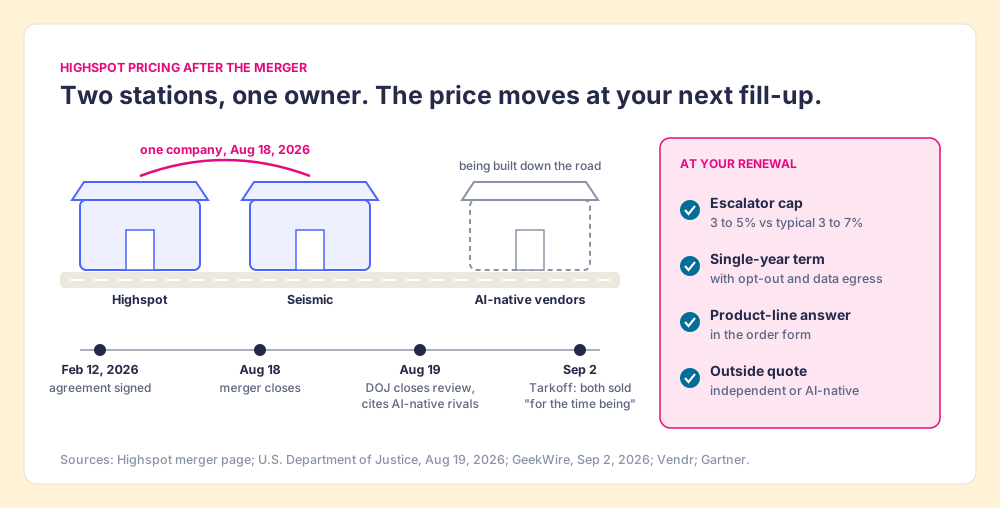
The dates come first. Highspot and Seismic signed a definitive agreement on February 12, 2026 and closed on August 18, 2026; the combined company operates as Seismic (Highspot merger page). We covered the deal itself in the Highspot-Seismic merger. On August 19, the Justice Department closed its antitrust investigation with no conditions, and its statement names the reason. Deputy Assistant Attorney General G. Charles Beller noted that merging companies “often claim that AI is a disruptive force,” and the Division found that “AI-native firms are growing quickly to win sales enablement software platform customers and are increasing competitive pressure on legacy providers” (U.S. Department of Justice).
Read that as a buyer. The regulator approved the merger because a new station is going up down the road. Your discount used to come from the station across the street. Vendr’s own Highspot advice still lists “leveraging competitive alternatives” as a core tactic and names Seismic first among Highspot’s competitors. That alternative now sits on the same cap table.
What Seismic has said since the close, from CEO Rob Tarkoff in GeekWire on September 2, 2026:
- Both products stay, for now. “The current Highspot and Seismic platforms both will continue to be sold and supported for the time being,” with migration “when one is ready” and no timeline.
- Seats stay. “Seat-based subscriptions aren’t going away, because enterprises want predictable costs.” The company says it is working toward “pricing tied to outcomes rather than usage.”
- Scale. About $600 million in combined annual recurring revenue, roughly $200 million of it from Highspot.
- Segments. Highspot serves “upper mid-market and lower enterprise customers”; Seismic serves “complex enterprise workflows and regulated industries.”
Highspot’s merger page tells customers that “your current customer success or account contact remains your primary point of contact” and that changes will be shared “as decisions are finalized.” Nothing on it addresses pricing or renewals.
So, the renewal plan for a Highspot customer:
- An escalator cap. Vendr reports negotiated caps of 3 to 5 percent against a typical 3 to 7. Get the cap in writing for every remaining year.
- A shorter term with exits. Gartner’s first take on the merger advised single-year renewals, price and opt-out protections, and secured data egress until the go-forward platform is clear (Gartner). A three-year discount buys less when the product’s future is “for the time being.”
- A product-line answer. Ask which platform your plan’s features land on after consolidation, and put the answer in the order form.
- A quote from outside the merged company. The Justice Department told you where the competition sits. Bring a real quote from an independent or AI-native vendor 90 days before renewal.
Why do teams look past Highspot at renewal?
Four reasons show up in the sources above, and none of them is that Highspot is a weak product. Its 4.7 rating across 1,206 G2 reviews says the opposite.
- The floor against team size. A $50,000 minimum is sized for 63 or more users. A 20-person team pays $208 a seat for software priced at $66.
- Modular pricing. Training, coaching, and meeting intelligence each raise the per-user rate, and reviewers would rather see them in the base price.
- Roadmap uncertainty. “For the time being” is an accurate answer from Seismic’s CEO, and it is a hard one to sign a three-year term against.
- The gap between capability and use. Forrester’s read on the merger: “Clearing that bar will require GTM organizations to do the harder work of aligning their people, processes, and data to turn better technology into better execution” (Forrester).
The fourth reason is the expensive one, and no pricing tier touches it.
Is Highspot worth the price if reps do not change what they do?
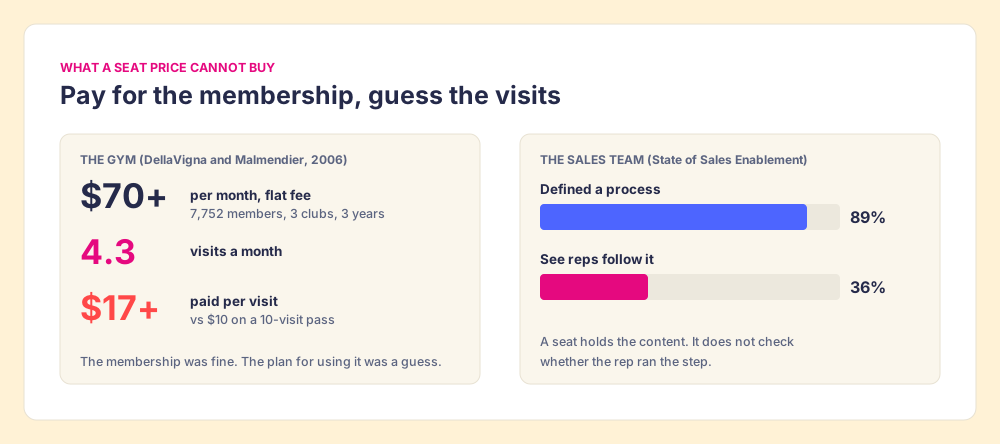
In 2006, Stefano DellaVigna and Ulrike Malmendier studied 7,752 members of three U.S. health clubs over three years. Members who chose a flat monthly fee above $70 went 4.3 times a month, paying more than $17 a visit when a 10-visit pass cost $10 a visit (American Economic Review). The researchers traced it to overconfidence about future attendance. The membership was fine. The plan for using it was a guess.
Enablement contracts get signed the same way. The buyer prices the membership, seats and modules and escalators, and assumes the visits. Our research on what happens after the signature found that 89 percent of teams have a defined sales process while 36 percent see reps follow it (The State of Sales Enablement). A Highspot seat holds the content. It does not check whether the rep ran the step.
The fix in both cases is the same: make the visit happen where the person already is, and count it. Teams that inspect deals against a defined process at the highest frequency hit quota at 6.3x the rate of the lowest band, per the same research. Inspection by hand eats a manager’s week, which is why it slides. Automated, it runs on every record.
What is the Highspot alternative for HubSpot and Salesforce teams?
Supered is built for one job: getting a team of 10 or more people to follow the process inside HubSpot or Salesforce, and showing managers who did. The rules live in Supered as Process Rulesets and Process Rules. Reps meet them in the CRM while they work, or in Claude or another LLM through our MCP server, and the Process Board shows compliance by rep and by rule. The same rules apply on any screen, which is the story behind sales expectations.
Supered prices per user on a published list:
- Digital Adoption. Cards, step-by-step guides, Action Plans, and Updates in the flow of work. $13.50 per user per month paid yearly, $15 paid monthly.
- Process Compliance. Everything in Digital Adoption, plus Process Rules that flag a record the moment it breaks the standard and the Process Board that reports adherence. $40 per user per month paid yearly ($480 per seat a year), $45 paid monthly, 5-user minimum.
- Time to live. Customers go live in under a week, sometimes in one day. Preferred HubSpot partners can implement it, or we support your own team directly.
- Standing. The #1 sales enablement app on the HubSpot marketplace, a HubSpot Premier Tech Partner, with 6,000+ installs. Works in HubSpot, Salesforce, and Pipedrive. See Supered for HubSpot and Supered for Salesforce.
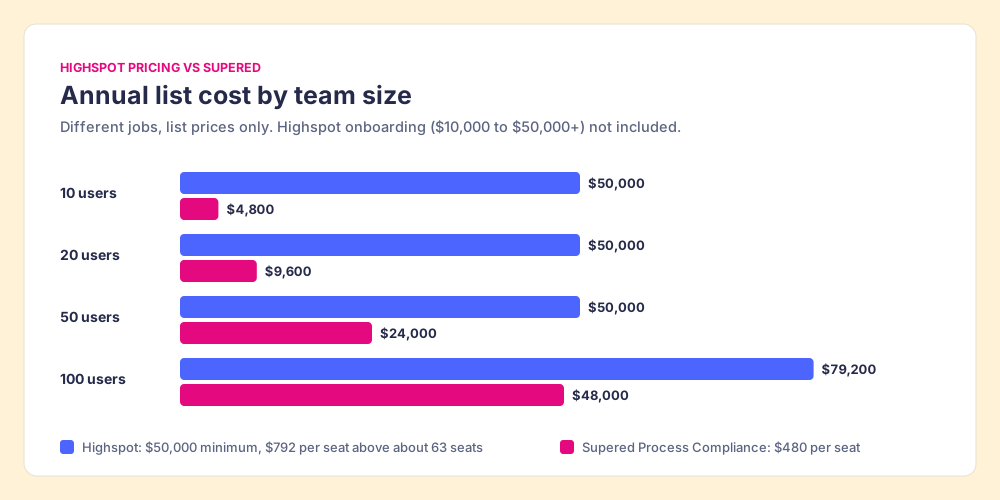
Priced side by side, as list prices only and for different jobs:
| Team size | Highspot at the AWS floor and rate | Supered Process Compliance, paid yearly |
|---|---|---|
| 10 users | $50,000 | $4,800 |
| 20 users | $50,000 | $9,600 |
| 50 users | $50,000 | $24,000 |
| 100 users | $79,200 | $48,000 |
Choose something else if:
- A content library at scale. Thousands of assets, governance, and Digital Sales Rooms are Highspot’s lane, and Supered does not replace them.
- Formal training and certification. Highspot’s Better plan or Mindtickle is built for course authoring and role play.
- Field or mobile-first teams. Supered has no mobile product and fits teams that work at a computer.
- Fewer than 10 people. Our fit starts at teams of 10.
What are the other options to Highspot?
- HubSpot Sales Hub playbooks. The question behind “Highspot vs HubSpot” is usually whether HubSpot already covers it. Sales Hub Professional costs $90 per seat per month billed annually, $100 monthly, plus a required $1,500 onboarding fee, and lets you “create up to 5 playbooks” (HubSpot pricing). Good for a handful of call guides; it does not grade adherence rule by rule.
- Seismic. The enterprise content platform for regulated industries, and since August 18 the same company as Highspot. Vendr median $31,950 a year; see our Seismic pricing breakdown.
- Mindtickle. Readiness and certification depth, a 4.7 rating across about 2,223 G2 reviews as of July 2026, and a Vendr median of $44,054. Details in Mindtickle pricing.
The full graded field is in Highspot alternatives, and the product-by-product view is in Supered vs Highspot.
What we recommend
Start with the floor. If your team is 63 users or more and the job is one platform for content, training, and coaching, Highspot earns its median price, and a 4.7 rating from 1,206 G2 reviewers backs that. Negotiate a 3 to 5 percent escalator cap, a single-year term with opt-out and data egress, and a written answer on which product line your plan lands on. If your team is under 63 users, compare the per-user cost at the minimum, $208 at 20 users, against what you need. And if what you need is reps following the process inside HubSpot or Salesforce, buy the measurement before the membership: a $40 seat that checks the process on each record costs less than an empty chair at a $50,000 table, and it is the lever the 6.3x finding points to. Book a demo and we will show you your own process, checked rule by rule.
Frequently asked questions
How much does Highspot cost in 2026?+
Does Highspot have a minimum contract?+
What is Highspot pricing per user?+
How does the Seismic merger affect Highspot pricing?+
What hidden costs come with Highspot?+
Highspot vs HubSpot: which costs less for a HubSpot team?+
Your process, running itself.