Mindtickle Pricing in 2026: The Real Contract Numbers, and the Cost the Quote Hides
Mindtickle publishes no prices, so we pulled the contract data: a 44,054 dollar median, an 11,068 to 139,140 dollar band, the module math behind the spread, and the recurring cost no proposal shows.
Mindtickle pricing is quote-based and per-user: there is no public list price, and Vendr's marketplace data puts the median contract at 44,054 dollars a year across 64 purchases, inside a band running from 11,068 to 139,140 dollars depending on seats, modules, and term.
Walk into a tailor’s shop with no prices in the window and you know two things before you sit down: the suit will fit, and the number will depend on who is asking. Mindtickle sells the same way. No plan grid, no calculator, no list price anywhere on the pricing page. A sales conversation goes in, a quote comes out, and two buyers of what looks like the same product can walk away with numbers twelve times apart.
Mindtickle pricing is quote-based and per-user: there is no public list price, and Vendr’s marketplace data puts the median contract at $44,054 a year across 64 purchases, inside a band running from $11,068 to $139,140 depending on seats, modules, and term. That band answers “how much does Mindtickle cost.” Where you land in it depends on three dials, and the quote leaves out one cost that comes back every year.
Mindtickle earns the category it leads, with a 4.7 rating across roughly 2,223 G2 reviews, and ElevateOS, its agentic enablement operating system, shipped in April 2026. The full field of Mindtickle alternatives is scored elsewhere; this page is only about the money.
How much does Mindtickle cost in 2026?
Every figure below carries its source and date.
| Question | The number | Source, date |
|---|---|---|
| Public list price | None; quote-only through sales | Mindtickle / G2, July 2026 |
| Median annual contract | $44,054 | Vendr, 64 purchases, Feb 2026 |
| Contract band | $11,068 to $139,140 per year | Vendr, Feb 2026 |
| Reported per-seat range | $15 at the floor; $30 to $50 per user per month typical | Prospeo; RevPilots |
| Typical contract term | 36 months (shorter terms raise the rate) | RevPilots |
| Onboarding and implementation | $10,000 to $50,000+ | Vendr, Feb 2026 |
| Average negotiated savings | 17.68% off the first quote | Vendr, Feb 2026 |
| Annual price escalators | 3 to 7% built into contracts | Vendr, Feb 2026 |
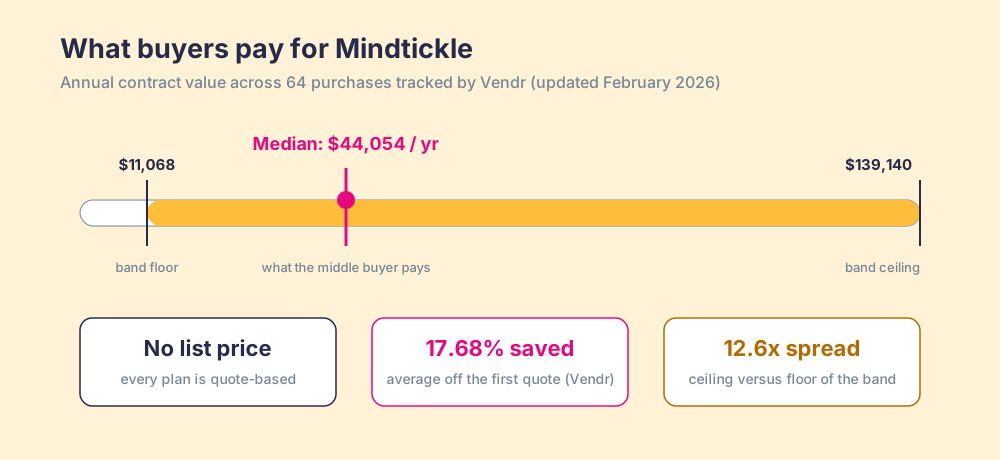
Hold the spread in mind. The ceiling of that band is 12.6 times the floor, and even the published guidance disagrees with itself: Vendr’s own buyer guide sketches 50-user deployments at $75,000 to $150,000 a year while its marketplace median, built from closed deals, sits at $44,054. Both numbers come from the same firm. Quote-based pricing scatters the reference points, because each deal is a private negotiation. In practice, anchor your budget at the median, treat the guide bands as the ceiling a first quote may test, and remember that the average buyer who negotiated got 17.68 percent knocked off.
What drives Mindtickle pricing so far apart?
Three dials, and the module dial moves the most.
- Modules. The Core Readiness Platform (onboarding, training, role-plays, coaching, analytics) is the base quote. Call AI, the conversation-intelligence module, adds an observed $50 to $100 per user per year on top (Vendr). Digital Sales Rooms and Revenue Intelligence, bundled, add 20 to 40 percent to total contract value.
- Seats and term. Per-user pricing falls as seat counts rise, and Mindtickle prefers multi-year deals: RevPilots reports a typical 36-month term, with shorter commitments raising the per-user rate.
- Timing. Mindtickle’s fiscal year ends in January, and Vendr’s negotiation data says the October-to-December window is where quotes soften most.
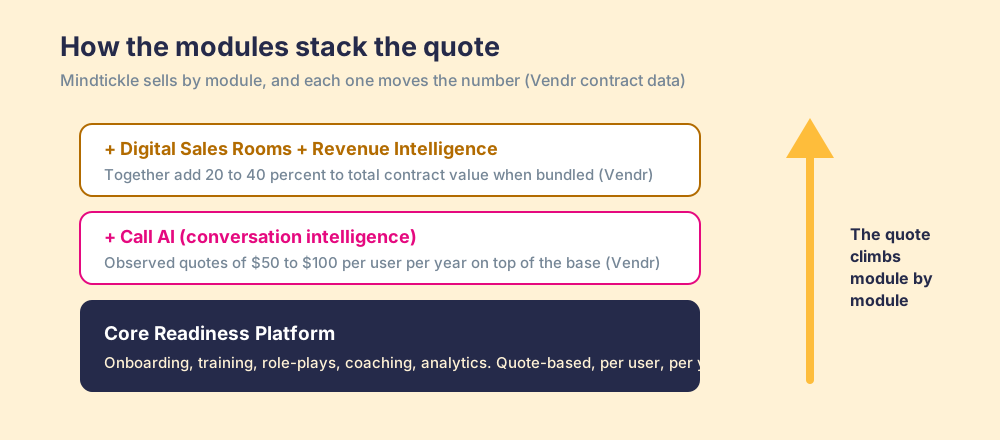
The stack explains the scatter. A 40-seat team on the base platform and a 200-seat team running all four modules are both “Mindtickle customers,” and their invoices differ by an order of magnitude.
What does Mindtickle cost for a 50 to 100 rep team?
Run the math from the reported per-seat range, the closest thing to Mindtickle pricing per user that exists in public, and it brackets the median neatly. At RevPilots’ reported $30 to $50 per user per month, 75 reps cost $27,000 to $45,000 a year for the base platform, which is where Vendr’s $44,054 median sits once a module or two lands on top. A 50-rep team at the same rate runs $18,000 to $30,000; a 100-rep team, $36,000 to $60,000 before add-ons.
Then year one adds the entry fee. Vendr puts onboarding for a 50-user deployment at $10,000 to $25,000, and RevPilots pegs a lighter implementation at $3,000 to $5,000 over six to eight weeks. Budget the middle. And read the escalator clause before you sign: Vendr’s data shows 3 to 7 percent annual increases written into contracts by default, which compounds a $44,000 year-one deal toward $50,000 by year three unless you cap it.
So plan on roughly $40,000 to $70,000 in year one for a 75-rep mid-market team, subscription plus onboarding, before Call AI or the buyer-facing modules. Push the quote against the 17.68 percent average savings and the fiscal-year-end window, and the low end of that range is winnable.
What hidden costs should you budget beyond the quote?
The proposal shows the subscription. Four more costs sit under the waterline, and the deepest one never surfaces on any invoice.
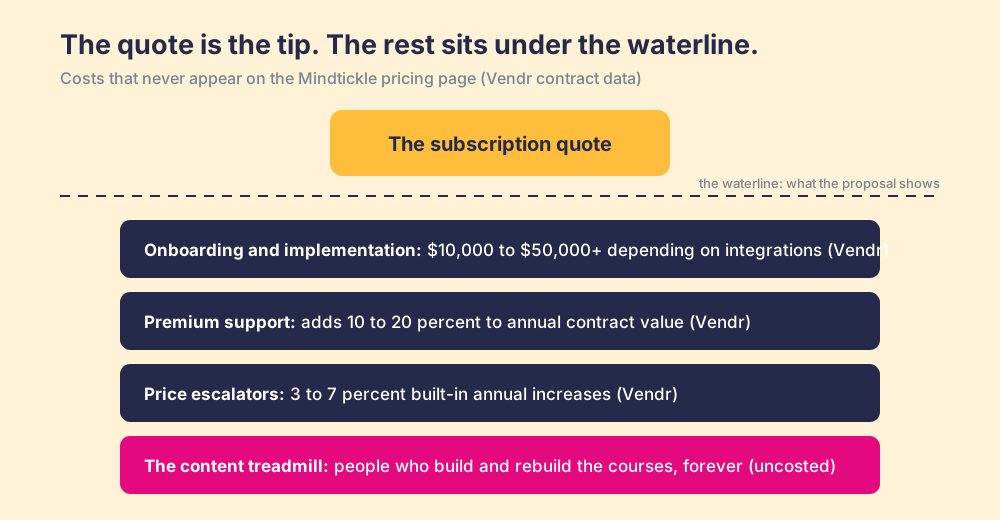
- Onboarding and implementation. $10,000 to $50,000+ depending on integrations and complexity (Vendr). CRM connections to Salesforce or HubSpot ride inside this; custom work costs more.
- Premium support. A dedicated CSM and faster SLAs add 10 to 20 percent to annual contract value (Vendr).
- Escalators and expansion. The 3 to 7 percent annual increases, plus pro-rated fees when you add users mid-contract.
- Content services. Vendr reports professional-services engagements for course and role-play development running $5,000 to $50,000+ when teams buy the building rather than staff it.
That last line is the tell, because it prices, once, a cost that recurs forever. A readiness platform runs on courses, and courses are a library where the books expire. Change the pricing, retire a product, revise the sales process, and a shelf of certifications drifts out of date until a person notices and rewrites it. The librarian never leaves the payroll. Input-based enablement, knowledge packaged ahead of the work, carries this treadmill by design, because the content has to be rebuilt as fast as the business changes. The deeper economics of that trade sit in sales readiness software, but the budgeting rule is short: whatever the quote says, add the salary fraction of whoever owns the course catalog, every year, forever.
Who should pay Mindtickle’s price, and who should not?
The fair verdict, both directions.
The teams that should pay it. Regulated industries where a rep saying the wrong sentence is a compliance event, pharma, financial services, insurance, and any org that must prove certification at scale. There, sales certification is the control itself, and Mindtickle leads that job with the G2 record to show for it. Large distributed teams ramping cohorts of hires get the same value: bootcamps, scored role-plays, and a Readiness Index do that job far better than a shared drive of decks.
The teams that should not. A 30-rep team whose reps are already trained is buying the wrong instrument. The band floor of $11,068 plus onboarding buys a certification engine, and their problem is rarely certification. The broader category trade-offs, including lighter and cheaper readiness tools, are mapped in Mindtickle alternatives and in the wider guide to sales training software. If the budget line next to readiness is conversation intelligence, the same quote-based logic, plus a metered AI credit, is unpacked in Gong pricing.
What does a readiness contract never buy?
One question matters more than any negotiation tip. Certification proves the rep knows the standard. It cannot prove the rep does the standard, because the exam happens away from the work, like a driving test that ends before the driver meets traffic. Our research across 198 sales teams found 89 percent had a documented sales process while 36 percent saw it followed as designed (The State of Sales Enablement). The knowledge was delivered. The behavior did not follow it into the work. And when reps drift from a process they were certified on, that is a system failure. The standard sat in a course, and nothing cued it at the moment of the choice.
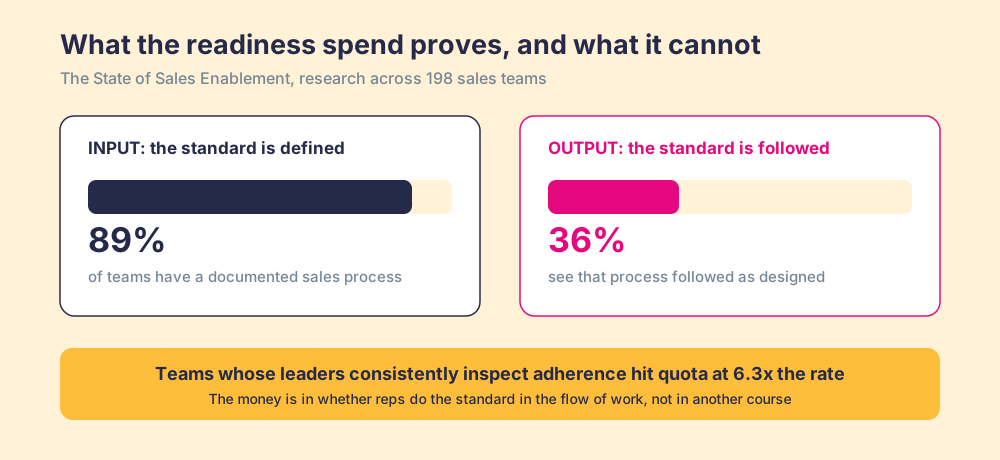
The same research shows where the money hides: teams whose leaders consistently inspected adherence hit quota at 6.3 times the rate of teams that did not. That is training on output. Set the expectation, then measure whether the work matches it, deal by deal, rather than measuring whether the training was consumed. A readiness contract, at any point in the $11,068-to-$139,140 band, prices the input side of that ledger. The output side, surfacing the standard in the flow of work and measuring whether it ran, is a different product, and it is the side Supered was built for: the Business Logic Layer that puts the next step inside HubSpot, Salesforce, Gong, Gmail, and LinkedIn the moment a rep needs it, then shows you adherence as a fact.
What we recommend
- The anchor number. Budget from Vendr’s $44,054 median, not from a first quote; the band runs $11,068 to $139,140 and the average negotiator saves 17.68 percent.
- The module discipline. Start with Core Readiness alone. Call AI at $50 to $100 per user per year and the +20 to 40 percent buyer-facing bundle can wait until the base earns its keep.
- The contract reads. Cap the 3 to 7 percent escalator, price onboarding into the deal, and negotiate in Mindtickle’s October-to-January window.
- The treadmill line. Add the recurring cost of course ownership to your total, because the contract never will.
- The prior question. Decide which side of the input-output line your problem lives on. If reps do not know the standard, Mindtickle is a category leader at a knowable price. If reps know it and the work does not show it, fund measurement of the work first: book a demo and bring one process your team is certified on and still skips.
The tailor’s suit will fit. Make sure it is the garment you needed.
Frequently asked questions
How much does Mindtickle cost?+
What is Mindtickle pricing per user?+
Does Mindtickle have a free trial or free plan?+
What hidden costs come with Mindtickle?+
Is Mindtickle worth the price?+
Everything we have written on Mindtickle
More on Mindtickle
Supered vs Mindtickle: compared by the jobYour process, running itself.