FullEnrich Review 2026: A Personal Shopper With No Store of Its Own
FullEnrich holds 4.8 on G2 and finishes fourth of 13 in Clay's North America work-email test.
A FullEnrich review built on its own verification rules, independent coverage data, what 239 reviewers praise and dislike, and who should buy it.
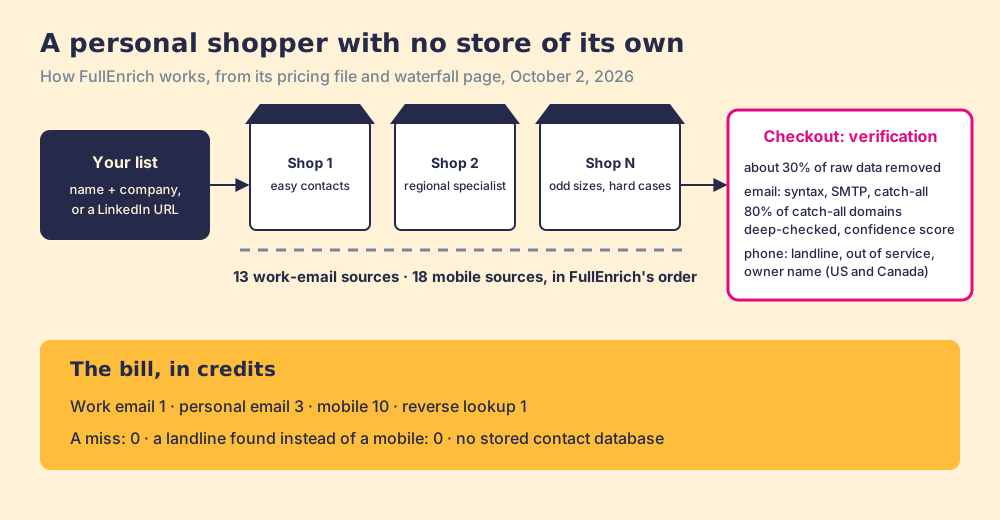
This FullEnrich review grades FullEnrich, a waterfall enrichment service that checks 13 work-email and 18 mobile sources in real time and charges only for verified finds, on coverage, accuracy, price, the rep's workflow, and compliance.
A personal shopper owns no store. You hand over a list, and she walks the high street on your behalf: the department store first, the boutique that carries the odd sizes next, the outlet at the end of the road if both come up empty. She checks each item before she buys it, and she charges you only for what she brings home. Her value is the walk and the checking. Her weakness is that she can only bring back what the shops on her route stock.
FullEnrich is that shopper for contact data, and this FullEnrich review grades it as one. The short answer:
- FullEnrich itself. A good buy for a team with no Clay and no one to build a waterfall: emails it finds are rated highly, misses cost nothing, and every plan has unlimited users. From $29 a month.
- Supered Prospector. The pick for a team that already pays for Clay: reps run the GTM engineer’s waterfall across 200+ vendors, FullEnrich as one step if it earns one, from LinkedIn and the CRM record. $45 per rep per month, billed annually.
- Findymail. The non-Clay switch when email accuracy decides it: first of 13 in Clay’s North America email test, with a Chrome extension. From $99 a month for the team.
This FullEnrich review grades FullEnrich, a waterfall enrichment service that checks 13 work-email and 18 mobile sources in real time and charges only for verified finds, on coverage, accuracy, price, the rep’s workflow, and compliance. It earns a B+ overall from us. The detail below shows where the plus comes from and where the grade drops.
Is FullEnrich legit?
Yes. FullEnrich held 4.8 out of 5 from 239 reviews on G2 on October 2, 2026 (G2, FullEnrich reviews). Its pricing file lists “SOC 2 Type II, GDPR, CCPA” and links a public SOC 2 report (fullenrich.com/pricing.md, opened October 2, 2026). It raised a €1.9 million seed round in February 2025 (EU-Startups), and a news search on October 2, 2026 found no later round or acquisition. Clay has listed it as a data provider since November 30, 2024 (Clay, FullEnrich integration).
One line in that pricing file deserves a second read: “Real-time lookups, no stored contact database.” Most contact-data companies own a warehouse of records and sell from it. FullEnrich says it owns no warehouse at all; it asks its suppliers at the moment you ask it. That changes what a FullEnrich review has to grade. The question is never “how good is FullEnrich’s database,” because by its own account there is none. The questions are how well it walks the route, how carefully it checks what it brings back, and what it charges for the walk.
How does FullEnrich work?
You send a name and a company, or a LinkedIn URL, by CSV, API, or an integration such as HubSpot, Zapier, Make, n8n, or Clay. FullEnrich routes the request “through 20+ data providers in an optimized sequence,” with “Regional specialists” prioritized by where the contact sits (fullenrich.com/waterfall-enrichment). Its pricing page counts 13 sources for work email and 18 for mobile. The providers named on the waterfall page include Clearbit, Wiza, ContactOut, Anymail Finder, Snov, and Hunter.
The checking is where FullEnrich earns its fee, and it publishes the rules. Each email passes “syntax, SMTP, and catch-all verification (80% of catch-all domains are deep-checked) with a confidence score.” Each phone is checked for landline, out-of-service status, and owner-name match in the US and Canada. And FullEnrich says “~30% of raw data is removed by verification before it ever reaches the user.” Three of every ten items the shopper picks up go back on the shelf.
The bill follows the checking. A lookup that finds nothing costs nothing; “A landline found instead of a mobile costs nothing.” A work email costs 1 credit, a personal email 3, a mobile 10.
Is FullEnrich’s data accurate?
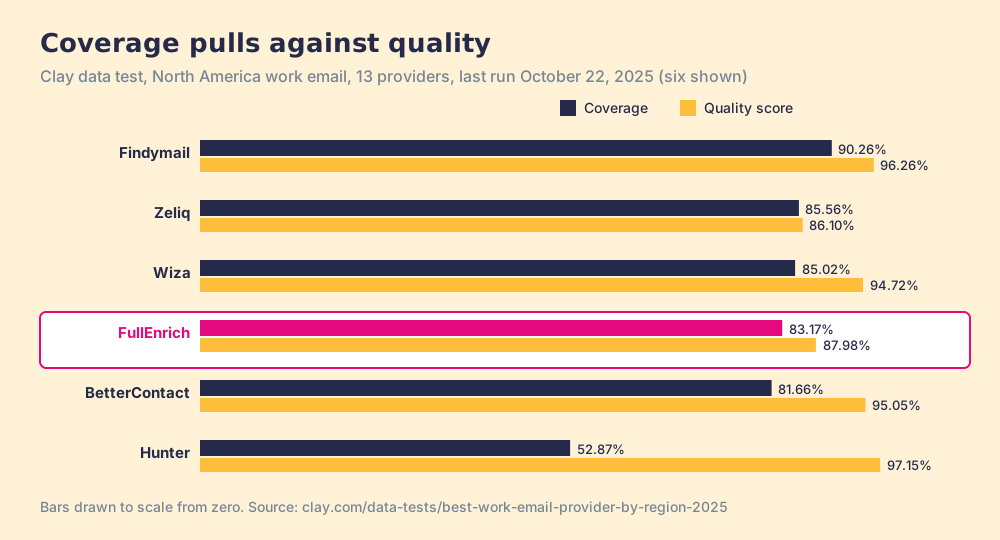
FullEnrich’s own claim is modest and specific: an email find rate of “~80% on average; varies by region and seniority.” The best outside check we found is Clay’s, which tests every provider in its marketplace on the same contacts. In its work-email test for North America, last run October 22, 2025, FullEnrich found an email for 83.17% of contacts with a quality score of 87.98%, fourth of 13 providers on coverage, at 1.5 Clay credits a lookup (Clay data test, work email by region).
| Provider (Clay test, North America work email) | Coverage | Quality score | Clay credits per lookup |
|---|---|---|---|
| Findymail | 90.26% | 96.26% | 0.5 |
| Zeliq | 85.56% | 86.10% | 2 |
| Wiza | 85.02% | 94.72% | 1 |
| FullEnrich | 83.17% | 87.98% | 1.5 |
| BetterContact | 81.66% | 95.05% | 1.5 |
| Hunter | 52.87% | 97.15% | 0.4 |
Two things in that table teach more than the rank. First, coverage and quality pull in opposite directions. Hunter returns an email for barely half the contacts and posts the highest quality score in the test; it answers only when it is sure. FullEnrich sits near the top on coverage and in the middle of the pack on quality.
Second, the reason is structural, and it follows from the shopper. A waterfall’s first stops answer the easy contacts. The contacts that reach the fourth or fifth stop are the hard ones: the new hire, the small company, the executive with a thin footprint. The shops that stock those odd sizes are often the ones whose fit is least reliable. So a waterfall’s coverage climbs with every source it adds, and its quality drifts toward the quality of the sources that answered the hard cases. BetterContact, also a waterfall, posts similar coverage and a higher quality score, because each shopper walks a different route.
Reviewers draw the same line between emails and phones. “Their emails are almost never bad data, their phone numbers are a bit less reliable but it’s still very good,” wrote a small-business developer in September 2024; a small-business sales rep wrote in August 2025 that “Many of the leads email and phone numbers are either inaccurate or out of date.” Clay’s test is one market and one data type, run a year ago, so treat it as a direction. Your own market is the test that counts: spend the 50 free credits on contacts whose emails and numbers you already have, and count.
What do FullEnrich reviews praise and complain about?
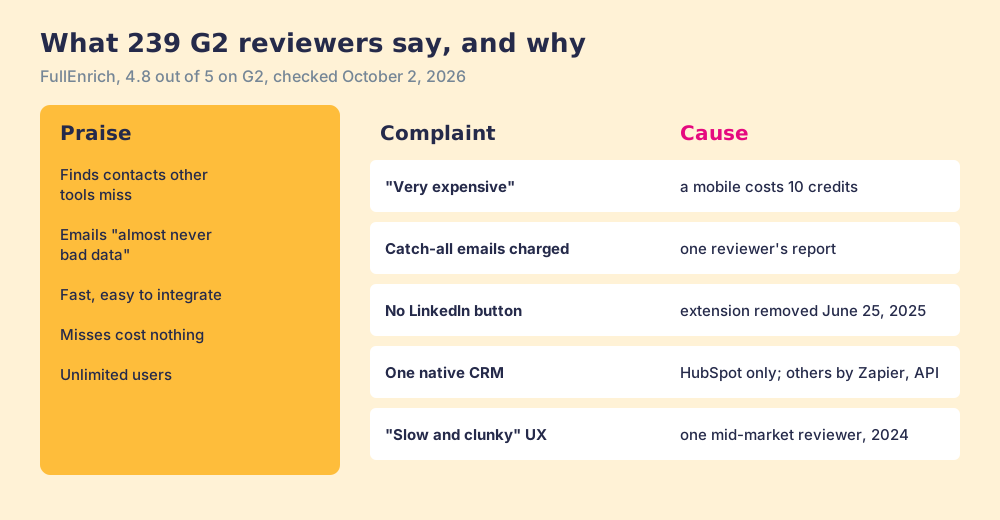
The praise is consistent and specific. “It aggregates info from multiple providers, making it stand out. It’s fast, easy to integrate, and the info it provides is almost always accurate,” wrote a mid-market senior BDR in March 2026. A recruiter wrote the same month that “It finds the coordinates you are looking for more often than its competitors and with remarkable reliability.”
The complaints cluster in four places.
- The price of a phone. A staffing-industry reviewer gave one star in January 2026: “Very expensive. Charges for ‘maybe’ emails as well as catch-all emails.” The first half is arithmetic: a mobile costs 10 credits, so a phone-led team spends most of its balance on phones. The second half disputes FullEnrich’s “verified, or it’s free” line. FullEnrich’s rules describe catch-all checks with a confidence score and do not say a low-confidence catch-all is free, so ask before you buy.
- The missing LinkedIn button. “FullEnrich lacks a native LinkedIn extension, which was removed,” an account executive wrote in November 2025. The extension left the Chrome Web Store on June 25, 2025, and the FullEnrich Chrome extension page covers what replaced it.
- One native CRM. FullEnrich’s integrations page lists HubSpot as its only CRM (fullenrich.com/integrations); Salesforce and Pipedrive go through Zapier, Make, n8n, or the API.
- The interface. A mid-market telecom reviewer wrote in November 2024 that the “UX is slow and clunky.”
How much does FullEnrich cost?
One Pro plan, sized by credits. FullEnrich’s pricing file, opened October 2, 2026, lists a free trial with 50 credits and no card; Pro from $29 a month for 500 credits through $55 for 1,000 to $3,500 for 100,000; and annual billing from $312 a year for 6,000 credits to $37,800 for 1,200,000, which it calls “~10% cheaper.” Unused credits roll over 3 months on monthly plans and 12 on annual. All plans include unlimited users, so a team of ten pays what a team of one pays for the same volume. A mobile at the $55 tier works out to $0.55. The FullEnrich pricing page prices a 1,000-name list tier by tier.
Why trust this review?
I started RevPartners, a HubSpot partner that did only sales implementations, sold roughly twice as much Sales Hub as any other partner, and reached Elite tier in 13 months. Supered came out of that work and is the #1 sales enablement app on the HubSpot marketplace, with 5.0 from 122 reviews there and 4.9 out of 5 from 81 reviews on G2 (checked October 1, 2026). That is also the disclosure: we make Supered Prospector, which runs Clay’s waterfall, and Clay can run FullEnrich as a step. We have no commercial tie to FullEnrich. The scorecard states its grades so you can disagree with them.
How does FullEnrich score, and how does it compare?
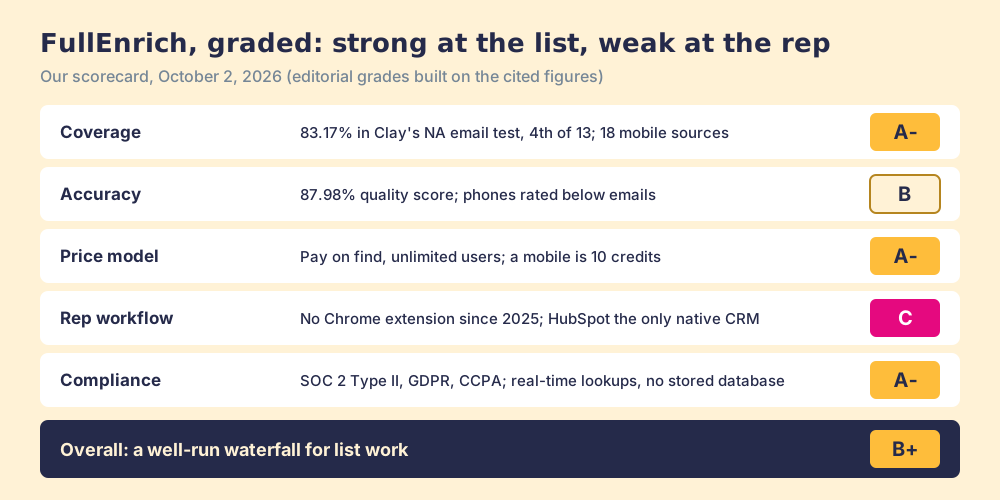
Our scorecard grades FullEnrich on the five things a buyer hires it for. These are our judgments, built on the figures above.
| Dimension | Grade | Why |
|---|---|---|
| Coverage | A- | 83.17% in Clay’s North America email test, fourth of 13; 18 mobile sources |
| Accuracy | B | 87.98% quality score, below Findymail, Wiza and BetterContact; phones rated below emails |
| Price model | A- | Pay on find, unlimited users, no seat fee; a mobile is 10 credits, and one reviewer reports catch-alls billed |
| Rep workflow | C | No Chrome extension since 2025; HubSpot the only native CRM |
| Compliance posture | A- | SOC 2 Type II, GDPR, CCPA; real-time lookups, no stored database |
| Overall | B+ | A well-run waterfall for list work, weakest where the rep works |
Against the field, the lens is a sales team of ten to fifty reps that wants verified contacts where reps work and a leader who can follow the lists. Coverage x3, rep-side delivery x2, price structure x2, what the leader sees x2, outreach x1, out of 50; the scores match the FullEnrich alternatives page.
| Rank | Tool | Grade | Score | Best fit | CRM integration | Setup effort | Pricing | Reason to switch from FullEnrich |
|---|---|---|---|---|---|---|---|---|
| ref | FullEnrich | B | 27 | A ready-made waterfall with no Clay | HubSpot native; others via Zapier, Make, API | Minutes | Pro from $29 a month, unlimited users | Stay if no one will build a waterfall |
| 1 | Supered Prospector | A | 44 | Teams that already pay for Clay | Native (HubSpot, Salesforce, Pipedrive) | Under a week on an existing Clay account | $45 per rep per month billed annually, plus your Clay plan | Your engineer’s order across 200+ vendors, run from the profile |
| 2 | Apollo | A- | 36 | Data, dialer and sequences in one plan | Native (HubSpot, Salesforce) | A day | $49 a seat a month billed annually | Cheaper phones, outreach included |
| 3 | Findymail | B+ | 29 | Email accuracy first | Native (HubSpot, Salesforce, Pipedrive, Clay) | Minutes | Starter $99 a month for the team | First of 13 in Clay’s email test, Chrome extension |
FullEnrich’s 27 on this lens is lower than its B+ on our scorecard because the lens weights the rep’s workflow and the leader’s view, the two places FullEnrich does not try to compete. Prospector’s coverage score is Clay’s waterfall, credited to Clay, and its outreach score is the lowest possible on purpose: no sequencer, no dialer.
Where does Supered Prospector fit?
Go back to the shopper. FullEnrich walks its own route, in its own order, and keeps its own accounts with the shops. Clay hands you the high street: 200+ data and AI vendors under one contract (clay.com, checked October 2, 2026), with your GTM engineer writing the route, paying with Clay credits or your own provider accounts, and landing every result in your own table. FullEnrich can be one of the shops on that route; Clay lists “Find mobile phone with FullEnrich” and “Find Work Email with FullEnrich,” each on “Clay Credits or Bring Your Own Account.” Both waterfalls charge nothing for a miss. The difference is who writes the route, and whose table the result lands in.
What a Clay team lacks is a way for reps to send the shopper out from where they stand. Prospector brings no database of its own; it brings Clay’s waterfall, which is every database, routed, and it runs inside the Supered Chrome extension on the team’s Clay account. Reps never open Clay.
- Lookups from the page the rep is on. A LinkedIn profile, a company website with company research, or a HubSpot, Salesforce, or Pipedrive record; in Sales Navigator, reps add leads to a prospect list and push the list to a Clay table.
- Your engineer’s route. Cheap shelves first, FullEnrich behind them for the hard cases if it earns the place, and a buying-committee lookup tuned to the titles and seniority the team chose.
- Context before the first touch. The matching CRM record and whether the prospect was already worked in the past, before anyone adds a duplicate.
- One click to the CRM. Field mapping set once, into HubSpot, Salesforce, or Pipedrive.
- Found, worked, closed. The leader sees who is working their list, and every lead ends the way the process says: qualified, recycled, or disqualified.
Prospector works within LinkedIn’s terms and does not copy search results in bulk; the contact data comes from Clay’s waterfall on the customer’s Clay account. For ten reps, Clay Growth at $495 a month ($5,940 a year, 72,000 data credits) plus Prospector at $45 per rep per month billed annually is $11,340 a year (Prospector).
Choose something else if you do not have Clay. Prospector runs on the customer’s Clay account and does nothing without one, and Clay says it plainly: “GTM engineers build on Clay.” If no one on your team will write the route, FullEnrich has already written a good one. The sourcing use case shows the Clay setup when it is in place.
Who should buy FullEnrich?
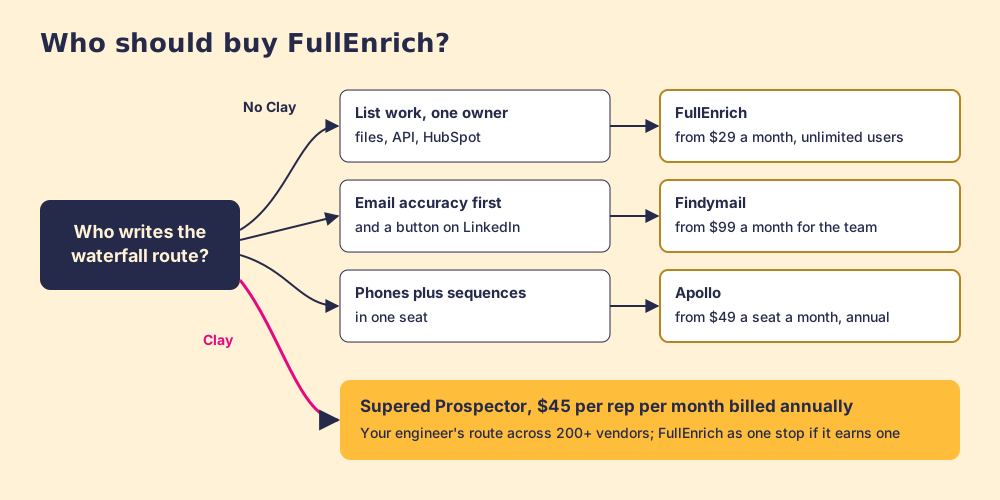
The verdict turns on two questions: who writes the route, and where the rep is when the number is needed.
- FullEnrich. The pick for a team with no Clay and no builder, doing list work: a well-checked waterfall, misses free, unlimited users. Buy annually if volume is steady, and size by mobiles.
- Findymail. The pick when email accuracy matters more than reach, and a rep wants a button on the profile.
- Apollo. The pick when the dialer and sequences belong in the same seat and phones are most of the volume.
- Supered Prospector. The pick when the team already pays for Clay: your engineer’s route, FullEnrich on it if it earns a stop, in every rep’s hand on LinkedIn and the CRM record.
What we recommend: buy FullEnrich for what it is, a careful shopper with a good route and a fair bill, and do not ask it to be a rep tool, because it stopped trying in 2025. If you have no Clay, it is one of the best list-enrichment buys on the market at its price, and the 50 free credits will tell you how it does on your contacts. If you have Clay, you already own the high street; write FullEnrich into your route behind the cheaper shops, and put that route in every rep’s hand where the list starts and where it can be followed to closed. The FullEnrich alternatives page grades the rest of the field, and a Prospector demo on your own Clay account shows FullEnrich running as one stop.
Frequently asked questions
Is FullEnrich legit?+
How accurate is FullEnrich?+
What do FullEnrich reviews complain about?+
Does FullEnrich charge for emails it cannot verify?+
Is FullEnrich better than Clay?+
How much does FullEnrich cost?+
Everything we have written on FullEnrich
More on FullEnrich
Looking past FullEnrich? See Supered Prospector on your own Clay accountYour Clay waterfall, where reps already work.