FullEnrich Pricing in 2026: Paid by the Fish, Priced by the Phone
FullEnrich pricing checked on October 2, 2026: one Pro plan in eleven monthly and eleven annual sizes, what a credit buys, what a 1,000-name list costs, when annual billing pays, when to renew early, and what a Clay team should do instead.
FullEnrich pricing in 2026 is one credit-based Pro plan in eleven monthly sizes, $29 for 500 credits to $3,500 for 100,000, or eleven annual sizes, $312 to $37,800 a year; a work email costs 1 credit, a mobile 10, and a lookup that finds nothing costs nothing.
A fishing guide can charge you two ways. By the day, so the boat costs the same whether the fish bite or not. Or by the fish, so an empty morning costs nothing and a good afternoon costs plenty, with the big fish priced well above the small ones.
FullEnrich pricing in 2026 is one credit-based Pro plan in eleven monthly sizes, $29 for 500 credits to $3,500 for 100,000, or eleven annual sizes, $312 to $37,800 a year; a work email costs 1 credit, a mobile 10, and a lookup that finds nothing costs nothing (fullenrich.com/pricing, opened October 2, 2026). FullEnrich is the guide paid by the fish.
The quick answer, three ways:
- FullEnrich Pro on monthly billing, from $29. A team testing the data, or prospecting in bursts. Credits roll over for 3 months.
- FullEnrich Pro on annual billing, from $312 a year. A team with steady volume. About 10% cheaper, with a 12-month rollover. Size it by phones.
- Supered Prospector, $45 per rep per month billed annually. A team that already pays for Clay. Reps run the team’s Clay waterfall across 200+ vendors, with FullEnrich available as one step in it, from LinkedIn, the company site or the CRM record.
The finding the plan cards leave out sits in FullEnrich’s own pricing file. Its worked example for 1,000 names with an email and a mobile comes to 5,800 to 7,800 credits, and phones are 86% to 90% of that. On a pay-on-find meter the price of a phone never moves. The size of the bill moves with how many phones get found, so a FullEnrich budget is a forecast of your mobile find rate.
What does FullEnrich pricing look like in 2026?
FullEnrich publishes a plain-text copy of its price book for AI agents to read, last updated July 14, 2026, which “mirrors the public pricing page” (fullenrich.com/pricing.md). The full ladder, opened October 2, 2026, with the per-credit price and the annual saving worked out by us:
| Monthly credits | Monthly price | Per credit | Annual credits | Annual price | Per credit | Annual saving |
|---|---|---|---|---|---|---|
| 500 | $29 | $0.058 | 6,000 | $312 | $0.052 | 10.3% |
| 750 | $42.75 | $0.057 | 9,000 | $468 | $0.052 | 8.8% |
| 1,000 | $55 | $0.055 | 12,000 | $588 | $0.049 | 10.9% |
| 1,500 | $79.50 | $0.053 | 18,000 | $852 | $0.047 | 10.7% |
| 2,000 | $104 | $0.052 | 24,000 | $1,128 | $0.047 | 9.6% |
| 5,000 | $255 | $0.051 | 60,000 | $2,784 | $0.046 | 9.0% |
| 10,000 | $499 | $0.050 | 120,000 | $5,448 | $0.045 | 9.0% |
| 15,000 | $720 | $0.048 | 180,000 | $7,860 | $0.044 | 9.0% |
| 25,000 | $1,150 | $0.046 | 300,000 | $12,552 | $0.042 | 9.0% |
| 50,000 | $1,950 | $0.039 | 600,000 | $21,228 | $0.035 | 9.3% |
| 100,000 | $3,500 | $0.035 | 1,200,000 | $37,800 | $0.032 | 10.0% |
Above 100,000 credits a month, or 1.2 million a year, FullEnrich asks you to “Contact sales.” The free trial is $0 with 50 credits and no card. Enterprise is custom and adds bring-your-own-key, custom SSO as an add-on, a dedicated account manager and custom rate limits.
One correction to the guides that rank for this search. ZoomInfo’s Pipeline blog and Landbase’s FullEnrich pricing guide both describe a “Starter” plan at $29 and a “Pro” plan at $55. FullEnrich sells no Starter plan. The word does not appear on fullenrich.com/pricing as served on October 2, 2026, and the pricing file lists three plans: Free trial, Pro and Enterprise. The $29 and $55 figures are two sizes of the same Pro plan, with the same features. FullEnrich’s own summary puts it in one line: “All integrations and core features on every plan.”
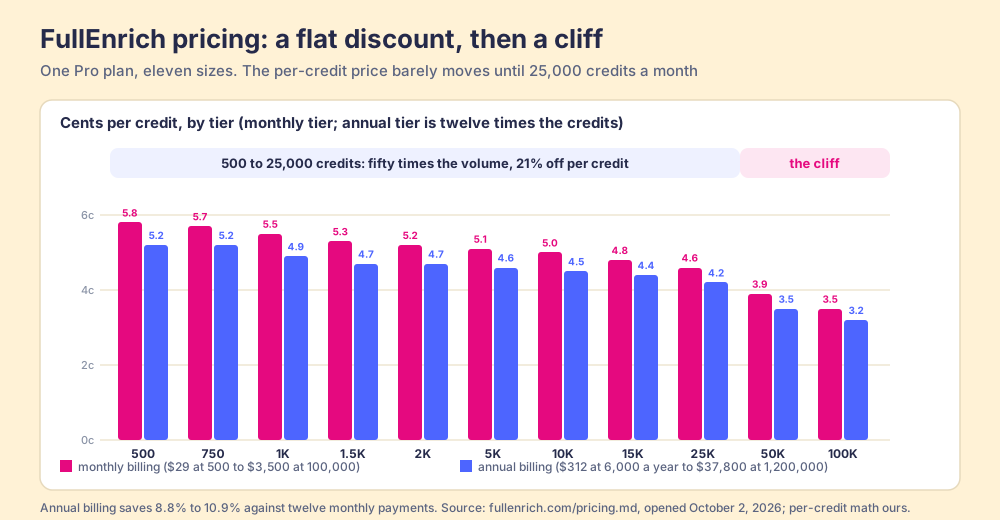
The ladder hides a second shape. The volume discount is shallow for most of its length and steep at the end. From 500 credits to 25,000, fifty times the volume, the price per credit falls from 5.8 cents to 4.6 cents, about 21%. The single step from 25,000 to 50,000 takes it to 3.9 cents, another 15%, and 100,000 lands at 3.5 cents. A small team buying more credits to chase a discount saves pennies. The discount lives above 25,000 credits a month.
What do FullEnrich credits buy?
Back to the boat. FullEnrich credits are the price list on the dock, and the guide writes it plainly:
| Data found | FullEnrich credits | At $0.055 a credit (1,000 tier) |
|---|---|---|
| Work email | 1 | 5.5 cents |
| Personal email | 3 | 16.5 cents |
| Mobile phone | 10 | 55 cents |
| Reverse email lookup | 1 | 5.5 cents |
| Person and company profile | 0.25 standalone, free with any enrichment | about 1.4 cents |
| Landline found instead of a mobile | 0 | free |
| Nothing found | 0 | free |
The small fish is the work email. The tuna is the mobile, ten times the price. A landline is a fish the guide throws back without charging you, and an empty net costs nothing at all. Credits are fungible: “Any credit can be spent on any data type,” the pricing file says, so there is no separate email allowance and phone allowance to juggle.
“Verified” carries weight in that table. FullEnrich says emails pass syntax, SMTP and catch-all checks, with “80% of catch-all domains” deep-checked and a confidence score attached, and phones are checked for landlines, out-of-service numbers and, in the US and Canada, an owner-name match. It also says “~30% of raw data is removed by verification before it ever reaches the user.” Not every buyer agrees on where the line sits. A recruiting firm’s one-star G2 review on January 1, 2026 opens “Very expensive. Charges for ‘maybe’ emails as well as catch-all emails.” A recruitment consultant’s review in October 2025 put the general view more kindly: “Great rates for emails, numbers are a bit more ‘expensive’” (Enzo S., G2). FullEnrich held 4.8 out of 5 from 239 reviews on G2 when we checked on October 2, 2026 (G2, FullEnrich reviews).
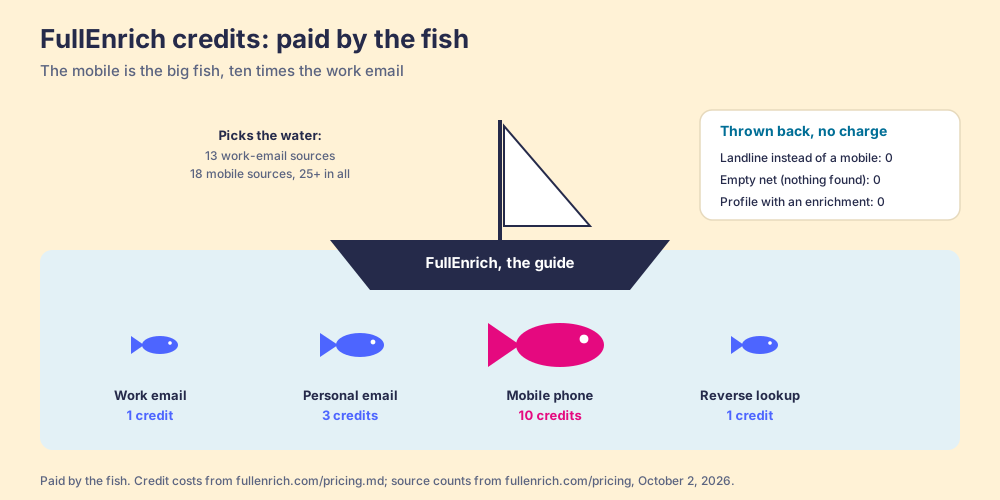
The comparison stops at one point, and that point matters for a team with Clay. A guide chooses the water. FullEnrich routes each lookup through its own sequence, 13 sources for work email and 18 for mobile on its pricing card, “25+” in all, with “Regional specialists” prioritized by the contact’s location (fullenrich.com/waterfall-enrichment). You buy the catch. You do not get to pick the order of the fishing spots, and for a team with no one to set that order, not having to is the point of hiring a guide.
What does a 1,000-contact list cost on FullEnrich?
FullEnrich answers this one itself, and the arithmetic is the most useful paragraph on its pricing file. For 1,000 contacts with a work email and a mobile:
- Work emails. About 1,000 lookups at 1 credit and an “~80% find rate,” so about 800 credits.
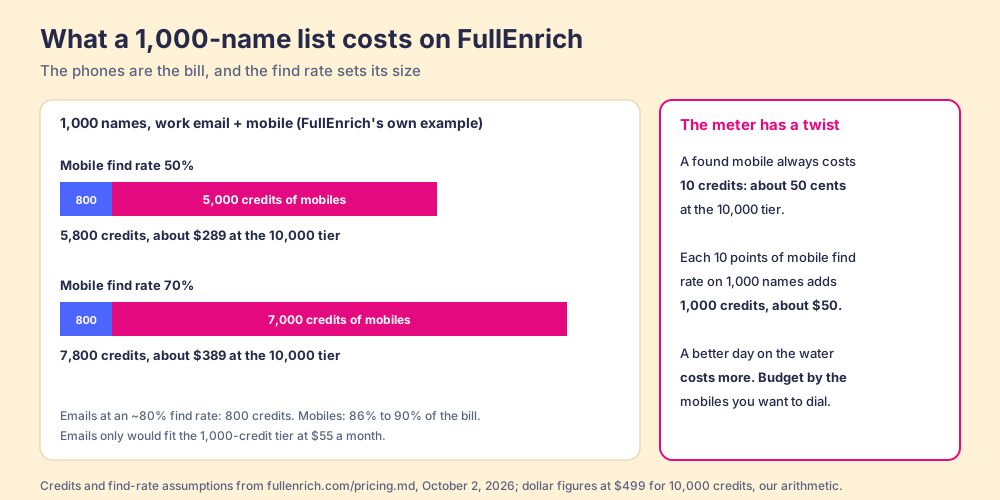
- Mobile phones. About 1,000 lookups at 10 credits and a find rate that “varies by region/seniority,” which FullEnrich assumes at 50% to 70%, so 5,000 to 7,000 credits.
- The total. 5,800 to 7,800 credits, which FullEnrich says fits the 10,000-credit tier at $499 a month “with headroom.” Emails only would fit the 1,000-credit tier at $55.
Run those credits at the 10,000 tier’s price of 4.99 cents and the list costs $289 to $389, or 29 to 39 cents a name. The phones are 5,000 of the 5,800 credits at the low end and 7,000 of the 7,800 at the high end: 86% to 90% of the bill.
Now walk the meter forward with one variable. Each 10 points of mobile find rate on 1,000 names is 100 more phones, which is 1,000 more credits, about $50 at that tier. The cost of a found mobile never changes; it is 10 credits, about 50 cents at the 10,000 tier. What changes is how many the guide lands. A better day on the water costs more. FullEnrich says its find rate varies by region and seniority, so two teams with the same list size on the same plan get different bills, and the team whose market yields more mobiles pays the larger one.
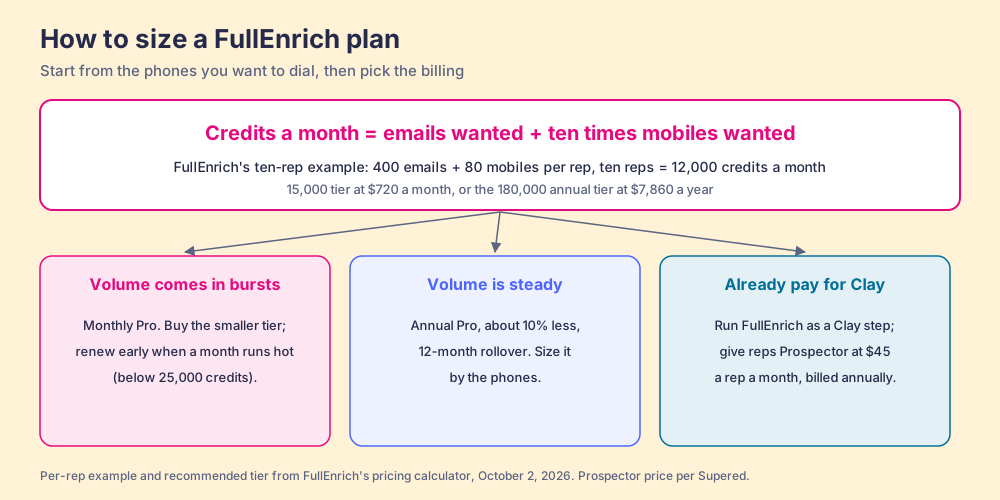
That gives the sizing rule, and it fits on a sticky label on the tackle box: credits a month equal the emails you want plus ten times the mobiles you want. Plan on the mobiles you hope to dial; the number of names you upload only sets the ceiling. FullEnrich’s calculator models ten people who each want 20 mobiles and 100 work emails a week, 300 credits a person a week, 12,000 credits a month, and recommends the 15,000 tier at $720 a month. Per rep, that is 80 mobiles and 400 emails a month for $72.
Is FullEnrich cheaper on monthly or annual billing?
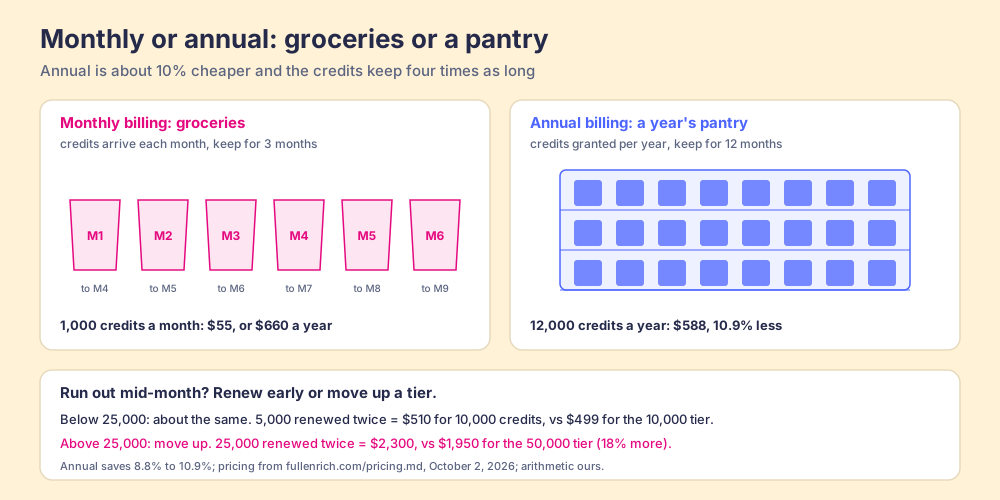
Annual, by 8.8% to 10.9% depending on the tier, which matches FullEnrich’s “~10% cheaper.” The 1,000-credit tier costs $660 over twelve monthly payments and $588 billed annually. The 15,000 tier costs $8,640 against $7,860.
The bigger difference is the shelf life, and a second comparison helps. Monthly billing is a grocery delivery that arrives each month and keeps for three. Annual billing is a year’s pantry, stocked at once and good for twelve months. FullEnrich’s file says annual credits are “granted per year” and roll over for 12 months, while monthly credits roll over for 3.
Two consequences follow, and neither appears on the plan cards.
- The uneven year. A pantry lets a team eat unevenly. If prospecting runs in campaigns, a launch month and a slow month, an annual grant absorbs the swing, where a monthly plan sized for the launch month leaves credits to spoil three months later.
- The early renewal. FullEnrich’s FAQ says a team that runs out mid-cycle can “Renew early or upgrade.” Below 25,000 credits, the two land within about 8% of each other. Renewing the 5,000 tier a second time in a month buys 10,000 credits for $510, against $499 for the 10,000 tier; renewing 1,000 twice is $110 against $104 for 2,000. So when you are unsure, buy the smaller size and renew early if the month runs hot. Above 25,000 the rule flips: two renewals of the 25,000 tier cost $2,300, while the 50,000 tier costs $1,950, 18% more for renewing.
A team of one testing the water should pay monthly. A team that will prospect all year should buy annual and size it by phones, because the phones decide the bill.
What does the FullEnrich price leave out?
Most of the plan is in every size, and that is generous. “All integrations and core features on every plan,” including waterfall enrichment, people and company search across “800M people, 50M companies,” bulk CSV, the API, the MCP server and Google SSO. The gaps sit outside the plan cards:
- One native CRM. The integrations FullEnrich lists name HubSpot as its CRM, and on its pricing page two HubSpot rows, “Enrich Contacts Already In HubSpot” and “FullEnrich Inside HubSpot,” are marked “Soon.” Salesforce and Pipedrive teams connect through Zapier, Make, n8n or the API (fullenrich.com/integrations).
- No Chrome extension today. FullEnrich’s integrations page lists none, and Chrome-Stats shows the old listing marked discontinued and removed from the Chrome Web Store on June 25, 2025. A rep in Sales Navigator moves names into FullEnrich by file or integration. The FullEnrich alternatives page covers that history and the options it leaves.
- Enterprise-only controls. Custom SSO with your own identity provider is an Enterprise add-on, and so are bring-your-own-key, custom rate limits and a dedicated account manager. Per-user credit limits and alerts start on Pro and are absent from the free trial.
- A stated find rate for emails only. FullEnrich publishes “~80% on average” for emails. For mobiles, its worked example assumes 50% to 70%. Your market sets your bill, so test 50 free credits on your own hardest segment before sizing.
Corporate status, checked October 2, 2026: FullEnrich is independent. It raised a €1.9 million seed round in February 2025 (EU-Startups), and a news search found no later round or acquisition.
Why trust this breakdown?
We sell no contact data. Supered has no database of its own, on purpose; Prospector runs on Clay, our only data provider, and Clay lists FullEnrich as one of its providers. Our stake is in what reps do with a contact once they have it.
I started RevPartners, a HubSpot partner that did only sales implementations, sold roughly twice as much Sales Hub as any other partner and reached HubSpot’s Elite tier in 13 months. Supered came out of that work and is the #1 sales enablement app on the HubSpot marketplace, with a 5.0 rating from 122 reviews there and 4.9 out of 5 from 81 reviews on G2, both checked October 1, 2026. Each FullEnrich number above links to the page it came from, with the date it was opened, and every per-credit and per-list figure is our own arithmetic on those numbers.
Which FullEnrich plan, or which alternative, fits your team?
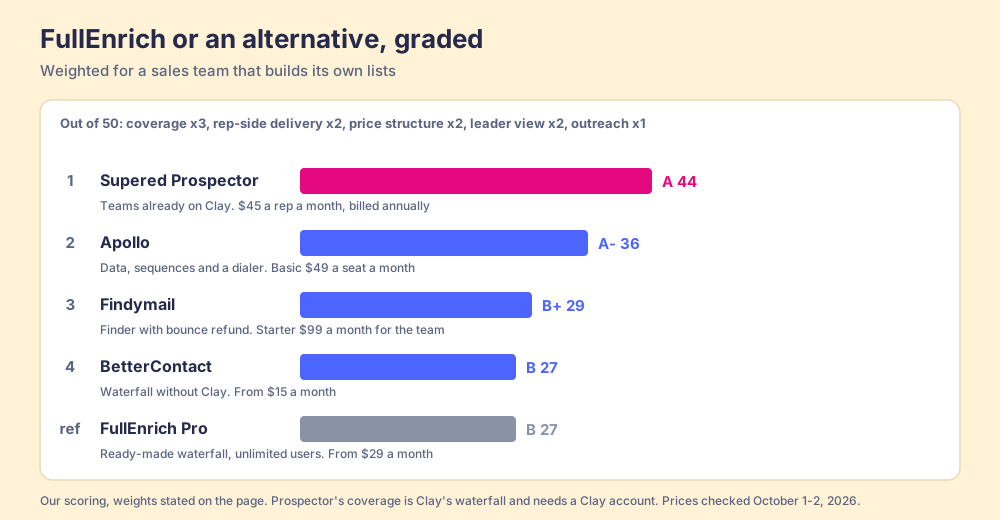
The grades use the same five weights as the FullEnrich alternatives page, so the two pages read together: coverage of the contact you need (x3), delivery where the rep already works (x2), price structure for a team (x2), what the leader sees after the export (x2) and bundled outreach (x1), out of 50. The weights serve one job, a sales team of ten to fifty reps building its own lists. Flip the lens to “no Clay, no builder for a waterfall, lowest admin” and FullEnrich climbs to the top three.
| Rank | Option | Grade | Best fit | CRM integration | Setup effort | Pricing (plan with the feature) | Reason to switch |
|---|---|---|---|---|---|---|---|
| 1 | Supered Prospector | A (44) | Teams that already pay for Clay | Native: HubSpot, Salesforce, Pipedrive | A demo, then live on your own Clay account | $45 a rep a month billed annually, plus your Clay plan | Clay’s waterfall across 200+ vendors, FullEnrich among them if you choose, run from the rep’s screen |
| 2 | Apollo | A- (36) | Teams wanting data, sequences and a dialer in one seat | Native: HubSpot, Salesforce | A day | Basic $49 a seat a month billed annually, mobile 8 credits | Outreach in the same plan and a cheaper phone from its own database |
| 3 | Findymail | B+ (29) | A finder with a Chrome extension and a bounce refund | Native: HubSpot, Salesforce, Pipedrive, Clay | Minutes | Starter $99 a month for the team, 5,000 credits | Mobile at 10 credits on cheaper credits, refund if bounces pass 5% |
| 4 | BetterContact | B (27) | A like-for-like waterfall without Clay | HubSpot, Clay, Make, Zapier | Minutes | Starter $15 a month, Pro $49 for 1,000 credits | Charges only for numbers it scores likely to connect |
| ref | FullEnrich Pro | B (27) | A ready-made waterfall for a team with no Clay | HubSpot native; others via Zapier, Make, n8n, API | Minutes | From $29 a month; $499 for 10,000 credits | The reference: unlimited users, pay on find, 25+ sources in its own order |
FullEnrich’s 27 is coverage 4, rep-side delivery 2, price structure 4, leader view 1, outreach 1. The price score is the friendliest structure in the table: unlimited users and pay on find, docked a point for the 10-credit phone. Prospector’s coverage score is Clay’s waterfall, credited to Clay, and it applies only to teams with a Clay account. Prices for the other rows were checked October 1 and 2, 2026, on apollo.io/pricing, findymail.com/pricing and bettercontact.rocks/pricing.
Is FullEnrich worth it if your team already pays for Clay?
For a Clay team, FullEnrich is already on the shelf. Clay’s integration page lists FullEnrich since November 30, 2024, with two actions, “Find mobile phone with FullEnrich” and “Find Work Email with FullEnrich,” each paid with “Clay Credits or Bring Your Own Account” (Clay, FullEnrich integration, October 2, 2026). Your GTM engineer can put FullEnrich’s 18 mobile sources behind cheaper providers in the team’s own order. Clay, like FullEnrich, charges nothing for an empty answer: “If an enrichment returns no result, you’re not charged Data Credits or Actions” (clay.com/pricing). The waterfall enrichment page explains why that order matters.
So the guide is already hired. What a Clay team lacks is the walk from the dock to the boat. The GTM engineer built great tables and has become the list desk, and reps still Slack for every list. Supered Prospector is the rep side of that Clay account. Clay plus Supered is the best way for a sales team to prospect: GTM engineers build in Clay, and reps never open Clay. Prospector runs inside the Supered Chrome extension, on the team’s own Clay account.
- Flows built once. The GTM engineer builds named flows, each tied to a Clay table, a person enrichment or a buying committee, and a destination. Reps pick a flow from a Push menu; the table runs and sends the result to the CRM or your sales engagement tool. Waterfalls, tiers, tags and sequence variables stay the engineer’s.
- The table as a button. A rep on a LinkedIn profile, a company’s website or a HubSpot, Salesforce or Pipedrive record runs the table from where they are. In Sales Navigator, reps add leads to a prospect list and push the list to a Clay table. Prospector works within LinkedIn’s terms and does not copy search results in bulk; the contact data comes from Clay’s waterfall on the customer’s Clay account.
- Owner and duplicate flags. Before pushing, a rep sees who owns the record and whether it was prospected before, so two reps do not work the same person.
- Found, worked, closed. Leaders see every list that was found, which ones are being worked and by whom, and how each lead ended: Qualified, Recycled or Disqualified, the way your process says.
- A starting template. Start from the Supered Clay template, or bring your own tables.
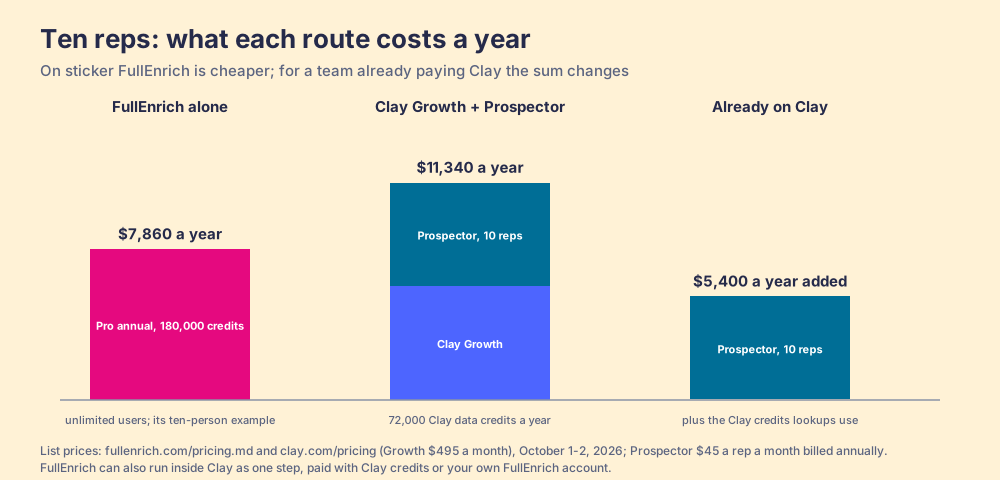
The arithmetic for ten reps, at list prices. FullEnrich’s own ten-person example fits the 180,000-credit annual tier at $7,860 a year. Clay Growth is $495 a month, $5,940 a year, with 72,000 data credits a year, and Prospector is $540 a rep a year, so ten reps on Clay Growth plus Prospector is $11,340 a year. On sticker, FullEnrich alone costs less. The comparison changes for a team that already pays for Clay, which it does for the tables, the workflows and the CRM sync: the added cost of putting that Clay account in ten reps’ hands is $5,400 a year, plus whatever Clay credits their lookups use. The volumes are not like for like, so run both on your own list sizes and find rates. Skip the extra seats, and get more out of the Clay you already pay for. The Clay pricing page shows the credit side of that sum.
Choose something else if you do not have Clay. Prospector runs on the customer’s Clay account and does nothing without one. If no one on your team will build and maintain a waterfall, FullEnrich’s Pro plan is the sensible buy, and its unlimited users make it easy to roll out. If your team is not on Clay yet and wants the build done with you, RevPartners, the company I founded, is a Clay Elite Studio Partner that builds and tunes the tables. The Clay Chrome extension page shows the rep’s side of a Clay account, and the sourcing use case walks the loop from profile to closed.
Which FullEnrich plan should you buy?
The FullEnrich cost resolves once you know two numbers: the mobiles you want a month and how steady that number is. The ways forward:
- The 50-credit trial. Run it on your hardest segment first. Five mobiles at 10 credits is a small sample, so use the email find rate to judge the data and the mobile hits to judge your market.
- Monthly Pro. A team prospecting in bursts, or testing. Buy the smaller tier and renew early when a month runs hot, up to 25,000 credits.
- Annual Pro. A team with steady volume. About 10% cheaper, a 12-month rollover, and a pantry that absorbs a launch month. Size it as emails plus ten times mobiles.
- The 50,000 tier and up. A team past 25,000 credits a month, where the discount finally bites: 3.9 cents a credit and below.
- Supered Prospector on your Clay account. A team that already pays for Clay, where FullEnrich becomes a step in your own waterfall and reps run it from the page they are on.
What we recommend depends on whether you already own a boat. If you do not, hire the guide: FullEnrich is a fair, transparent meter with unlimited users, and the one thing to manage is the phone share of the bill, so buy annual and budget by the mobiles you hope to dial. If you already pay for Clay, you own the boat and FullEnrich is one of the spots you can fish; pay for it inside Clay, behind the cheaper providers, and spend the money on getting reps to the water instead of a second guide. The email finder tools page compares the finders that sell the small fish cheaper, Prospeo pricing and Wiza pricing price two of them line by line, and a Prospector demo on your own Clay account shows FullEnrich running as one step of a rep’s list.
Frequently asked questions
How much does FullEnrich cost in 2026?+
How do FullEnrich credits work?+
Do FullEnrich credits expire?+
Is FullEnrich cheaper on annual billing?+
Does FullEnrich charge per user?+
Do I need FullEnrich if my team already pays for Clay?+
Your process, running itself.