Agentforce Pricing in 2026: Four Meters, Three New Editions, and What None of Them Count
Agentforce pricing as of October 2026: Flex Credits, conversations, resolutions, per-user add-ons, and the new Core, Advanced and Max editions, with the break-even math for a 20-rep sales team and the job no meter measures.
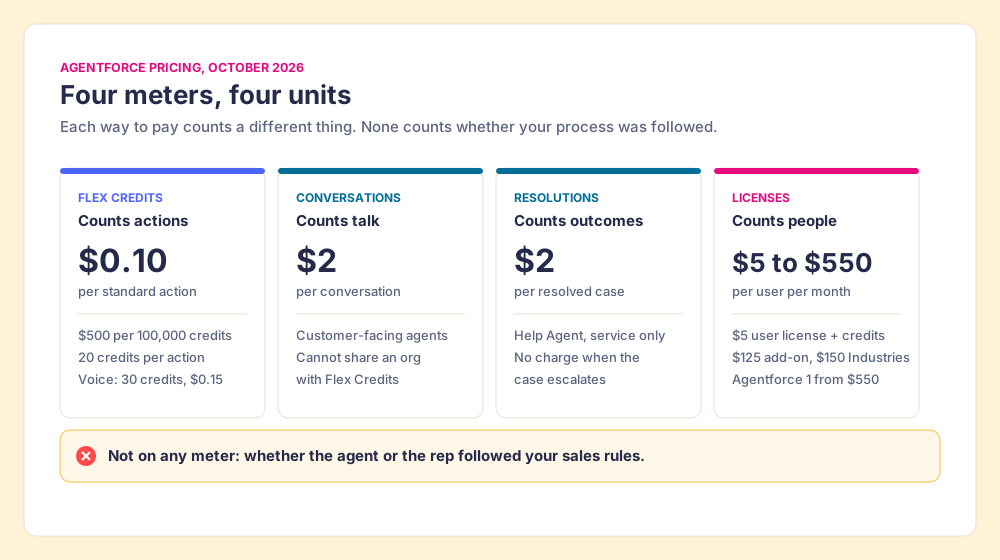
Agentforce pricing is Salesforce's menu of four ways to pay for AI agents: Flex Credits at $0.10 per action, $2 per conversation, $2 per resolved service case, or per-user licenses from $5 to $550 a month, plus credit pools in the new Core, Advanced and Max editions.
Agentforce pricing, the short list for a sales team (Salesforce’s pricing pages, checked October 1, 2026):
- The Agentforce add-on. $125 per user per month on top of your edition, unmetered for licensed reps. It fits teams whose reps would trigger more than about 60 agent actions a working day.
- Flex Credits on pay-as-you-go. $0.10 per standard action, billed monthly in arrears. It fits a team piloting one or two agents.
- No agent license at all. Your rules in Supered, with Claude doing the work in Salesforce through the hosted MCP server, from $40 per user per month. It fits teams whose problem is reps skipping the process.
Hire a house painter who charges by the brushstroke and you learn two things by lunchtime. The first is that you can budget the job only if you can guess how many strokes it takes. The second takes longer to see. The bill counts strokes, and it counts them whether the wall comes out the color on your swatch card or the color the painter guessed.
Agentforce pricing is Salesforce’s menu of four ways to pay for AI agents: Flex Credits at $0.10 per action, $2 per conversation, $2 per resolved service case, or per-user licenses from $5 to $550 a month, plus credit pools in the new Core, Advanced and Max editions (Salesforce, Agentforce pricing; Salesforce News, September 3, 2026). The top-ranking guides list those prices well. This one does the arithmetic they skip, starting with where the per-user add-on stops paying for itself, what the edition pools buy per rep, why Salesforce changed the menu seven times in seventeen months, and what a per-action meter cannot see, which is whether your agent, or your rep, followed your sales process.
| Agentforce pricing at a glance | Price (checked October 1, 2026) | What it counts |
|---|---|---|
| Salesforce Foundations | $0 | Access to Agentforce Builder and Prompt Builder |
| Flex Credits | $500 per 100,000; 20 credits ($0.10) per action, 30 ($0.15) per voice action | Actions |
| Conversations | $2 per conversation | Customer conversations |
| Help Agent resolutions | $2 per resolution | Resolved service cases |
| Agentforce User License | $5 per user per month, plus Flex Credits | People, then actions |
| Agentforce add-ons (Sales, Service, Field Service and Operations) | $125 per user per month | People (unmetered use) |
| Agentforce Industries add-ons | $150 per user per month | People (unmetered use) |
| Agentforce 1 Editions | From $550 per user per month, 2.5M Flex Credits per org per year | People, plus a pool |
| Sales Cloud Core / Advanced / Max (new Sept 3, 2026) | $195 / $395 / $550 per user per month, billed annually | People, plus 500K / 1M / 2.75M credits per org |
Sources: Agentforce pricing and Sales Cloud pricing, both opened October 1, 2026. The Agentforce page says Agentforce 1 Editions include 2.5 million Flex Credits; the Sales Cloud page and Salesforce’s September 3 announcement give Max 2.75 million. Ask your account executive which number your quote carries.
Why trust this Agentforce pricing breakdown?
I founded RevPartners, a HubSpot partner that sold roughly twice as much Sales Hub as any other partner and reached Elite tier in 13 months, and Supered grew out of that work. I run my own open deals against 22 rules on a Process Board, so the question this post ends on, whether an AI followed the rules, is one I answer on my own pipeline. For disclosure, we make Supered, and it appears below as the alternative for one specific job. Supered holds 4.9 out of 5 on G2 from 81 reviews; Salesforce Agentforce holds 4.3 from 1,698 (both checked on G2 October 1, 2026). Salesforce is an independent public company (NYSE: CRM), and Agentforce is selling. Annual recurring revenue passed $1.5 billion in the quarter reported August 26, 2026, up over 240% year over year, with the caveat that from that quarter the figure also counts Salesforce’s other AI offerings, Slackbot and Headless 360 (Salesforce Q2 FY27 results).
How much does Agentforce cost in 2026?
Salesforce Agentforce pricing runs on four meters, and each one counts a different unit. The unit tells you what Salesforce thinks you are buying.
- Flex Credits count actions. Agentforce Flex Credits sell at $500 per 100,000. Salesforce’s pricing page says “Agentforce actions are 20 Flex Credits, while Agentforce Voice actions are 30 Flex Credits,” so $0.10 and $0.15. An action is one function the agent runs: updating a record, summarizing a case, answering from knowledge, running a flow. Salesforce first put a price on the action on May 15, 2025, at $0.10 (Salesforce press release).
- Conversations count talk. Agentforce pricing per conversation is $2, the original Agentforce price, built for customer-facing agents. An org cannot run Flex Credits and Conversations at the same time.
- Resolutions count outcomes. Help Agent resolutions cost $2, and Salesforce’s September 3 announcement describes it as outcome-based pricing in which “you only pay when issues are resolved.” It is a service product, included in the Advanced and Max service editions, and a case escalated to a human is not charged (Salesforce Ben, July 2026).
- Licenses count people. The $5 Agentforce User License gives any employee “access to limited Salesforce CRM objects” and meters their agent use against Flex Credits. The $125 add-on (Sales, Service, Field Service and Operations) and the $150 Industries add-on make agent use unmetered for licensed users. Agentforce 1 Editions start at $550 and bundle the add-on with a credit pool.
The fine print is short and worth reading in full. Unused Flex Credits “do not roll over into subsequent subscription terms.” There is “no overage penalty,” and past your entitlement you pay your contracted rate, billed monthly in arrears. You can pre-purchase credits upfront (the cheapest route), pre-commit to a baseline with a true-up at term end, or pay as you go. And every worked example on the pricing page carries the same line, that it “does not include other costs like Data 360 credits or other consumption services.” Data 360, the data layer that was called Data Cloud, has its own meter.
What do the new Core, Advanced and Max editions include?
On September 3, 2026 Salesforce replaced the way it sells its main clouds. New buyers of Sales Cloud now choose Core at $195 per user per month, Advanced at $395 or Max at $550, billed annually, and each edition carries a pool of Flex Credits for the whole org: 500,000, 1 million and 2.75 million a year. Max keeps the Agentforce 1 price and adds Agentforce for Sales and Agentforce Coworker; Salesforce says existing Agentforce 1 customers can move to Max at no extra cost, and “existing customer pricing on legacy editions remains unchanged” (Salesforce News). Miguel Milano, Salesforce’s president and COO, gave the reason in one figure: “Only 5% of the knowledge workers who use Sales and Service Cloud have upgraded to the higher-end editions” (Salesforce Ben, September 3, 2026). The bundles exist to move the other 95% up.
The pool is per org. The seats are per user. That single asymmetry decides what the included AI is worth to you, and the arithmetic takes one line per edition. At 20 credits per standard action:
| Edition | Annual seat cost, 20 reps | Included credits per org | Standard actions per year | Per rep per working day (20 reps, 250 days) | Credit value at list |
|---|---|---|---|---|---|
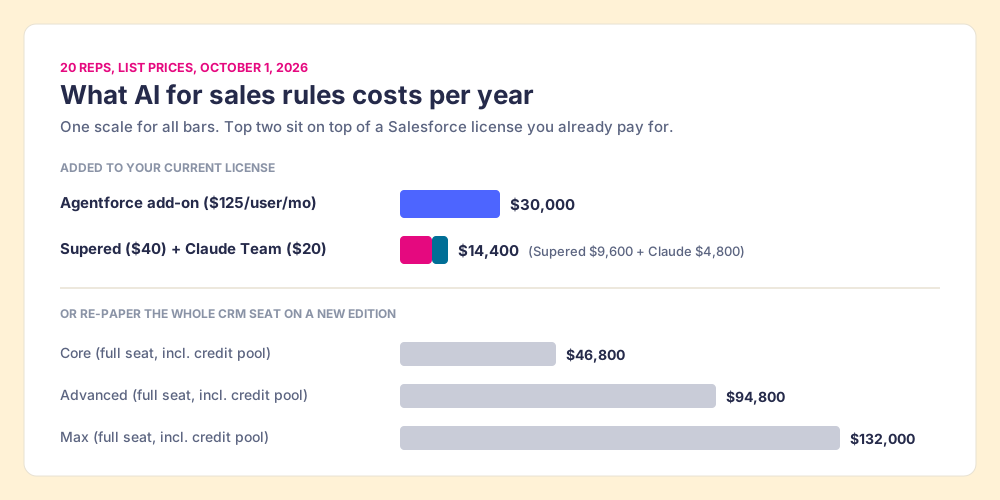
| Core | $46,800 | 500,000 | 25,000 | 5 | $2,500 |
| Advanced | $94,800 | 1,000,000 | 50,000 | 10 | $5,000 |
| Max | $132,000 | 2,750,000 | 137,500 | 27.5 | $13,750 |
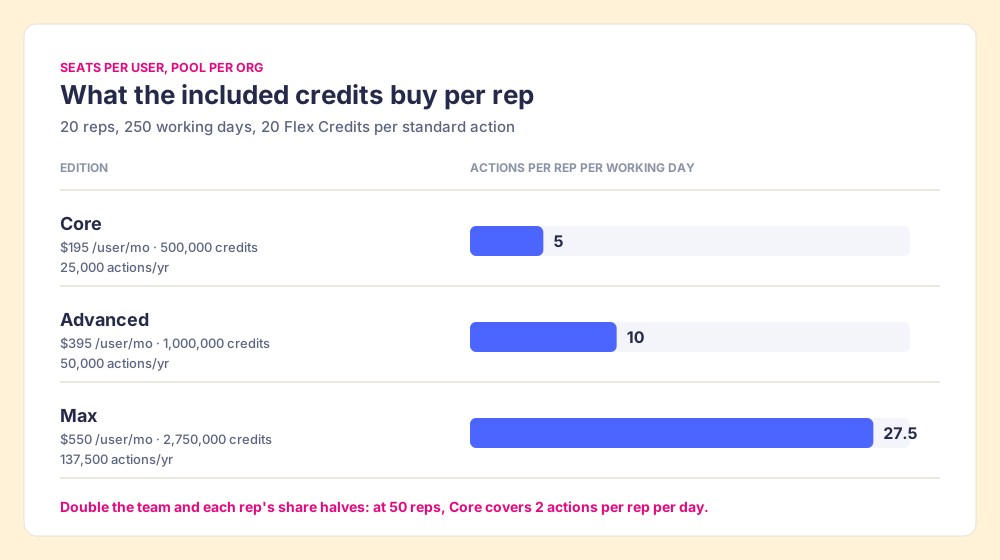
Run the Core line for a 50-rep team and each rep’s share falls to two actions a day, while the seat bill rises to $117,000. The pool is a tasting menu, $2,500 of credits at list inside a $46,800 subscription for 20 reps, about 5% of the spend. It lets a team find out what its agents consume before it signs for more, which is useful, and it is the reason the first renewal after a successful pilot is the conversation to prepare for.
Which Agentforce pricing model is cheapest for a sales team?
Two pieces of arithmetic settle most of it.
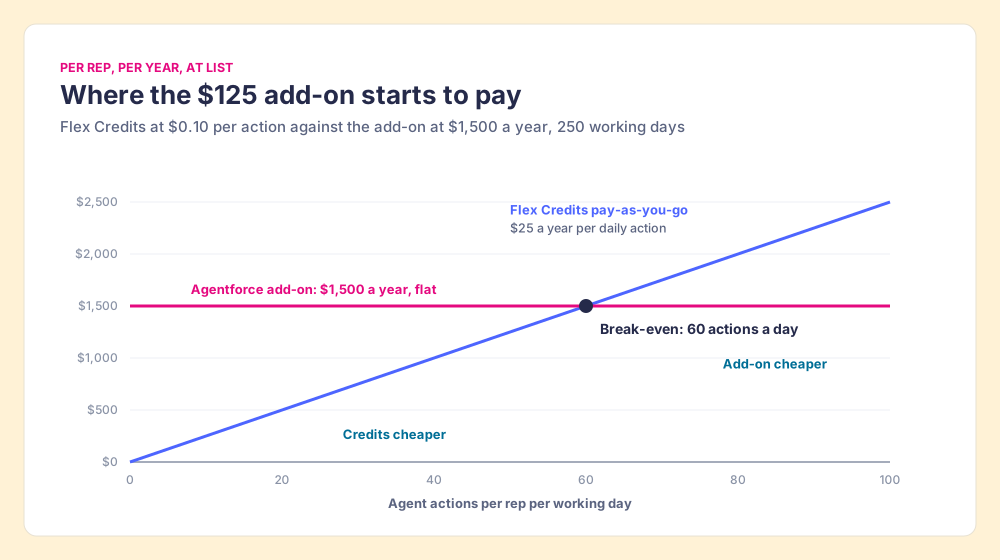
- Add-on against Flex Credits. The $125 add-on costs $1,500 per rep per year. At $0.10 an action, $1,500 buys 15,000 actions, or about 60 per rep per working day. A rep who triggers fewer than 60 agent actions a day is cheaper on pay-as-you-go credits at list; above that, the unmetered add-on wins. The add-on also bundles Prompt Builder and AI analytics, so price those if you need them.
- Conversations against Flex Credits. A $2 conversation equals 20 standard actions. Salesforce’s own worked examples use two to five actions per request (an order status check is two actions, or $0.20; appointment scheduling is five, or $0.50). Unless your conversations run past 20 actions, Flex Credits cost less, and you cannot run both meters in one org.
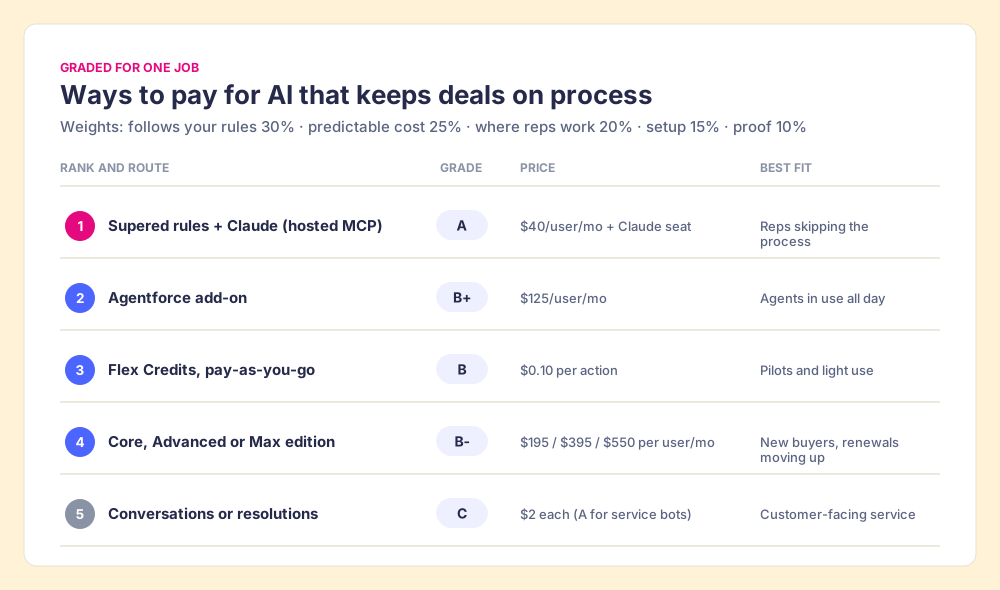
Jason Lemkin, the founder of SaaStr, read the menu as deliberate rather than confused: “When the market hasn’t converged on how to buy something, you don’t force one model. You let customers self-select into the model that matches how they want to buy” (SaaStr, February 17, 2026). He is right that self-selection only works for a buyer who knows their own usage, and a team buying its first agent has no usage history to read. So we graded the routes on a single job, for a 20-to-100-rep Salesforce sales team that wants AI to keep deals current and reps on process.
Method and weights: follows your own sales rules 30%, cost you can predict 25%, works where reps already work 20%, setup effort 15%, proof (ratings, references) 10%. The weights serve that sales job. A service leader would weight resolutions first and get a different order.
| Rank | Route | Grade (this job) | Best fit | CRM integration | Setup effort | Price | Reason to switch |
|---|---|---|---|---|---|---|---|
| 1 | Supered rules + Claude on the hosted MCP server | A | Teams whose problem is reps skipping the process | Native Salesforce app; Claude via Salesforce hosted MCP (Enterprise Edition and above) | Rules live in about two weeks | Process Compliance $40/user/mo yearly + a Claude seat ($20/mo Team standard, annual) | Rules checked each night; fixes in Salesforce or Claude |
| 2 | Agentforce add-on | B+ | Reps who use agents all day inside Salesforce | Native | Admin builds agents in Agentforce Builder | $125/user/mo | Unmetered for licensed users |
| 3 | Flex Credits, pay-as-you-go | B | Pilots and light use | Native | Same build, no commitment | $0.10/action, billed monthly in arrears | Pay only for what runs |
| 4 | Core, Advanced or Max edition | B- | New buyers, or renewals already moving up | Native | Re-papering the whole contract | $195 / $395 / $550 per user/mo + 500K / 1M / 2.75M credits | Slack, Tableau Next and support bundled |
| 5 | Conversations or resolutions | C here; A for service | Customer-facing service agents | Native | Service build | $2 each | You pay per outcome or per chat |
Why did Agentforce pricing and the product names keep changing?
Because Salesforce is still finding the price of an agent in public. Lay the dated changes end to end and the cadence is plain:
- May 15, 2025. Flex Credits launch at $0.10 per action, beside the existing $2 per conversation.
- June 17, 2025. Agentforce add-ons ($125) and Agentforce 1 Editions ($550, then with 1 million Flex Credits per org) go generally available (Salesforce).
- August 1, 2025. Enterprise and Unlimited list prices rise an average of 6%.
- October 2025. Sales Cloud is renamed Agentforce Sales at Dreamforce (Salesforce Ben).
- September 3, 2026. Core, Advanced and Max replace the edition lineup for new buyers, announced as “Agentforce Sales Editions.”
- September 14, 2026. Eleven days later, Agentforce Sales reverts to Sales Cloud, and Service, Field Service, Marketing and Commerce get their old names back (The Next Web; Diabsolut). Agentforce remains the name of the agent platform and the add-ons.
- September 17, 2026. Salesforce says each successful call a registered agent makes to Salesforce over MCP or the API, in a production org, will be metered as a “Headless Platform Interaction.” The multiplier is “TBA,” and Salesforce “will provide 30 days’ notice” before metering starts (Salesforce Help, Understand AIforce Impact).
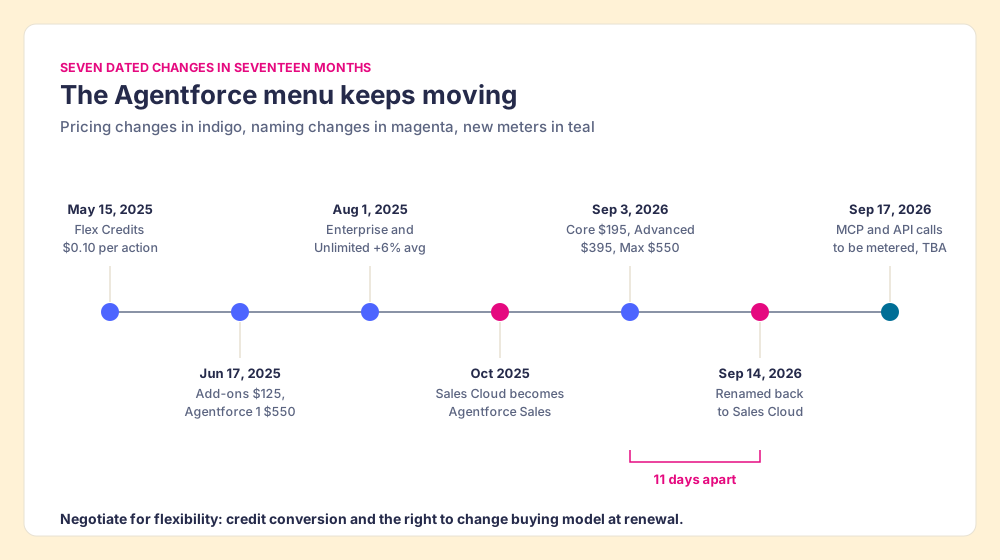
On the day this post went up, the two Salesforce pricing pages still disagreed on the name. The Sales Cloud page says Sales Cloud, and the Agentforce page still sells “Agentforce Sales & Agentforce Service add-ons.” It does not change a price. It does tell a buyer how to negotiate. A contract written against a menu that moves this often should carry the flexibility, credit conversion and the right to change buying model at renewal, rather than lock you into whichever model looked best this autumn.
Why do buyers push back on Agentforce pricing?
Salesforce’s own research named the first reason in May 2025, before the add-ons existed: “90% of CIOs report that managing AI costs is limiting their ability to drive value” (Salesforce press release, May 15, 2025). The reviews say the same thing in plainer words.
- A bill you cannot forecast. “It’s hard to evaluate what I have and what I need to purchase,” wrote Kelly H., a senior demand generation manager, in a G2 review dated June 3, 2026 (quoted by Oliv). Four meters and an org-level pool make the first-year bill a forecast of agent behavior the buyer has not measured yet.
- Agents that need clean data first. “Agentforce can feel complex to set up and depends heavily on cleanup data to perform well,” wrote Sashko M., a small-business reviewer on G2 (April 16, 2026, via Oliv). An agent working on stale close dates and empty amount fields does fast work on wrong records.
- A separate meter for the data layer. Every Salesforce pricing example excludes Data 360 credits, so the agent quote and the data quote arrive as two documents.
- An upgrade path in place of a price. With 5% of users on the higher editions, per Milano, the commercial logic of the bundles is the move up, and the pool math above shows when the question arrives: once a pilot has used the included credits.
What does a per-action meter count, and what does it miss?
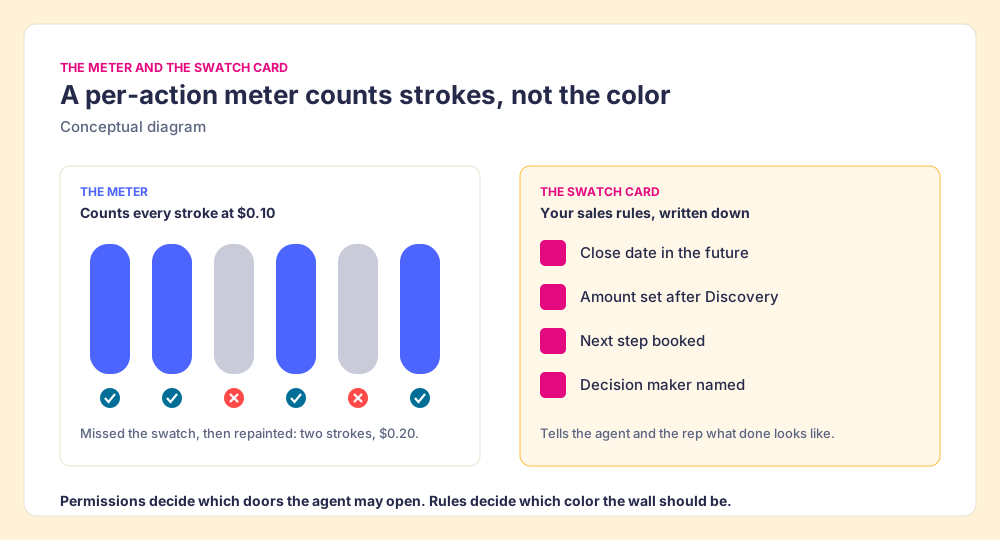
Back to the painter. A per-stroke bill has a strange property. A painter who does not know your color charges you more, because he paints the wall, steps back, and paints it again. The meter cannot tell a stroke that matched your swatch card from one that missed it. It counts motion.
A per-action meter on an agent works the same way. An agent that updates a close date, gets corrected by the rep, and updates it again has run two actions and cost $0.20. An agent that drafts a follow-up your manager would never send has run an action. Salesforce’s meter is fair about what it measures; it was never built to measure whether the work followed your sales process, because your sales process is not written anywhere it can read. Salesforce’s hosted MCP servers do carry your permissions: Claude or an agent signs in as the rep and sees only what that rep may see (Salesforce MCP guide). Permissions say which doors the agent may open. They say nothing about which color the wall should be.
Our own research says the swatch card comes first. In The State of Sales Enablement, 89% of teams had a defined sales process and 36% saw reps follow it. Teams with strong process adherence were almost twice as likely to rate AI’s impact high, 40% against 21% for teams with weak adherence. And teams that inspect deals against a defined process at the highest frequency hit quota at 6.3x the rate of the lowest band. AI amplifies the process you have, so an agent bought before the rules are written amplifies the 53-point gap between the process on paper and the one reps run.
Do you need Agentforce to get your sales rules followed?
For one job, no. If what you want from AI in Salesforce is deals kept current against your own expectations (close dates in the future, an amount past Discovery, a next step booked, a decision maker named), you need the rules written down, a check that runs without a manager, and a way to fix what the check finds. An agent license is one way to supply the last part. It is not the only one, and on its own it supplies neither of the first two.
Supered is built for that job, and this is where it fits.
- The rules. Your expectations live in Supered as Process Rules inside a Process Ruleset, grouped as momentum, data and process expectations. You can describe a rule in English and Supered’s MCP creates it, and you can read exactly what each rule checks.
- The check. A Process Board checks each open deal against the ruleset every night and lists what is broken, rep by rep, with a daily summary to Slack. Managers stop opening records to find problems and spend the hour coaching.
- The work, on any screen. The rep clears a flag in Salesforce, or asks Claude. With Supered’s MCP and Salesforce’s hosted MCP server connected, Claude reads the rules, finds each violation and does the work: updates fields from context, drafts the emails, moves the tasks. Same rules in the CRM or in the LLM. On my own deals, one prompt cleared 11 violations against 22 rules in about 10 minutes, against about 45 by hand; that is my example, not an average (how it works).
For a 20-rep team at list, Supered Process Compliance at $40 per user per month paid yearly is $9,600 a year (Supered pricing), and Claude’s Team plan at $20 per standard seat per month on annual billing adds $4,800 (Claude pricing, checked October 1, 2026). That is $14,400 a year, against $30,000 for the same 20 reps on the $125 Agentforce add-on. The hosted MCP route needs Enterprise Edition or above, which you are already paying for if you are reading an Agentforce quote (Claude Salesforce integration).
Two caveats belong next to that number. Salesforce’s September 17 notice means registered agents calling your org over MCP will be metered in production once the rate is published, so the Claude route will carry a Salesforce meter too, at a price Salesforce has not published yet; read the 30-day notice when it arrives. And Claude’s standard seats have usage limits, so a team that leans on Claude all day may need premium seats at $100 per month.
Choose something else if any of these is true:
- Customer-facing service agents. Agentforce’s resolution and conversation pricing is built for it, and Supered does not run customer chats.
- Reps living inside agents all day. Past about 60 agent actions per rep per working day, the unmetered $125 add-on is the cheaper meter, and it runs inside your permission model.
- A new Salesforce buyer. If you are licensing Salesforce for the first time, the Core, Advanced or Max bundle may be the simplest contract, and the included pool is a free pilot.
- Field or mobile-first teams. Supered fits teams of 10 or more who work at a computer; it has no mobile product.
Our AI CRM comparison grades Agentforce against HubSpot Breeze, Claude and the rest on the same job, and the Salesforce MCP guide shows what Claude can read and write once it is connected.
The recap
- The four meters. Actions at $0.10 ($0.15 voice), conversations at $2, resolutions at $2, and people at $5, $125, $150 or from $550 a month.
- The new editions. Core $195, Advanced $395, Max $550 per user per month, with 500,000, 1 million and 2.75 million Flex Credits per org per year; legacy pricing stays for existing customers.
- The pool math. For 20 reps, Core’s pool is 25,000 actions a year, about 5 per rep per working day, worth $2,500 at list inside a $46,800 subscription.
- The break-even. The $125 add-on costs less than pay-as-you-go credits only above about 60 actions per rep per working day; Flex Credits cost less than a $2 conversation below 20 actions.
- The moving menu. Seven dated changes in seventeen months, a rename reversed after eleven days, and MCP calls from outside agents to be metered at a rate still TBA.
- The missing count. No meter records whether the work followed your sales process; 89% of teams define one and 36% see reps run it.
What we recommend
There are three paths. If you run customer service at volume, buy Agentforce on conversations or resolutions and let the outcome meter do its job. If your reps will live inside agents all day, price the add-on against your measured action count, using the 60-a-day line, and negotiate credit conversion and buying-model flexibility into the contract, because the menu will move again. And if the reason you opened an Agentforce quote is that deals go stale and reps skip steps, write the rules before you buy the agent. In our survey, teams whose process is followed rated AI’s impact high almost twice as often, and a per-action meter bills the misses at the same rate as the hits. That third path is the one we built Supered for. Book a demo and we will run your own sales expectations against your Salesforce pipeline.
Frequently asked questions
How much does Agentforce cost in 2026?+
What are Agentforce Flex Credits?+
Is Agentforce included in Salesforce?+
Is the Agentforce add-on cheaper than Flex Credits?+
Did Salesforce rename Agentforce?+
Do you need Agentforce to get reps to follow your sales process in Salesforce?+
Your process, running itself.