Sales Tools by Stage: The Stack a Small Team Buys First, and the Stage the Lists Skip
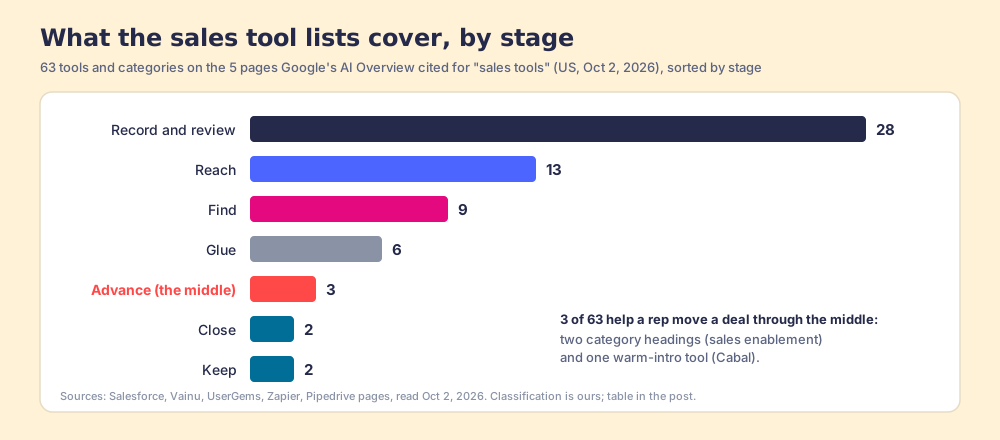
Sales tools sorted by the stage of the deal they serve, with a buying order for small businesses and prices checked October 2, 2026. Of 63 tools and categories on the pages Google cites for sales tools, 3 help a rep move a deal through the middle.
Sales tools are the software a sales team uses at each stage of a deal, from finding the buyer to closing and renewing, and a small team gets the most from them by buying one per stage, in order, starting with the CRM.
Sales tools are easiest to buy by the stage of the deal they serve, and the short answer for a small team is three purchases in this order:
- A CRM first. HubSpot Sales Hub Starter at $7 per seat per month billed annually, or Pipedrive Lite at $14. It records everything the other tools do.
- Find tools second. LinkedIn Sales Navigator for the right person, plus Apollo for contact data; or, for teams already on Clay, Supered Prospector, which turns the team’s Clay tables into a button reps press where they work.
- Rules for the middle third. Once two or more reps share a pipeline, Supered Process Compliance puts the next step in front of each rep in HubSpot, Salesforce or Pipedrive. It is the stage almost no published list of sales tools covers.
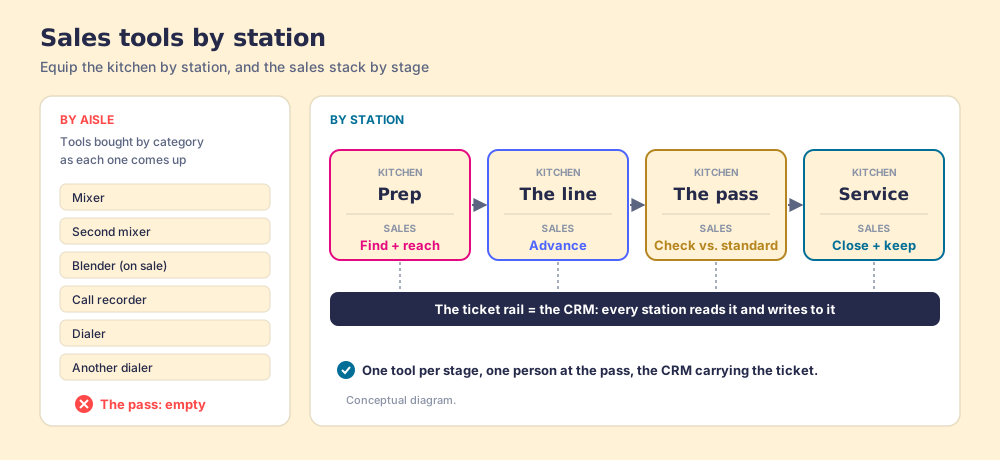
Auguste Escoffier (1846 to 1935) organized his kitchens on the brigade system: a cook per station, the saucier at the sauces, the garde manger at the cold larder, each plate passing from station to station toward the dining room (Brigade de cuisine). A restaurant owner who equipped a kitchen by walking the appliance aisle, two mixers here, a third blender because it was on sale, would end up with a room full of machines and an empty pass, the counter where the head chef looks at each plate before it leaves. Sales teams buy software the second way. Salesforce’s survey of 7,775 sales professionals found sales teams “use an average of 10 tools to close deals,” and 66% of reps said they were overwhelmed by the number (Salesforce, December 2022).
Sales tools are the software a sales team uses at each stage of a deal, from finding the buyer to closing and renewing, and a small team gets the most from them by buying one per stage, in order, starting with the CRM. Organized that way, the gaps show up before the bills do.
What do lists of the best sales tools leave out?
On October 2, 2026, Google’s AI Overview for “sales tools” in the US cited five pages (Ahrefs SERP overview): Salesforce’s sales tools page, Vainu’s “15 Types of Sales Tools” (Mikko Honkanen, November 14, 2025), UserGems’ list of 15 (Dozie Anyaegbunam, updated January 26, 2026), Zapier’s eight best (Ben Lyso, updated June 1, 2026) and Pipedrive’s 15 CRM tools (July 23, 2026). I read all five and sorted every tool or category they name by the stage of a deal it serves. The sorting is mine, and the table shows it so you can check it.
| Page | Entries | Find | Reach | Advance | Close | Keep | Record and review | Glue |
|---|---|---|---|---|---|---|---|---|
| Salesforce | 10 | 1 | 2 | 1 | 0 | 0 | 4 | 2 |
| Vainu | 15 | 4 | 1 | 1 | 2 | 1 | 4 | 2 |
| UserGems | 15 | 3 | 8 | 1 | 0 | 0 | 3 | 0 |
| Zapier | 8 | 1 | 1 | 0 | 0 | 0 | 5 | 1 |
| Pipedrive | 15 | 0 | 1 | 0 | 0 | 1 | 12 | 1 |
| Total | 63 | 9 | 13 | 3 | 2 | 2 | 28 | 6 |
Of 63 entries, 28 record or review what already happened and 22 find or reach a buyer. Three touch the middle of a deal, the stretch from first meeting to decision where a rep has to run discovery, find the economic buyer and agree a next step. Two of those three are a category heading (“sales enablement tools” on Salesforce’s page, “sales enablement and digital sales rooms” on Vainu’s) and the third is Cabal, which UserGems describes as a deal acceleration tool for using connections. None of the five pages says which tool to buy first.
The lists are not wrong about the tools they name. Gong is good at recording calls, Calendly is good at booking meetings. The pattern comes from who writes them: a vendor writes about the stage it sells into, and the stages with a big software category get covered. The middle of a deal has no famous category, so it falls out of the article, and then out of the budget.
Why does the middle of a deal need its own sales tool?
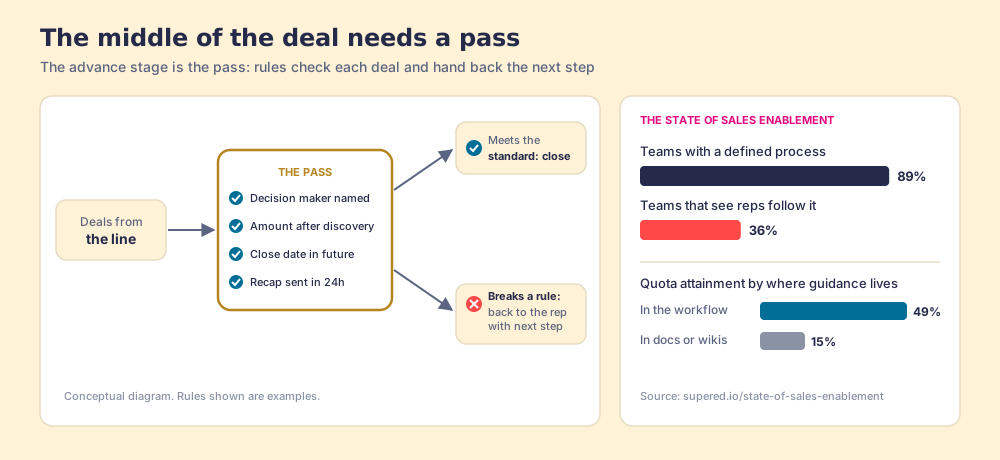
Because the middle is where the process lives, and the process is where small teams drift. In The State of Sales Enablement, 89% of sales teams had a defined sales process and 36% saw reps follow it, a 53-point gap between the process on paper and the process in practice. The same survey found 49% quota attainment where reps get guidance embedded in their workflow, against 15% where it sits in docs or wikis.
Go back to the kitchen. A plate does not leave because the cook says it is done; it leaves because someone at the pass looked at it against the standard. Strip out the pass and the food still goes out, most of it fine, some of it missing the sauce, and the owner hears about the missing sauce from the customer. The sales version: the deal reaches proposal without a decision maker named, the close date sits in last month, the recap email never went out, and the founder finds out on the forecast call.
The usual answer is the manager. A manager reading every deal by hand is the pass, run by one tired person, and Gartner’s survey of 1,026 B2B sellers found sellers already overloaded: 50% are overwhelmed by the amount of technology their job needs, and overwhelmed sellers are 45% less likely to attain quota (Gartner, September 2024). When reps skip a step, that is a system failure. The rep had three deals open and the buyer waiting, and the step lived in a document two clicks away.
So the advance stage needs a tool with three properties:
- Rules in one place. The exit criteria for each stage written once, as rules a machine can check: a named decision maker before proposal, an amount after discovery, a recap within a day of the meeting.
- The next step where the rep works. The rule shows up inside the CRM record, or in Claude or another AI assistant the rep uses, at the moment the deal needs it.
- A view for the manager. Which deals broke which rule, so the manager’s hour goes to coaching the deal, not hunting for it.
Why trust this stack?
I founded RevPartners, a HubSpot partner that did only sales implementations. We sold roughly twice as much Sales Hub as any other partner, reached HubSpot’s Elite tier in 13 months, and set up stacks for teams from three reps to a few hundred. Supered came out of that work. It holds a 4.9 rating from 81 reviews on G2 and 5.0 from 122 on the HubSpot App Marketplace (both checked October 1, 2026), and Supered sells two of the tools on this page, so read the grades with that in mind. Where another tool does a stage better for your situation, the table says so.
Which sales tools belong at each stage?
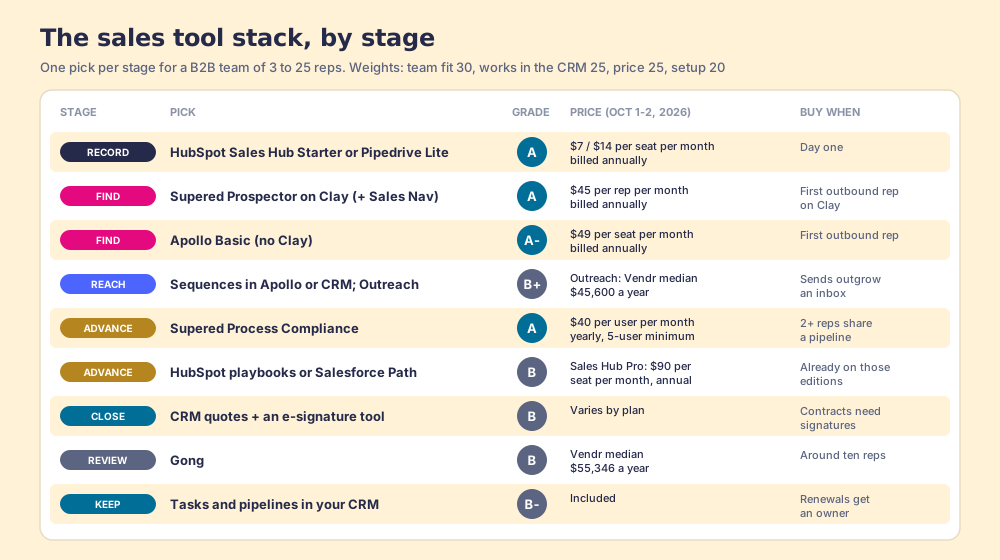
The grades below are for a B2B team of 3 to 25 reps selling through conversations. The method, so you can flip it if your team differs: fit for that team size (30%), works inside the CRM reps already use (25%), price at that size (25%), setup effort (20%). Prices are list prices checked October 1 or 2, 2026, or Vendr medians where a vendor does not publish a price.
| Stage | Job | Pick for a small team | Grade | Price | Buy when |
|---|---|---|---|---|---|
| Record | Holds contacts, deals, tasks; every other tool writes here | HubSpot Sales Hub Starter, or Pipedrive Lite | A | $7 per seat per month billed annually; Pipedrive Lite $14 | Day one |
| Find | The right person, and a verified email or phone | Supered Prospector on Clay, with Sales Navigator for search | A | Prospector $45 per rep per month billed annually; Sales Navigator Core $119.99 a month | The first rep doing outbound, if the team runs Clay |
| Find | Same job, for teams without Clay | Apollo Basic | A- | $49 per seat per month billed annually | The first rep doing outbound |
| Reach | The first touch: sequences, calls, booking | Sequences in Apollo or the CRM; Outreach at volume | B+ | Outreach Vendr median $45,600 a year | When sends outgrow one inbox |
| Advance | The next step in each deal, checked against your rules | Supered Process Compliance | A | $40 per user per month billed yearly, 5-user minimum | When two or more reps share a pipeline |
| Advance | Same job, built into the CRM | HubSpot playbooks (Sales Hub Professional, up to 5) or Salesforce Path | B | Sales Hub Professional $90 per seat per month billed annually, plus $1,500 onboarding | If you already pay for those editions |
| Close | Quotes and signatures | Quotes in the CRM, plus an e-signature tool such as DocuSign or PandaDoc | B | Varies by plan | When contracts need a signature you can track |
| Review | Call recording, coaching, forecasting | Gong | B | Vendr median $55,346 a year | Around ten reps, when the manager cannot hear enough calls |
| Keep | Onboarding and renewal | Tasks and pipelines in the CRM you have | B- | Included | When renewals become a number someone owns |
Sources for prices: HubSpot and Pipedrive, opened October 2, 2026; Apollo, Sales Navigator and Vendr (Outreach median on 917 purchases, Gong on 1,144), checked October 1, 2026; Supered from our pricing page.
A few judgments in that table deserve a sentence each:
- The CRM as the rail. In a kitchen the tickets hang on a rail every station can read. The CRM plays that part, which is why it comes first and why a tool that does not write back to it costs more than its price.
- Apollo’s A minus. Apollo puts search, contact data and sequences in one plan, which is the best single purchase for a small team without Clay. It is one database, so a missing phone stays missing.
- Outreach’s B plus. A strong sequencer, priced for teams with volume; a five-rep team gets most of the job from Apollo or the CRM.
- Gong’s B. Call review earns its place once a manager cannot listen to enough calls. On a small team the founder still can.
- The built-in playbooks’ B. HubSpot playbooks and Salesforce Path put guidance in the record, which is the right place. They stop short of checking each deal against rules and showing the manager who skipped what.
Where does Supered fit in a stack of sales tools?
In two stages, as two products.
At find, Supered Prospector is for teams that already run Clay. Clay plus Supered is the best way for a sales team to prospect: GTM engineers build in Clay, reps never open Clay. The GTM engineer builds named flows once (person enrichment, buying committee), each tied to a Clay table and a destination. A rep on a Sales Navigator lead, a company’s website or a HubSpot, Salesforce or Pipedrive record picks a flow from a Push menu, Clay’s waterfall across 200+ providers fills in the email and phone, and the contact lands in the CRM or a sequence. Before pushing, the rep sees who owns the record and whether a teammate already prospected the person. Leaders see each list found, worked and closed, with every lead ending the way your process says: Qualified, Recycled or Disqualified. Prospector works within LinkedIn’s terms and does not copy search results in bulk; the contact data comes from Clay’s waterfall on the customer’s Clay account. It runs inside the Supered Chrome extension and costs $45 per rep per month billed annually, from one rep. See it on the Prospector page, or read the sales leader’s view and how sourcing works.
At advance, Supered Process Compliance is the pass. Your process lives in Supered as Process Rulesets and Process Rules; reps follow them in the CRM, or in Claude or another LLM; Process Boards show managers which deals broke which rule. The same rules run on HubSpot, Salesforce and Pipedrive. It costs $40 per user per month billed yearly ($45 monthly), with a 5-user minimum, and includes Digital Adoption (in-CRM cards and guides). Sales expectations shows the rules a team starts with, and sales process adoption shows the manager’s side.
Choose something else if:
- No Clay account. Prospector needs your own Clay account. Start with Apollo, or have a Clay partner build your tables first.
- Fewer than five users. Process Compliance has a 5-user minimum. Write your stage exit criteria as required fields in the CRM until you get there.
- A field team. Supered has no mobile product. Teams that sell from a phone in a truck need a CRM with a strong mobile app instead.
Book a demo of Process Compliance or see Prospector on your Clay account.
What sales tools does a small business need first?
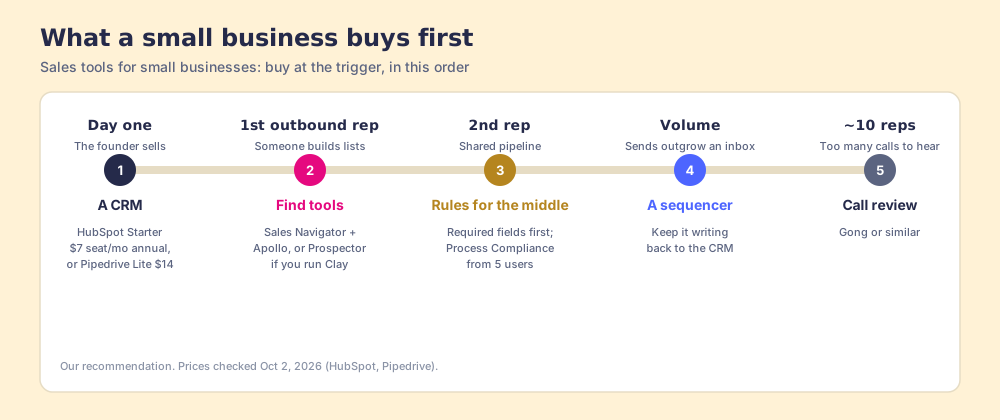
Sales tools for small businesses should arrive in the order the team grows into them, and the trigger for each purchase is a change in who does the selling, not a calendar.
(If you sell through a web store, you want online sales software of a different kind, an ecommerce platform and a checkout; this order is for teams that sell through reps and conversations.)
- Day one: the CRM. Even a founder selling alone needs one place that remembers who said what. HubSpot’s free plan covers up to 2 users; Starter is $7 per seat per month billed annually.
- The first outbound rep: find tools. Someone now builds lists. Sales Navigator for search, plus Apollo, or Prospector if the company already runs Clay.
- The second rep: rules for the middle. The founder no longer sees every deal, so the process has to reach the reps without the founder in the room. Required fields and HubSpot playbooks carry a two-person team; at five users, Process Compliance takes over.
- Volume: a sequencer. When a rep sends more than an inbox handles, buy reach tooling, and keep it writing back to the CRM.
- Around ten reps: review. Call recording and forecasting pay off once a manager cannot hear the calls in person.
The order matters for a reason the price list hides. Salesforce’s 2026 State of Sales, a survey of 4,050 sales professionals, found the average seller spends 40% of the week selling (Salesforce, February 2026). A tool bought before the team needs it takes from the other 60%: another login, another place to update.
What does a full stack of sales tools cost?
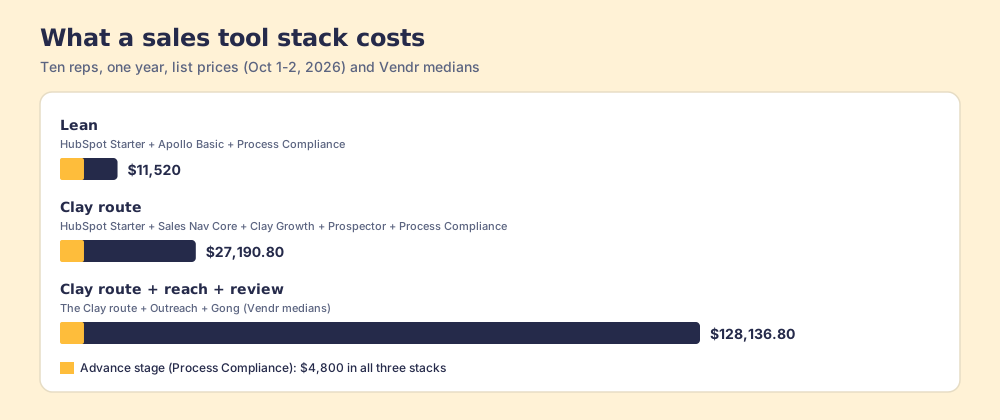
For ten reps, a year, at list prices and Vendr medians:
| Stack | Tools | Annual cost |
|---|---|---|
| Lean | HubSpot Sales Hub Starter ($840) + Apollo Basic ($5,880) + Supered Process Compliance ($4,800) | $11,520 |
| Clay route | HubSpot Sales Hub Starter ($840) + Sales Navigator Core ($10,798.80) + Clay Growth on annual billing ($5,352) + Supered Prospector ($5,400) + Supered Process Compliance ($4,800) | $27,190.80 |
| Clay route plus reach and review | The Clay route + Outreach ($45,600) + Gong ($55,346), at Vendr medians | $128,136.80 |
Clay Growth is $446 a month on annual billing, captured from Clay’s pricing page on September 25, 2026. Sales Navigator Core is $1,079.88 per seat per year on annual billing.
The arithmetic carries one surprise. The stage the lists skip is the second-smallest line on every bill: $4,800 for ten reps, against $10,798.80 for Sales Navigator seats and $55,346 for a median Gong contract. The last two tools a small team buys, the sequencer and call review, cost more than the first three together.
Which sales tools should you choose?
Three ways forward, depending on where the team is:
- A founder and one or two reps. A CRM and a find tool. Write the stage rules into required fields, and add Process Compliance when the team reaches five.
- Five to twenty-five reps without Clay. The lean stack: HubSpot or Pipedrive, Apollo, Process Compliance. Add Sales Navigator for the reps who prospect.
- Five to twenty-five reps on Clay. The Clay route: Sales Navigator, Clay, Prospector, Process Compliance. Reps run the GTM engineer’s tables from where they work, and managers see each deal against the process.
My recommendation, for any team past two reps: fund the middle before the sequencer and before call review. The evidence above points one way. The middle is where 89% of teams have a process and 36% see it followed, guidance in the workflow comes with 49% quota attainment against 15%, and the tool that covers it is the second-cheapest line on the bill. A kitchen with good stations and an empty pass sends out food. A kitchen with someone at the pass sends out the same plate every time.
If the find stage is where your team loses the most leads, sales prospecting tools, graded by job goes one stage deeper, and CRM hygiene shows the rules a team writes first.
Frequently asked questions
What sales tools does a small business need first?+
What are the main types of sales tools?+
How much does a sales tool stack cost for ten reps?+
Do I need Clay to use Supered Prospector?+
Is online sales software the same as sales tools?+
Which sales tool helps reps follow the sales process?+
Your Clay waterfall, where reps already work.