How to Manage a Sales Team When the Reps Outnumber Your Hours
Most advice on managing a sales team is a list of habits.
It skips the arithmetic: the average manager carries more reps than manual inspection can cover, and adherence halves past five. How to fix that.
Managing a sales team is the work of setting a short list of clear expectations, checking every rep against them on a fixed cadence, and spending the hours that checking frees on coaching the reps and deals that fall short.
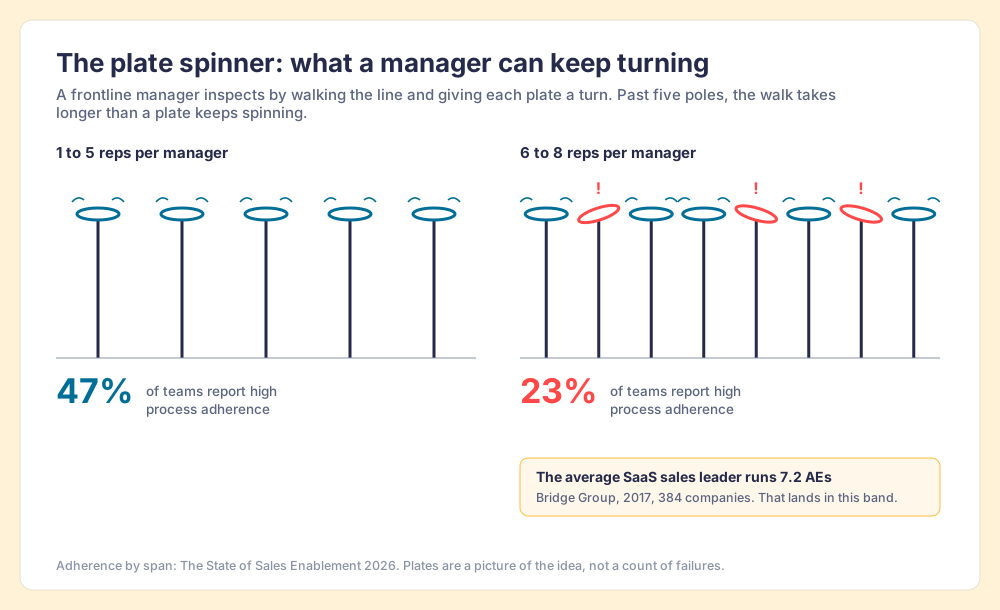
A plate spinner on a stage does not hold any plates. He walks a line of poles and gives each wobbling plate a flick before it falls. With five poles he strolls. Add three more and the stroll becomes a sprint, and somewhere behind him a plate starts to tip while he is busy with another.
Strip away the stage lights and you have how to manage a sales team. Managing a sales team is the work of setting a short list of clear expectations, checking every rep against them on a fixed cadence, and spending the hours that checking frees on coaching the reps and deals that fall short. The top-ranking guides list the habits: hire well, coach, build culture, celebrate. They skip the arithmetic of the walk. In The State of Sales Enablement 2026, process adherence was 47% on teams with one to five reps per manager and 23% on teams with six to eight. The Bridge Group’s survey of 384 SaaS companies found the average sales leader runs 7.2 AEs. The typical sales manager already stands on the wrong side of that drop.
Why does managing a sales team get harder after five reps?
Because inspection is a walk, and the walk gets longer while the day does not.
I founded RevPartners, a HubSpot partner that ran RevOps as a service for its clients, and the pattern I watched there was the same one the data shows. A manager with four reps knows every open deal by heart. She hears the call that went badly, sees the close date slip, and asks about it over coffee. Give her eight reps and she still has the same forty-odd working hours, now split across twice the pipeline, plus forecast calls, hiring and her own deals.
The numbers line up behind that picture:
- Adherence by span. In The State of Sales Enablement 2026, which surveyed 198 revenue leaders, process adherence fell from 47% at one to five reps per manager to 23% at six to eight.
- The reason reps give. The most-cited reason reps skip the process, at 29%, is that managers do not enforce it, and respondents named manager capacity more often than rep indifference.
- The typical span. The Bridge Group’s 2017 SaaS AE Metrics report, with 384 companies responding, found “on average, 7.2 AEs report to a single leader,” a figure it called “a continuation of a long-term rise” (For Entrepreneurs, 2017).
- The manager’s own fuel. Gallup’s 2026 analysis found manager engagement “tends to decline as team size increases,” and that managers account for 70% of the variance in team engagement (Gallup, 2026).
Suppose, for the sake of arithmetic, that a rep carries 20 open deals and a manager needs three minutes per deal to check it against six rules. A weekly check costs an hour per rep. Seven reps cost seven hours, nearly a full working day, before a single minute of coaching. A nightly check, the cadence that catches a stale close date while the rep still remembers the call, would cost five hours per rep per week. No frontline manager has that. These numbers are my assumptions, and no survey measured them. Change them however you like and the shape holds: manual inspection grows with every rep and every deal, and the manager’s week does not.
So adherence halves. It halves because the reps on a team of eight stop hearing about a missed step until it is too late to matter, and a step no one asks about drifts. I want to be plain about who is at fault here: the system. The reps behave the way a sensible person behaves when a rule is enforced some weeks and forgotten in others.
What do the top guides on how to manage a sales team leave out?
They agree with each other, and most of what they say is right. Salesforce’s list of 16 habits of effective sales managers (Walter Rogers, 2025) tells managers to define a process, coach, measure and protect their time. Indeed’s ten steps cover hiring, training, goals and one-on-one coaching. Neither cites a number.
Salesforce comes closest to the problem in one sentence: “Coaching is the responsibility most neglected by sales managers, because it requires them to borrow time from their already busy day.” That is the whole difficulty, named and then left alone. SPOTIO’s 2026 State of Field Sales data puts a figure on it for field teams: nearly 4 in 10 field sales managers spend less than 3 hours per week coaching (SPOTIO).
The coaching is worth the time. CSO Insights found that organizations with a random coaching approach won 43.9% of forecast deals, and that a dynamic, structured approach won 13.8 percentage points more (CSO Insights, 2018). The guides are right to push it.
Where I part ways with them is the source of the hours. Telling a manager with eight reps to “protect their time” is like telling the plate spinner to relax. The hours for coaching have to come from somewhere, and the biggest block of a frontline manager’s week that a machine can do better is the checking. You cannot drop the inspection: you can only expect what you inspect, and in our survey the teams that inspect deals against a defined process at the highest frequency hit quota at 6.3x the rate of the lowest band. You can move it off the manager’s desk.
How to manage a sales team in five moves
The method below is the one I run on my own pipeline at Supered and the one we built the product around. It also works with a spreadsheet and a disciplined ops person. Software lowers the cost.
1. Write expectations down as rules a system can check
You already have a sales process. It lives in the things that make you angry when they do not happen: the deal with no amount three weeks after discovery, the call with no recap, the close date that passed last Friday. Each irritation is an unwritten rule. Write it down in a form a machine can test.
A good rule has five parts:
- Trigger. The event that starts the clock, such as a meeting with the buyer ending.
- Condition. What has to be true afterward, such as a recap email logged.
- Owner. Who fixes it, normally the deal owner.
- Deadline. How long they have, such as 24 hours.
- Buyer reason. Why the buyer is better off when the rule holds, such as getting the next step in writing.
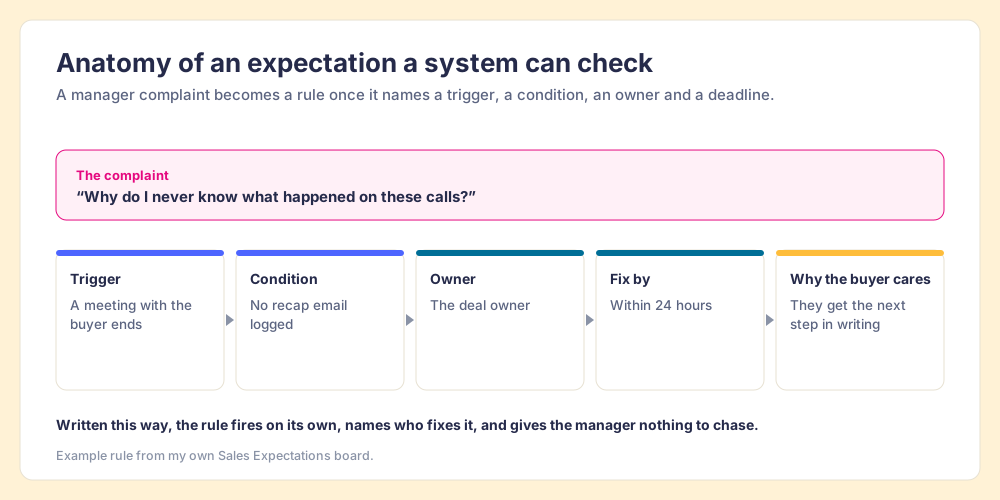
Start with five or six rules. My own Sales Expectations board runs 22, and I would not have started there. The first six I would pick are the ones from my board that fire most often: no close date in the past, no open deal past Discovery without an amount, no overdue tasks, a pre-call email within 24 hours of a meeting, a recap after every meeting, and a decision maker named once the deal moves forward. Our post on CRM hygiene walks through why each one matters.
Copy the rules from your best rep. The process that works already lives in somebody’s habits, and the rest of the team will believe a rule they can watch working more readily than one a consultant wrote.
2. Let a system check every open deal every night
A smoke detector reads the air in every room all night and makes noise only when something is burning. The household does not sniff each room before bed. The firefighter does not patrol the house. Each does the job it is built for.
Inspection should work the same way. Software reads every open deal against the rules overnight and passes the manager the exceptions. The manager stops reading records and starts responding to flags. Done this way, the walk along the poles costs the manager nothing, so the span stops mattering for the checking and matters only for the coaching.
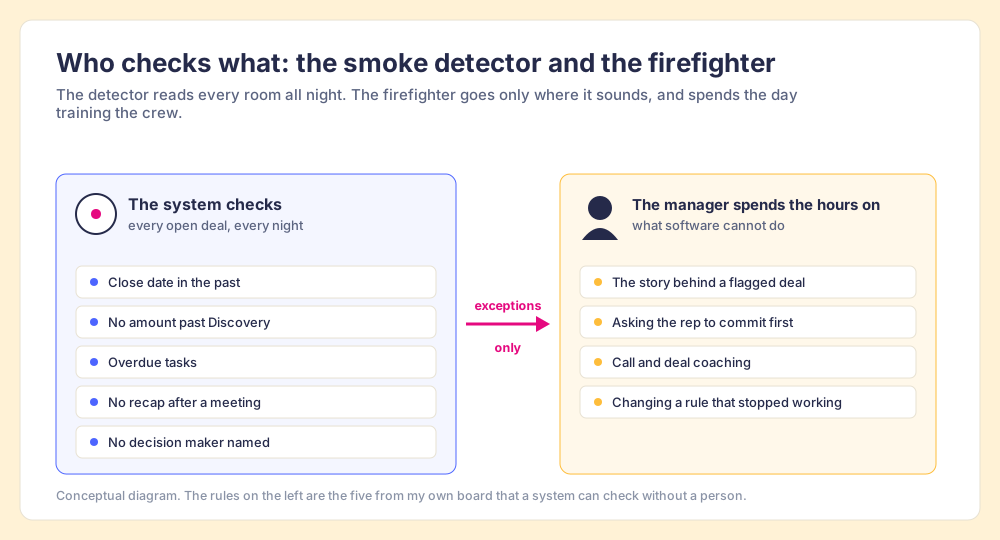
The comparison has a limit. A smoke detector knows what smoke is. A rule knows only what you told it, so a deal can pass every rule and still be in trouble with the buyer. So the manager keeps the weekly conversation (move 4), and a stage should reflect the buyer’s commitment as well as the boxes a rep ticked.
3. Give each rep a daily target of zero
A flagged deal is only useful if someone fixes it while it still matters. The cleanest target I have found is zero: by the end of the day, no open deal on a rep’s list breaks a rule. A rep either has violations to clear or does not, which makes it a target a person can hit every day.
Count the days in a row a rep finishes at zero and post the streak where the team can see it. Harkin and colleagues pooled 138 studies with 19,951 participants and found that monitoring progress toward a goal raised the odds of reaching it, with a larger effect when progress was “physically recorded or publicly reported” (Harkin et al., 2016). A visible streak is progress, physically recorded.
One night of mine shows the loop; treat it as one example, never an average. My board showed 11 violations across 22 rules shortly before midnight. With Supered, HubSpot and Gmail connected to Claude, one prompt cleared it: fields updated from my notes and calendar, recap and pre-call emails saved as drafts for me to send. By hand it takes me about 45 minutes. That night it took about 10.
4. Spend the one-on-ones on the exceptions
Once the readout is done before the meeting, the weekly one-on-one can go to the deals that broke a rule or stalled and to the story the CRM does not hold. Ask the rep to commit to an answer before you give yours. Medical educators built a teaching method on that move: the One-Minute Preceptor, published by Jon Neher and colleagues in 1992, starts by having the learner commit to a diagnosis before the teacher speaks (Neher et al., 1992). Our post on the pipeline review covers how Crispy Barnett and I run that meeting once the recital is gone.
5. Review the rules every month
A rule that no rep has broken in a month is either doing its job or checking nothing; decide which and retire it if it adds no value. A rule that fires on the same rep every day points at a coaching gap or a rule that does not fit the deal type. Add the next rule from what your top rep already does. A process that never changes slowly stops describing how your team wins.
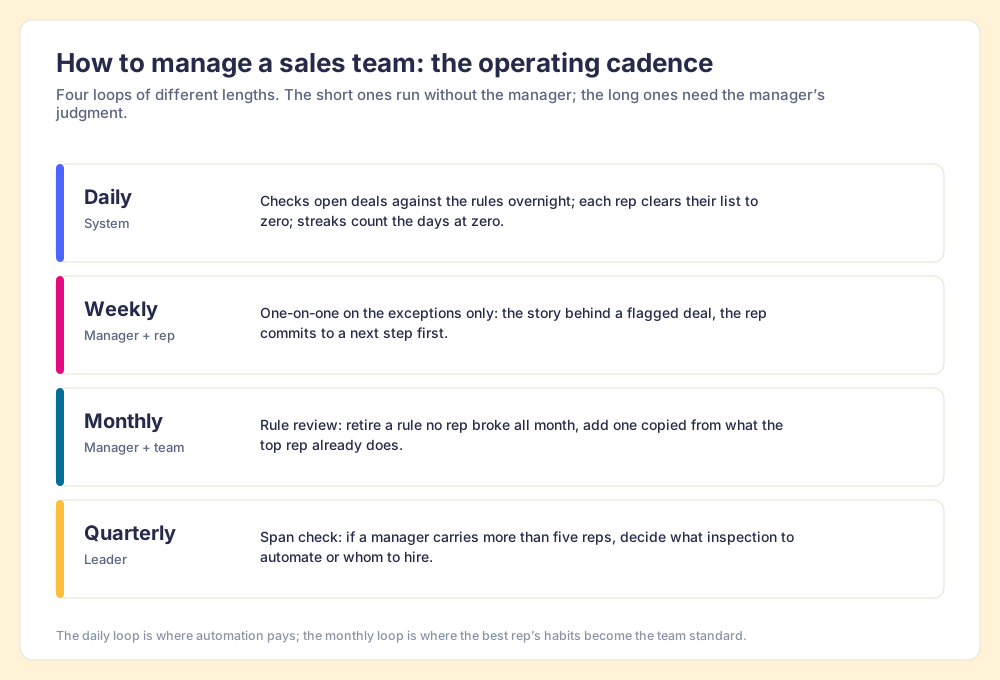
The cadence, in table form:
| Loop | Who runs it | What happens | What it protects |
|---|---|---|---|
| Daily | The system, then each rep | Every open deal checked against the rules; reps clear their list to zero | Data that is never more than a day stale |
| Weekly | Manager and rep | One-on-one on flagged and stalled deals; rep commits first | Coaching time |
| Monthly | Manager and team | Retire, change or add rules, copied from the best rep | A process that matches how the team wins |
| Every three months | Sales leader | Check spans; past five reps, automate more checking or hire | Adherence at scale |
How do you measure sales team productivity?
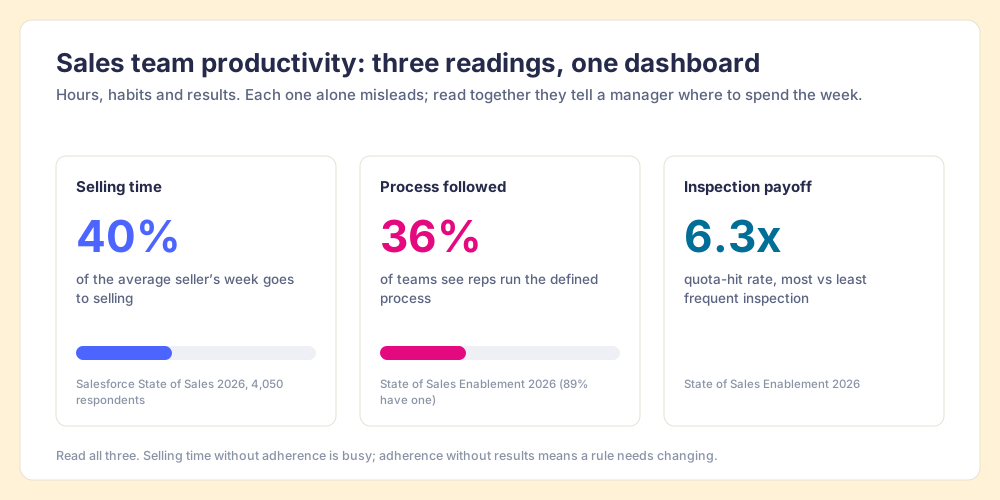
Sales team productivity is three readings, and each misleads on its own.
- Selling time. The average seller spends 40% of the week selling, according to Salesforce’s State of Sales 2026, a survey of 4,050 sales professionals (Salesforce, 2026). Raise it and reps have more hours for buyers, though more hours spent badly is still busy work.
- Process followed. In The State of Sales Enablement 2026, 89% of teams had a defined sales process and 36% saw reps run it. The share of open deals at zero violations is the daily version of that number, and it tells you whether the hours are spent the way the team agreed.
- Results tied to inspection. Win rate and quota attainment are the readings that pay the bills. Teams that inspect deals against a defined process at the highest frequency hit quota at 6.3x the rate of the lowest band, so watch the first two readings because they move the third.
Count the activity too. Calls, meetings and emails are how you confirm the process happened, and they shape what the buyer experiences. Do not let a deal advance on activity alone. Salesforce’s same report found high performers prioritize data hygiene 79% of the time against 54% for underperformers, which fits: the teams that win keep the record accurate about where the buyer stands.
Where does AI fit in managing a sales team?
After the rules. Teams in our survey with strong process adherence rated AI’s impact high 40% of the time, against 21% for teams with weak adherence. AI amplifies the process you already run, so a team with no written expectations gets faster chaos.
With rules in place, AI can do the fixing as well as the finding. The night I described in move 3 is the pattern: the rules live in one place, Claude reads them, updates the CRM from context and drafts the emails, and the rep approves anything a buyer will read. Our guide to Claude for sales covers that setup, and CRM hygiene covers which rules to give the model first.
What we recommend for a manager with more than five reps
You have three real options.
- Smaller spans. Hire managers until no manager carries more than five reps. It works and it is expensive: every new frontline manager is a salary that carries no quota.
- The status quo. Keep spans near the 7.2 average, inspect when you can, and accept adherence near the 23% band. Cheap on paper, costly in deals.
- Automated inspection. Write the expectations as rules, let a system check every deal every night, set a daily zero target, and give the freed hours to coaching.
I recommend the third, and the data in this post is why. Adherence falls with span because inspection is manual, the most-cited reason reps skip the process is that managers do not enforce it, and the most-inspected teams hit quota at 6.3x the rate of the least. Automating the check is the only one of the three options that removes the bottleneck without hiring around it.
We built Supered for this job. Your expectations live in Supered as Process Rules grouped into a Process Ruleset. Process Boards list every deal that breaks a rule, rep by rep, a daily summary goes to Slack, and streaks count the days each rep finishes at zero. Reps see the next step inside HubSpot, Salesforce or Pipedrive, or in Claude, while the work is in motion. Process Compliance costs $40 per user per month billed yearly, with a five-user minimum, and includes our Digital Adoption product (pricing).
Choose something else if your team is under five reps and you can read every deal yourself, or if your reps sell from phones in the field: Supered is built for teams that work at a computer. The Sales Expectations use case shows the board, the zero target and the morning summary, and sales process adoption covers getting a new process followed in the first place.
If you manage eight reps and change one thing this week, write down the three expectations that annoy you most when they slip, in trigger, condition, owner and deadline form. Then read our post on the pipeline review and take the recital out of your next one.
Frequently asked questions
How do you manage a sales team effectively?+
How many reps should one sales manager manage?+
How do you measure sales team productivity?+
What should a sales manager do every week?+
Why do sales reps not follow the sales process?+
Can AI help manage a sales team?+
Your process, running itself.