Field Enablement: First Ask Which Field You Mean
Field enablement names three jobs that share one word: the software GTM org at a keyboard, outside reps in cars, and frontline workers on phones. The field decides the delivery surface and the tool. How to tell them apart, who owns the work, and how to measure it.
Field enablement is the work of getting a company's customer-facing people, the field, ready to run the motion the business expects and then checking that they run it, whether that field sits at a laptop in the CRM, drives a territory, or works a shop floor.
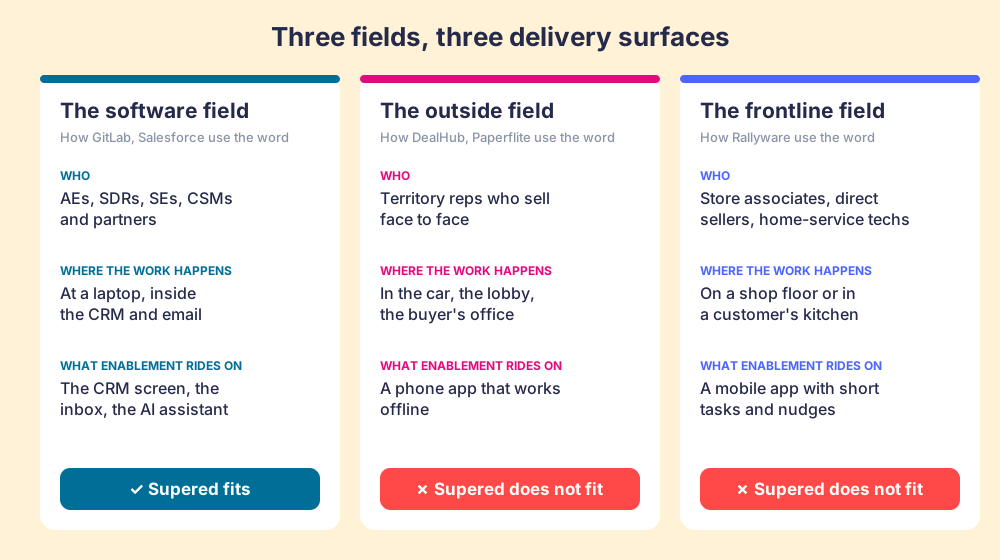
“Field enablement” is three jobs wearing one name. In a software company the field is the whole go-to-market org, sitting at laptops inside the CRM. In medical devices or building supplies it is the outside rep in a car between two hospitals. In retail, direct selling or home services it is a frontline worker with a phone in one hand. The top results for the term each describe one of these and treat it as the only one. The field you have decides the delivery surface, and the delivery surface decides the tools, the measures and, for us, whether Supered belongs in the conversation at all. For two of the three, it does not.
What is field enablement?
Field enablement is the work of getting a company’s customer-facing people, the field, ready to run the motion the business expects of them, and then checking that they run it. The second half is where the job lives. A field that has been told about the new pricing and still quotes the old one has been informed. It has not been enabled.
GitLab publishes its whole field enablement charter in a public handbook, which makes it the clearest real example on the web. The team’s stated mission is “to design and deliver effective enablement solutions to field team members and partners that grow expertise and confidence needed to drive efficient, predictable, and scalable growth for GitLab” (GitLab Handbook, opened 2026-10-02). The vision line goes further: it wants to inspire the field “through the acquisition and application of knowledge, skills and behaviors.” Acquisition is the course. Application is the job.
The word is borrowed from the army, where “the field” is wherever the fighting happens and headquarters is wherever it does not. The borrowing works because it names the people who face the buyer. It breaks because the buyer sits in a different place in each industry.
Why does field enablement mean three different jobs?
Ask a man in London and a man in Dallas to bring a football to the park. Both arrive on time, both are certain, and one carries a round ball while the other carries an oval one. Neither is wrong. They cannot play the same game with what they brought, and the trouble only shows once the kickoff starts.
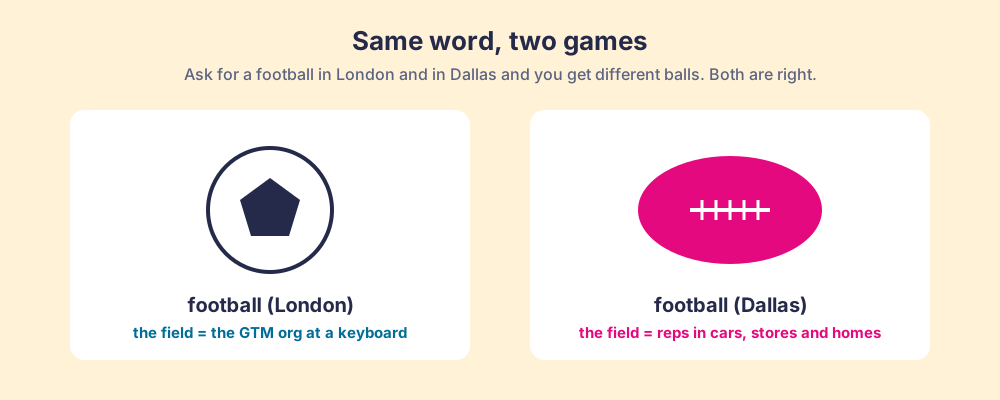
“Field” behaves the same way. Read the pages that rank for the term side by side and three different fields appear:
- The software field. GitLab’s handbook files field enablement under Field Operations, beside sales development, enterprise and commercial sales, solutions architects and customer success. These people work at a laptop, inside the CRM, the inbox and increasingly an AI assistant.
- The outside field. DealHub’s glossary defines field sales enablement as giving “in-person sellers” what they need, combining “mobile-ready tools, territory-specific content, and live training to support sales reps working face-to-face with buyers” (DealHub, opened 2026-10-02). Paperflite’s version stresses “offline functionality” so reps can keep working without a connection (Paperflite, opened 2026-10-02).
- The frontline field. Rallyware writes about field enablement for direct selling networks, retail store associates and home-service teams “with minimal field oversight” (Rallyware, opened 2026-10-02). Their screen is a phone, used between customers.
The third field is the largest by headcount. Emergence Capital estimates the deskless workforce at 80% of the global workforce, with 113 million workers in the United States, while nearly all business software spend goes to applications for desk workers (Emergence Capital, Kevin Spain). A field enablement leader at a home-services company and one at a SaaS company share a job title and almost no tooling.
How does the field change the work?
The program content looks similar across all three: onboarding, product knowledge, plays, certifications, launch communications. What changes is where the guidance has to land, and that single difference rearranges the whole tool stack.
- The software field’s surface. The rep’s day runs through the CRM record, the email thread and the call. Guidance belongs on the record the rep is already working, at the stage where the rep needs it. A separate portal is one more tab, and Gartner’s 2024 survey of 1,026 B2B sellers found 50% already feel overwhelmed by the technology their job requires, with overwhelmed sellers 45% less likely to attain quota (Gartner, September 2024).
- The outside field’s surface. The rep’s day runs through the car, the parking lot and ten minutes before the meeting. Guidance belongs in a phone app that opens fast, works offline and shows the one sheet for this account.
- The frontline field’s surface. The worker’s day runs through customers in person. Guidance belongs in brief mobile tasks and nudges, usually a few minutes long, sent between shifts or between jobs.
Our own research shows how much the surface matters for the first group. In the State of Sales Enablement 2026, teams whose process guidance is embedded in the workflow hit quota at 49%, against 15% for teams whose guidance lives in docs or wikis. The finding comes from software-style teams working in a CRM. We have no data on outside or frontline fields, and I would not stretch it to them.
Who does field enablement: enablement manager, revenue enablement manager, sales enablement analyst?
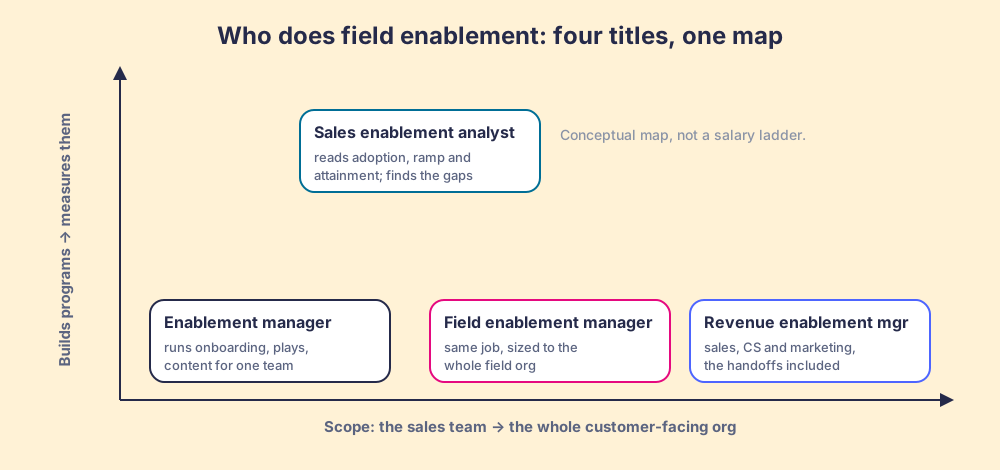
The titles overlap, and job boards use them loosely. Guru’s reference page describes the field enablement manager as the person responsible “for ensuring that sales and field teams are fully prepared, equipped, and motivated to perform their best” (Guru, opened 2026-10-02), which is a fair summary of the whole family. The useful split is by scope and by whether the role builds programs or measures them.
| Role | Scope | Owns | Judged on |
|---|---|---|---|
| Enablement manager | One team, usually sales | Onboarding, plays, content, coaching support | Ramp time, adherence to the motion |
| Field enablement manager | The whole customer-facing field | The same, plus launches and field communications | Behavior change across segments |
| Revenue enablement manager | Sales, CS and marketing, with handoffs | Cross-team programs and the handoffs between them | Handoffs that hold, retention and expansion |
| Sales enablement analyst | Whatever the program covers | Adoption, adherence and attainment data | Telling the managers which program to fix first |
A few notes on each. I come at this from RevPartners, the HubSpot partner I founded, where we ran sales process for clients as a fractional revenue team, so I read these roles from the side of the process they are meant to install:
- The enablement manager. The generalist. On a small team this person writes the onboarding plan on Monday, rebuilds a play on Tuesday and runs the certification on Friday. The trap is becoming the content desk.
- The field enablement manager. The same work with more stakeholders. Segments differ (commercial, enterprise, partners), so the work splits into tracks, and the field communications calendar becomes its own job.
- The revenue enablement manager. The handoffs are the work. A new price that sales quotes and customer success never hears about gets undone at the first renewal. More on that scope in revenue enablement.
- The sales enablement analyst. The least glamorous title and the one that makes the others credible. The analyst is the person who can say which reps run the motion and which do not, and the sales enablement KPIs are this person’s raw material.
What does GitLab’s intake question teach a field enablement team?
GitLab’s handbook asks one question before it takes any request: “Does the Field need to know something?” or “Does the Field need to know AND do something?” The first goes to field communications, an announcement. Only the second becomes a field enablement motion (GitLab Handbook).
That small fork carries more weight than its length suggests. A request to know something is finished when the field has seen it. A request to do something is finished only when the field does it, on real accounts, after the meeting where it was announced has faded. The two need different measures, and a team that runs both through the same pipe ends up measuring both by the easier one, views and completions.
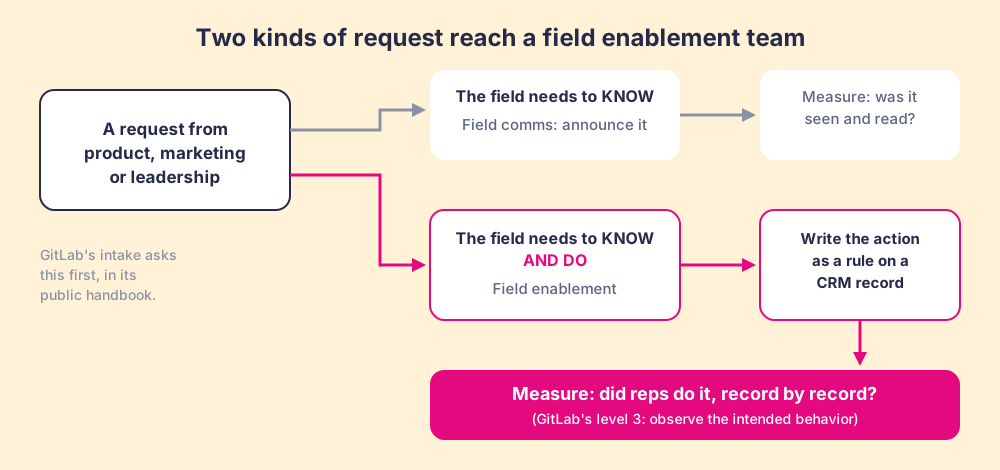
For the software field, the do-branch has a natural home. “Send a recap within 24 hours of the discovery call.” “No deal past Discovery without an amount.” “Name the decision maker before the proposal stage.” Each is a behavior with a yes or no answer on a CRM record. Written that way, the expectation stops being a slide and becomes something a system can check every night. For outside and frontline fields the same discipline applies, with the check living in whatever app the worker uses.
How do you measure field enablement?
GitLab measures its field enablement at four levels, and the handbook spells them out: did the intended audience complete or engage with the enablement; how did they think and feel about it; “were we able to observe an intended behavior?”; and did a business outcome move, such as “lower ramp time, accelerated deal cycle time, higher volume or quality of pipeline, lower churn/contraction” (GitLab Handbook). The four levels follow the model Donald Kirkpatrick published in 1959 (Wikipedia, Donald Kirkpatrick).
Think of a driving instructor. Level one asks whether the student showed up. Level two asks whether the student enjoyed the lesson. Level three asks whether the student checks the mirror when the instructor is not in the car. Level four asks whether the student has fewer accidents. Only the third and fourth tell you anything about the road.
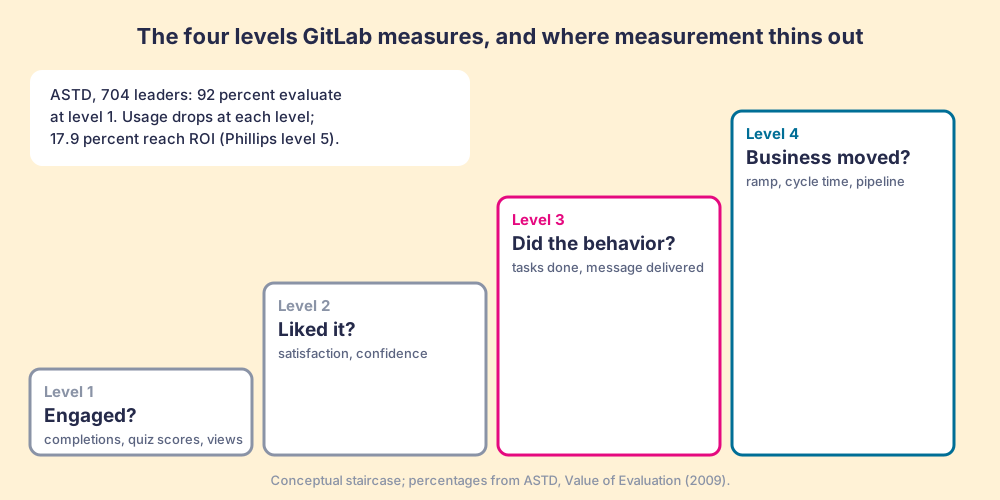
Training departments have known this for a long time. ASTD’s Value of Evaluation study, built on 704 respondents in senior roles, found 92% of organizations evaluate participant reaction, use “drops off dramatically with each subsequent level,” and 17.9% reach return on investment. Organizations spent an average of 5.5% of training budgets on evaluation, with the largest share going to level one (ASTD, November 2009). The study is old, and its shape is easy to recognize in a dashboard built from LMS completions and satisfaction scores: the two easiest levels on top, behavior missing.
Level three is the hinge because it is the only level the field enablement team can act on directly. Completions do not tell you which rep needs help. Pipeline numbers arrive too late and blend a hundred causes. Behavior, read deal by deal, tells a manager on Monday which three reps skipped the recap last week, and that is a coaching conversation. In the State of Sales Enablement, teams that inspect deals against a defined process at the highest frequency hit quota at 6.3x the rate of the lowest band.
A working measurement plan for the software field looks like this:
- Coverage. How many open records each expectation should touch. Without it, every other number floats.
- Adherence. The share of those records where the behavior happened, by rep and by team, read weekly.
- Time to first use. For a launch or a new hire, how many days until the rep runs the new motion on a real account.
- Outcome. Ramp time, stage conversion or win rate for records that followed the motion, against records that did not.
- Reaction, kept small. One satisfaction question per program. It tells you whether the content is usable and nothing more.
When reps skip an expectation at scale, treat it as a design problem in the system: the step is hard to find, arrives late, or goes unchecked. Gartner’s 2024 survey found 72% of sellers feel overwhelmed by the number of skills their job requires, and a field carrying that load drops the steps the system does not make easy.
Where does Supered fit in field enablement, and where does it not?
Supered fits one of the three fields. If your field is a software-style team of 10 or more people who work primarily at a computer in HubSpot, Salesforce or Pipedrive, Supered is built for the do-branch above. You write your expectations as Process Rules, group them into Process Rulesets, and Process Boards show which records break them and who owns those records. Reps see the next step in the CRM screen at the moment they need it, or ask for it in Claude or another LLM, and the same rules apply in both places. Cards and in-app guides carry the know-branch into the same screen, and managers see adherence without chasing anyone. The use cases are on sales process adoption and sales expectations, and new-hire programs on onboarding and ramp.
Pricing as of 2026-10-02 on our pricing page: Process Compliance is $40 per user per month paid yearly ($45 monthly) with a 5-user minimum and includes Digital Adoption, which is $13.50 per user per month paid yearly ($15 monthly) on its own.
Choose something else if your field drives a territory or works a shop floor. Supered has no mobile product, and it is not a fit for field or mobile-first teams. A rep who checks the account sheet on a phone in the parking lot needs a mobile app with offline content, the kind DealHub and Paperflite describe. A store associate or home-service technician needs short mobile tasks, the kind Rallyware describes. Buying a CRM-native tool for those teams adds a laptop screen the field will not open.
What we recommend
Start by naming your field in one sentence: who they are, where they work, and what screen they hold. Then pick the delivery surface that matches it, and only then the tools. For a software field, put the do-requests on the record as rules and read adherence weekly. For an outside or frontline field, buy mobile-first and hold it to the same four levels. In both cases, run GitLab’s fork before you build anything, because the requests that only need knowing are cheap and the ones that need doing are the job.
If you are standing up the function, the GTM enablement guide covers how to make a launch hold past launch day, which is where a new field enablement team usually gets its first test.
Frequently asked questions
What is field enablement?+
What does a field enablement manager do?+
What is the difference between an enablement manager and a revenue enablement manager?+
What does a sales enablement analyst do?+
Is field enablement different for outside sales reps?+
How do you measure field enablement?+
Your process, running itself.