AI Adoption Strategy for Sales Teams: Write the Rules Before the Rollout
An AI adoption strategy has two jobs, and the popular guides cover one: getting people to use AI. In sales, the second decides whether the first pays: getting the AI to follow your process. Why usage numbers mislead, and the order we recommend.
An AI adoption strategy is the plan for getting a team to use AI in its daily work and for making sure the work the AI does follows the way the team has agreed to sell, judged by what changed in the work rather than by how many people logged in.
The rollout report looks great. Most of the team opened the AI assistant this week, prompts are climbing, and the slide in the leadership deck is green. Then the sales leader opens three deals the AI touched. A recap email with no next step. A close date moved to a date the buyer never agreed to. A discovery summary that never names the person who signs. The AI was used, by any measure on the slide. The sales process was not followed, and nothing on the slide could have told you.
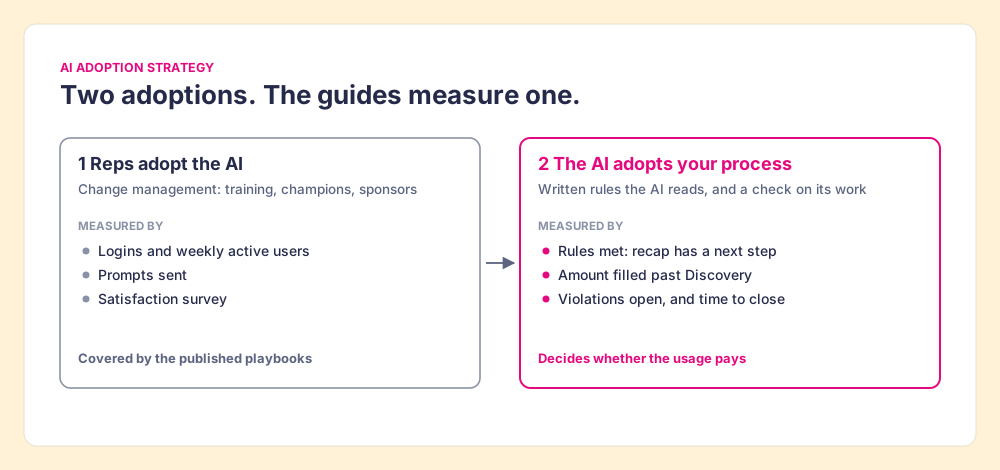
An AI adoption strategy is the plan for getting a team to use AI in its daily work and for making sure the work the AI does follows the way the team has agreed to sell, judged by what changed in the work rather than by how many people logged in. The guides ranking for the term, from Gallup, McKinsey, Moveworks and Highspot, treat it as the first half of that sentence: people adopting a tool, solved with training, champions, executive sponsorship and a monthly-active-users target. That half matters. In sales it is the smaller half. The second adoption, the AI adopting your process, decides whether all that usage pays, and it has to come first.
What is an AI adoption strategy, and what are the two adoptions inside it?
When a sales team “adopts AI,” two different things have to happen, and they fail for different reasons.
- Adoption one: reps use the AI. People open the tool, trust it enough to try it, and fold it into the day. This is change management, and the published playbooks are good at it. It fails on fear, confusion and missing manager support.
- Adoption two: the AI follows your process. The drafts, field updates and summaries the AI produces meet the expectations your team has agreed on: a recap within a day, an amount filled past Discovery, a decision maker named before a proposal. It fails when the team has not written those expectations down where the AI can read them.
The Moveworks guide shows the gap clearly. It is a sensible playbook, and its measurement section recommends usage targets of roughly 60% monthly active users and a 40% weekly-to-monthly ratio, then outcome measures like help desk volume and time to resolution (Moveworks, August 2026). For an IT help desk that works, because a password reset either happened or it did not. Highspot’s guide for go-to-market teams makes good points about embedding AI in workflows and involving frontline managers (Highspot, updated September 30, 2026). Neither asks whether the work the AI produced followed the sales process. In sales, that question carries the weight, because a deal does not close or die for weeks, and by then the AI’s shortcuts are baked into the pipeline.
Why do AI usage numbers mislead sales leaders?
Because people are poor judges of whether a tool helped them, and usage numbers inherit that misjudgment.
The cleanest proof comes from software engineering. In 2025, the research group METR ran a randomized trial with 16 experienced open-source developers working on 246 real issues in their own codebases. Before starting, the developers expected AI tools to speed them up by 24%. With AI allowed, they took 19% longer. Afterward, they still believed AI had sped them up by 20% (METR, July 10, 2025). These were experts in their own code, measuring their own work, and their felt sense pointed the wrong way by about 40 points.
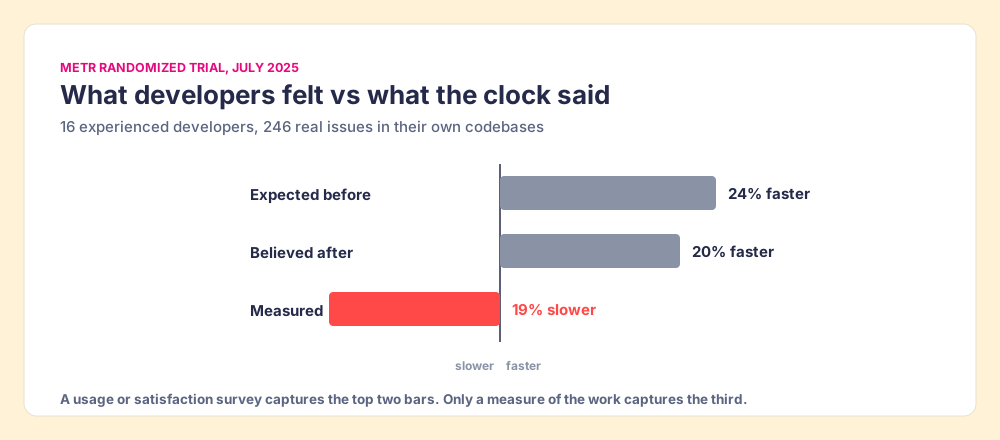
Sales has its own version. A rep who has Claude draft the recap feels faster, and may be. Whether the recap carried a next step the buyer agreed to is a separate fact, and no dashboard counts it. The rep’s satisfaction score and the weekly-active number both go up either way.
Counting AI logins to judge AI adoption is like counting gym turnstile clicks to judge fitness. The turnstile tells you the door works and the membership is paid. It cannot tell you whether anyone lifted anything, and a member who drove over, sat in the sauna and left counts the same as one who trained. The scale and the stopwatch are somewhere else in the building.
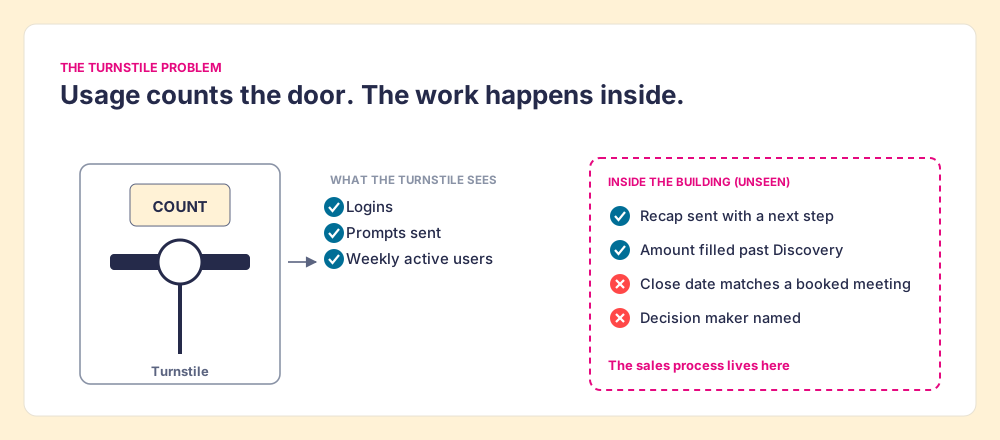
The analogy has an edge. A gym can at least see who walked in; the sales version is worse, because an AI-drafted email that skipped the next step looks, in the CRM, exactly like a good one.
The big surveys show what happens when organizations measure the turnstile. MIT NANDA’s July 2025 report, The GenAI Divide, found that 95% of organizations were getting no measurable business return from generative AI, despite $30 to 40 billion in enterprise spending, and over 80% had explored or piloted tools like ChatGPT and Copilot (Virtualization Review on the MIT NANDA report, August 19, 2025). The report’s diagnosis was blunt: “Most GenAI systems do not retain feedback, adapt to context, or improve over time.” Usage spread fast. The work did not change. BCG’s AI at Work 2025 survey of more than 10,600 leaders, managers and frontline employees across 11 countries and regions found that “regular use among frontline employees has stalled at 51%” (BCG, June 23, 2025). Gallup’s 2026 panel puts it closer to home: four in 10 US employees never use AI at work, and 25% strongly agree their organization has communicated a clear plan or strategy for it (Gallup).
What does the research on adoption of new technology say about AI?
The study of how people take up new tools is older than personal computers. Everett Rogers’s Diffusion of Innovations, first published in 1962, named five attributes that predict how fast a new technology spreads: relative advantage, compatibility with existing work, complexity, trialability, and observability, meaning how easily people can see the results (Diffusion of innovations, Wikipedia). Run AI through that list and four of the five favor it. The advantage is plain, it fits into email and the CRM, it takes a sentence to use, and anyone can try it free in a browser tab.
Observability is where it breaks. A manager can see that the rep used AI. The manager cannot see whether the AI’s work was right without reading every draft and every field change, and a manager with eight reps does not have those hours. Rogers’s research says an innovation whose results people cannot see spreads slowly and gets abandoned. AI in sales spreads fast anyway, because it is easy, and the unseen results pile up in the pipeline.
So make the second adoption observable. You cannot read every AI draft. You can write down what a correct one has to contain and check for it automatically.
Why does AI need your sales process before the rollout?
Because AI copies the process it is given, the good parts and the bad parts at the same speed.
The best evidence is the largest field study of generative AI at work. Erik Brynjolfsson, Danielle Li and Lindsey Raymond followed 5,179 customer support agents given an AI assistant. Productivity, measured as issues resolved per hour, rose 14% on average and 34% for novice and low-skilled workers, with minimal impact on the most experienced. Their explanation: “the AI model disseminates the best practices of more able workers and helps newer workers move down the experience curve” (Brynjolfsson, Li and Raymond, Quarterly Journal of Economics, 2025). The assistant was trained on the conversations of the best agents. It handed every new hire the top performer’s playbook.
Think of the AI as a photocopier. It copies whatever page is on the glass, fifty times a minute. Put your best rep’s page there, a discovery call that names the decision maker and a recap that ends with an agreed next step, and fifty reps get a clean copy. Put a smudged page there, or no page, and the copier still runs. You get fifty smudges, faster than any human could have made them.
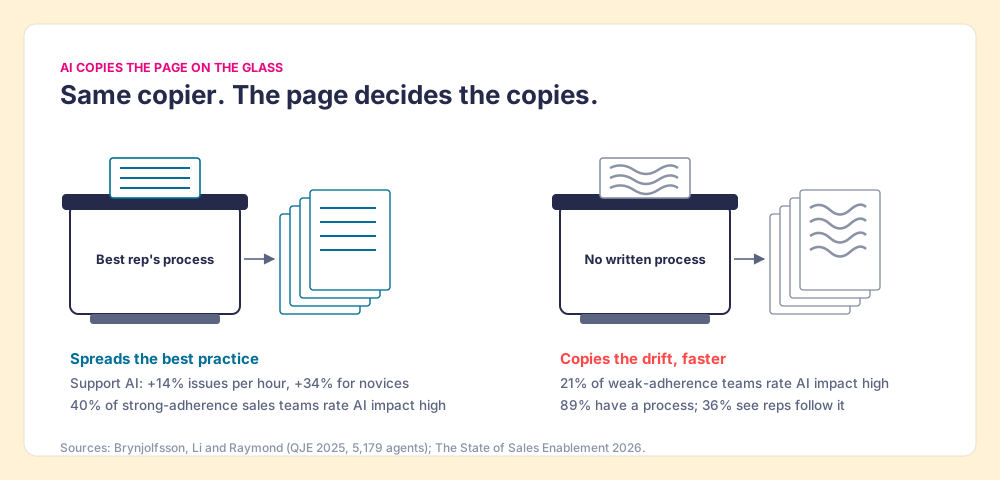
The picture stops being exact at one point. A copier cannot improve the page, and an AI sometimes can. But it can only improve toward a standard it can see, and on most sales teams the standard is not written anywhere it can read.
Our own survey says how often that is the case. In The State of Sales Enablement 2026, 89% of teams said they have a defined sales process and 36% said their reps follow it (The State of Sales Enablement). That 53-point gap is the page on the glass. The same survey found AI pays off in proportion to adherence: 40% of teams with strong process adherence rate AI’s impact high, against 21% of teams with weak adherence. AI amplifies the process you have. A team that rolls out AI before closing the gap is making copies of the gap.
I spent the RevPartners years doing HubSpot Sales Hub implementations, and the AI rollout repeats the CRM rollout’s mistake: buy the tool, train the people, count the logins, and hope the process shows up on its own. We wrote up why that fails for the CRM in CRM adoption. AI adds a twist. The CRM sat there waiting for reps to fill it in. AI fills things in by itself, so a missing process stops being a gap and starts being an output.
How do you build an AI adoption strategy for a sales team?
The AI adoption framework we recommend runs in five steps. The order carries the weight: each step makes the next one measurable.
- The rules, written as checks. Turn the expectations in your managers’ heads into yes-or-no tests a machine can apply to a record: recap sent within 24 hours of a meeting, amount filled after Discovery, close date not in the past, decision maker named before a proposal. Capture them from what your best reps already do, and skip the consultant’s template your reps have never seen work.
- One home for the rules, read by reps and the AI. The rules have to sit where the rep works, inside HubSpot, Salesforce or Pipedrive, and where the AI reads, through a connector or MCP server. Rules in a slide deck reach neither.
- Two starting jobs, picked for checkability. Start where the AI’s output can be checked against a rule the same day. CRM cleanup and post-meeting recaps are the natural first two, and teams already point AI there: 46% of teams in The State of Sales Enablement use AI for CRM admin and cleanup.
- Adherence as the adoption metric. Track how many rule violations are open and how fast they close, per rep and across the board, whether a human or the AI did the work. Keep usage as a secondary health check.
- Managers on coaching, not chasing. Automate the inspection so the manager’s hours go to the deals the check flags. BCG found the share of employees who feel positive about generative AI rises from 15% to 55% with strong leadership support, and that support is easier to give when the manager is not reading every draft.
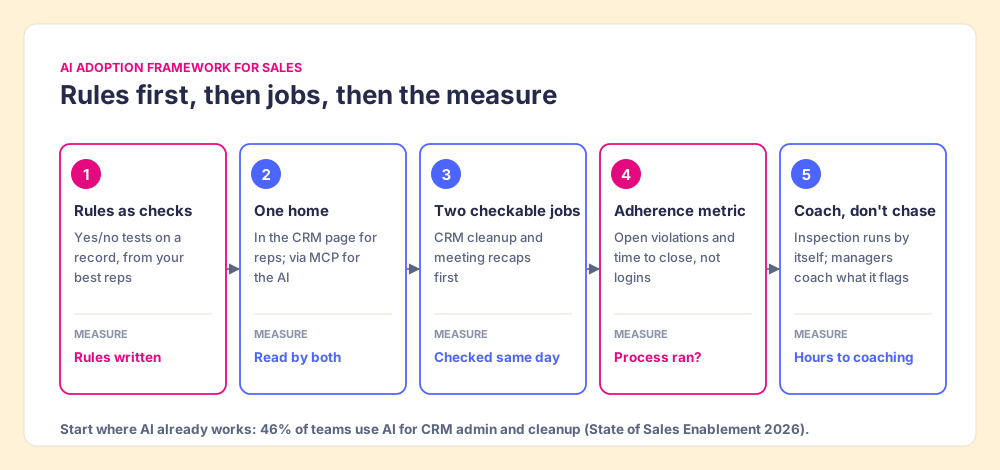
Inspection is the step teams want to skip, and it is the one with the strongest evidence. In The State of Sales Enablement, teams that inspect deals against a defined process at the highest frequency hit quota at 6.3x the rate of the lowest band. With AI doing more of the work, inspection by hand stops being possible, so it has to be automatic.
The difference between the two measurement plans fits in a table.
| What you measure | Turnstile plan (usage) | Rules-first plan (adherence) |
|---|---|---|
| Headline number | Weekly active users, prompts sent | Open rule violations, time to close them |
| What it proves | The tool is being opened | The process ran, by a person or the AI |
| Who reads it | IT and the vendor’s success manager | The sales manager, deal by deal |
| What a bad week looks like | Fewer logins | A recap with no next step, a close date in the past |
| What it misses | Whether the work was right | Whether reps like the tool (track it separately) |
Where does Supered fit in an AI adoption strategy?
Supered is one way to run the rules-first plan, and it does both adoptions in one place. The rules live in Supered as Process Rules grouped into Process Rulesets, checked across open records on Process Boards. Reps see the rule, the card or the guide on the HubSpot, Salesforce or Pipedrive page at the moment of the work. Claude reads the same rules through the Supered MCP server and does the fixing: fields updated, recaps and pre-call emails drafted.
My own example, not a study: one night my board, “Zero Board · Sales Expectations,” held 22 rules and showed 11 violations across my deals, from close dates in the past to a missing decision maker. One prompt in Claude, with Supered, HubSpot and Gmail connected, cleared it. Claude updated the fields from context and saved the emails as Gmail drafts for me to review. About 45 minutes of work by hand took about 10. The next morning the summary showed zero violations. The point for an adoption plan is the measure: the board counts whether the process ran, whoever did the work. The setup is the sales expectations use case, and the in-app cards and guides that bring new reps up to speed are onboarding and ramp.
Pricing, from the pricing page as of October 2, 2026: Digital Adoption (cards, guides, page triggers) is $13.50 per user per month paid yearly, $15 monthly. Process Compliance, which adds Process Rules and Process Boards and includes Digital Adoption, is $40 per user per month paid yearly, with a 5-user minimum.
Choose something else if:
- A company-wide AI program is the job. If you are rolling out AI to HR, finance and IT, an enterprise employee-AI platform like Moveworks and a people-first program like Gallup’s are built for that breadth. Supered is for the sales process.
- The team works in the field or on mobile. Supered has no mobile product, so field teams who rarely sit at a computer are a poor fit.
- The process is not agreed yet. No tool fixes that. Sit with your two best reps, write what they do, and come back.
What we recommend
Write the rules before the rollout. The standard plan, licenses, training, champions, a usage target and a satisfaction survey at 90 days, has its uses, and it will produce a green slide. Run on its own, it measures the turnstile. Put the rules-first steps underneath it: expectations written as checks, kept where reps and the AI both read them, two checkable jobs to start, and adherence as the number the sales leader reviews.
The evidence for that order comes from four directions. METR showed experts misjudging AI’s effect on their own work by about 40 points. MIT found 95% of organizations getting no measurable return while usage spread. Brynjolfsson, Li and Raymond showed an AI assistant spreads whatever practice it learned from. And our survey found strong-adherence teams nearly twice as likely to rate AI’s impact high. The process decides what the AI is worth, so the process goes in first.
To go further, Claude for sales shows how to connect the tools and hand Claude your rules, the HubSpot Claude connector walks through the one-prompt workflow, and sales process adoption covers closing the 53-point gap before the AI starts copying it.
Frequently asked questions
What is an AI adoption strategy?+
What is the failure rate of AI adoption?+
How do you measure AI adoption in a sales team?+
What should an AI adoption framework for sales include?+
Do we need a new tool to adopt AI in sales?+
Who should own AI adoption on a sales team?+
Your process, running itself.