Sales Targets and Goals: Set the Number, Then Set What Reps Control
A sales target is the number.
A sales goal is what someone can act on this week. Fifty years of goal-setting research says outcome goals can hurt performance on complex work like B2B selling. Here is how to plan from the target down to expectations reps meet every day.
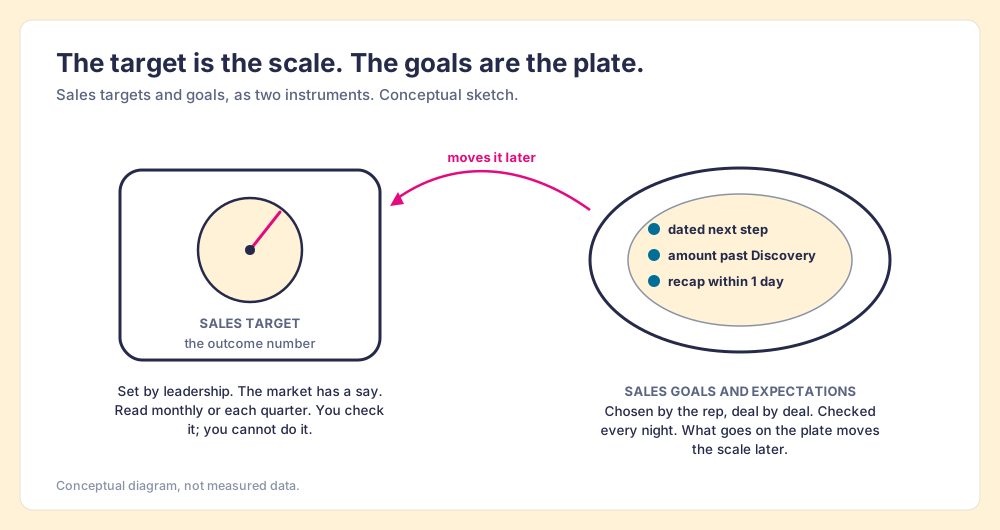
Sales targets and goals are two layers of one plan: a sales target is the outcome number the business needs by a date, and a sales goal is a specific commitment a team or rep controls that makes the target likely, such as an expectation met on each open deal.
A bathroom scale is an accurate instrument and a useless coach. It will tell you to the tenth of a pound where you stand on the morning you step on it, and it has nothing to say about the second helping, the skipped walk, or what to order at lunch. A person who wants to weigh less changes what goes on the plate, then steps on the scale to see whether the change worked.
Sales targets and goals are two layers of one plan: a sales target is the outcome number the business needs by a date (revenue, new logos, units), and a sales goal is a specific commitment a team or rep controls that makes the target likely, such as an expectation met on each open deal. The scale and the plate. The trouble is that the popular lists of sales goals are mostly scale readings. The first of Highspot’s 15 SMART sales goals is “hit quarterly revenue targets,” and most of the rest are outcomes too: churn, customer lifetime value, acquisition cost, deal size.
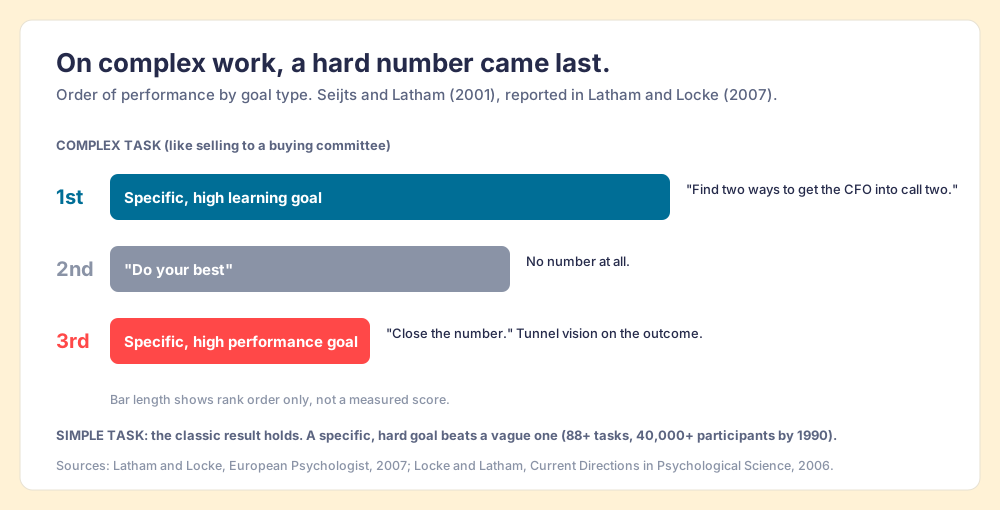
Fifty years of goal-setting research says something those lists leave out. A specific, hard goal raises performance on a simple task. On a complex task, where people do not yet know the strategy that wins, a specific outcome goal can lower performance below a plain “do your best,” and a specific goal about learning or behavior does better than both (Latham and Locke, European Psychologist, 2007). Selling a six-figure deal to a buying committee is a complex task. So the revenue target belongs on the scale, where leadership reads it. The goals reps work toward belong on the plate: the expectations they can meet today, deal by deal, and check by tonight.
What is a sales goal, and how is it different from a sales target?
A sales goal is a commitment someone can act on this week. It is the shortest test I know. If the person holding the goal cannot name the next thing to do about it, it is a target that has been renamed.
The plan has three layers, and they differ by who controls them and how often you can read them:
- Sales target. The outcome number the business needs by a date: $1.2 million in new annual revenue, 40 new customers, 3,000 units. Leadership sets it from the business plan, the market has a large say in whether it lands, and you can read it monthly at best. A quota is a sales target assigned to one rep.
- Outcome goals. Results the team influences but does not control: win rate, average deal size, sales cycle length, new pipeline created each month. They explain the target. You can read them monthly, and they move slowly.
- Expectations. Behaviors a rep controls on each open deal: a next step with a date, an amount once Discovery is done, a decision maker named before the proposal, a recap within a day of each meeting. You can check them every night, and a rep can fix a broken one before lunch.
The pages that rank for this search stop at the second layer. Qobra’s explainer, cited in Google’s AI answer for it, draws a clean line: a target is “a specific, quantitative benchmark,” and a goal is the broader, longer-term objective (Qobra). That line is correct and it is not enough, because both of its halves are still readings on the scale. The third layer is where the work happens, and it is the one a manager can check without waiting for the month to close.
Why do revenue targets make weak goals for reps?
Goal-setting theory deserves its reputation. Edwin Locke and Gary Latham summarized the core finding in 2006: “specific, high (hard) goals lead to a higher level of task performance than do easy goals or vague, abstract goals,” a result that by 1990 had held across more than 88 tasks and 40,000 participants (Locke and Latham, Current Directions in Psychological Science, 2006). If your reps have no number at all, give them one.
The same researchers found the edge of their own result. In Winters and Latham’s 1996 experiment, a learning goal made no difference on a task that was straightforward for people. “Only when the task was complex for people did a learning goal lead to higher performance.” Seijts and Latham pushed it further in 2001. On a complex task, “those who were urged to do their best performed better than those with a specific high performance goal,” and both groups did significantly worse than people given a specific high learning goal (both quoted in Latham and Locke, 2007).
Read that slowly. On complex work, a hard number did worse than no number.
The mechanism is attention. Locke and Latham call it tunnel vision: focusing on a performance outcome on a new, complex task leads people to chase the goal “rather than on acquiring the skills required to reach it.” In their 2007 review the authors put it plainly: “Sheer effort and persistence to attain a specific level of performance taxes the limited cognitive resources necessary for task mastery.” A rep staring at the gap to quota is spending the attention that should go to finding out who else signs off.
B2B selling sits on the complex side. Gartner reports that a typical buying group for a complex B2B purchase involves six to ten decision makers, and that 77% of buyers describe their latest purchase as complex or difficult (Gartner). A new rep handed “$1.2 million, go” is in the experimental condition that came last.
You might say a learning goal sounds soft for a sales floor. Fair. “Get better at multithreading” is soft. “Find two ways to get the CFO into the second call this month” is a learning goal, and it is as specific as any quota. Once the team finds what works, it stops being a learning goal and becomes an expectation: the CFO is named in the CRM before the proposal goes out. Your best reps already run a process like that. The job is to write their motion down and make it the standard, deal by deal.
What happens when a sales target has no expectations underneath it?
A target with nothing underneath it tells people what number to produce and nothing about how. People fill the gap themselves, and some of what they fill it with you would never have approved.
Lisa Ordóñez, Maurice Schweitzer, Adam Galinsky and Max Bazerman catalogued the damage in a 2009 paper titled “Goals Gone Wild.” The side effects they identified include “a narrow focus that neglects non-goal areas, a rise in unethical behavior, distorted risk preferences, corrosion of organizational culture, and reduced intrinsic motivation” (Ordóñez et al., 2009, SSRN).
Wells Fargo ran the experiment at full scale. In September 2016 the Consumer Financial Protection Bureau found that employees had opened about 1.5 million deposit accounts and about 565,000 credit card accounts that customers may not have authorized, and fined the bank $100 million. The CFPB’s own words: “Spurred by sales targets and compensation incentives, employees boosted sales figures by covertly opening accounts” (CFPB, September 8, 2016).
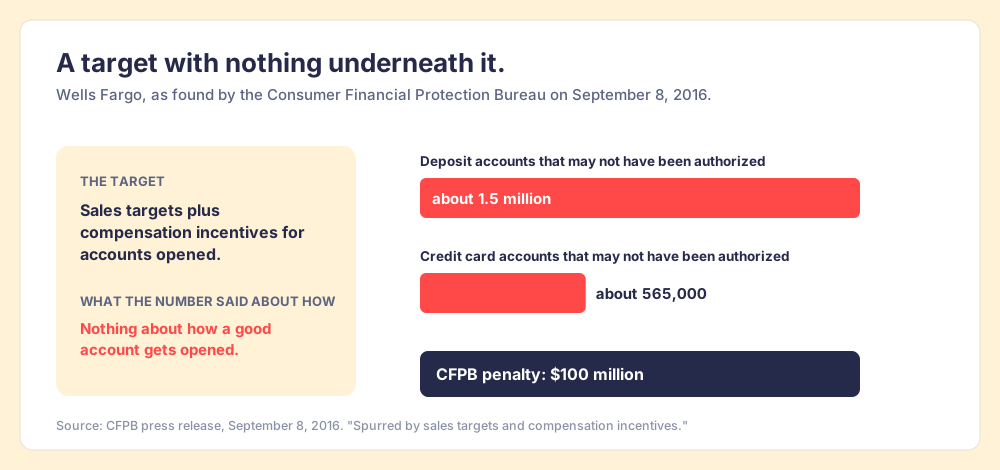
Wells Fargo is the extreme case, and it is a system story more than a story about bad people. The bank set a number and paid for the number, and the number said nothing about how a good account gets opened. The ordinary sales-team version is smaller and familiar: close dates moved to fit the month, a deal pushed to Proposal because the demo happened even though the buyer has not agreed to anything, a discount offered to land the number. Seller activity matters and should be tracked. A stage should also reflect where the buyer stands, and only an expectation written in advance can say so.
How do you set sales goals in a sales plan?
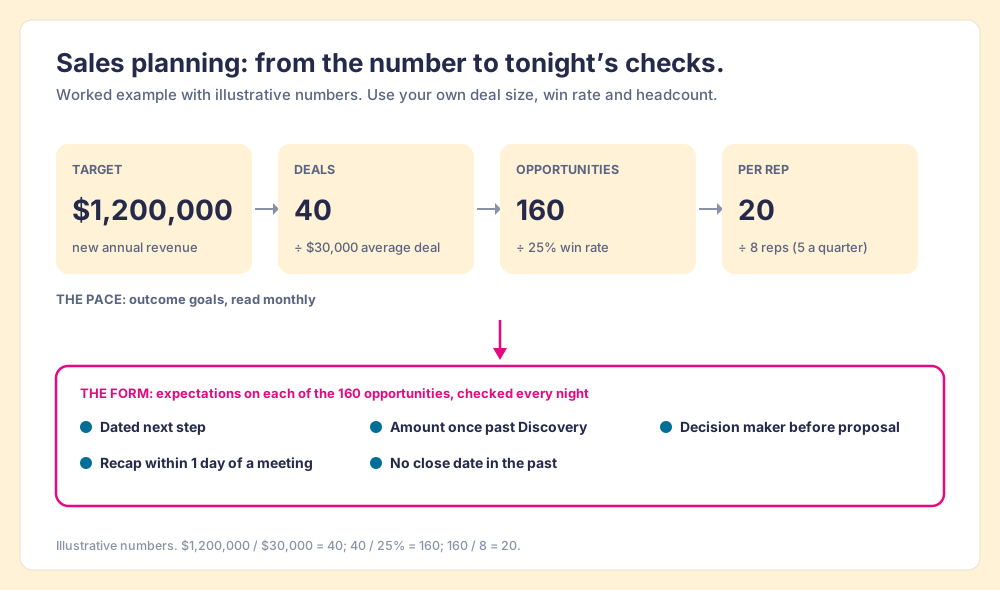
Sales planning works backward, from the far number to the checks you can run tomorrow. A marathoner aiming for four hours does not think about four hours at mile nine. She checks her split, 9:09 a mile (four hours over 26.2 miles), and her form, because those are the things she can still change. A sales plan needs the same two instruments: a pace for the outcome goals and a form check for the expectations.
The arithmetic, on a worked example. The numbers are illustrative; use your own history.
- Target. $1,200,000 in new annual revenue this year.
- Deals needed. At an average deal size of $30,000, that is 40 closed-won deals.
- Opportunities needed. At a 25% win rate, that is 160 qualified opportunities.
- Per rep. With 8 reps, 20 opportunities each, or 5 a quarter per rep.
- Expectations per deal. The steps that, in your own closed deals, separate the ones you won from the ones you lost, checked on each of those 160 opportunities while they are open.
Check the plan against capacity before you send it. In Salesforce’s 2022 research with 7,775 sales professionals, reps spent 28% of their time selling (Salesforce, December 2022). A plan built on full selling weeks is built on hours the team does not have. When the math does not close, you have three real levers: a lower target, more reps, or a higher win rate. The expectations layer is how you go after the third one without guessing.
What are good examples of sales goals?
Sorted by who controls them, so you can see which ones a rep can work on today:
| Layer | Sales goal example | Who controls it | How often you can check it |
|---|---|---|---|
| Target | $1.2M new annual revenue this year | Leadership and the market | Monthly |
| Target | Quota of $150,000 per rep | Leadership and the market | Monthly |
| Outcome goal | Win rate from 20% to 25% | Team influences | Monthly |
| Outcome goal | Average deal size up to $30,000 | Team influences | Monthly |
| Outcome goal | New pipeline created each month | Team influences | Weekly |
| Learning goal | Find two ways to get the CFO into the second call | Rep | Weekly |
| Expectation | A dated next step on each open deal | Rep | Daily |
| Expectation | Amount filled in once a deal passes Discovery | Rep | Daily |
| Expectation | Decision maker named before a proposal | Rep | Daily |
| Expectation | Recap sent within one day of each meeting | Rep | Daily |
| Expectation | No close date in the past | Rep | Daily |
The lists that rank for “sales goals” are almost entirely the first five rows. They are good rows. ZoomInfo’s ten examples, for instance, run from revenue and churn to win rate, cycle time and activity goals (ZoomInfo). The rows at the bottom are the ones that change what a rep does this afternoon.
How do you know if reps are working toward the goals?
You check, and you check often. Harkin and colleagues pooled 138 experiments with 19,951 participants and found that interventions that raised how often people monitored their progress improved goal attainment (d = 0.40), with larger effects when the progress was physically recorded or reported to others (Harkin et al., Psychological Bulletin, 2016). Goals that get looked at get met more often.
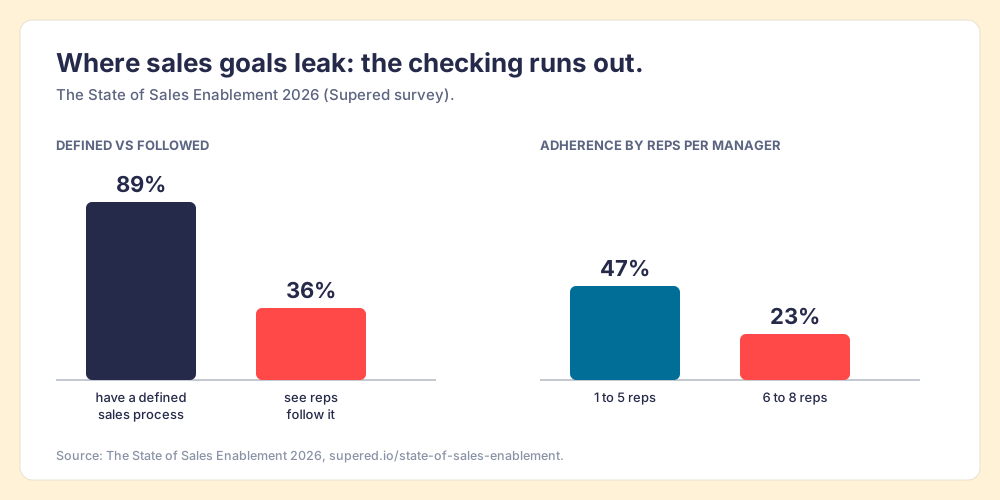
Sales teams write expectations down and then stop looking. In The State of Sales Enablement 2026, 89% of teams said they have a defined sales process and 36% said reps follow it. Teams that inspect deals against a defined process at the highest frequency hit quota at 6.3x the rate of the lowest band.
The checking breaks down for a plain reason: managers run out of hours. In the same survey, process adherence was 47% when a manager had one to five reps and 23% at six to eight, and the most common reason reps gave for skipping the process was that managers do not enforce it (29%). A manager can open every deal for five reps. Past that, the expectations that do not get checked stop being expectations.
So the inspection has to happen without a manager reading records. Lift that work off the manager and the human hour goes to coaching the deal instead of chasing the field.
Where does Supered fit for sales goals?
Supered is software for the third layer. Each expectation becomes a Process Rule inside a Process Ruleset, a Process Board checks each open deal against the rules every night, and the rep sees what is broken and clears it in HubSpot, Salesforce or Pipedrive, or asks Claude to do the work from the same rules. My own board runs 22 rules under a ruleset called Sales Expectations; the sales expectations use case shows how one prompt cleared 11 violations on it. Process Compliance is $40 per user per month paid yearly ($45 monthly), with a 5-user minimum, and includes Digital Adoption (pricing).
Choose something else if your problem is the number itself. Setting territories, splitting quota and modeling capacity is planning and finance work, and a spreadsheet with your finance lead, or a dedicated sales planning tool, is the right home for it. Supered is also a poor fit for a team under five sellers or a field team that works mostly from phones. If your number is set and your reps miss the steps that produce it, book a demo and we will build your first expectations against your own pipeline.
What we recommend
Keep the target, keep the outcome goals, and add a short list of daily expectations under both. Each layer has a job:
- The target, for leadership. One number and a quota split, read monthly. On its own it puts a rep in the condition the research ranks last on complex work.
- Outcome goals, for the team. Win rate, deal size, cycle length, pipeline created. The SMART lists that rank cover this layer well, and it shows why the number moves.
- Expectations, for each rep. Five to ten behaviors on each open deal, written down and checked every night, plus a learning goal while the team is still working out a new motion.
Latham and Locke’s review found behavior and learning goals win on complex tasks. Harkin’s 138 experiments found frequent, recorded checking raises attainment. Our own survey found the teams that inspect most often hit quota at 6.3x the rate of the lowest band. Keep the target on the scale. Put the work on the plate, and check the plate every day.
The next step is reading those checks well. How to track sales progress lays out the weekly cadence for outcomes, activity and adherence, and CRM hygiene shows the six nightly rules I run on my own deals. If reps know the expectations and skip them anyway, start with sales process adoption.
Frequently asked questions
What is a sales goal?+
What is the difference between a sales target and a sales goal?+
What are good examples of sales goals?+
How do you set sales targets?+
What is sales planning?+
Are SMART goals enough for a sales team?+
Your process, running itself.