What Is a Sales Closing Strategy? One Buyer Commitment per Stage, Checked
The top guides answer with closing lines for the last five minutes.
The research on large deals says those lines backfire. A closing strategy is one buyer commitment per stage, written as exit criteria and checked daily.
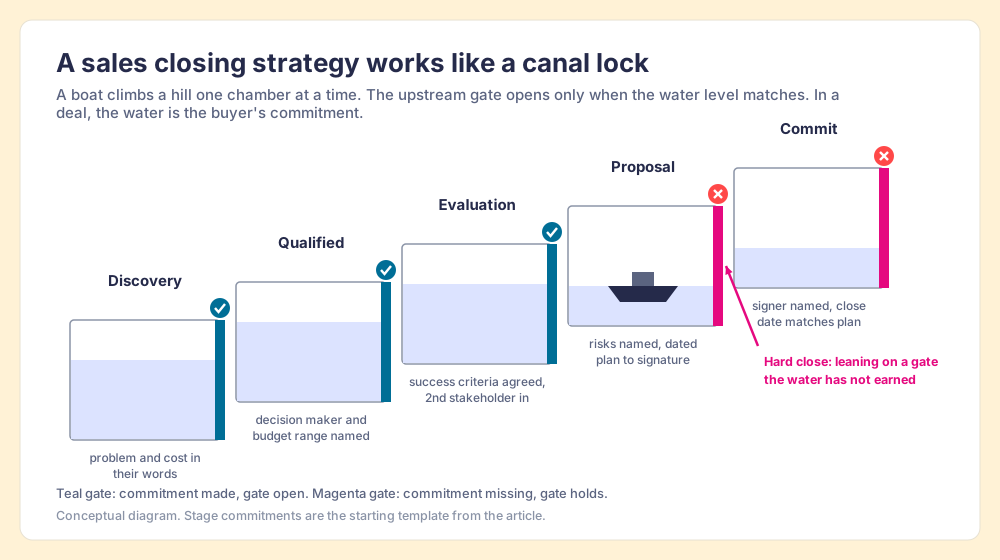
A sales closing strategy is the plan for how a deal reaches a signed yes: the buyer commitment you need before a deal leaves each stage, written down as exit criteria, and the routine that checks those criteria on each open deal.
Search for a sales closing strategy and you are handed a toolbox for the last five minutes of a deal. The assumptive close. The puppy dog close. The now-or-never close. Wikipedia lists sixteen of them (Closing (sales)). They make lively reading, rather like a book of chess traps, and they share a flaw with chess traps: they assume the game is decided in the final move. In a B2B deal with six to ten people on the buying side, it seldom is.
So what is a sales closing strategy, if it is not a script? A sales closing strategy is the plan for how a deal reaches a signed yes: the buyer commitment you need before a deal leaves each stage, written down as exit criteria, and the routine that checks those criteria on each open deal. The close is the last of five or six small yeses. The strategy lives in the earlier ones, and Neil Rackham’s study of 35,000 sales calls found that closing techniques backfire as deals get larger.
A boat does not leap a hill. It climbs a canal one lock at a time. It enters a chamber, the gate shuts behind it, water fills the chamber until the level matches the stretch ahead, and only then does the upstream gate swing open. A lock keeper who leans on that gate early gets nowhere, however strong he is, because the water on the far side holds it shut. A deal works the same way. Each stage is a lock, and the water level is the buyer’s commitment. A closing technique used at the end is the lock keeper leaning on a gate the water has not yet earned.
A canal is only an analogy, of course. Buyers can turn the boat around halfway up, and water never changes its mind. The useful part is the order of events: the level rises first, and the gate follows.
What is a sales closing strategy, and how is it different from a closing technique?
A closing technique is a line a rep says in one conversation. A sales closing strategy decides whether that conversation is a formality or a gamble.
Highspot’s guide, which Google features for this search, says the close “is simply confirming the decision they’ve already made” (Highspot, checked 2026-10-02; Highspot completed its merger with Seismic on August 18, 2026). That sentence is right, and we agree with it completely. Then the guide spends most of its length on twelve techniques for the confirming moment. The decision it mentions was made, or not made, several stages earlier. A strategy is the part that makes sure it was made.
A working closing strategy has three parts:
- The commitments. One buyer action per stage that proves the deal moved. Rackham called this an advance: in the words of HubSpot’s summary of his book, “an action the buyer commits to that brings you closer to a purchase” (HubSpot on SPIN Selling, updated November 20, 2025). A friendly call that ends with “let’s stay in touch” is what he called a continuation.
- The exit criteria. Each commitment written as a condition you can check in the CRM, such as a decision-maker contact on the record or a close date that matches the last dated step of a plan.
- The check. A routine that looks at each open deal against those criteria, so a deal that skipped a commitment shows up before the forecast call, while there is still time to go back and get it.
The second and third parts are what separate a strategy from good intentions. A commitment that lives in a rep’s memory is a hope, and a written one that no one checks drifts within a month.
Why do closing techniques fail in large B2B deals?
Neil Rackham’s research team spent 12 years observing 35,000 sales calls in more than 20 countries (Wikipedia). One of its least popular findings concerned closing. Huthwaite International, the firm Rackham founded, states it flatly: “Closing techniques are actually counterproductive to the sales process” (Huthwaite International, June 24, 2021). HubSpot’s summary of the same work puts the size effect plainly: “The bigger the deal, the more likely a hard close will raise red flags for the buyer.”
The mechanism is worth following one step at a time. In a small sale, one person decides in one sitting, and a decision that is cheap to reverse can be nudged. In a large sale, the person across the table usually cannot sign alone. Gartner puts the typical B2B buying group at six to ten people, and finds that buyers spend about 17% of their buying time with all potential suppliers combined (Gartner). So a hard close lands on someone who must carry it into a meeting the rep will never attend, where the question on the table is risk.
And risk, more than price, is what kills deals at the end:
- Customer indecision. Matthew Dixon and Ted McKenna analyzed 2.5 million sales calls and report that “between 40% and 60% of deals today are lost due to customer indecision” (The JOLT Effect, May 30, 2024).
- Risk dressed up as price. Huthwaite studied 50 lost sales where the client blamed price. When researchers interviewed the decision makers, risk was the real barrier in 32 of the 50 (Huthwaite International, August 10, 2022).
- Slippage as the symptom. Ebsta’s 2025 benchmark digest, built on 655,000 opportunities worth $48 billion, charts win rates falling from 18% after a one-week slip in the close date to 3% after more than six months (Ebsta).
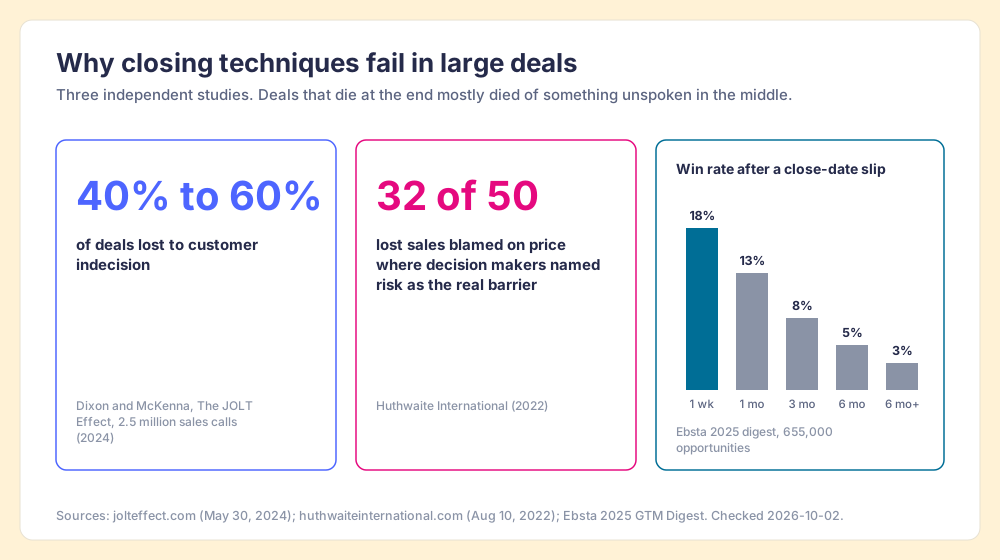
Put the three findings side by side and the shape of the problem changes. The deal that “fell apart at the close” was carrying an unanswered risk from Evaluation, a missing decision maker from Qualified, a close date no one on the buyer’s side had agreed to. No technique fixes those in the final five minutes, because what was missing is a fact about the buyer, and only the buyer can supply it.
How do you close a deal, stage by stage?
You close a deal by getting one buyer commitment per stage and refusing to move the deal until you have it. The table below is the set we start from. Rename the stages to match yours; the logic carries over.
| Stage | Buyer commitment to exit | Rep-side step | What the CRM can check |
|---|---|---|---|
| Discovery | States the problem and what it costs, in their own words, and books the next meeting | Recap email within a day of the call | Pain field filled; next meeting dated |
| Qualified | Names the decision maker and how the decision gets made; shares a budget range | Decision maker added as a contact | Amount set; decision-maker contact on record |
| Evaluation | Agrees the success criteria; a second stakeholder joins | Pre-call email before each meeting | Two or more buyer contacts; success criteria filled |
| Proposal | Walks the proposal with the decision maker; names the risks they see | Risks logged with an answer for each | Mutual plan with dated steps through signature |
| Commit | Names the signer; schedules legal and procurement | Close date matched to the plan | Close date in the future and equal to the plan’s last step |
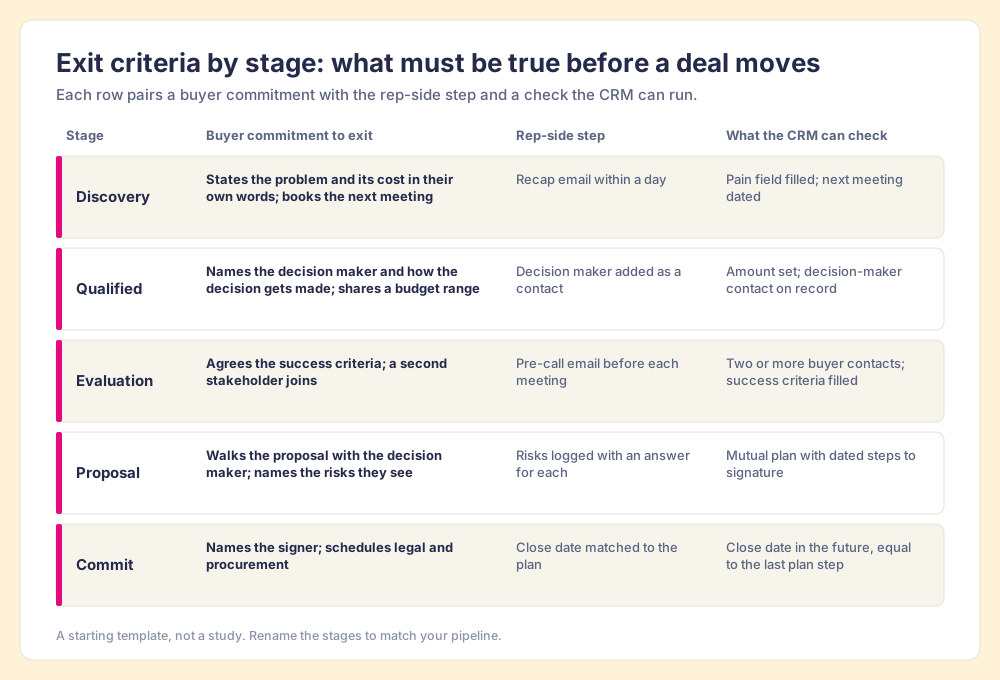
A few of these rows rest on more than taste:
- The second stakeholder at Evaluation. Gong’s analysis of 1.8 million new business deals closed in 2024 found that won deals have “twice as many buyer contacts” as lost ones (Gong Labs, April 28, 2025). A deal with one contact at Proposal is one resignation away from zero. Our multithreading guide covers how to add the second.
- The named risks at Proposal. Huthwaite’s 32 of 50 is the reason this row exists. A buyer who names a risk to you has handed you something to answer. A buyer who keeps it to themselves will use price to say no politely.
- The dated plan before Commit. Ebsta’s slippage curve is the reason. A close date the buyer agreed to, tied to their own steps, slips less often than a date the rep picked to fill a field.
Both columns matter. The rep-side column tells you the process ran: the recap went out, the pre-call email landed. The buyer-side column tells you the buyer moved. A deal can carry a perfect rep-side record and a buyer who has not budged, and that deal belongs back in the earlier stage, however hard the rep worked.
What makes an exit criterion checkable?
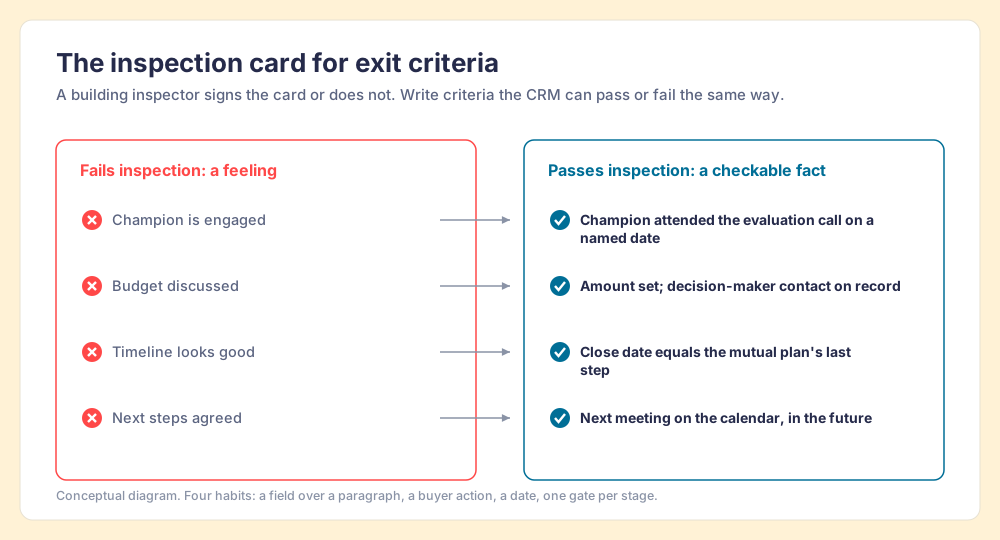
A house going up has inspections the owner rarely sees. The electrical inspector signs off before the drywall goes on, because once the wall is closed the wiring is out of sight. The builder does not argue with the inspector about whether the wiring feels done. The card stapled to the stud is signed, or it is not.
Exit criteria need the same property. “Champion is engaged” is a feeling. “The champion attended the evaluation call on a named date” is a fact the CRM can hold. Four habits turn the first kind into the second:
- A field over a paragraph. A playbook paragraph can be read; a field can be checked. Put each criterion where a report or a rule can see it.
- A buyer action over a rep opinion. Write what the buyer did (booked, named, shared, agreed), never how the rep feels about the deal.
- A date on the commitment. “Next meeting booked” with no date passes forever. “Next meeting on the calendar, in the future” expires on its own.
- One stage, one gate. If two reps would move the same deal at different moments, the criterion is too loose. Tighten the wording until they would agree.
Where do the classic closing techniques still belong?
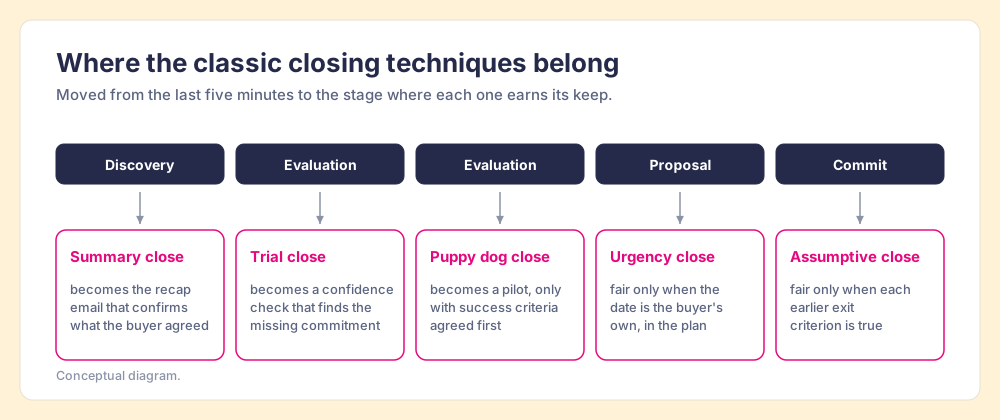
The techniques are not useless. Most of them are good habits filed in the wrong place. Moved to the stage where they belong, several become part of the strategy:
- The summary close. At the end, it is a recap that asks for a signature. After each meeting, it is the recap email that confirms what the buyer agreed and what happens next, which is the rep-side step in the Discovery row.
- The trial close. “How confident are you, on a scale of one to ten, that this solves the problem?” is a poor final question and an excellent stage check. Asked at Evaluation, a low number tells you which commitment is missing while you can still get it.
- The assumptive close. Fair to the buyer when each earlier exit criterion is true, because then the assumption is a fact. Pressure when they are not.
- The urgency close. Legitimate when the date belongs to the buyer: a go-live, a contract renewal, a board meeting in the mutual plan. A deadline the seller invented adds risk, and risk is what Huthwaite found behind 32 of 50 losses.
- The puppy dog close. A trial or pilot is a strong Evaluation exit if the success criteria were agreed before it started. Without them, it is a free month with no verdict.
Who checks the exit criteria, and how often?
Most closing strategies stop working here. Writing the criteria takes an afternoon. Checking them takes a manager’s week, and managers do not have the week.
Our survey for The State of Sales Enablement 2026 found that 89% of teams have a defined sales process and 36% see reps run it as designed. The same research found that teams that inspect deals against a defined process at the highest frequency hit quota at 6.3x the rate of the lowest band (The State of Sales Enablement). The criteria are rarely the missing piece. The checking is. When reps skip a step, we treat it as a failure of the system around them (late feedback, no check, a field no manager opens), and we fix the system.
I have seen this from both sides. Before Supered, I founded RevPartners, a HubSpot partner that sold roughly twice as much Sales Hub as any other partner, and Supered started inside it. My own deals run against a board of 22 rules, and a few of them are exit criteria by another name: close date in the past, no amount past Discovery, no decision maker recorded, no recap sent. One night it showed 11 violations. Clearing them by hand takes me about 45 minutes; with Claude reading the rules and doing the updates, about 10. They are one rep’s numbers from one night, and they show why the check has to run on its own. A strategy that depends on someone finding a spare hour runs only in the weeks they find one.
Supered does that check. You write each exit criterion as a Process Rule, group them in a Process Ruleset, and a Process Board checks each open deal against them and lists what is missing, rep by rep, with a daily summary in Slack. Reps fix the gap in HubSpot, Salesforce or Pipedrive, or ask Claude to do it. Managers spend the one-on-one on the buyer, because the fields are already right. Process Compliance is $40 per user per month billed yearly ($45 monthly), with a five-user minimum. The sales expectations use case shows a full ruleset.
Choose something else if your team has fewer than five sellers (a weekly pipeline review against a written table does the job), if your reps sell from a phone in the field (Supered has no mobile product), or if the gap is how reps run the conversation itself, where a call recording and coaching tool is the better first purchase.
What we recommend
Write five commitments, one per stage, as CRM fields, check them on each open deal every day, and coach the misses, starting with the stage where the most deals sit without their commitment. We would run it that way on our own pipeline, for the reasons the evidence above gives.
The alternatives each fall short in a specific way:
- Technique training alone. Fast and cheap, and useful when you close sales in a single call. For large deals it is the weakest lever, for the reasons Huthwaite gives.
- Exit criteria in a playbook. A real step forward, because the commitments get written down. But guidance that lives in documents goes with 15% quota attainment in our survey, against 49% when the guidance is built into the workflow.
Learning how to close a deal, in the end, is mostly learning to stop moving deals that have not earned the next stage. When a deal reaches Commit with each lock behind it filled, the close becomes what Highspot says it should be, a confirmation, and the line you choose for that last conversation matters far less.
For the numbers side of the same idea, read sales conversion rates by stage, which shows how one loose gate distorts each rate behind it, or see how teams keep the criteria current in pipeline hygiene. If you want to see your own stages as Process Rules, book a demo.
Frequently asked questions
What is a sales closing strategy?+
How do you close a deal in B2B sales?+
Do closing techniques work?+
What are exit criteria in sales?+
Why do deals stall right before they close?+
Can HubSpot, Salesforce or Pipedrive enforce stage exit criteria?+
Your process, running itself.