What Does MEDDIC Stand For? 30 MEDDIC Questions, Spread Across Three Calls
MEDDIC stands for six facts PTC's won deals had in common.
Here are 30 MEDDIC questions to find them, split across three calls so no call turns into an interrogation, plus the CRM field each answer belongs in and the rule that checks it.
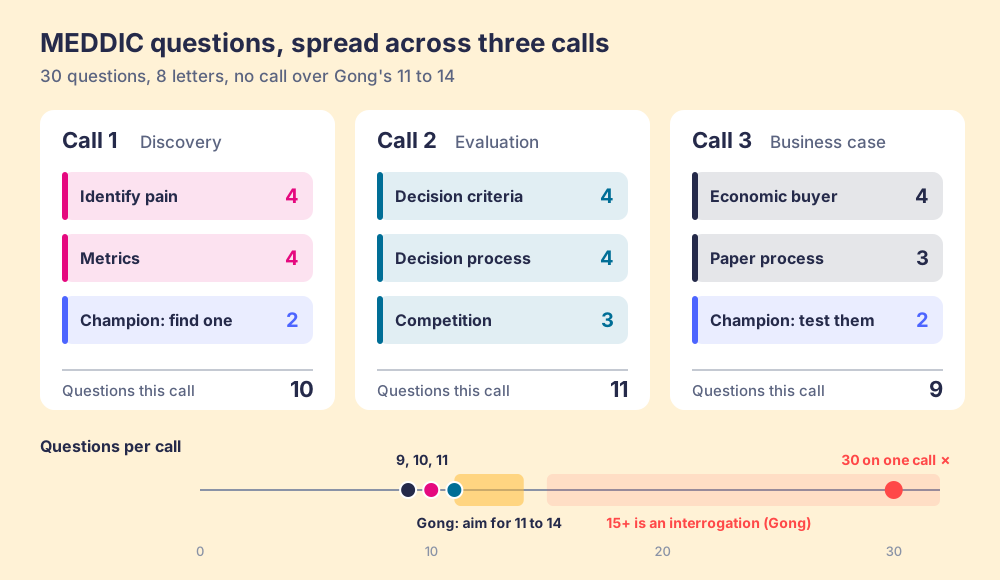
What does MEDDIC stand for? Metrics, Economic buyer, Decision criteria, Decision process, Identify pain and Champion, the six facts PTC found in its won deals; MEDDIC questions are how a rep finds each fact and records who said it.
A manager in a deal review asks a rep who the economic buyer is. The rep says the CFO. The manager asks who told him that, and the room goes still while the rep works out that no one at the account did. He looked at the org chart, saw a CFO, and filled in the field.
What does MEDDIC stand for? Metrics, Economic buyer, Decision criteria, Decision process, Identify pain and Champion, the six facts PTC found in its won deals; MEDDIC questions are how a rep finds each fact and records who said it. The internet has no shortage of question lists. Gong’s MEDDIC guide promises 26 (Gong), Rattle’s runs to 25-plus (Rattle, January 2023). Gong’s own discovery research says to ask 11 to 14 questions per call and calls 15 or more an interrogation (Gong). Put those two Gong pages side by side and the arithmetic says a full list cannot be asked in one sitting. So below are 30 MEDDPICC questions split across three calls, each one paired with the CRM field its answer belongs in and the rule that checks the answer came from the buyer.
What does MEDDIC stand for, and where did it come from?
MEDDIC came out of a post-mortem. MEDDICC Ltd’s own history says the framework “was originally created inside of PTC in 1996 by Dick Dunkel” (MEDDICC), and the usual telling credits Jack Napoli alongside him. iSEEit, which interviewed Napoli, describes how the team analyzed “hundreds of wins and losses” and found that “when they won, they absolutely dominated in 6 areas” (iSEEit). The same page says PTC used it to grow sales from $300 million to $1 billion in four years, a figure I read as company legend, since I have found no audited source for it.
Hold on to the order of events, because it changes how you use the questions. Dunkel and Napoli did not start with a list of questions. They started with won deals and asked what those deals had on record that the lost ones did not. The six letters are facts about the buyer. The questions came later, as the tools for finding those facts out.
The letters, in the words of the people who maintain the framework:
- Metrics. “The quantifiable measures of value that your solution can provide.”
- Economic buyer. “The person with the overall authority in the buying decision.”
- Decision criteria. The principles and requirements the buyer will judge you on.
- Decision process. The steps the buyer takes to make the decision and sign.
- Identify pain. The problem costing the buyer enough to act on.
- Champion. “A person who has power, influence, and credibility within the customer’s organization.”
MEDDICC added Competition, and MEDDPICC added Paper process, the legal and procurement steps that come after a yes. The April 2026 federal ruling on the MEDDPICC trademark describes the longer acronym as coined in 2005 by former PTC employees (MEDDICC Ltd, April 2026). The questions below cover all eight letters, because the two late additions cover the steps after a verbal yes, where a signed date can still slip. For the stage-by-stage version of the framework, read our MEDDIC sales process guide; for why the two added letters matter, read MEDDPICC.
Why can’t you ask every MEDDIC question on one call?
Because the buyer does not know most of the answers yet, and the ones they know they will not tell a stranger.
On a first call, the person across from you can usually describe the problem and what it costs. They often cannot tell you who signs, because they have not had to find out. They will not walk you through procurement for a purchase they have not decided to make. A rep who pushes all 30 questions into that hour gets guesses back, and guesses typed into a CRM look exactly like facts.
Gong’s research lands in the same spot. Its guidance is “aim for between 11 and 14 targeted questions per call,” and it reports “a strong link between buyers’ response lengths and closed deals” (Gong). Long answers need room. Thirty short questions leave none, and they make the first meeting feel like a form being filled in, which is a poor first experience for the person you hope will champion you.
So the list below is sequenced by what the buyer can answer at each stage. Call 1 carries 10 questions, call 2 carries 11, call 3 carries 9. Your calls will not split this cleanly, and a fast deal may fold two of them together. The principle holds anyway: ask each letter when the buyer has the answer.
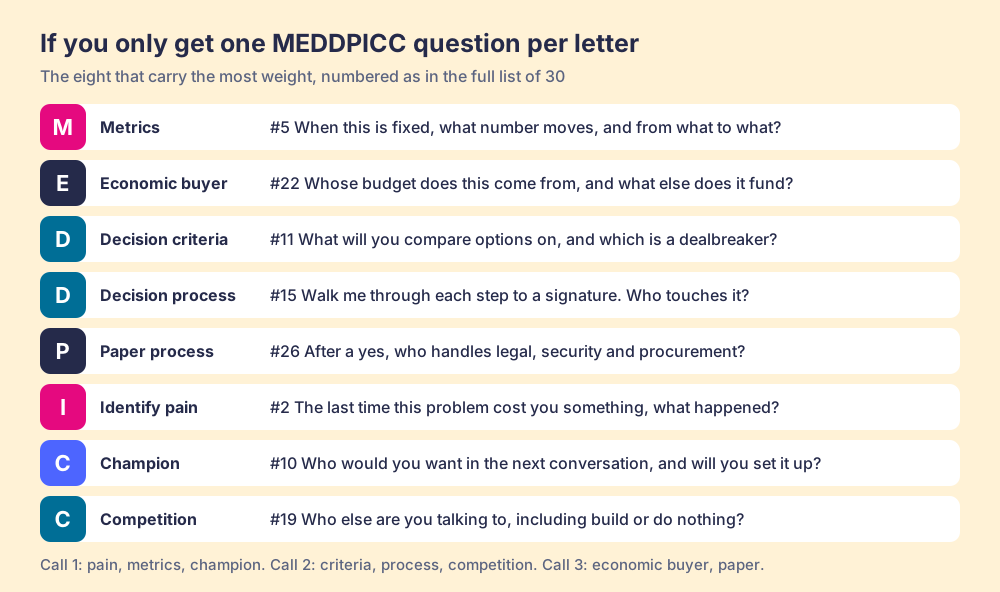
When a deal moves too fast for three calls, keep one question per letter. These eight carry the most weight, numbered as they appear in the full list.
Which MEDDIC discovery questions belong on the first call?
The first call is about pain and metrics, plus spotting the person who might champion the deal. The later letters depend on these, because an economic buyer funds the fix to a cost the team can name.
Identify pain (4)
- What made this a priority now, and not a year ago?
- Walk me through the last time this problem cost you something. What happened?
- Who else feels this, and how do they describe it?
- If nothing changes for twelve months, what breaks first?
Metrics (4)
- When this is fixed, what number moves, and from what to what?
- How do you measure that number today, and who reports it?
- What is one point of improvement worth to you, in dollars or hours?
- By when does that number need to move for this to count as a win?
Champion, finding one (2)
- Why does this matter to you personally?
- Who would you want in the next conversation, and would you set it up?
The pain questions ask for a story, which is where Gong’s long answers come from. The metric questions ask for a number in the buyer’s units with a baseline, because “faster” cannot be checked and “from 21 days to 14” can. Question 10 is the first test of a champion. A friendly contact says “send me something.” A champion books the next meeting.
Which MEDDIC questions belong on the second call?
By the second call more people are in the room, and the buyer is comparing you to something. Now they can answer how they will decide.
Decision criteria (4)
- What will you compare options on, and which of those is a dealbreaker?
- Who wrote those criteria, and has anyone added to them since?
- What would rule a vendor out on day one?
- Which requirement will IT, security or finance add that we have not heard yet?
Decision process (4)
- Walk me through each step from today to a signed agreement. Who touches it at each step?
- What date do you need this live, and what happens on that date?
- The last time your team bought something this size, how long did it take, and where did it stall?
- Who can say no at any step, even if they cannot say yes?
Competition (3)
- Who else are you talking to, including building it yourselves or keeping what you have?
- What do you like about the option you are leaning away from?
- What other projects are asking for the same budget this year?
Question 16 does two jobs. A date tied to an event, such as a board meeting or an expiring contract, is a decision process with a deadline. A date with nothing attached is a hope. Question 20 is the one reps skip, and it is the one that tells you what the competitor does well before the buyer’s procurement team tells you at the worst moment.
Which MEDDIC questions belong on the third call?
The third call is the business case: the person who funds it, the paperwork after the yes, and a hard look at whether your champion is one.
Economic buyer (4)
- Whose budget does this come from, and what else is that person funding this year?
- What does that person need to see to say yes, in their words?
- Has that person approved something like this before, and what did it take?
- Can we get thirty minutes with them before the proposal, and what would make it worth their time?
Paper process (3)
- Once you say yes, who handles legal, security review and procurement, and how long does each take?
- Is there a security questionnaire or vendor form we can start now?
- Which contract terms usually get redlined at your company?
Champion, testing them (2)
- How will you present this internally, and can I help you build it?
- What will you do between now and our next call?
Question 30 is a test you grade later. Write down what the champion promised, then check on the next call whether it happened. Someone who keeps small promises to you is spending their own credibility on your deal, which is what the MEDDICC definition asks for. Someone who keeps forgetting is a coach, and a coach is a fine thing to have, but a coach does not sell for you in rooms you are not in.
How do you know a MEDDIC answer is real?
Courts settled this question long before sales did. Under the US Federal Rules of Evidence, hearsay is a statement the speaker “does not make while testifying at the current trial or hearing,” offered “to prove the truth of the matter asserted” (Federal Rules of Evidence, Rule 801(c), Cornell LII). The court wants the witness on the stand, because a witness can be asked a follow-up and a rumor cannot.
A MEDDIC field has the same weakness. “Economic buyer: CFO” reads identically whether the CFO told you, your champion told you, or the rep guessed from LinkedIn. Only one of those is testimony. So each answer gets a second field beside it: the source.
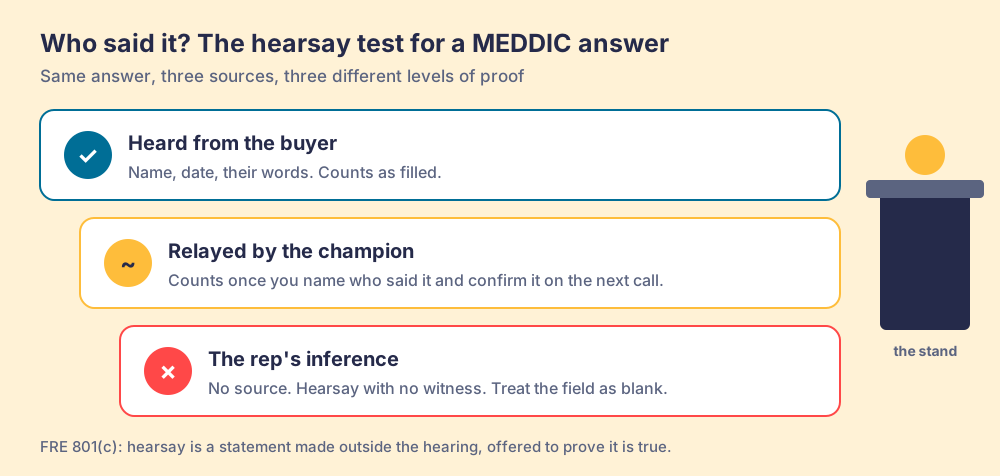
The three sources, and how to treat each:
- Buyer testimony. The person said it to you, on a call or in writing, and you logged their name, the date and their words. The field counts as filled.
- Champion relay. Your champion told you what someone else thinks. Useful, and usually true, but log who said it and confirm it with the source on the next call.
- Rep inference. The buyer never said it. The rep worked it out from a title, a hunch or a pattern from another deal. Treat the field as empty, however confident the rep is.
The picture has a limit. A courtroom wants proof beyond doubt, and a deal review needs proof enough to forecast, so a relayed answer is allowed where a court would exclude it. The point carries over intact: an answer without a named source cannot be tested, and an untestable field is how the rep in the opening walked into a review with a CFO he had never met.
This matters beyond one deal. Gartner found only 45% of sales leaders and sellers had high confidence in their forecast accuracy, and named data quality and CRM adoption discipline among the causes (Gartner, February 2020). MEDDIC fields are forecast inputs. Inferences recorded as facts feed straight into that low confidence.
Which CRM fields should hold MEDDIC answers?
A carpenter measures with a tape and marks the board with a pencil. The tape alone does nothing for the cut if the number lives in his head on the walk to the saw, and anyone who has cut a shelf a half-inch short knows how that walk goes. A MEDDIC question is the tape. The field is the pencil mark. The rule is the square he holds against the cut before it leaves the bench.
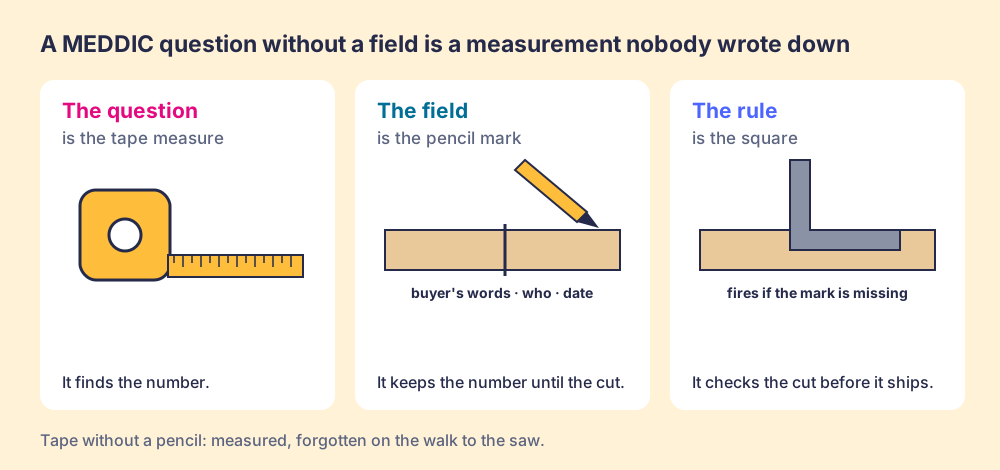
The analogy breaks in one place, and the break is useful. A board does not change after you mark it. A buyer’s answer does, when a champion leaves or a budget moves. So the source field carries a date, and why the rule checks the field at each stage instead of once.
The template I would hand a RevOps lead has one job per letter. One answer field and one source field per letter, and one rule per letter tied to the stage where the letter becomes required. The stage names are examples; map them to your own pipeline.
| Letter | Questions | Answer field | Rule fires when |
|---|---|---|---|
| Identify pain | 1-4 | Pain, in the buyer’s words | A deal leaves Discovery with pain blank or sourced only from the rep |
| Metrics | 5-8 | Metric: baseline, target, by when | A deal leaves Discovery with no baseline |
| Champion | 9-10, 29-30 | Champion contact role + last action they took, with date | A deal enters Commit with no champion action logged since the last stage change |
| Decision criteria | 11-14 | The buyer’s criteria list, dealbreakers flagged | A deal enters Proposal with criteria blank |
| Decision process | 15-18 | Steps, owners, compelling event date | The close date falls before the last step, or no compelling event is logged |
| Competition | 19-21 | Competing options, including build and do nothing | A deal enters Proposal with competition blank |
| Economic buyer | 22-25 | Economic buyer contact role + date met | A deal enters Proposal with no economic buyer, or Commit with no meeting |
| Paper process | 26-28 | Legal, security and procurement steps with owners | A deal enters Commit with the paper process blank |
Each source field is a short picklist: buyer, champion relay, rep inference, plus the date. The rules treat “rep inference” the way a court treats hearsay.
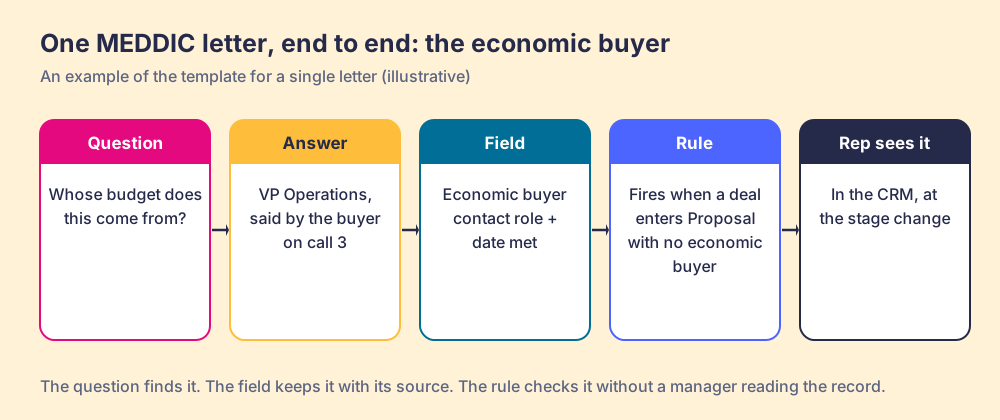
Keep the field count low. Eight answer fields and eight source fields is already sixteen, and a rep updating sixteen fields after a call will start typing whatever clears the form. If you must cut, cut the source picklists for Competition and Paper process first; those answers are hard to fake.
Does putting MEDDIC in CRM fields get reps to ask the questions?
On its own, no, and our own survey shows why. In The State of Sales Enablement 2026, quota attainment was 49% on teams whose process guidance was embedded in the workflow, 24% where it lived in CRM fields or stages, and 15% where it lived in docs or wikis.
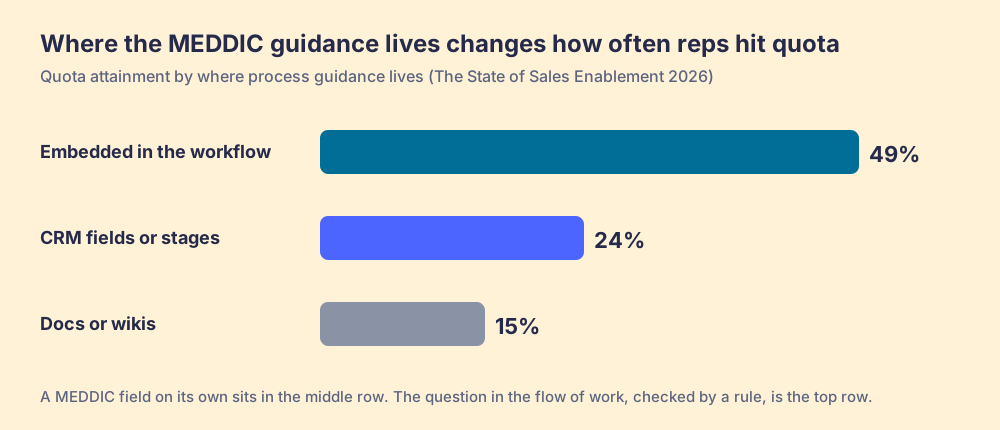
A MEDDIC field on its own sits in the middle row. The field tells the rep a letter is missing; it does not hand them the question at the moment they open the deal before the call, and it does not check whether the answer came from the buyer. That gap between the field and the conversation is where MEDDIC rollouts fade (sales process adoption covers the wider pattern), and it is a gap in the system. The reps are doing what the system puts in front of them. A rep with eight open deals and a call starting soon will ask the questions in front of them.
Then there is inspection. In the same survey, teams that inspect deals against a defined process at the highest frequency hit quota at 6.3x the rate of the lowest band. Reading every deal for eight letters and their sources is more than a manager can do by hand each week, and the hours spent reading are hours not spent coaching the rep on how to ask question 23 better. The reading is the part a machine should do, every night, so the manager’s time goes to the conversation.
How does Supered run MEDDIC questions in the CRM?
I founded RevPartners, a HubSpot partner, and Supered grew out of it, so this is the system we built for exactly the gap above. In Supered, the eight rules in the table become Process Rules inside a Process Ruleset, and a Process Board shows every open deal against them. When a rep opens a deal in HubSpot, Salesforce or Pipedrive, the rule that is failing shows up in the record, and you can put the questions for that letter on a card beside it, so they reach the rep at the moment before the call. Reps who work in Claude can ask it to check their MEDDIC rules and draft the recap; the same rules apply on either screen (sales expectations use case).
Process Compliance costs $40 per user per month billed yearly ($45 monthly), with a five-user minimum, and includes the in-CRM cards and guides (pricing). Supered holds 4.9 on G2 from 81 reviews and 5.0 on the HubSpot App Marketplace from 122 reviews, both checked October 2026.
Choose something else if your need is a hard stop at a stage change and nothing more. HubSpot’s required deal-stage properties and Salesforce validation rules block a deal from advancing with a blank field, at no extra cost. They will not tell a field filled by the buyer from one filled by a guess, and they will not show the rep the question, but if a hard stop covers it, start there. And if your team is under ten sellers or works mostly away from a computer, Supered is the wrong fit today.
What we recommend
Use MEDDIC questions as the first link in a chain, and build the other three links before you train anyone on the list.
- Questions sequenced by call. Pain and metrics first, criteria, process and competition second, the economic buyer, paperwork and champion test third. Gong’s 11 to 14 per call is the ceiling that forces the split, and the buyer’s knowledge is the reason it works.
- Answers with a source. Each letter gets a field for the buyer’s words and a field for who said it and when. Rep inference counts as blank, the way hearsay does in court.
- Rules per stage. Each letter becomes required at the stage where the buyer can answer it, and a rule checks it every night.
- The question at the moment of work. Guidance in the workflow sat at 49% quota attainment against 24% for CRM fields alone, so put the questions where the rep opens the deal.
The alternative, the one that comes free with any downloaded list, is a rep with 26 questions in a PDF, a CRM with six empty fields, and a deal review where someone asks who told you it was the CFO. Dunkel and Napoli started from evidence in won deals. The questions only matter if they leave evidence behind.
For the stage gates and deal review agenda that sit on top of these fields, read the MEDDIC sales process guide next. To compare MEDDIC with a lighter framework for smaller deals, see BANT. For the nightly check that keeps these fields current after the call, read CRM hygiene, or book a demo and we will build your MEDDIC rules against your own pipeline.
Frequently asked questions
What does MEDDIC stand for?+
What are the best MEDDIC discovery questions to ask on a first call?+
How many MEDDIC questions should you ask on one call?+
What is the difference between MEDDIC and MEDDPICC questions?+
Is MEDDPICC a trademark?+
How do you track MEDDIC answers in HubSpot, Salesforce or Pipedrive?+
Your process, running itself.