CRM Strategy: Write It as Rules Your CRM Can Check
Most CRM strategy guides stop at the plan: goals, customer mapping, a dashboard to review later. The plan counts once it reaches a rep mid-deal and something checks it. A four-layer CRM framework, and data on why strategies stall.
A CRM strategy is the set of decisions about which buyers you pursue, how your team moves them from first touch to signature, and what the CRM must show at each step, written as rules your CRM can check, so the plan shows up in what reps do each day instead of in a deck.
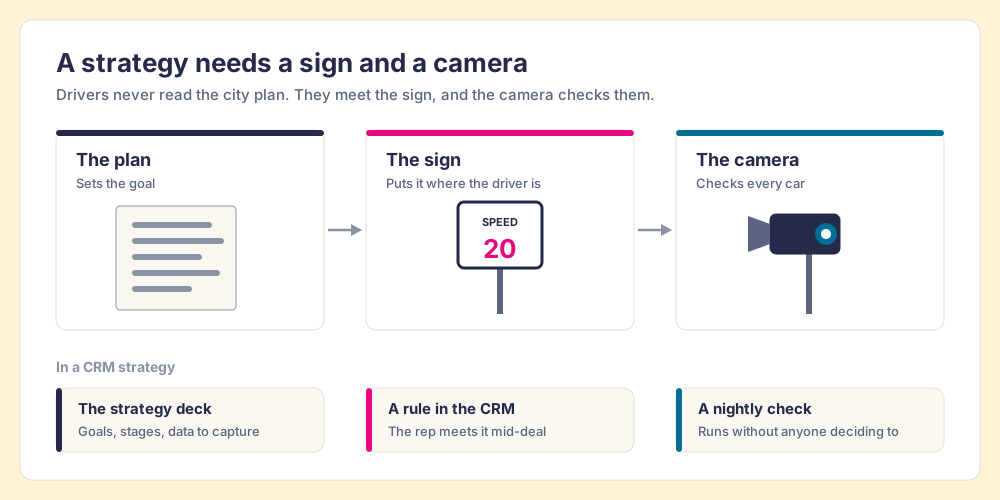
A city that wants slower cars near its schools writes a transportation plan. The plan has goals, maps, a budget and a public hearing, and almost no driver in the city will ever read it. What a driver meets is a sign on a pole that says 20 when the lights flash, and on the streets where the city means it, a camera. The plan is real. The sign and the camera are where it touches a car.
A CRM strategy works the same way, and most of what gets written about it describes the plan. The top-ranked guides walk you through goals, customer mapping, data, workflows and a dashboard to review later. All of that is sound. What they leave out is the sign and the camera: the place the strategy reaches a rep in the middle of a deal, and the check that tells you whether it did.
A CRM strategy is the set of decisions about which buyers you pursue, how your team moves them from first touch to signature, and what the CRM must show at each step, written as rules your CRM can check, so the plan shows up in what reps do each day instead of in a deck.
I founded RevPartners, a HubSpot partner that did only sales implementations and sold roughly twice as much Sales Hub as any other partner on its way to Elite tier in 13 months. The CRM strategy I would write for a client today fits on one screen, and software can check every line of it.
What is a CRM strategy, and what did the original definition say?
The vendor definitions are short and reasonable. Salesforce calls a CRM strategy “a plan that businesses use to manage interactions with current and potential customers” (Salesforce, updated August 2026). NetSuite says it “defines goals and practices that a company will use to manage and improve its interactions with customers via a CRM system” (NetSuite). Both describe a plan, and both stop there.
The older analyst definition went further. Gartner’s research note on its CRM framework defines CRM as a business strategy pursued by “organizing around customer segments, fostering customer-satisfying behaviors and implementing customer-centric processes” (Gartner, Ed Thompson, note G00149424, June 2007). The middle clause is about behavior. Gartner was saying, almost twenty years ago, that a CRM strategy is measured in what people do, and the modern guides have drifted back to describing what people decide.
The decide-first advice did win, and it deserved to. In 2002, Darrell Rigby, Frederick Reichheld and Phil Schefter summed up their Harvard Business Review piece with the warning that “most initiatives fail to deliver,” and named the first of four perils as implementing CRM before creating a customer strategy (HBR, February 2002). The top-ranked guides today agree with them. Salesforce’s eight steps start with goals; Asana’s start with goals and KPIs (Asana, May 2026).
So the strategy gets written. The trouble starts the week after.
Why do CRM strategies stall after go-live?
In The State of Sales Enablement 2026, 89% of teams said they had a defined sales process, and 36% said their reps follow it. That 53-point gap sits between the strategy and the deal. The data shows the same gap from the record’s side: in Validity’s survey of 602 CRM users and stakeholders, 76% said less than half of their organization’s CRM data is accurate and complete, and 37% reported losing revenue as a direct result of poor data quality (Validity, The State of CRM Data Management in 2025).
None of this means reps ignore the strategy out of spite. Salesforce’s own State of Sales research, with 5,500 sales professionals responding, found that reps spend 70% of their time on non-selling tasks (Salesforce, July 2024). A rep with that week does not reopen the strategy deck before a discovery call. When reps skip the process, the system put the plan somewhere the rep was not standing.
The usual fix is to build the strategy into the CRM itself: stages that mirror the sales process, required fields at each gate, a workflow or two. That is step four of Salesforce’s guide (“Establish your processes and workflows”) and a sensible instinct. Our survey measured how far it gets you. Quota attainment was 49% where guidance was embedded in the rep’s workflow, 24% where it lived in CRM fields or stages, and 15% where it lived in docs or wikis.
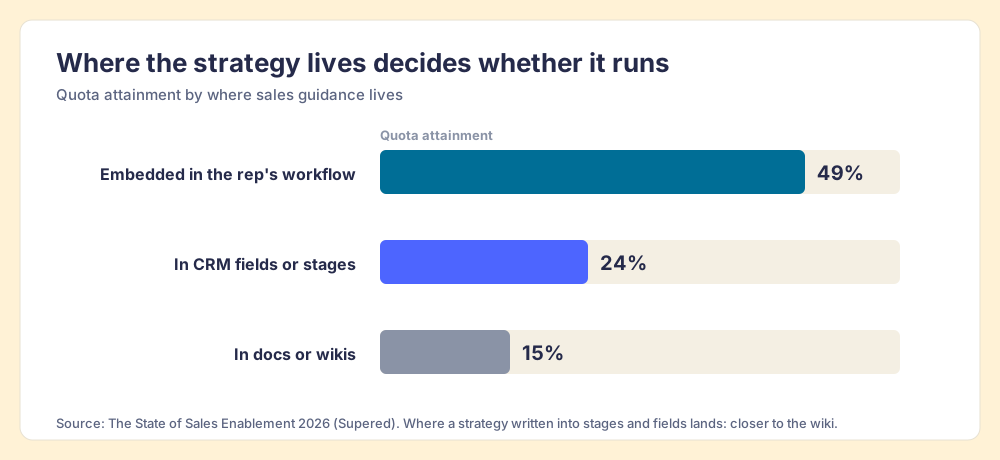
Twenty-four percent is closer to the wiki than to the workflow, and the mechanism is not mysterious. A stage name tells a rep where a deal is. It does not tell them what they owe the buyer next, and nothing in it checks whether they did. A required field gets filled at the moment the gate demands it, with whatever gets the deal through the gate. The stage list is the transportation plan printed on the dashboard. The rep still needs the sign.
What is a CRM framework, and which one should you use?
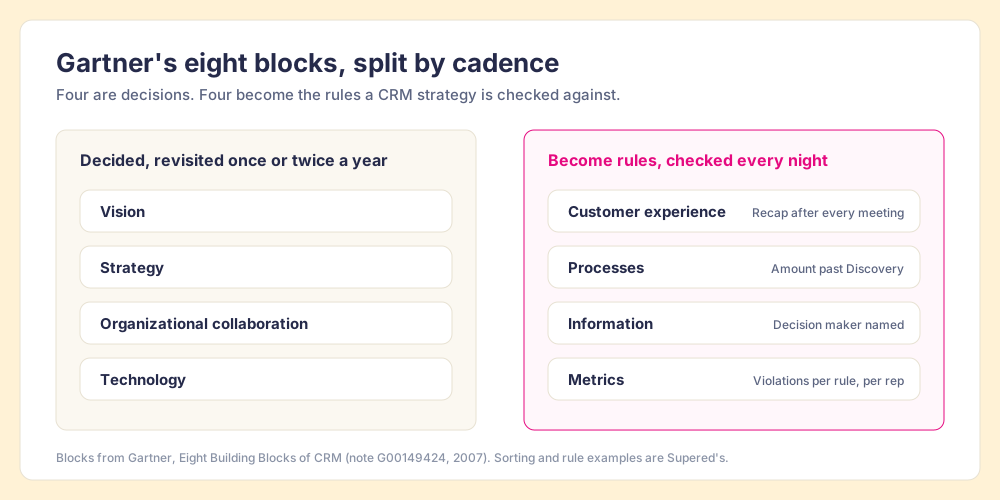
A CRM framework is a checklist of what a CRM strategy has to decide. The best-known one is still Gartner’s, built after the firm analyzed several hundred organizations in 2002, and it holds up. The Eight Building Blocks of CRM:
- Vision. The picture of the customer-centric company and the value proposition behind it.
- Strategy. Which customers you want, and how the CRM strategy ties into the marketing and sales strategy.
- Customer experience. What the buyer should feel at each interaction.
- Organizational collaboration. How sales, marketing, service and partners share the customer.
- Processes. The steps, rethought from the customer’s side.
- Information. The data the company must capture and use.
- Technology. The applications and integrations.
- Metrics. “Enterprises must set measurable, specific CRM objectives and monitor indicators if they are to become customer-centric,” in the note’s own words.
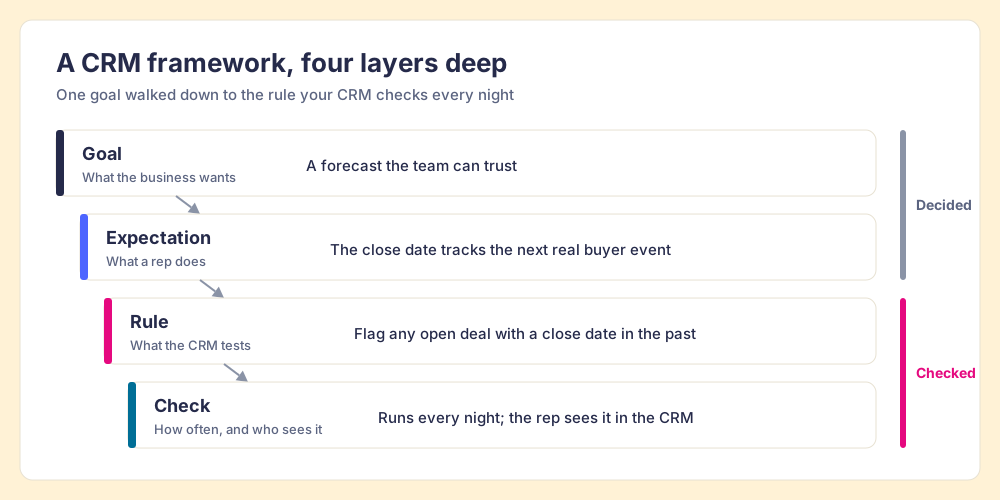
Use it as written for the deciding half. Where I would extend it is underneath processes and metrics, because those two blocks are where a strategy either becomes behavior or stays a document. Gartner’s note says metrics provide “the feedback mechanisms for the continuous development of strategy and tactics.” For a sales team, the feedback has to reach one deal and one rep, so each goal needs three more layers under it.
- Goal. What the business wants, such as a forecast within a set margin or a better buying experience.
- Expectation. What a rep does, in a sentence a new hire could follow: “send a recap after every meeting.”
- Rule. The expectation written so software can test it: a condition, the records it applies to, and the fix.
- Check. How often the rule runs, and who sees the result.
The rule layer is where the psychology lives. Peter Gollwitzer’s research on why people fail to act on goals they hold found that plans of the form “Whenever situation x arises, I will initiate the goal-directed response y!” close much of the distance (Gollwitzer, 1999). A later meta-analysis of 94 independent tests found a medium-to-large effect on goal attainment, d = .65 (Gollwitzer and Sheeran, 2006). A CRM rule has that same if-then shape: when a deal passes Discovery, it carries an amount. The difference is that the CRM holds the plan for the whole team, so no rep has to carry it in their head while three other deals wait.
How do you turn a CRM strategy into rules?
Write the goals down, then refuse to keep any goal that cannot produce at least one rule. A goal with no rule under it is a wish, and wishes do not show up on a Process Board. Six common goals translate like this, using rules I run on my own open deals:
| Strategy goal | Expectation for the rep | Rule the CRM checks | Who it protects |
|---|---|---|---|
| A forecast you can trust | The close date tracks the next real buyer event | Open deal with a close date in the past | The forecast |
| A forecast you can trust | An amount once the buyer has shared budget | Deal past Discovery with no amount | The forecast |
| Deals that move | Tasks get done, re-dated with a reason, or closed | Overdue task on an open deal | The buyer |
| A better buying experience | The buyer hears from you before each meeting | No pre-call email within 24 hours of a meeting | The buyer |
| A better buying experience | A recap after every meeting | Meeting held, no recap sent | The buyer |
| Fewer surprise losses | The person who signs is known before a proposal | Deal advanced with no decision maker named | The forecast and the buyer |
Two things stand out in that table. Four of the six rules protect the buyer, which the “measure, iterate, grow” step of a typical guide never mentions; a strategy is felt by the buyer first, and an agenda the day before plus a recap the same afternoon is what consistency feels like from the other side. And two of the rules track the buyer’s position (budget shared, signer known) as well as what the rep did. A strategy that only checks seller activity can pass every rule while the buyer sits still.
The working method, in the order I would do it:
- One screen of goals. Two or three, each named in a sentence the whole team can repeat.
- Stages defined by buyer commitment. A deal moves when the buyer does something, which gives each stage a fact the CRM can test.
- Five or six rules to start. Each written as a condition, a scope and a fix. Bainbridge’s line about control rooms applies here: “a proliferation of flashing red lights will confuse rather than help” (Bainbridge, Automatica, 1983).
- A check that runs without anyone deciding to run it. Nightly, with the result waiting for the rep in the morning.
- A weekly look at which rules fire most. A rule that fires for the whole team points at a broken step in the process, and the fix belongs to that step of the process.
Gartner’s eight blocks sort cleanly against this. Vision, strategy, collaboration and technology are decided once and revisited a couple of times a year. Customer experience, processes, information and metrics are where the rules come from, and those four get checked every night.
How often should a CRM strategy be checked?
A thermostat set to 68 degrees does nothing on its own. The house stays warm because a sensor reads the room every few minutes and switches the heat on the moment the temperature drops. Read that sensor once a quarter and you have a thermometer with a dial on it: it tells you, after the fact, that the house was cold in February.
Most CRM strategy guides end on the thermometer. Salesforce’s last step is “Measure, iterate, and grow”; Asana’s is “Track your CRM performance and engage stakeholders,” with reviews of dashboards and response times. Both are right that you should measure. The cadence is what decides whether measuring changes anything. A close date that went stale in the second week of a quarter and gets found at the quarterly review has been wrong in the forecast for up to 90 days, and the rep is now reconstructing a conversation instead of remembering it.
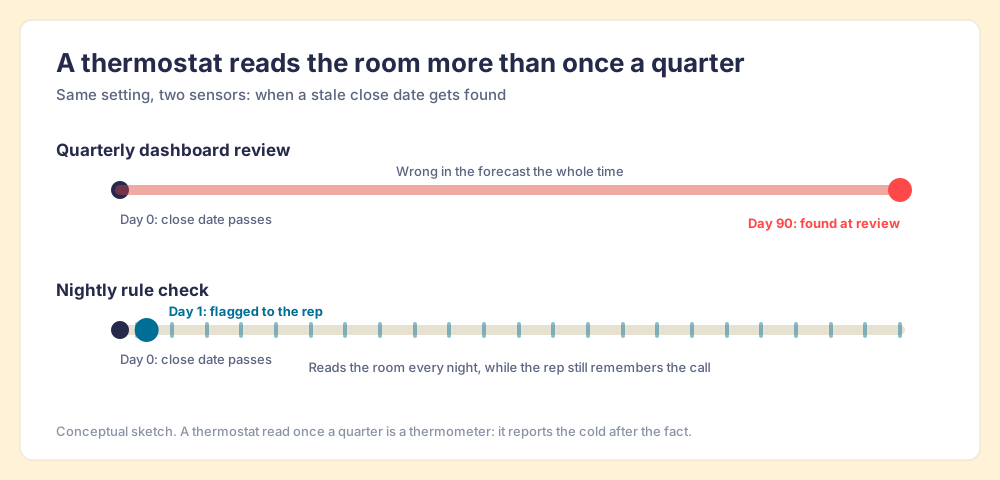
Our survey puts a number on cadence. Teams that inspect deals against a defined process at the highest frequency hit quota at 6.3x the rate of the lowest band. Inspection is the lever, and it is also the part managers run out of hours for. Adherence fell from 47% on teams with one to five reps per manager to 23% on teams with six to eight, and the most-cited reason reps skip the process was that managers do not enforce it (29%). Managers are not lazy. A manager with eight reps and forty open deals cannot read every record every night, and the strategy decays in whatever the manager did not read.
So the check has to run without the manager, and the manager’s hours go to coaching the rep through what the check found. Inspection stays mandatory; the burden of it moves to software.
Where does AI fit in a CRM strategy?
After the rules. In The State of Sales Enablement 2026, teams with strong process adherence rated AI’s impact high 40% of the time, against 21% for teams with weak adherence. AI amplifies the process you already run. A model asked to “keep the CRM tidy” tidies toward its own guess; a model handed your rules does the work your strategy describes.
Teams are already pointing AI at the CRM: 46% use it for CRM admin and cleanup, against 26% for deal strategy and forecasting. The sensible setup keeps the rules outside the model. Claude or another assistant reads the rules, updates the fields from notes and calendar context, and drafts the recap; a person approves anything a buyer will read; and the next night’s check runs against whatever the AI wrote. Our post on CRM hygiene walks through one night of that on my own board, and the HubSpot MCP server post covers what the connection can see and what it cannot know about your rules.
Where does Supered fit in a CRM strategy?
Supered is where the rule and check layers live. You write expectations as Process Rules inside a Process Ruleset (describe one in a sentence and Supered’s MCP can create it), and a Process Board checks every open deal against them every night. My own board runs 22 rules under a ruleset called Sales Expectations. Reps see what is out of line inside HubSpot, Salesforce or Pipedrive, where they already work, or in Claude if they would rather fix the list with one prompt. Leaders see who followed the rules and which rules fire most. Same rules, any screen; the sales expectations use case shows the setup.
Supered started inside RevPartners. It holds a 4.9 rating from 81 reviews on G2 and 5.0 from 122 on the HubSpot App Marketplace (both checked October 1, 2026). Process Compliance is $40 per user per month paid yearly, with a 5-user minimum, and includes the in-CRM guidance of Digital Adoption (pricing). We do not do implementations; preferred HubSpot partners add Supered to their scope, or we support your in-house team directly.
Choose something else if:
- No CRM yet, or no agreed stages. Do the deciding half first. Our CRM implementation post and the HubSpot implementation guide cover that work; rules come after.
- Duplicates and formatting as the main problem. That is structural dirt, and the CRM vendor’s data quality tools handle it without knowing your process.
- A team of one or two. A shared checklist and a weekly review may be enough until the team outgrows one manager’s attention.
What we recommend
There are three ways to run a CRM strategy:
- The strategy deck with a quarterly review. Good for deciding. It reaches the rep only through memory, and the review finds drift up to 90 days late.
- The strategy built into stages and required fields. Better, and worth doing. Guidance living in CRM fields or stages tracked with 24% quota attainment in our survey, against 49% when it was embedded in the workflow.
- The strategy written as rules, checked every night, with fixes landing where the rep works. This is what we recommend, added on top of the second option.
The evidence for the third option sits above. The 53-point gap between having a process (89%) and following it (36%) is the distance a strategy deck cannot cross on its own. If-then rules carry a medium-to-large effect on goal attainment across 94 tests. The highest-frequency inspectors hit quota at 6.3x the rate of the lowest band, and manual inspection halves as a manager’s span grows from five reps to eight. A rule the CRM checks nightly is the sign and the camera together.
Gartner’s 2007 definition already had the answer folded inside it: a CRM strategy is measured in behavior. Write the plan, then write the rules that put it in front of a rep the morning after something slips.
If the rules are the part you want next, CRM hygiene shows the six I check every night and what fires each one. For why reps drift from a process once it is written, read sales process adoption, and for the people side of rolling a CRM out, CRM adoption. Or book a demo and we will turn your strategy into its first six rules against your own deals.
Frequently asked questions
What is a CRM strategy?+
What is a CRM framework?+
What are the steps to build a CRM strategy?+
What is the difference between a CRM strategy and a CRM implementation?+
How often should you review a CRM strategy?+
What should a CRM strategy include for a small sales team?+
Your process, running itself.