Cross-Sell Emails That Arrive When the Customer Already Wants the Offer
Seven copy-ready cross-sell email templates, each tied to the account signal that should fire it: a new use case on a call, a usage threshold, a new team, a renewal window, a ticket pattern, a launch, a QBR. Plus who sends them and how to make the CRM send the right one on time.
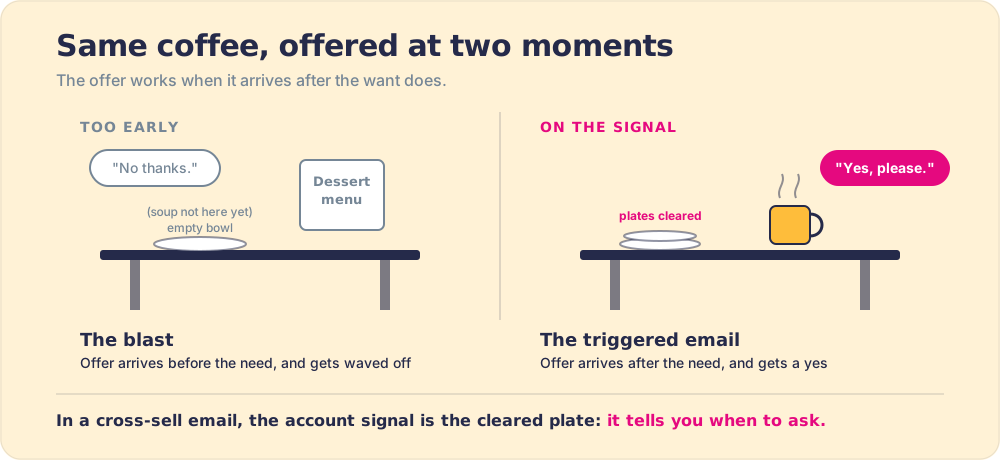
Cross sell emails are messages to an existing customer offering a product or service they do not yet own, sent in response to a specific account signal (a new need raised on a call, a usage threshold, a new team) so the offer lands while the customer has the problem it solves.
A good waiter sells more coffee than a bad one, and the coffee has nothing to do with it. The bad waiter recites the dessert menu while you are still waiting for your soup. You wave him off, and you mean it. The good waiter clears the plates, sees you lean back from the table, and asks whether anyone would like a coffee. The coffee and the price never changed. The offer worked because it arrived after the want did.
Cross sell emails live or die on the same timing. Cross sell emails offer an existing customer something they do not own yet, and most advice about them polishes the copy: a sharper subject line, a warmer opener. Copy matters. But the yes depends on when the email arrives, and that is decided by account data the rep often cannot see: a usage spike, a new hire, a ticket that keeps coming back.
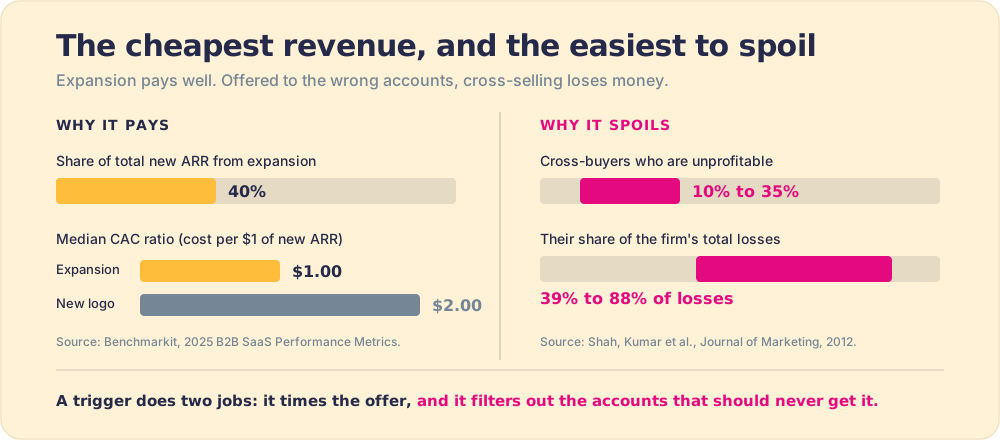
The timing has a second job. Across five firms in consumer and business markets, Denish Shah, V. Kumar, and colleagues found that 10% to 35% of customers who cross-buy are unprofitable, and those customers account for 39% to 88% of each firm’s total losses (Journal of Marketing, 2012). They buy little, return a lot, and lean hard on service. A cross-sell sent to every account recruits them. One sent only when a real signal fires filters them out.
Why do cross sell emails matter more than new-logo emails?
The math favors them. Benchmarkit’s 2025 B2B SaaS benchmarks put expansion at 40% of total new ARR, at a median CAC ratio of $1.00 against $2.00 for new customers, so expansion revenue costs half as much to win (Benchmarkit, 2025). High Alpha’s 2025 survey of 800+ respondents finds that companies above $50 million ARR get roughly 60% of new ARR from existing customers (High Alpha, 2025).
Valuable, and easy to spoil. A blast to the whole book spends goodwill you will need at renewal.
Seven cross sell email templates, each tied to a trigger
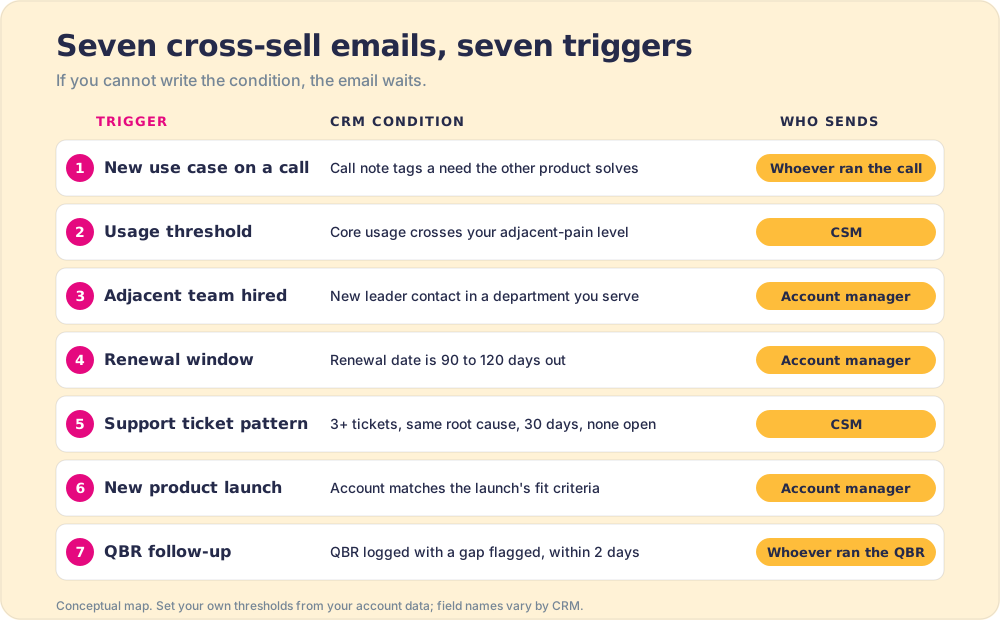
Each cross sell email template below names the signal that fires it, the sender, and why it earns a reply. If you cannot fill a bracket with something true, the signal has not fired yet.
1. A new use case came up on a call
Send within a day of a call where the customer describes a problem your other product solves. Sent by whoever ran the call.
Subject: The [problem] you mentioned on our call
Hi [First name],
On our call you said [their words, e.g. “finance rebuilds the pipeline report by hand every Monday”]. I did not want that lost in my notes.
That is the job [Second product] does. [Customer like them] uses it for exactly this, and [their real result].
Would a 15-minute walkthrough with your own data help, or should I send a two-minute recording first?
[Your name]
It works because the customer named the need before you named the product, so the email is a follow-up, not a pitch. Two sizes of ask make the small yes easy.
2. Usage crossed a threshold
Send the week core usage crosses the level where the adjacent problem shows up. Sent by the CSM.
Subject: [Number] [actions] last month
Hi [First name],
Your team ran [number] [core actions] through [Product] last month, up from [earlier number].
At that volume, teams start feeling [adjacent pain, e.g. “approval bottlenecks”]. If that is happening, [Second product] handles it inside the same workflow.
Worth a look, or not an issue yet?
[Your name]
Opening with their success in a real number, and offering a painless no, makes yes easier to say.
3. An adjacent team was hired
Send within a month of a new leader appearing in a department your second product serves. Sent by the account manager.
Subject: Congrats on the new [team] build-out
Hi [First name],
I saw [Company] brought on [new leader] to build out [team]. Congratulations.
Two offers. I am happy to onboard [new leader] on what your team already uses, free. And [Second product] is how [similar company] set up their [team] from day one.
Should I reach out to [new leader], or would you rather introduce us?
[Your name]
It works because the first offer is a gift, so the second lands as advice. Asking before contacting the new leader protects your champion.
4. The renewal window opened
Send 90 to 120 days before renewal. Sent by the account manager.
Subject: Before renewal: what to add, and what to drop
Hi [First name],
Renewal is on [date], and I would rather plan it with you than send a quote.
Two things to review: [unused seats or feature] you may not need, and [Second product], which covers [problem they raised]. Adding it at renewal means one procurement cycle instead of two.
Does [two dates] work for 30 minutes?
[Your name]
Offering to cut something you sold them is the best evidence that the addition serves them.
5. A support ticket pattern repeated
Send after the tickets are resolved, when three or more in 30 days share a root cause your other product removes. Sent by the CSM.
Subject: Your last [number] tickets have one root cause
Hi [First name],
Your team opened [number] tickets this month about [issue]. Each is resolved, but they all trace back to [root cause].
[Second product] removes that step. I would rather show you the pattern and let you decide.
Want to see the tickets side by side?
[Your name]
The email leads with a service outcome and teaches the customer something about their own account. Gartner reports that when customers receive value enhancement during a service interaction, their likelihood of repurchase or renewal increases by 86% (Gartner).
6. A new product launched
Send only to accounts that match the launch’s fit criteria. Sent by the account manager, even when marketing announces the launch.
Subject: [New product] is live, and why I thought of [Company]
Hi [First name],
We launched [New product] this week. I thought of you because [specific reason: a request they made, a problem on their roadmap].
If it is not a fit, say so and I will stop there. If it is, you could be one of the first teams on it.
[Your name]
The “why I thought of you” line is the filter. If you cannot write it for an account, that account does not get the email.
7. After a QBR
Send within two days of the quarterly business review, while the gap is fresh. Sent by whoever ran the QBR.
Subject: QBR recap, and the gap we flagged
Hi [First name],
Thanks for the time. The headline: [result with a number]. The gap we flagged: [gap].
We discussed three ways to close it: [option you do not sell], [process change], and [Second product]. A one-page comparison is attached.
Which should we dig into first?
[Your name]
It works because your product sits beside options you do not sell, so the email becomes a recommendation, and the customer chooses.
When should you send a cross selling email, and who sends it?
BJ Fogg’s behavior model puts the timing plainly: “Behavior happens when Motivation, Ability, and a Prompt come together at the same time” (Fogg Behavior Model). In a cross selling email, the signal supplies the motivation, the small ask supplies the ability, and the email is the prompt. Send before the signal and one of the three is missing.
Ownership follows one rule: the person who saw the signal writes the first email, and the commercial owner handles price.
- The account manager. Renewal, new team, and launch emails: commercial moments with a price attached.
- The CSM. Usage, support ticket, and QBR emails, because the CSM sees those signals first, then brings in the account manager when price comes up.
- The AE. Only while the original deal is fresh, or when the comp plan pays on expansion.
The common failure is a signal with no owner. The CSM hears about the new finance team, assumes the AM knows, and the AM never hears. Buying more data does not fix it:
From the field
You’re hearing everyone’s complaint about this. It’s like, “I know the signals. That’s great. How do I action them?”
Our piece on the sales to customer success handoff covers how that seam gets built.
What is the difference between a cross-sell and an upsell email?
| Upsell email | Cross-sell email | |
|---|---|---|
| Offers | More of the same: seats, tier, volume | A different, complementary product |
| Typical trigger | Capacity: near a limit | A new problem the current product does not cover |
| Usual sender | Account manager | Whoever saw the signal, then the account manager |
What mistakes kill cross-sell emails?
- The blast. One email to the whole customer base, including the accounts in the Shah and Kumar loss group.
- The early ask. A cross-sell before the customer has seen value from the first purchase. Get them live first; our guide to customer enablement covers what that takes.
- The open ticket. An offer landing while a problem is unresolved tells the customer the rep ignored the complaint.
- The claim with no proof. “Customers love [Second product]” persuades no one. One named result from a similar customer does.
- The unlogged send. No record of the send or the reply means no way to tell which triggers produce revenue.
How do you make the trigger fire in the CRM?
Most of these signals already sit in or beside the CRM. The gap is getting each one to the right person, with the right email, while it is fresh. In the State of Sales Enablement 2026, 89% of sales leaders said they have a defined sales process and 36% said reps follow it as designed. A cross-sell motion is a small process, and it leaks the same way.
- A condition per trigger. Written so a system can evaluate it: “3 or more tickets with category = [issue] in 30 days AND no open tickets.” If you cannot write it, the trigger lives in someone’s memory.
- An owner per condition. One named role, from the rule above.
- The email at the moment. When the condition turns true, the template and the account context (ticket list, usage number, call note) appear in front of the owner inside the CRM.
- A logged outcome. The send, the reply, and the opportunity created or the reason declined.
- A weekly inspection. How many triggers fired, and how many were acted on. Teams whose managers inspect process compliance weekly with a real number hit quota at 6.3 times the rate of the least-inspected teams.
The third item carries the most weight. A flag with no instruction attached leaves the owner guessing:
From the field
A rule can have a piece of content telling them what to do. You may have “no recent touch in three days,” but, okay, what am I supposed to do? What touches am I supposed to give?
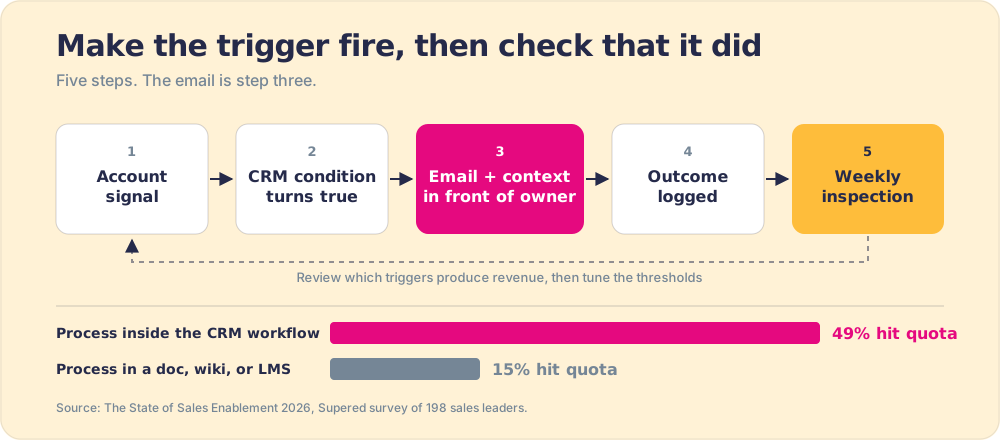
Together, those pieces make a sales play: a trigger written as a condition, a response, and an exit.
What we would build first
Build two triggers into the CRM, the call-raised use case and the renewal window, and put the template in front of the owner the moment each one fires. Both arrive with a moment attached, so they are the easiest to get right. A marketing blast reaches the Shah and Kumar loss group along with the accounts worth emailing, and a rep-enrolled sequence or a workflow task still depends on someone noticing the signal and then hunting for the email. Write each trigger as a CRM condition with one owner, log the result, and review weekly. Add a third trigger only after the first two show up in the weekly review as sends and replies.
We built Supered to do this inside HubSpot and Salesforce: surface the right step to the rep when a condition becomes true, and record whether it ran. The principle holds with any tool.
If the customer stops replying after the first email, our sales follow-up email templates pick up from there, and the account plan template is where the expansion triggers for your largest customers belong.
Frequently asked questions
What is a cross-sell email?+
How do you write a cross-sell email?+
When is the best time to send a cross-sell email?+
What is the difference between a cross-sell and an upsell email?+
Who should send cross-sell emails, the account manager or customer success?+
Can cross-selling hurt customer relationships?+
Your process, running itself.