Sales Pipeline Management: Inspecting, Not Staring
Sales pipeline management is usually a weekly stare at a dashboard.
That is monitoring, not managing. Real pipeline management inspects deals against buyer commitments and coaches while the deal is still live.
Sales pipeline management is the practice of moving deals through the pipeline to a forecastable outcome, and it works when managers inspect deals against real buyer commitments and coach while the deal is live, not when they only review a dashboard after the fact.
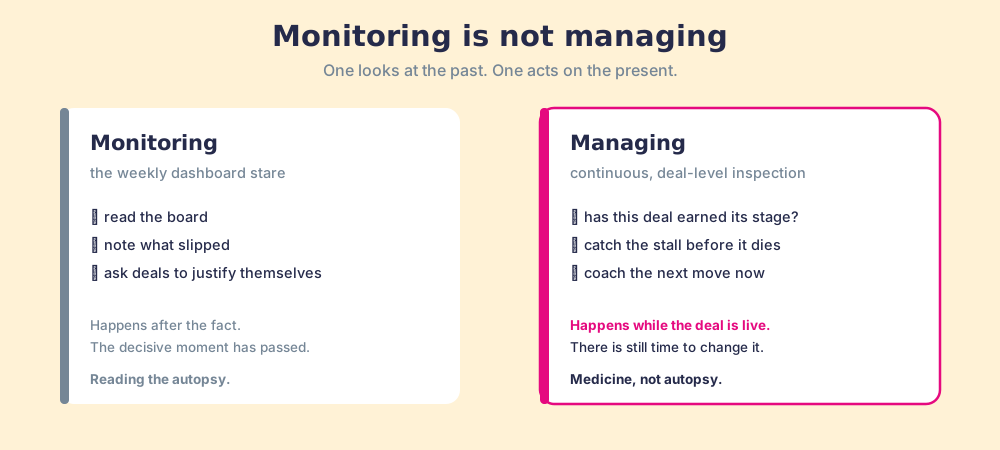
In its usual form, sales pipeline management is a weekly meeting with the whole team staring at one dashboard. The manager reads the board, asks a few deals to justify themselves, notes what slipped since last week, and the meeting ends. That meeting is monitoring, and monitoring is a different job from management. By the time a deal shows up as a problem on the dashboard, the moment to change its outcome has usually passed. Pipeline management that changes outcomes happens earlier and more often, while the deal is still live and the next move still matters. Watching a pipeline and managing one differ mainly in timing.
Sales pipeline management is the practice of moving deals through the pipeline to a forecastable outcome, and it works when managers inspect deals against real buyer commitments and coach while the deal is live, not when they only review a dashboard after the fact. Doing it well depends on that distinction, inspecting versus staring.
What is sales pipeline management, exactly?
It is the work of getting deals to a predictable outcome, not the work of reporting on them. The job has four real parts: prioritizing the deals worth attention, spotting risk early enough to act, keeping the stages accurate so the picture is true, and coaching reps on the specific moves that move specific deals. Reporting is a byproduct, not the job. A team that has confused the byproduct for the job ends up with beautiful dashboards and a forecast that misses, because looking at a number never changed it. The payoff for getting this right is well documented: Harvard Business Review found that companies which mastered a few specific pipeline-management disciplines grew revenue meaningfully faster than those that did not (Harvard Business Review).
The reason this matters is scarcity. A manager has limited hours and a rep has limited deals, so management is the act of pointing finite attention at the deals where it changes the outcome. A pipeline managed well concentrates effort where it pays; a pipeline merely monitored spreads attention evenly across deals that are already won, already dead, and genuinely in play, which is the same as having no priorities at all.
A pipeline is a flow system, not a pile
The dashboard tempts you to see the pipeline as a stock, a pile of deals to count and grow. Operations research has a better model, and it changes what you manage. A pipeline is a flow system, the same class of thing as a factory line or a checkout queue, and flow systems obey Little’s Law, proven by John Little in 1961: the average number of items in a system equals the throughput rate multiplied by the average time each item spends inside it (Little’s Law). For a pipeline, that reads: the deals sitting in your pipeline equal your throughput (deals closing per month) times your cycle time (how long a deal takes). Rearrange it and the management insight falls out: the number you care about, throughput, is governed by cycle time and flow, not by how big the pile is.
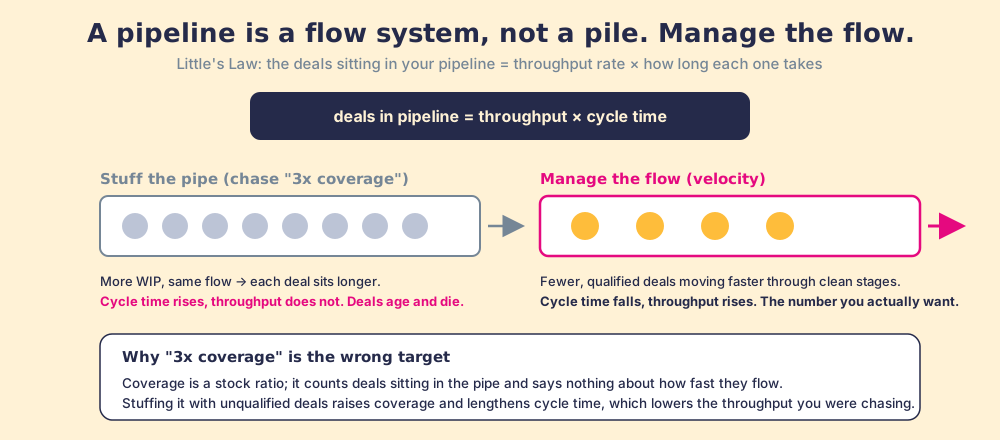
The most common pipeline target, “3x coverage,” misleads at exactly this point. Coverage is a stock ratio: pipeline value divided by quota. It counts the pile and says nothing about how fast it flows. Little’s Law shows why that is dangerous. If you hit 3x coverage by stuffing the pipe with unqualified deals, you have raised the work-in-progress without raising throughput, which means, by the law itself, you have lengthened cycle time. Longer cycles age deals toward the “no decision” graveyard and slow the throughput coverage was supposed to protect. A team can be at 4x coverage and slowing down. The right object of management is velocity, the rate at which qualified deals move through clean stages, and velocity is a flow property you manage deal by deal, not a stock you accumulate.
Why do aging deals die instead of closing?
Little’s Law tells you that stuffing the pipe lengthens cycle time, but it does not say why a longer cycle is fatal rather than merely slow. The reason is the loss that pipeline reports undercount, the deal that goes to no decision rather than to a competitor. Matthew Dixon and Ted McKenna studied more than two and a half million sales conversations for The Jolt Effect and found that 40 to 60 percent of qualified, engaged deals end in no decision, the customer choosing the status quo over any option on the table (Dixon & McKenna, The Jolt Effect, 2022). The driver is the customer’s own fear of making a mistake, more than price or product, and that fear compounds the longer a deal sits unresolved. Time is not neutral in a pipeline. Each extra week a deal ages is another week for the buyer’s indecision to harden into the safest answer of all, which is to do nothing.
Little’s Law was pointing at this cost. A bloated pipeline moves slowly, and it moves slowly through a graveyard, one paved with deals that were real and went cold.
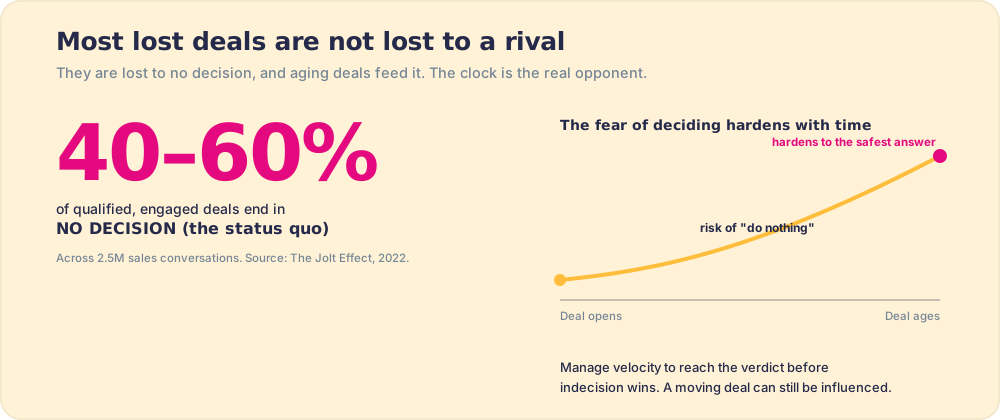
Managing velocity, then, is more than an efficiency nicety. It is how you get to the buyer’s decision before the fear of deciding wins. A deal kept moving is a deal you can still influence; a deal left to age is one you have handed, by default, to the status quo. The manager who watches cycle time is watching the one variable that determines whether qualified deals reach a verdict or rot into a no-decision that never shows up as a loss in anyone’s report.
Why is monitoring not managing?
Because the dashboard reports the past, and management acts on the present. When a deal slips on the board, that is news of something that already happened. The discovery the rep should have run differently, the stakeholder they never reached, the stall they did not catch, all of it is over by the time it surfaces in the weekly review. You are reading the autopsy and calling it medicine.
The same timing problem limits any after-the-fact tool, and it is why our research keeps pointing to in-the-flow inspection rather than periodic review. Teams that consistently inspect deals against a defined process hit quota at 6.3 times the rate of those that rarely do (The State of Sales Enablement). The operative word is consistently, which a weekly meeting is not. Pipeline management that lives in a recurring calendar event (the weekly sales pipeline tracker review) is, by construction, too infrequent and too late to change much. The deals move every day; the management happens once a week; the gap between them is where deals die unnoticed.
How do you manage a pipeline well?
A good sales pipeline management process replaces periodic monitoring with continuous, deal-level inspection and coaching. The shift has four parts:
- Stages defined by buyer commitment. A stage means the buyer did something, not the rep did. It is the foundation, covered in what is a sales pipeline and pipeline hygiene.
- Inspection against those criteria. You check whether the buyer commitment is real, not whether the fields are filled, so you manage reality rather than appearance.
- Coaching on the deals that move. Effort goes where it changes the outcome, rather than spreading evenly across every deal.
- Continuous, in the flow. Inspection and coaching happen as deals move, not in a weekly retrospective.

A business logic layer changes that cadence. A tool like Supered inspects whether each live deal has earned its stage inside HubSpot and Salesforce, surfaces the deals that need attention, and flags the next move, so management becomes continuous and deal-level rather than a weekly stare. The manager stops reading autopsies and starts intervening while the patient is alive. That continuous inspection is also what makes the forecast trustworthy, because a pipeline managed against real commitments forecasts itself.
What we recommend
Stop confusing the weekly pipeline review with pipeline management, and stop managing the pile instead of the flow. Looking at the board is monitoring, and monitoring after the fact changes nothing about deals whose decisive moments have already passed; chasing coverage grows the pile while Little’s Law lengthens your cycles. Managing the sales pipeline well is the daily, deal-level work of inspecting whether deals have earned their stage and coaching reps on the next move while it still matters, which is what keeps velocity high. So define stages by buyer commitment, inspect against them continuously, target the deals where attention changes the outcome, and watch cycle time and throughput rather than coverage. Manage the deals while they are live, and the forecast and the win rate follow, because a pipeline managed as a flow forecasts itself.
From here: the foundation in what is a sales pipeline, keeping it clean in pipeline hygiene, the forecast it produces in sales forecasting, and the system that makes inspection continuous in sales process adoption.
Frequently asked questions
What is sales pipeline management?+
What is the difference between managing and monitoring a pipeline?+
How do you manage a sales pipeline effectively?+
What is the biggest mistake in pipeline management?+
Your process, running itself.