Sales Playbook Examples: You Can Borrow the Pattern, Not the Plays
Sales playbook examples are useful for the pattern they reveal and dangerous when copied. Transplanting another team's plays is cargo-cult selling. Use examples to learn the structure, then build from your own wins.
Sales playbook examples are sample playbooks from other teams, useful for learning the structure and principles of a good playbook but not for copying, because the plays that win are specific to your buyers and your best reps and cannot be transplanted from someone else's motion.
People search for sales playbook examples hoping to find a playbook they can copy. It is the wrong hope, and acting on it produces the most common failure in playbook-building: transplanting another team’s plays into your team and wondering why nothing improves. An example is genuinely valuable, but for the pattern it reveals, not the content it contains. You can learn from how a good playbook is structured and what a specific, behavior-level play looks like. You cannot borrow the plays themselves, because the moves that win are built for a particular buyer and run by particular reps, and pasting them into your team gives you the form of a playbook without the substance that makes one work.
Sales playbook examples are sample playbooks from other teams, useful for learning the structure and principles of a good playbook but not for copying, because the plays that win are specific to your buyers and your best reps and cannot be transplanted from someone else’s motion. Use them for the pattern, and they help; copy them for the content, and they mislead.
Why does copying a sales playbook example fail?
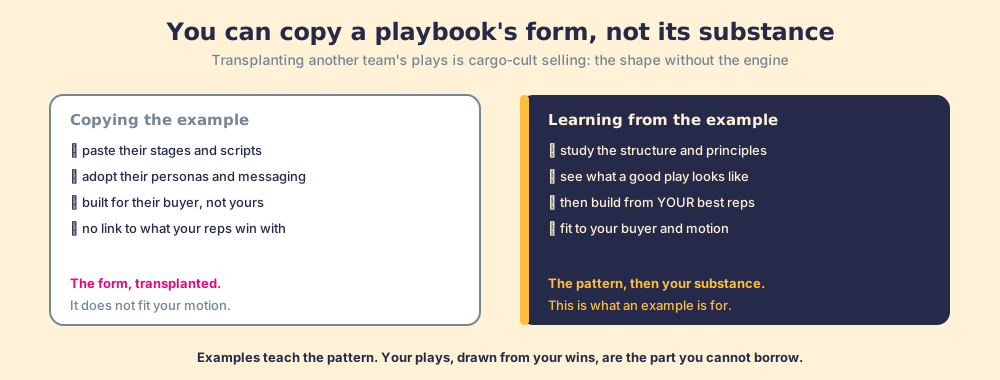
Because you copy the visible form and leave behind the invisible substance that made it work. The physicist Richard Feynman named this trap “cargo cult science”: imitating the outward shape of something successful while missing the underlying mechanism that produced the result (Feynman, on cargo cult science). A playbook example shows you the shape, the stages, the scripts, the persona sections, but the engine, why those specific plays win with that specific buyer, is not in the document. Transplant the shape into your team and you get cargo-cult selling: a playbook that looks complete and changes nothing, since the plays were built for someone else’s buyer, someone else’s product, and someone else’s reps.
The deeper issue is that a play precise enough to be useful is precise to a context. “Open the discovery by asking about their renewal timeline” wins for a team whose buyers are renewal-driven and loses for one whose buyers are not. The specificity that makes a play valuable is the same specificity that makes it non-transferable. So the better the example, the less of it you can copy, because the parts worth having are exactly the parts bound to the other team’s situation.
Feynman told the story to make a hard point about science, and it lands with equal force here. After the Second World War, islanders who had watched cargo planes land during the war built runways out of bamboo, lit fires along them, and sat a man in a wooden hut with two coconut halves over his ears like headphones, waiting for the planes to return. They had reproduced the form of an airfield in faithful detail. What they could not reproduce was the thing that summoned the planes, an entire industrial and logistical system invisible from the island. The runway was real. The planes never came. A borrowed playbook is the bamboo runway: every visible feature copied, the one invisible thing, the fit between these plays and this buyer, missing, and so nothing lands.
This is also where the popular “steal our sales playbook” genre earns a second look. The internet is full of downloadable example playbooks from admired companies, and the implicit promise is that their success is portable if you copy their document. It is not, and the better the company, the less portable it is, because a great playbook is great precisely by being tuned to one buyer, one product, one set of reps. You can admire the tuning. You cannot inherit it. Treat those downloads as worked examples to study, the way a chess player studies a grandmaster’s game, not as moves to replay against a different opponent.
What should you take from a sales playbook example?
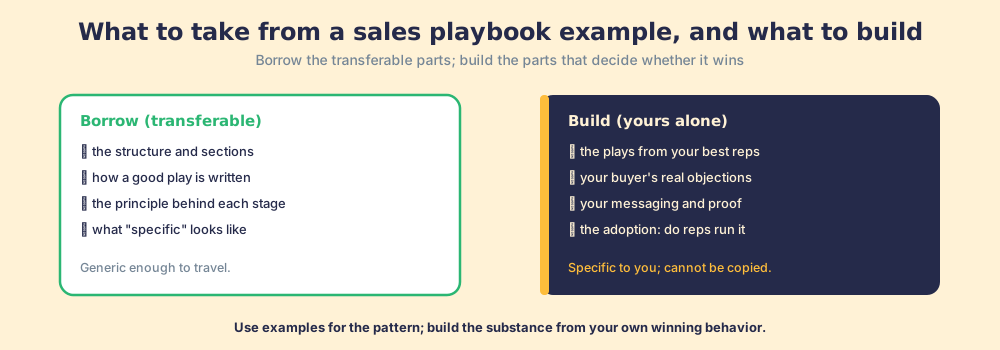
The transferable pattern, and nothing that is bound to the other team’s buyer. There is a clean line between what travels and what does not. The structure travels: the sections, the way a strong play is written, the principle behind each stage, what “specific” looks like as opposed to vague. Study those, and an example teaches you how to build a good playbook. The substance does not travel: the plays themselves, the real objections, the messaging and proof, and above all the adoption, whether reps run it. Those you build from your own team, drawing the plays from what your best reps do, which is the build described in the sales playbook guide and the discipline in the sales playbook.
- Borrow the structure. Sections, format, and how a good play reads. Generic enough to travel between teams.
- Borrow the principle. Why each stage exists and what makes a play specific rather than generic. The pattern is transferable.
- Build the plays. From your best reps, your buyer’s objections, your proof. Specific to you, and the part no example can supply.
- Build the adoption. Whether reps run it on real deals, the part a document never solves on its own.
What does a good b2b sales playbook example show you?
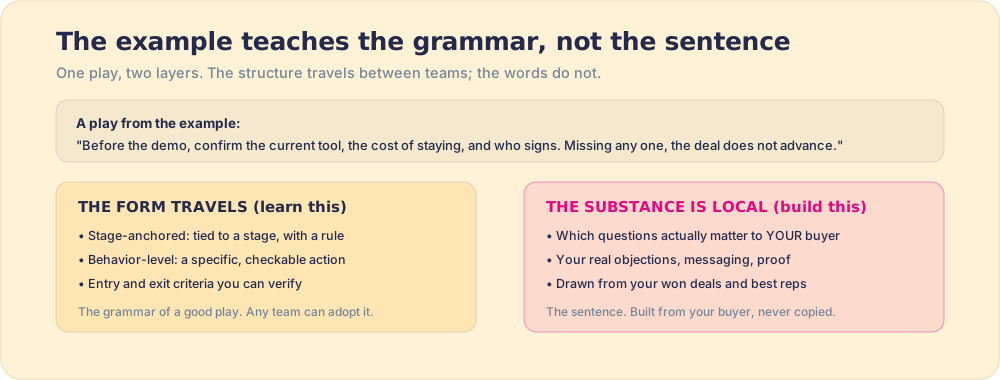
Take a concrete b2b sales playbook example and watch where the transferable line falls. A strong example might contain a discovery play that reads: “Before booking the demo, confirm the buyer’s current tool, the cost of staying on it, and who signs. If any of the three is unknown, the deal does not advance to demo.” Read that as a sample sales playbook entry and two different things are happening at once. The form, an entry rule tied to a stage, a play written at the level of a specific action, an exit criterion you can check, is a pattern any team can and should adopt. The substance, that these three questions are the ones that matter for this buyer, is local. Your buyer may not have an incumbent tool, or may have five signers, or may decide on risk rather than cost.
So the example teaches you the grammar of a good play: stage-anchored, behavior-level, checkable. It cannot hand you the sentence, because the sentence is built from your buyer’s reality. This is the tenet underneath every Supered argument about playbooks: the best plays already live in your best reps, who have learned by losing what your buyer responds to. An example shows you what a captured play looks like. Your own won deals are where the plays come from.
How do you turn an example into your own playbook?
Reverse-engineer the pattern, then rebuild the substance from your wins. Take the example apart to see how it works: how it structures stages, how it writes a play at the behavior level, how it ties a play to a buyer situation. That is your lesson in what good looks like. Then set the example aside and build from your own evidence, looking at your won deals to find the plays your best reps run, writing them at the same level of specificity the example taught you, and fitting them to your buyer’s real objections and your proof. Finally, do the part no example addresses: get reps to run the plays on real deals by surfacing them in the flow of work and measuring adherence, which is the sales process adoption problem at the heart of every playbook. The example taught you the form. Your wins supply the content.
What we recommend
Treat sales playbook examples as lessons in pattern, never as content to paste, because copying another team’s plays is cargo-cult selling that gives you the shape of a playbook with none of the engine. Learn everything the example can teach, the structure, the principle behind each stage, what a specific behavior-level play looks like, and then build the substance from your own team: the plays your best reps run, your buyer’s real objections, your proof, and the adoption that makes any of it matter. The better the example, the less of it transfers, because the plays precise enough to be useful are precise to the other team’s buyer. So study examples closely and copy them never. The pattern is theirs to teach and yours to keep. The plays are yours alone to build.
From here: the structure to start from in the sales playbook template, the full build in the sales playbook guide, the discipline in the sales playbook, and the adoption underneath in sales process adoption.
Frequently asked questions
What are sales playbook examples?+
Can you copy a sales playbook from an example?+
How do you use sales playbook examples well?+
What makes a good sales playbook example?+
Your process, running itself.