How to Plan a Conference: Brendan Tolleson on Building Southbound From 100 Guests
RevPartners' Brendan Tolleson built Southbound from a six-week scramble in a borrowed office to a 500-guest target with HubSpot's CEO on stage. The decisions he made before any logistics, in his words.
To plan a conference, Brendan Tolleson decides purpose, size, the team's hours, who the guests are and the pipeline target first, then books venue, speakers and logistics, then runs the follow-up in the week after.
The email arrived while RevPartners was at its annual offsite in Tucson, Arizona. HubSpot had approved the firm’s request for market development funds to run an event, on one condition: it had to happen within six weeks. Brendan Tolleson, RevPartners’ co-founder and CEO, and his team had six weeks to work out how to plan a conference from nothing: find sponsors, book speakers, pick a room, and build a guest list.
They pulled it off. CallRail lent its Atlanta office. Over 100 people came. Brendan was not one of them. The date had been chosen around the speaker, and he had a family trip booked six months earlier.
That was the first Southbound. Two years later the target was 500 guests at The Roxy in Atlanta, with HubSpot CEO Yamini Rangan, StoryBrand’s Donald Miller, former HubSpot CRO Mark Roberge and Clay co-founder Varun Anand on the program. RevPartners had grown to over $10 million in annual recurring revenue and 85 people.
Brendan walked me through all three years when he came on Fast & Tierious in March 2026. His conference planning checklist has venue deposits and badge printers on it, like anyone’s, but they come near the bottom. Above them sit a handful of decisions he learned to make first: why you are hosting, how big to start, what it will cost your team in hours, and who the event is for.
Why did Brendan start Southbound at all?
He gave two reasons, and pipeline was not the first. “One, we wanted to put a stake in the ground for the southeast and so hence southbound to play on inbound,” he said. RevPartners wanted to own the region. “Two, we really wanted to create um when I say a community, we we wanted to add value to the community.”
He wanted the biggest partner-hosted event outside Inbound, with enough people to matter but not so many that the day turns into a crowd with name tags. In his words, he wanted size without the scale “where there’s not the human connection.” The 2026 theme played on time: what is timeless and what is timely for a go-to-market leader.
A third reason has grown since the first year. Brendan counts over 7,000 HubSpot partners, “probably 8,000 at this point,” and an event is how RevPartners stands out among them. He added that AI has made face-to-face trust worth more. “Trust is fostered oftentimes through face to face because you’re just break through that noise of what’s real and what’s fake.”
Event organizers report the same pull. In Bizzabo’s 2025 State of Events research, 78% of organizers called in-person events “the most powerful way to engage with their audience” (Bizzabo, 2025).
How big should your first conference be?
Brendan’s advice is to “start with what you can do,” and he put a number on it: “I would recommend a 100 person event and see go from there.”
Southbound grew in steps. Year one: a little over 100 guests in a borrowed office. Year two: 250 at the Atlanta Tech Village. Year three: a 500-guest target at The Roxy, a music venue at The Battery Atlanta, with a plan for The Roxy to become to Southbound what Boston’s convention center is to Inbound.
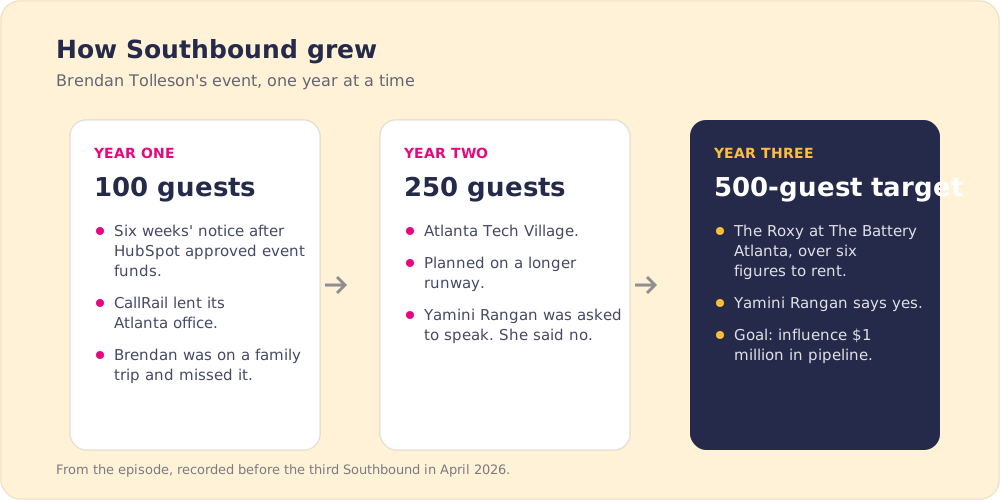
He would not repeat the six-week sprint. “Don’t do an event in six weeks. I’ll say that.” The standard advice runs the other way: Exordo’s planning guide puts a conference plan at 12 to 14 months (Exordo, 2026). RevPartners got away with six weeks once, with about 100 people in a borrowed office.
The bigger venue came only after three years of showing up. “Time is on our side because we’ve invested it for three years,” Brendan said. “There’s no way I would spend that much money the first year.”
Speakers worked the same way. Year one was built around Andy Pitre, then HubSpot’s head of product, who lived in Atlanta, and the date was set for him. RevPartners asked Yamini Rangan to speak in year two. She said no. Brendan kept asking, and in year three he showed her the vision: who would come, where, and why. She said yes. His advice to anyone hoping for a big name: “don’t expect Yomi to come to your event year one. Like, you need to have a track record.”
What does a conference cost beyond the venue?
Brendan brought up the hours before the dollars. The money matters, he said, but “it’s really the time.” The event, in his words, “sucks a lot of my time. It sucks a lot of the marketing team’s time.” For a firm whose people bill clients, those hours come out of delivery and selling. His conclusion: “You really have to go all in on it.”
The money is large too, and most of it goes out before any comes in. The Roxy, he said, is “over six figures to even rent out,” before sponsors, before ticket sales, and before speakers and hotels.
Sponsors help pay for it. In the same Bizzabo research, 37% of organizers attributed 40 to 60% of event revenue to sponsorships (Bizzabo, 2025). Whatever sponsors do not cover, the host pays, so put the team’s hours in the budget next to the venue.
Why did Brendan call them guests?
Because the first two years were about how people felt. “Let’s not talk about attendees,” he told his team. “Call them guests.” The word changed the planning: hospitality first, an experience that felt different from a standard event, and a brand people associated with how they were treated.
In 2026 the effort pointed at customers. RevPartners arranged hotels, a Braves game, and a VIP experience at the Omni. I pointed out on the episode that this starts to look like a user conference, and that retention is as much the lifeblood of a service firm as new sales. Brendan agreed, with a condition: a user conference works “if you actually have things to say,” which for him means something to take to market beyond “hey I do implementations.”
He measures the result across the whole funnel, which he describes as “all phases of the pipeline.” For 2026, RevPartners set a target to influence $1 million in pipeline.
Brendan named one more return. Hosting showed HubSpot’s leadership that RevPartners was “not playing it safe” and was “looking to scale something.” In his words, “that gets rewarded.” In June 2026, three months after this episode, Walker Sands acquired RevPartners, which now operates as RevPartners, a Walker Sands company, with Brendan still leading it (Business Wire, June 10, 2026).
How to plan a conference, in Brendan’s order
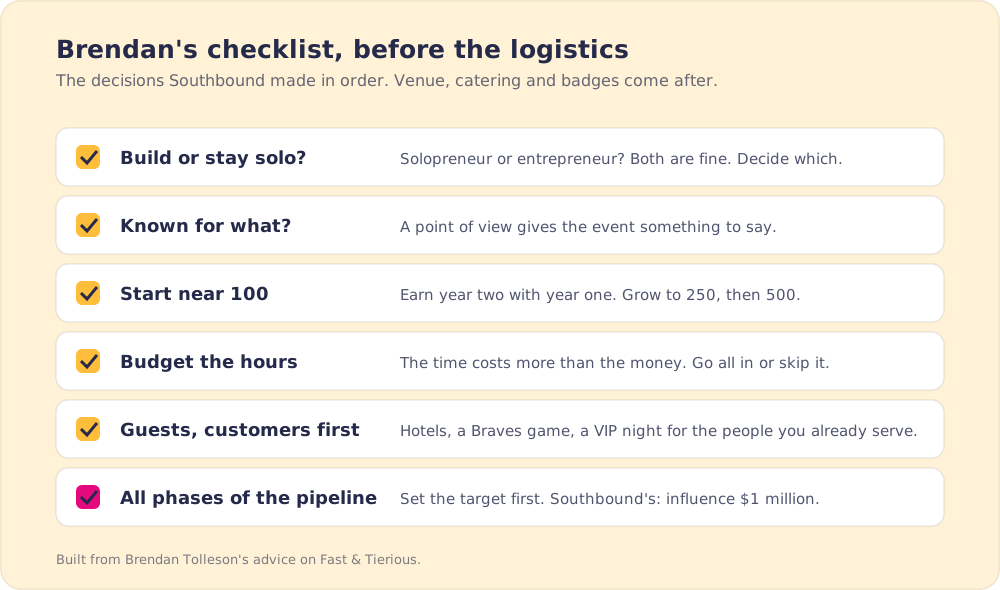
When I asked Brendan for advice to a partner who wants to build something like Southbound, he answered about the company first. His first question: are you a solopreneur or an entrepreneur? Both are fine, he said, and a solo practice should celebrate that: “don’t try to be something you’re not.” Then: “what do you want to be known for?” Then: “focus focus focus.”
Put his event lessons behind those three and you get the first phase of the plan, the decisions to make before any logistics. Treat it as the top half of an event planning checklist for any B2B event.
- The build decision. Decide whether you are building a company or a practice. An event is a scaling bet, and a solo practice may not need one.
- The point of view. Know what you want to be known for, so the stage has something to say.
- The first size. Start near 100 guests and grow from there.
- The hours. Budget the founder’s and marketing team’s time as seriously as the venue, and go all in or wait.
- The guests. Plan the experience around the people you already serve, customers first.
- The target. Set the pipeline goal before the doors open and measure every phase, retention included.
The second phase is the familiar one. Book the venue and the speakers the decisions call for, with enough lead time; Exordo’s 12 to 14 months is the standard, and Brendan’s six weeks is the warning. Then sponsors, contracts, catering, AV, registration, signage and the run of show. The third phase starts when the guests leave.
What happens in the week after?
A $1 million influenced-pipeline target gets hit or missed after the guests go home, in what reps do with the conversations they had: who logs each contact, who follows up, and how fast. A Harvard Business Review study of lead response found that firms that tried to contact a lead within an hour were nearly seven times as likely to qualify it as firms that waited even an hour longer (Oldroyd, McElheran and Elkington, HBR, 2011). Those were web leads. A guest who shook a rep’s hand at The Roxy will also forget the conversation if no rep calls for two weeks.
Write the follow-up into the plan: which reps own which guests, what the first touch says, and the deadline. Our guide to trade show strategy with HubSpot covers capture, and our post on sales and marketing alignment covers who owns the lead afterward.
Should your firm host its first conference?
Sponsoring someone else’s event is cheaper, and it builds their brand. Going big in year one puts six figures on an audience you have not proven. We would do what Brendan did: host about 100 people, treat them as guests, and grow only as fast as the track record allows. By year three RevPartners could afford The Roxy, and the CEO who said no in year two said yes.
Brendan also warned that the event sits inside a harder project, growing the company. RevPartners stalled between 65 and 75 people for 12 to 18 months before reaching 85. “It’s not easy, guys,” he said. “But if it was easy, a lot of people would do it.”
The follow-up after an event is a process reps run in the CRM, and that is where Supered helps: it puts the next step in front of the rep inside HubSpot or Salesforce while they work the contact, so each guest gets the same follow-up. Partner firms can see how agencies productize this on our page for HubSpot partners.
To see how RevPartners runs the rest of its business, read our RevPartners partner profile, then our sales kickoff ideas for the internal event that often comes next.
Frequently asked questions
How do you plan a conference?+
How far in advance should you plan a conference?+
How much does it cost to host a B2B conference?+
How big should a first conference be?+
How do you measure the ROI of a conference?+
Your process, running itself.
Turn the playbook into rep behavior.
More from Fast & Tierious

Agency Organizational Structure: How Ash Collyer Built Forbidden to 18 People
Ash Collyer
How to Pivot Your Business: Lessons From an Agency That Changed Course Three Times
Przem Orlikowski