How to Pivot Your Business: Lessons From an Agency That Changed Course Three Times
Przem Orlikowski left travel tech in the pandemic, joined a three-person HubSpot shop in Poland, and pivoted it three times on the way to 20 people. His lessons on how to pivot your business: close the loop, be patient, commit.
How to pivot your business, in Przem Orlikowski's experience: pick a point of view you can deliver end to end, change one piece at a time, give it more than six months, and have the founder carry it for years.
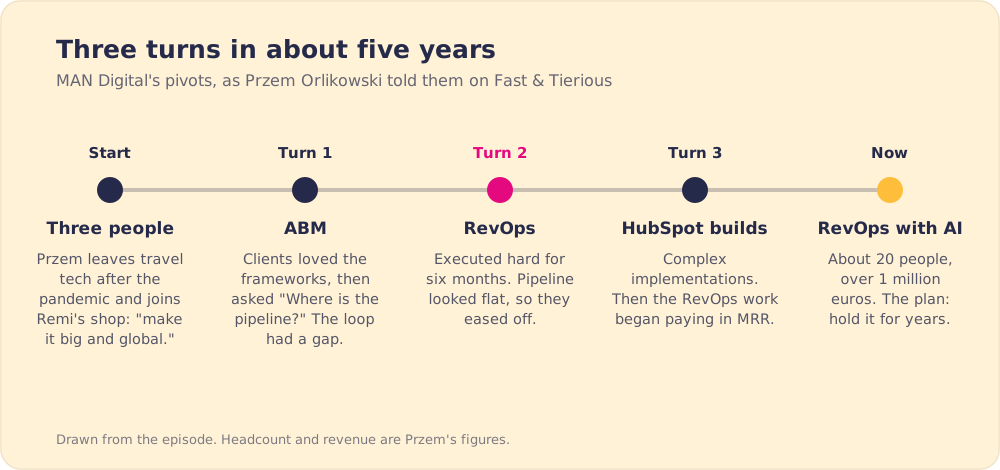
In 2020 Przem Orlikowski was running the Polish office of a travel tech company, and the pandemic took it apart. Remi, founder of a small HubSpot shop called MAN Digital, had asked him to team up before. This time Przem said yes, on one condition: “let’s make it big and global.”
MAN Digital was three people then. Today it has around 20 people, over 1 million euros in revenue, and a place among the biggest HubSpot partners in Central and Eastern Europe. Ask Przem how to pivot your business and he starts with what his three turns cost the firm. “I feel we didn’t solve this problem well enough,” he told me, “and because of that I suppose we are not as far as we could be.”
The turns went from account-based marketing, to RevOps, to complex HubSpot builds, and now back to RevOps with AI built in. We spent most of his Fast & Tierious episode on them. He came away with three lessons for any service firm thinking about changing course: pick a point of view you can deliver from start to finish, give it longer than six months, and have the founder carry it until the company can.
Why does a point of view have to close the loop?
MAN Digital’s first specialty was account-based marketing strategy. Clients liked the frameworks. Then they wanted results. “At the end everyone asks, ‘Where is the pipeline?’” Przem said.
To produce that pipeline, ABM needs prospecting, paid ads, SEO, and content all running at once, and MAN Digital did not have enough people to deliver every piece. Przem would not paper over the gap. He did not want to run “a consulting business that preaches stuff and tells people what to do, but never delivers that and just tells them you didn’t execute the strategy well.”
He is blunt about why ABM trips firms up. “People confuse ABM thinking that ABM is a channel that suddenly will solve their problems,” he said. He sees it as a philosophy that uses every channel together. “So if you suck at those channels, don’t even think that you will suddenly win with ABM.”
On the episode I called this completing the loop. A point of view promises a client an outcome, and the firm has to be able to do each step between the first call and that outcome. When a step is missing, you build it or you move to a promise you can keep. MAN Digital moved. It narrowed to the HubSpot work it had been doing behind the strategy, “because we can deliver this.”
Researchers who study pivots have seen firms change course in exactly this piecemeal way. Jacqueline Kirtley and Siobhan O’Mahony followed seven young firms through 93 strategic decisions and found that a pivot “was not achieved with a single decision, but by incrementally exiting or adding strategy elements over time” (Kirtley and O’Mahony, Strategic Management Journal, 2023). MAN Digital dropped the parts of ABM it could not deliver and kept the HubSpot work it could.
How long should you give a strategy before you pivot?
The RevOps turn is the one Przem regrets, and he tells it without dressing it up.
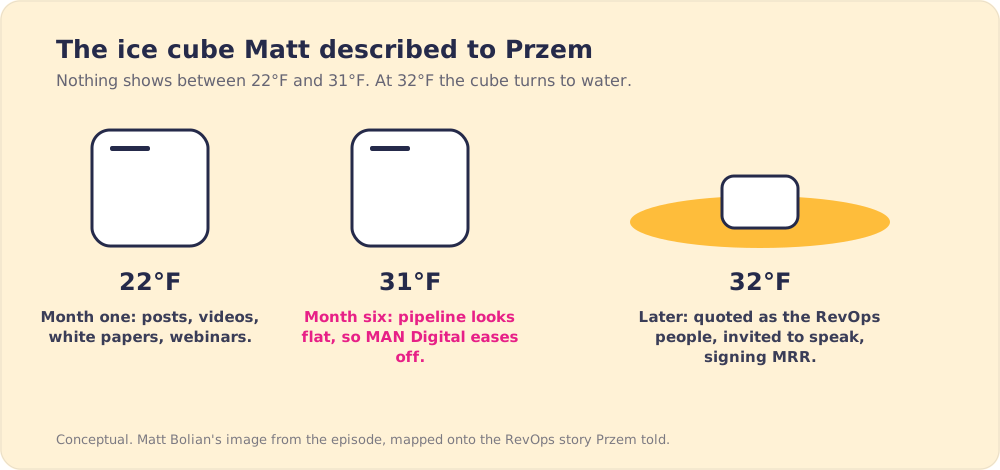
The team built its message the way he now recommends to anyone: what we say, why it is urgent, the problems it solves, the solution, the proof points, the themes, and the formats. Then they published all of it: LinkedIn posts, videos, articles, white papers, infographics, and webinars with industry leaders. “We executed brilliantly,” he said. “The issue was that after 6 months we didn’t see this pushing the pipeline that much.”
MAN Digital was being quoted as the RevOps people in the region and invited to speak, yet the pipeline lagged. The market was small. By his estimate, RevOps searches across all of Europe ran around 1,000 a month, against 20,000 to 30,000 or more in the US.
The team got shaky and leaned back toward complex HubSpot implementations. Then, after they had eased off, the RevOps work started to land and brought in a lot of monthly recurring revenue. “It actually takes at least 6 months or more to bring results,” he said, and “the biggest issue was our patience that we were not patient enough.”
I gave him a picture on the episode for what that stretch feels like. “What’s the difference in the ice cube at 22° Fahrenheit and 31° Fahrenheit? Nothing. They’re still ice cubes.” At 32 it melts. From the inside, the cube at 31 degrees looks the same as the cube at 22.
Advertising researchers have measured the same impatience. Les Binet and Peter Field studied long-term brand effects for the IPA, and System1’s summary of their work puts it in one line: “too often, marketers tire of their creative before consumers do” (System1 on The Long and the Short of It). By month six, Przem’s team had written and recorded the RevOps message many times over. Most prospects in a 1,000-searches-a-month market had seen it a few times at most.
What does a business pivot cost a service firm?
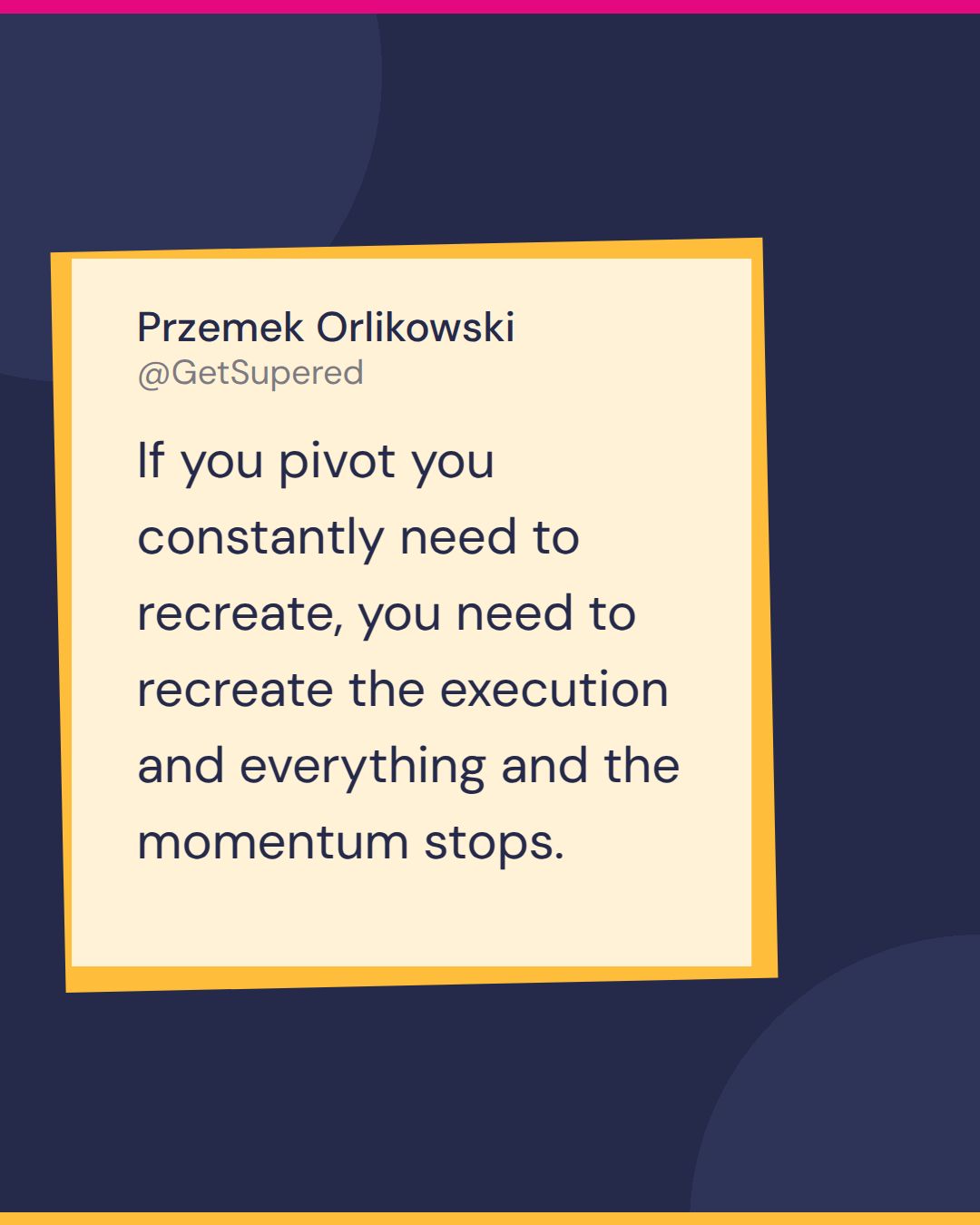
Przem listed the cost in one breath: “if you pivot you constantly need to recreate, you need to recreate the execution and everything and the momentum stops. And then it’s hard to scale because you don’t have the processes because you just change the category, change the point of view.”
I put it this way on the call: “a service company recreates people as the product.” When a software company changes direction, engineers change the code. When a service firm changes direction, its people have to learn a new way to scope work, a new first deliverable, and new questions to ask a client in week one.
He also named the cost of having no point of view at all. A firm without one, he said, is “constantly in a stress of chasing the projects that you took but are not exactly what you want to have.” I added the sales side. A service firm can say yes to almost anything, and each unusual yes creates a new product that delivery has to figure out. The handoff from sales to delivery “gets really dicey when you make up new things.”
The startup data leans toward few turns. The Startup Genome Report studied more than 600 startups and found that those that pivoted once or twice raised 2.5x more money and had 3.6x better user growth than those that pivoted more than twice or never (Startup Genome Report, via Wamda, 2011). The sample was software companies and the finding is a correlation. A service firm has to retrain people on each turn, which costs more than rewriting code.
Our own research gives a planning number for the retraining. The State of Sales Enablement 2026 advises planning any new playbook on a 30% baseline adoption assumption, meaning roughly three in ten people running it at first (The State of Sales Enablement 2026). A pivot hands the whole team a new playbook at once.
Who has to believe the point of view first?
Przem was clear that the founder has to carry the belief in the early years. “If you don’t believe it in by your heart, people will also not believe in you either,” he said. “Only usually the founders are capable of actually conveying such a message so strong, and then align entire company.”
He admits it is a hard job. The founder has to communicate well and also hold “a unique insight into how things should work,” while each person in the company arrives with their own ideas about how to work.
I told him what worked for us at RevPartners. Our point of view was that your CRM is a product, and it shaped how we organized delivery: sprints, releases, feedback from users. It also gave sales a simple way to talk about competitors. They are good at projects, and if you want a project, hire them. Dropping that belief in a slow month would have meant rebuilding how the whole team worked.
MAN Digital’s current turn keeps its belief in RevOps and adds new tools. The firm is building AI into its RevOps work, betting that HubSpot becomes an operating platform for whole businesses, and aiming to land a Fortune 500 migration to HubSpot. Przem also set a longer horizon this time: “sometimes we just committed for a year to a certain thing and what we should do is commit to 5 years at least.”
What Przem learned from three turns
- A closed loop. Promise only what the firm can deliver from the first call to the outcome.
- The cost of each turn. A pivot resets the sales message, the training, and the delivery process together, and momentum stops while they are rebuilt.
- The founder’s belief. The founder carries the point of view until the company can, because customers will not believe what the founder does not.
How do you pivot your business, step by step?
- Check the loop first. List each step between the first call and the outcome you promise, and mark the ones you cannot deliver today. Build those or move to a promise you can keep, as MAN Digital did when it left ABM.
- Change one piece at a time. Keep the point of view and swap one element, the way Kirtley and O’Mahony saw young firms do it and the way MAN Digital is adding AI to RevOps now.
- Write the message before you publish it, in Przem’s order: what we say, why it is urgent, the problems it solves, the solution, the proof points, the themes, and the formats.
- Plan the retraining. Expect about three in ten people to run the new playbook at first, and budget time for the rest.
- Hold it past month six. MAN Digital’s RevOps results came after it eased off.
When I asked Przem what he wished he had done sooner, he said “to focus on this point of view and find it earlier and commit to that with full confidence as soon as possible.” For the pivot or persevere call, his experience gives one test: change course when you cannot deliver what you promised, and wait when you can but the market has not caught up.
Supered puts the process a team has agreed to inside HubSpot and Salesforce, in the flow of work, so you can tell whether a strategy failed or was never run. If you lead a partner firm, our page for HubSpot partners shows how other agencies package their delivery.
Before you decide a strategy failed, read our guide to strategy execution, then what the sales execution gap is, which covers how to tell a bad plan from one that never ran.
Frequently asked questions
How do you pivot your business?+
Why did MAN Digital pivot away from account-based marketing?+
How long should you wait before a business pivot?+
What does a business pivot cost a service company?+
How many times should a company pivot?+
Your process, running itself.
Turn the playbook into rep behavior.
More from Fast & Tierious

Sales and Marketing Conflict: What Sara Hanlon Learned From Both Sides
Sara Hanlon
Agency Organizational Structure: How Ash Collyer Built Forbidden to 18 People
Ash Collyer