Scaling Company Culture: Brendan Tolleson's Numbers for Growing RevPartners Without Losing Its Values
RevPartners CEO Brendan Tolleson wants a $100 million services firm and a culture that survives the trip. On Numbers Known he walked Rob Jones through the numbers he runs on: seven people per $1 million, a voice but not a vote, and excellence with care.
Scaling company culture means keeping how people decide, give feedback and treat customers the same as headcount grows, using written principles the CEO models every week and rituals that run without the founders in the room.
Rob Jones opened his interview with Brendan Tolleson by getting Brendan’s middle name wrong. The AI he used for research had invented one. “You got to be careful with AI, man,” Brendan told him, and Rob moved on to the three numbers he had picked to explain the CEO of RevPartners, a fully remote RevOps firm built on HubSpot and, more recently, Clay.
Brendan wants a $100 million services firm and a culture that holds together on the way there, so most of their conversation on Numbers Known turned into a talk about scaling company culture. Rob worked at RevPartners for close to four years, and he knew where to push. (Disclosure: I started RevPartners, and Brendan runs it as CEO.)
Why does a services CEO care about a $100 million number?
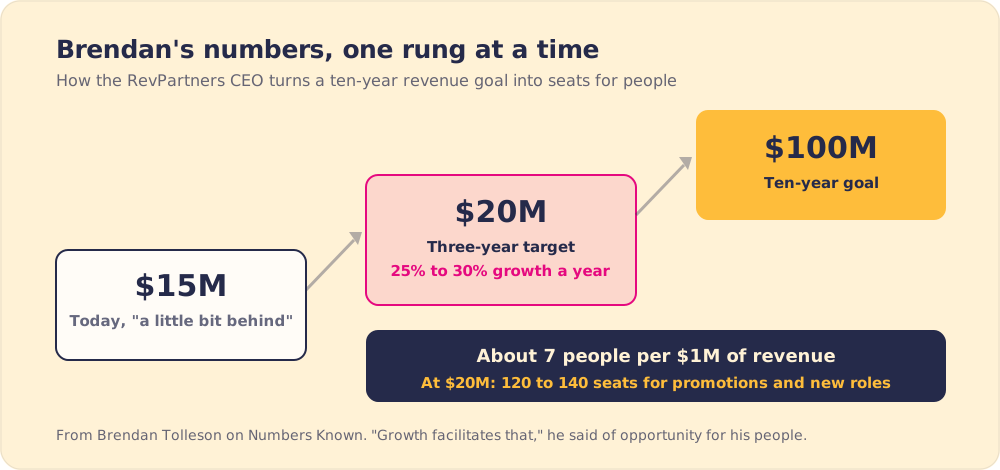
Rob’s first number was 100 million, and Brendan knew it at once. RevPartners’ ten-year goal is to be a $100 million business. He admitted they are behind it. “We’re 15,” he said, meaning $15 million, “a little bit behind.”
To make the ten-year number usable, Brendan broke it into a three-year one. The team has been told the target is $20 million in three years, which takes 25% to 30% growth a year. Then he translated revenue into people. “For every million in revenue, it’s about seven people,” he said. At $20 million that is somewhere between 120 and 140 people.
Those people are why he cares about revenue at all. “Yes, I like to build things, but I also want to create opportunity for our people, uh and growth facilitates that.” In his view, 120 to 140 seats means room for a consultant to become a manager, or to stay an expert and still move up.
Seven people per $1 million works out to about $143,000 of revenue per employee. Statista’s survey of 94 management consulting firms put their average at roughly $181,000 per employee in 2025 (Statista). Brendan plans to hire ahead of that ratio, and at 25% to 30% growth a year, a large share of the company will be people who joined in the last twelve months.
How do you make decisions when everyone has a voice but not a vote?
Rob quoted a line Brendan uses a lot, growth begets complexity, and pressed on it. Department heads want different things. How does Brendan choose between what he wants, what they want and what the business needs?
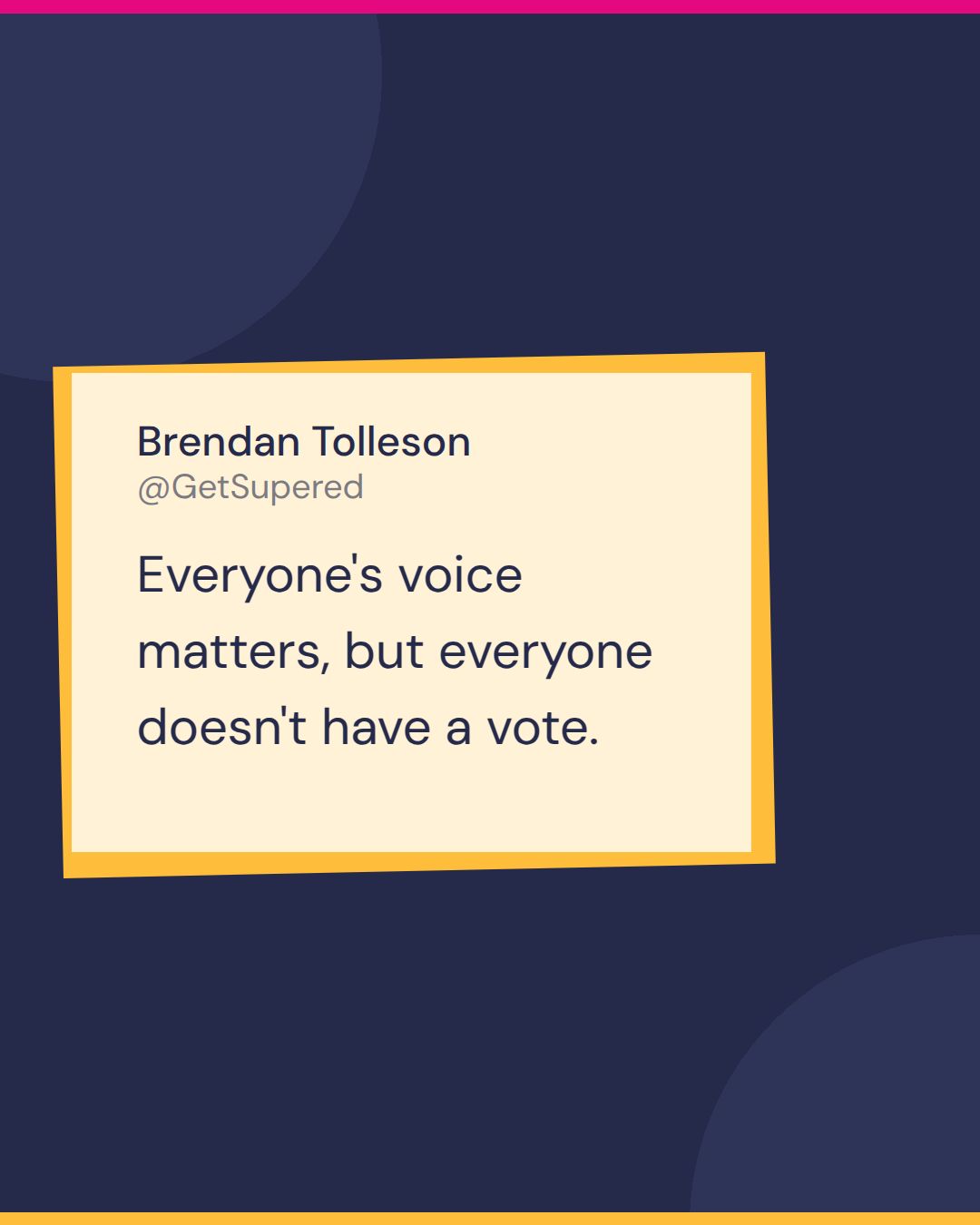
“Everyone’s voice matters, but everyone doesn’t have a vote,” Brendan said. He asks the team for feedback because it shows him “the gaps that I don’t see,” and then he makes the call. “You may disagree, but I need you to commit to the decision. It’s one of our, you know, core principles is disagree and commit.”
He used the $100 million goal itself as the example. People may think it is the wrong number. “We’re going to commit to that number and make sure that we attack that.”
Jeff Bezos told Amazon shareholders in 2016 to “use the phrase ‘disagree and commit.’ This phrase will save a lot of time,” and described it as “a genuine disagreement of opinion, a candid expression of my view, a chance for the team to weigh my view, and a quick, sincere commitment to go their way” (Amazon 2016 shareholder letter). In Bezos’s version the boss commits too, sometimes to a call he argued against. Brendan’s version puts the listening first: he asks for feedback to learn “the gaps, the problems, or the opportunities,” and then he decides.
The same rule governs RevPartners’ bets. Brendan said the move into Clay alongside HubSpot “has worked out really well,” and that other service lines “have not worked. That’s okay.” The method is to “make small bets and small investments” and then put more into whatever is working. His last number of the day pointed the same way: he wants RevPartners to be the number one HubSpot and Clay partner, and he sees that as the road to $20 million and then $100 million.
How do you set a standard when there is no playbook?
Rob’s second number was 404. Part of it is Atlanta’s area code, Brendan’s hometown. The other part is the web error: page not found. When RevPartners started, RevOps was a new idea and there was no firm like it to copy. Rob said people called Brendan insane.
Brendan gave credit to the people he learned from. “I had models of like how I thought we could build it,” he said. One of his lines is “aim for perfection, settle for excellence.” The rest came from what he saw people want: “people want to be part of something, um that’s meaningful, that has purpose, and that they enjoy.” Give them “safety and belonging and and clarity on where we’re going,” he said, and let them execute, and “pretty powerful things happen.”
He named what he thinks the business rests on. “Our sustainable competitive advantage is our people um and the culture that we’ve created.” Then he asked Rob, who had lived it, whether that was true or “garbage.”
Rob answered from his own years there. He said Brendan drove the standard through reflection. RevPartners wrote operating principles such as “Feedback is to give” and “Fail forward,” and Brendan sent the company a reflection in Slack every Friday. “If you aren’t doing what you expect from others,” Rob said, “then how the heck are you going to get them to do it?”
Without a written standard, people doing the same job drift apart, and more people means more drift. Gallup describes a “noise audit” at an insurance company where executives expected underwriters’ quotes on the same case to differ by about 10%, and the real difference was 55% (Gallup, 2021). In our own survey of sales teams, the top quota band averaged 3.83 on deal-execution consistency against 3.00 for the bottom band, and no one in the top band sat at the floor of the scale (The State of Sales Enablement 2026). Our guide to standard work covers how to turn one person’s good habit into the team default.
What does excellence and care look like as a company grows?
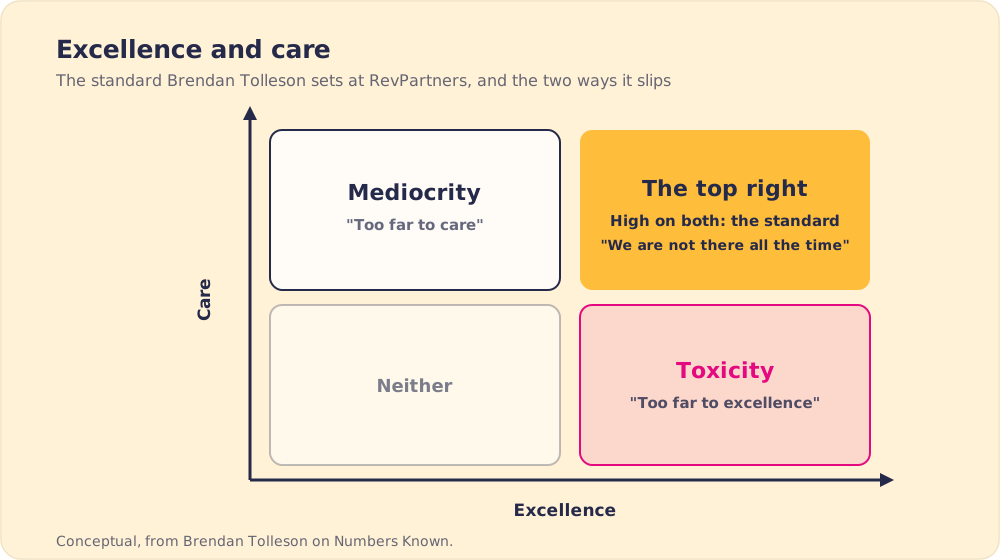
Brendan’s standard has two parts. “We talk a lot about as you know, this idea of excellence and care,” he said. He draws it as a grid and aims for “that top right” box. “If we go too far to excellence, then we get into toxicity. Too far to care, then we get into mediocrity.”
“We are not there all the time, of course,” he added, “um cuz we’re not perfect.”
Kim Scott’s Radical Candor uses the same two-axis shape for feedback. Her quadrants are “Care Personally and Challenge Directly at the same time,” against “ruinous empathy” (“you care, but you stay quiet or sugar-coat it”) and “obnoxious aggression” (“you challenge, but you don’t show you care”) (Radical Candor). Scott built her grid for feedback between a boss and one employee. Brendan uses the same shape for the whole company, with his own names for the two ways it goes wrong.
What scaling company culture takes at a fully remote firm
RevPartners is fully remote, and Brendan said, “I don’t see that changing.” That makes remote company culture his daily problem, and it is where the Atlanta half of Rob’s 404 comes in. Brendan built SouthBound, which Rob called the Inbound of the Southeast, to bring Atlanta’s tech community together.
For a remote team, the event is a chance to be in one place with a job to do. The team gets to see “the people they serve like in person so face-to-face,” and learn “what’s on the mind of the buyer.” They work it together and treat attendees as guests, which Brendan called “a very practical way for us to be reminded of what we we do on a day-in and day-out a basis.” He can talk about purpose, he said, but “if they see it and experience it, it it changes things.”
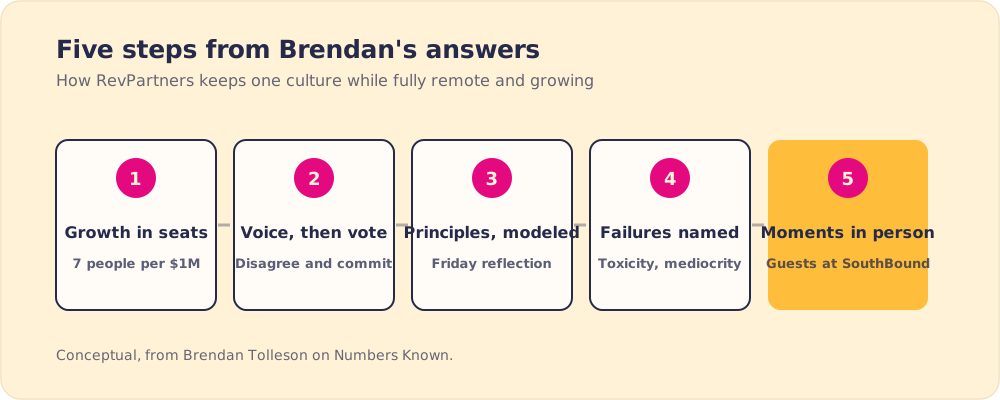
Brendan’s answers line up as five steps a growing firm can copy:
- A growth number in seats. Translate revenue into roles and promotions, as with seven people per $1 million.
- A decision rule. Hear the team, let one person decide, and ask for commitment afterward.
- Written principles the CEO models. “Feedback is to give” and “Fail forward,” plus a weekly reflection from the top.
- Named failure modes. Toxicity and mediocrity give people words to flag drift early.
- In-person moments with a job to do. SouthBound puts a remote team face to face with the buyers it serves, as hosts.
What does Matthew 6:24 have to do with running a company?
Rob’s third number was 624, for Matthew 6:24: “No one can serve two masters.” He asked how Brendan chooses among competing demands, and reminded him that in a 2024 interview Brendan admitted he had often failed at balancing business and family.
He answered with his own story. When RevPartners started, he said, “my wife and I weren’t aligned on the business,” and he now tells would-be founders to settle that first. He frames priorities as what will endure. “There are plenty of people that can run RP or whatever job I have. Like I’m replaceable. In my job I’m not replaceable at home.” He cited former senator Ben Sasse, who said that looking back he would travel far less, and Brendan said he tries not to travel with a 12, 10 and 7-year-old at home.
Rob said Brendan’s advice changes with the person asking, and that AI could learn from that. “Context is very important.”
Brendan Tolleson’s numbers at a glance
- $100 million in ten years. RevPartners is at $15 million and aims for $20 million in three years.
- Seven people per $1 million. Brendan cares about revenue because of the 120 to 140 seats it creates.
- Disagree and commit. The team is heard, the CEO decides, and the team commits.
- Small bets on new services. Clay stayed because it worked, and the service lines that failed were dropped.
- Excellence and care. Brendan names the two failures, toxicity and mediocrity, so people can call them out.
- Priorities that endure. He says someone else could run RevPartners, and no one else can be the dad and husband at home.
What should a founder do next?
If you are adding people faster than your habits can travel, I would start where Brendan does. Write the principles down, send the weekly note yourself and give the team words for how the culture fails. If you grow 25% to 30% a year, as RevPartners plans to, a big share of your company will have joined recently, and they learn the standard from what the leaders repeat every Friday.
Then make the standard show up where people do the work. Supered puts a team’s process in front of each person inside the CRM while they work, which is one way to keep it in reach at 140 people. Our piece on sales accountability goes further into holding a growing team to what it agreed to, and the RevPartners partner profile shows what Brendan’s team does for clients.
Frequently asked questions
What does scaling company culture mean?+
How do you keep culture when a company grows fast?+
What is disagree and commit?+
How many employees does a services company need per $1 million of revenue?+
How does a fully remote company build culture?+
Your process, running itself.
Turn the playbook into rep behavior.
More from Numbers Known

Active Listening in Sales, Taught by a Comedian: Chris Bogue's Improv Rules for Sellers
Chris Bogue
Pipeline Coverage: Diana Marcela Gonzalez's Quarter Math and the Month-Two Check
Diana Marcela Gonzalez