Strategy Execution: Your Strategy Is Probably Fine, Your Execution Is the Gap
When results miss, leaders rewrite the strategy. But research keeps finding that strategies fail in execution, not formulation. The gap is between the plan and the front-line behavior, and that is where to invest.
Strategy execution is the work of turning a plan into front-line behavior and results, and it is where most strategies fail, because the gap is not a flaw in the plan but the distance between the strategy and what people do every day.
A sales team misses its number, and the leadership response is almost automatic: revisit the strategy. Bring in the offsite, redraw the territories, rewrite the plan, relaunch at kickoff. It feels like decisive action, and it usually misses the actual problem, because the strategy was rarely the thing that failed. Decades of research keep arriving at the same uncomfortable finding: strategies fail in execution, not in formulation. The plan was fine. What broke was the distance between the plan and what the front line did on Monday morning. Rewriting a strategy the team was not executing only gives them a new strategy to not execute.
Strategy execution is the work of turning a plan into front-line behavior and results, and it is where most strategies fail, because the gap is not a flaw in the plan but the distance between the strategy and what people do every day. Aim at that gap, and you stop solving the wrong problem.
Why do good strategies fail in execution?
Because execution is a behavior-change problem, and changing behavior is far harder than writing a plan. Donald Sull and colleagues, studying strategy execution across hundreds of companies for Harvard Business Review, found that the conventional wisdom about why execution fails is largely wrong, and that the breakdown happens in the daily coordination and follow-through of the front line, not in the boardroom’s plan (Sull, Homkes and Sull, in Harvard Business Review). A strategy is a set of intentions. Execution is thousands of people changing what they do, and intentions do not automatically become actions. The plan gets communicated in a stirring kickoff, everyone nods, and then the front line returns to its desks and runs deals as before, because nothing in the daily work changed.
This is the knowing-doing gap at organizational scale. The company knows the strategy; the front line does not do it. And the reason is the same: a plan, like a piece of knowledge, does not convert itself into behavior. Communicating the strategy more clearly does not close the gap, because the gap was never a comprehension problem. The team understood the strategy. They kept doing what they had always done, because the strategy lived on a slide and not in the flow of their work.
The scale of the failure is not a rumor; it is one of the most stubborn numbers in management. The figure most often cited, that the majority of strategies never get executed, traces back to Robert Kaplan and David Norton, the Balanced Scorecard authors, who reported that a striking share of organizations fail to execute the strategy they set (Kaplan & Norton, Harvard Business Review). Whatever the exact percentage, the direction has held across two decades of replication: the plan is the part that gets done, and the doing is the part that does not. Sull’s team put a sharper edge on it. Surveying managers, they found that only about half the strategic priorities a company sets are reliably delivered, and that the breakdown is not the dramatic kind leaders imagine, a competitor’s surprise move or a market shift, but the ordinary kind, commitments between teams that never get kept. The gap is not exotic. It is the ordinary friction of getting people to do a new thing when the old thing still works well enough to get through the week.
Why is behavior so much harder to move than a plan? Because a plan is written once, by a few people, in a room, and a behavior has to be re-chosen by hundreds of people, alone, every day, under load. A strategy is a decision made at a single point in time. Execution is that decision re-made thousands of times at the front line, and each re-making competes with habit, with the old comp plan, with the path of least resistance, with the deadline already on the calendar. The plan does not have to fight anything to exist on the slide. The behavior has to win a small contest against inertia every time a rep opens a deal, and inertia is undefeated until something changes the cost of the new action in the moment it is needed.
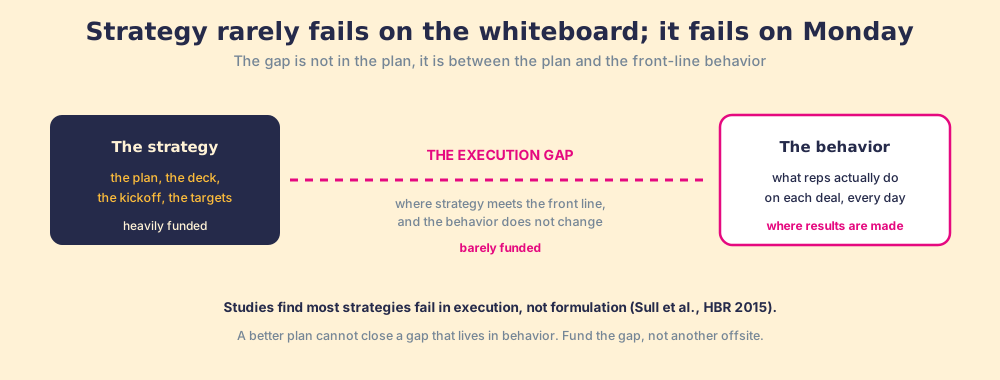
Why does rewriting the strategy not help?
Because a better plan cannot close a gap that lives in behavior, and the gap is the same regardless of which plan sits above it. If the front line is not executing the current strategy, the problem is not the content of the strategy; it is the conversion of any strategy into action. Hand the team a brand-new, better plan and you have changed the thing they are not executing, not the fact that they are not executing it. The energy goes into the most visible and satisfying activity, planning, while the harder gap, getting the behavior to change, stays unfunded.
There is a name for this misallocation, and it comes from psychology, not strategy. Daniel Kahneman called it the planning fallacy: we systematically overweight the part of a project we can see and narrate (the plan, the timeline, the best case) and underweight the messy frictions that actually determine the outcome (Kahneman, on the planning fallacy). A strategy offsite is the planning fallacy as an annual ritual. The plan is vivid, satisfying, and inside our control, so it gets the budget and the attention. The execution, the part that lives in other people’s daily friction, is invisible from the boardroom, so it gets a kickoff slide and a hope. We fund the part we can picture and starve the part that decides the result, and then we are surprised by the result.
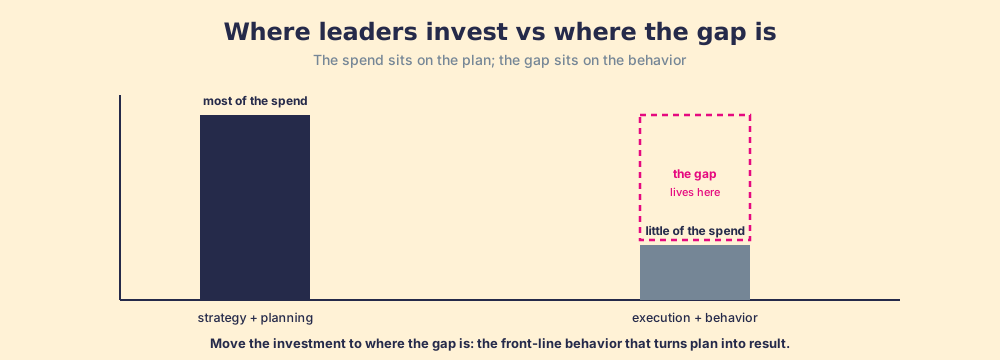
Look at where the investment lands and the gap is stark. The strategy gets the offsite, the consultants, the kickoff, the dashboards. The execution gap, the unglamorous work of changing what people do daily, gets a memo and a hope. The money is on the plan; the gap is on the behavior; and the two are in different places.
- The plan is over-invested. Offsites, decks, and kickoffs absorb the budget and attention, because planning is visible and feels like progress.
- The gap is under-invested. Changing daily front-line behavior is hard and unglamorous, so it gets a launch event and little else.
- Results live on the behavior side. The plan produces nothing until the behavior changes, so the unfunded gap is exactly where the value is.
Why does strategy execution fail even when everyone agrees with the plan?
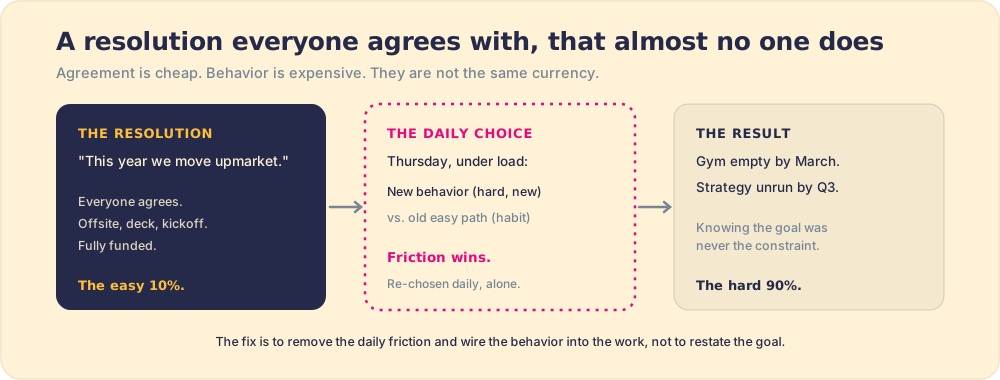
This is the part that confounds leaders most, and it is the heart of why strategy execution fails so reliably, so it is worth sitting with. The strategy is sound, the team nods along, nobody objects, and still nothing changes. The reason is that agreement is cheap and behavior is expensive, and they are not the same currency. A rep can wholeheartedly believe the team should move upmarket and still take the easy mid-market meeting already on the calendar, because the new behavior was never made the path of least resistance in the moment the choice arrived.
Think of it like a New Year’s resolution. The strategy is the resolution: “this year I will get fit.” The agreement is total; nobody resolves to a goal they disagree with. And the gym is busy in January and empty by March, not because anyone changed their mind about being fit, but because the resolution lived in intention and never got wired into the day. Behavioral scientists Katherine Milkman and colleagues, studying tens of thousands of gym-goers, found that the levers that actually built the habit were the ones that lowered friction and attached the new action to an existing routine, not the ones that raised motivation or restated the goal (Milkman et al., on habit formation, PNAS). Knowing the goal was never the constraint. The strategy execution gap is a resolution gap at company scale: a thing everyone wants, nobody opposes, and almost no one does, because wanting it was always the easy 10 percent.
Of course, the picture is not perfect. A genuinely wrong strategy exists, and no amount of execution will save it; you cannot out-execute driving toward a cliff. But that is the rarer failure, and it has a tell: if the few teams who truly run the strategy still lose, the plan is the problem. Far more often, no team is running it at all, and the leader is debating the map while the convoy sits parked. Before rewriting, find out whether anyone has driven the current road. Usually no one has.
How do you close the strategy-execution gap?
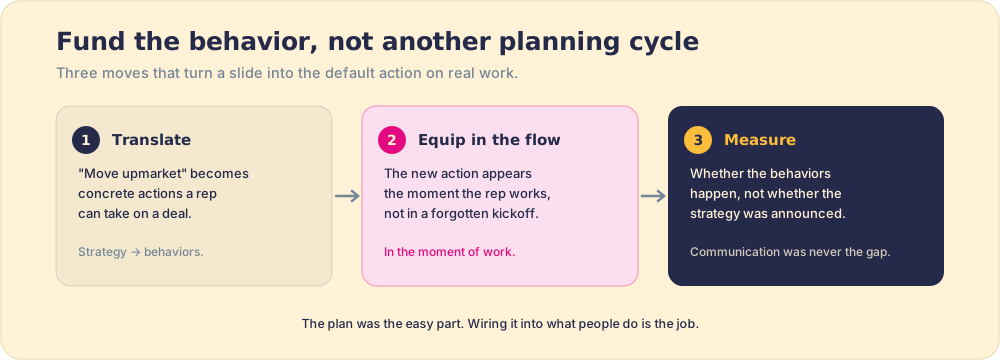
Fund the behavior change, not another planning cycle. Executing strategy is the work of turning intention into action at the front line, and it is a different discipline from planning, with its own tools and its own scoreboard. Translate the strategy into the specific behaviors it requires, so “move upmarket” becomes a concrete set of actions a rep can take on a deal. Equip those behaviors in the flow of work, so the new action appears at the moment the rep is working, not in a kickoff they will forget. And measure whether the behaviors happen, not whether the strategy was communicated, because communication was never the gap. This is the loop in sales process adoption and sales performance management, applied to strategy: the strategy is the standard, and execution is making the standard the default behavior on real work. The plan was the easy part. Wiring it into what people do is the job.
What we recommend
When the number misses, resist the urge to rewrite the strategy, because the strategy is rarely what failed. The research is consistent: strategies break in execution, not formulation, and execution is a behavior-change problem that no replanning addresses. A better plan handed to a team that was not executing the last one merely changes the thing they are not doing. So put the diagnostic question first: are people doing the behaviors the strategy requires? If not, the gap is execution, and the work is to translate the strategy into specific front-line behaviors, equip those behaviors in the flow of work, and measure whether they happen. The reason this beats another offsite is that it funds the gap where strategies truly die, the distance between the plan and the daily action, instead of pouring more money into the plan that was already fine. Your strategy is probably good enough. Your execution is the gap.
From here: the same gap at the individual level in the knowing-doing gap, the discipline that closes it in sales process adoption, the management loop in sales performance management, and the wider frame in the sales execution gap.
Frequently asked questions
What is strategy execution?+
Why do strategies fail in execution?+
How do you close the strategy-execution gap?+
Is the problem usually the strategy or the execution?+
Your process, running itself.