Moving Upmarket: Sam McCann's Three Moves From a Stalled Sales Floor to the Mid-Market
Sam McCann watched cold calling stop working, started All Demand with his wife Eva, and grew it to about eight people in 18 months. Now they are moving upmarket. Here is how he got there and what he learned.
Moving upmarket is the shift from selling to small businesses to winning larger, more complex mid-market clients, which for a services firm means a pipeline beyond the founders' network, a team that delivers without the founders, and offers built for bigger buyers.
The meeting where Sam McCann gave up on the old sales playbook was an ordinary one. He was head of sales for a tech company scaling across Australia and New Zealand, running the outbound system that had worked for him at every job. He asked a rep how the day had gone. Pretty good, the rep said. He had spoken to two people.
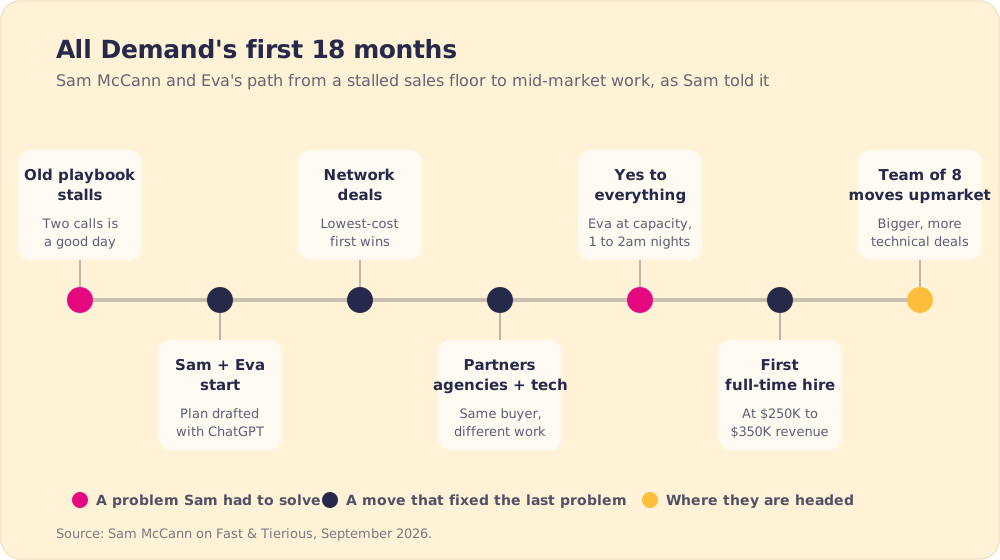
Sam remembers thinking “we have a problem.” About 18 months ago he and his wife Eva started All Demand, a New Zealand HubSpot agency. The team is now about eight people, they reached Platinum along the way, and they are moving upmarket into the Australian and New Zealand mid-market. Sam told me how they got here on Fast & Tierious, including the months when he and Eva worked until two in the morning.
Three decisions from that conversation are worth stealing if you run a young agency: where to find clients once friends and former colleagues have all bought, when to make the first full-time hire, and how to get a team delivering the way the founders do.
Why did Sam McCann bet on himself when the old playbook stopped working?
Sam had built sales teams for other people his whole career. The method was familiar. Pick a sector, load a big list, blast it, and count on the volume to produce meetings. Then the meetings stopped coming. He made tweaks for a couple of months while the conversation counts kept falling.
“That was kind of my first challenge in life where I wasn’t winning how I’d always won,” Sam said. “So I went deep, mate. I went deep.” He started calling operators in America, where revenue operations was an established job, and came away convinced that New Zealand companies had little of that skill in-house.
His rep was not imagining the empty phone lines. In Gartner’s survey of 646 B2B buyers, run in August and September 2025, 67% said they prefer to buy without talking to a rep at all (Gartner, 2026).
Sam had also been putting money into other people’s companies. “I want to keep my resources close to me and bet on myself,” he said. Eva had spent seven or eight years as a fractional HubSpot leader, so the two of them sat down with ChatGPT and asked what a business built on both their skills might look like. It suggested a RevOps agency. They are “all deep on Claude now,” Sam added.
I asked what it is like to start a company with the person you are raising children with. He laughed. “It’s not for every man and wife, that’s for sure.”
All Demand now does that RevOps work for companies stuck where Sam’s team was, with good lists and buyers who would not pick up.
What do you do when your network runs out?
A new agency sells to people who already trust its founders first, and Sam makes no apology for it. “You’re always going to go network first because that’s kind of your lowest CAC,” he said. CAC is customer acquisition cost, and a warm intro costs close to nothing.
The trouble comes a few deals in. Sam described the first wins as awesome, and then the realization that “we need five of these things” from strangers, for something as hard to picture as a CRM rebuild.
He turned to partnerships. He did “deep research on like who doesn’t do what we do, but is kind of talking to that same ICP,” meaning the same ideal customer, and signed agreements with those agencies. He also got close to software vendors whose products pair with HubSpot. “We try and scratch their back and they scratch ours with leads and introductions,” he said. I told Sam that RevPartners grew the same way. We did partners first and marketing much later.
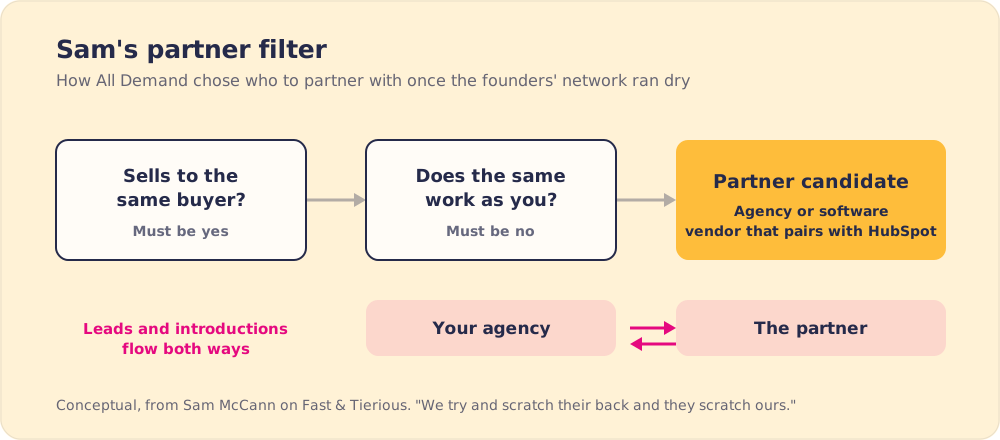
Crossbeam has numbers on this. It looked at thousands of companies on its network that had win-rate data both with and without partners, and found win rates rose 11.7% on average when a partner was involved in the deal (Crossbeam, 2024). A buyer who already trusts the other agency extends some of that trust to the firm it recommends.
To copy Sam, write down the firms that sell to your exact buyer and do none of your work. Call them before you spend a dollar on ads, and send them introductions before you ask for any.
When should an agency make its first full-time hire?
The partners sent work, and All Demand said yes to nearly all of it: SaaS, professional services, manufacturing, health tech. “We’re so afraid of saying no to anything because we don’t know what’s around the corner after that,” Sam said. He thinks niching early is a luxury a new firm cannot afford. “You can’t be picky at the start like you have to just like embrace everything you get and be passionate about it.”
Eva ran out of hours first. She runs delivery, and she and Sam were soon working until one or two in the morning, because a new firm does not want to let a single client down. They tried contractors. By Sam’s account, the two of them could not have kept that pace much longer.
So they hired a full-time HubSpot and project manager, someone who already knew their systems, when revenue was somewhere between $250K and $350K. Sam did not pretend it was cheap. Expect “losing some margin and making less money yourself,” he said, and “you got to think long term and big picture.”
On the episode I gave my own rough rule from the early RevPartners days: about $100K to $150K of revenue per person, and the next hire will always feel unaffordable. Mature firms run higher. SPI Research’s 2026 benchmark of more than 500 professional services firms reports $168K of revenue per employee and $210K per billable consultant (Deltek summary of the SPI 2026 benchmark). Agencies move toward those figures as their delivery gets repeatable, and repeatable delivery is the work Sam is on now.
He waited until the late nights were routine, which told him the demand would hold, and he paid for the hire out of his own margin.
What does moving upmarket take for a services firm?
With a trained team and steady deals, All Demand is going after bigger clients. Part of Sam’s reason is credibility: “as you want to go up from SMB to the midmarket, you’re taken more seriously.” Part is taste. He and Eva like complex projects.
He named two obstacles. One is the team. “We are who our people are,” Sam said. Today the method lives with him, Eva and one senior leader, and the job is to pass it on so a newer consultant delivers the way a founder would.
Our survey data suggests why that gets harder with each hire. In The State of Sales Enablement 2026, 47% of teams where a manager oversees one to five people reported high process adherence; at six to eight people, it fell to 23% (The State of Sales Enablement 2026). A founder can watch over five people. Fifteen is too many to watch that way, so the method has to be written down and built into the tools the team already uses. Our guide to standard work covers how to turn one expert’s habits into a team’s default.
The other obstacle is proof. Sam called it “showcasing that capability to the market,” which is hard when the whole team is busy delivering. His answer is to package new offers. All Demand is testing Claude Code rollouts inside client businesses, list building based on buying signals, and ABM campaigns run with LinkedIn tools. “HubSpot is our core and it always will be,” he said. He calls the HubSpot work and the new services two sides of the coin.
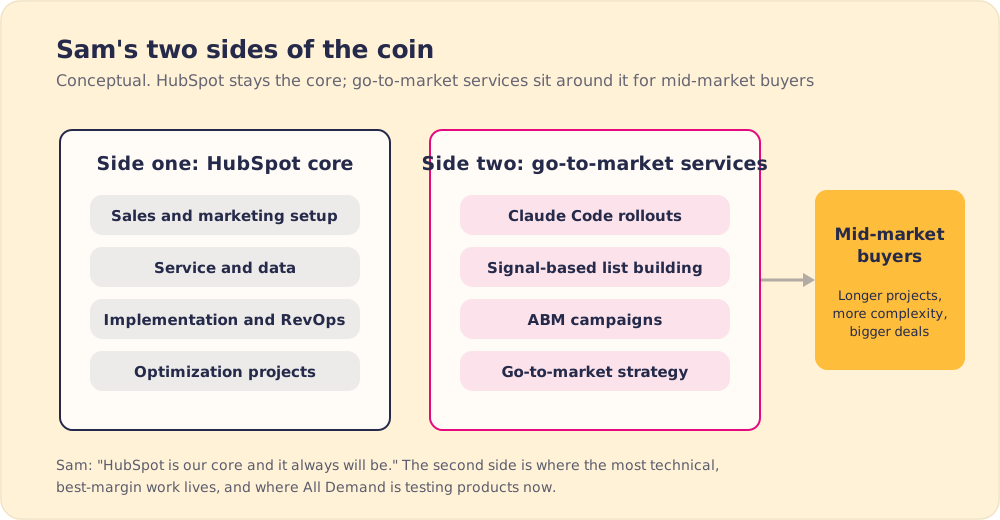
I told Sam I think list building is the most technical job in go-to-market right now: finding the right person at the right time, with a real signal behind the message. He agreed, with a warning. Master the work yourself before you sell it to anyone else.
I asked what he wants to be celebrating a year from now. He wants All Demand to own the mid-market of Australia and New Zealand, and he put the plan in five words: “let’s get the bigger deals.”

What Sam McCann learned growing All Demand
- A stalled sales floor. Sam’s reps could not get buyers on the phone, and he went looking for why. What he found in American RevOps teams became All Demand’s offer.
- Partners who sell to your buyer. Friends and former colleagues are the cheapest first clients and run out fast. Sam replaced them with agencies and software vendors that serve the same customer, and he sends them leads in return.
- A first hire paid for with margin. All Demand hired full-time at $250K to $350K in revenue, after contractors, and the founders took home less for a while.
- A method the whole team can run. “We are who our people are.” Mid-market clients will judge All Demand by its newest consultant, so the founders’ way of working has to be written down and taught.
- HubSpot plus the technical work around it. HubSpot stays at the center. List building, Claude Code rollouts and ABM sit beside it, and Sam wants to master each one before selling it.
What should an agency owner do next?
If your calendar is full and your network is spent, we would follow Sam’s order. Line up partners before paying for marketing, since Crossbeam measured an 11.7% win-rate lift when partners join a deal. Hire full-time once the late nights stop being the exception, and pay for it with margin. Then write down how the founders deliver, while the team is still small enough for them to check the work themselves.
If you run a HubSpot agency on this path, our partner program is built for firms turning their delivery into repeatable offers, and Supered puts that method in front of each consultant and client rep inside the CRM while they work. For the offer most agencies package first, read our guide to HubSpot implementation next.
Frequently asked questions
What does moving upmarket mean for an agency?+
How do you win agency clients outside your network?+
When should an agency make its first full-time hire?+
What revenue per employee should a services firm target?+
Why is moving upmarket hard for a small agency?+
Your process, running itself.
Turn the playbook into rep behavior.
More from Fast & Tierious

Agency Retainer Model: Why Sean Towson Is Moving Ziply From Hourly Projects to Retainers
Sean Towson
Performance-Based Pricing: Why Matthew Kay Puts Coleman Rose's Fee on the Line
Matthew Kay