Performance-Based Pricing: Why Matthew Kay Puts Coleman Rose's Fee on the Line
Matthew Kay named his agency after his children and ties part of its fee to client results. Why performance-based pricing shapes how Coleman Rose works, finds clients and keeps them.
Performance-based pricing is a fee structure where part of what a client pays depends on an agreed, measured result, such as qualified pipeline or closed revenue, so the provider earns more when the work produces the outcome and less when it does not.
Matthew Kay has wanted a business of his own since he was a teenager. His dad ran businesses, and his brother runs one now. Out of university he took a job in a sales call center, hated it, and quit after four days. He taught himself web development, first by hand in Dreamweaver and then in Joomla, and freelanced for a couple of years. When he felt his career had stalled, he took a job with a plan: two years at an agency, two years in-house, then back out on his own.
“I ended up 11 years into a 4-year journey,” he said.
His chance came at the back end of 2023, when the company he worked for had a bad year and he left with some money in his pocket. He started Coleman Rose, a four-person HubSpot agency in the UK named after the middle names of his two children, and it reached Platinum this year. Its contracts use performance-based pricing: the agency is paid more when a client’s pipeline grows and less when it does not.
He walked me through how he got there on Fast & Tierious. Three of his ideas are worth taking home to any agency: why part of the fee should ride on results, how a four-person shop keeps a pipeline when up to 95% of buyers are not shopping, and why keeping clients is the growth plan.
Why does Matthew Kay put his fee on the line?
Matthew says Coleman Rose exists for two reasons. The first is client growth. “That’s why we do performance-based contracts,” he said. If the agency is not generating pipeline and helping it turn into closed-won business, “what’s the point, right?”
The second is a life outside the nine-to-five, for him and for the people who work with him. He keeps the stakes in proportion. “What we do is not open heart surgery,” he said. “It’s just marketing. It’s just sales.”
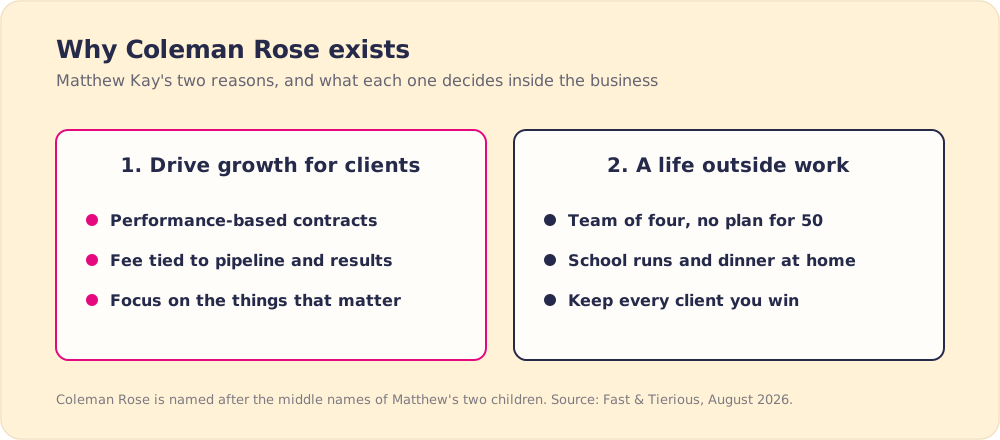
He prices on performance, he said, “to encourage the right behaviors, to focus on the things that matter.” If a slice of the fee depends on qualified pipeline, his team spends its week on the work that creates qualified pipeline.
He also needs a way to stand apart. There are over 100,000 agencies in North America and over 7,000 in the UK, by his count. “It’s a commodity. So, you have to find a way to try and differentiate.” He places Coleman Rose somewhere between an agency and a consultancy. “Agencies typically do more hands-on stuff,” he said, while consultancies “give you the frameworks and templates, but it’s up to you to execute.” Some of what his clients need, such as SDR outreach, his team does not do for them, so he ties the fee to the part of the result his team does produce.
Buyers are asking for this. When Intercom researched how to price its Fin sales agent, “zero buyers preferred paying for activity. They wanted to pay for results” (Intercom, 2026).
Is performance-based pricing as hard to run as it sounds?
Matthew says no. “It’s probably not as operationally hard as you think it is,” he said. “I would say it’s more of a mental thing to get over.” In his opinion, “it’s the right thing to do.”
What makes it feel hard is the risk. An agency on performance terms is betting on a result it only partly controls, so the first job is to pick which result the fee depends on. Intercom’s pricing team had to make that choice when it built outcome-based pricing for Fin. It charges “$10 per qualified lead,” and the customer decides what qualified means. It chose not to charge on closed deals, because “between the moment Fin qualifies a lead and the moment a deal closes, dozens of things can impact the final result.”
Economists worked on this problem long before software companies did. Bengt Holmström shared the 2016 Nobel Prize in economics partly for his work on incentive contracts, which showed that pay should rest on measures that tell you something about the agent’s own effort (Nobel Prize, 2016). For an agency, qualified pipeline mostly reflects its own work. Closed revenue also depends on how the client’s reps run each deal after the handoff.
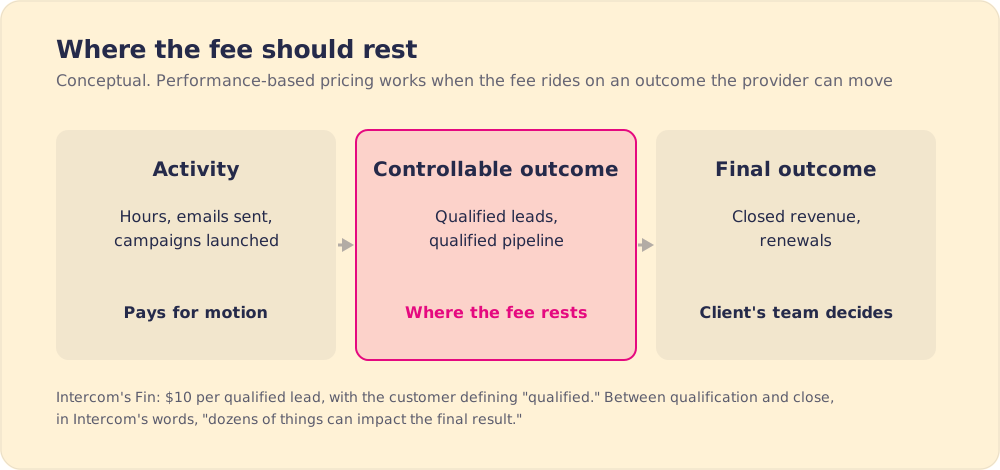
The definition of qualified has to be written down before any money depends on it. Sales teams already struggle here: in The State of Sales Enablement 2026, 16% of respondents named qualification as the phase where their deals break down most often (The State of Sales Enablement 2026). Our guide to lead qualification covers how to agree on the definition with a client.
How do you keep a pipeline full when 95% of buyers are not buying?
In nearly 15 years of working life, Matthew has found two things hardest: pipeline and people. On pipeline, he does not expect a fix. “We’ll probably never get over that hump,” he said. “We are a commodity.”
He plans around the 95:5 rule. “Only 5% of your audience are ever in market to buy at any one time,” he said. “You can’t control when they go from the 95 into the five, so you just got to be present so that you’re one of the people they think of when they do.” The rule comes from John Dawes of the Ehrenberg-Bass Institute, who found that up to 95% of firms are out of the market for a given service at any one time (John Dawes, 2021).
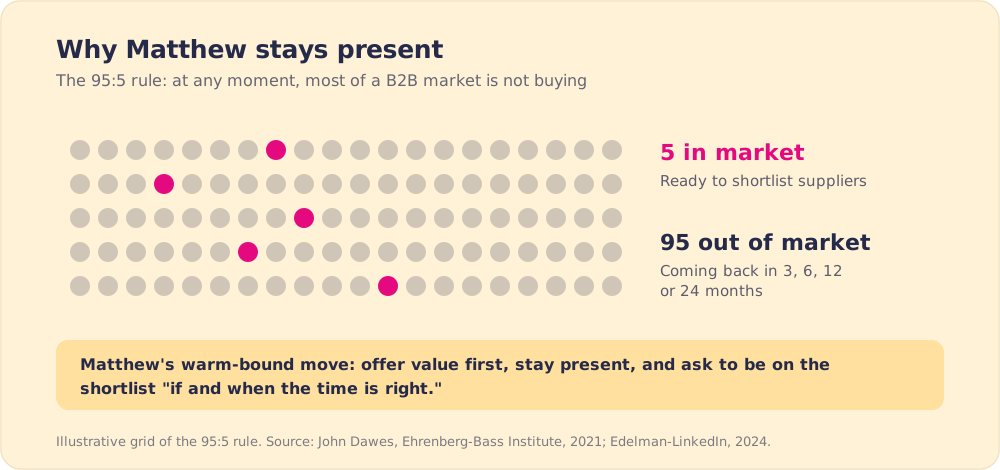
He calls his method warm-bound, and admits he does not love the phrase. He builds relationships and networks, asks for introductions, and offers something useful first. Then, “when the timing’s right,” he asks how Coleman Rose can “get on the short list of potential suppliers if and when the time is right.” Some prospects say they are fine for now and come back in three months. Others come back in two years. Some months are slow, and then a message he sent four months earlier turns into a project.
He keeps two habits that let a four-person team do this. He balances his own time between delivery and new business, and he does not expect that to stop. I have watched agency founders stop lead generation to focus on delivery, and it turns into a vicious cycle. He also shares the load. Two of his three hires are senior people, “it’s not their first rodeo,” and some of the new-business campaigns are theirs to run.
He posts on LinkedIn three times a week. Edelman and LinkedIn’s 2024 study of 3,500 B2B decision-makers found that 73% trust a company’s thought leadership more than its marketing materials when judging what the company can do (Edelman, 2024).
Why is client retention Matthew’s growth plan?
I agreed with this part of the conversation more than any other. “In my opinion, the actual biggest growth driver typically is client retention,” he said. About 90% of Coleman Rose’s contracts are retained. “Our number one priority should be and is delivering on them because if you never lose a client, you’ll grow. Because you’ll get referrals and you’ll get introductions.”
Bain & Company has made the same case for decades: raising retention by as little as 5% can lift profits by as much as 95% (Bain & Company, 2006). For an agency that finds new clients through introductions, a kept client also keeps sending them.
When I asked for his one big goal for the next 12 months, he said: not to lose a single client. I asked whether that was realistic. “I think that a goal should be deliberately hard,” he said. Coleman Rose did lose one in June, for reasons outside its control, and within a week or two that client left a glowing review on its Google Business page.

Keeping clients also keeps the company small enough for his second reason. He has no plans to build a 50- or 100-person firm. “I do school runs,” he said. Before his first child was born, a group of men in their 50s and 60s told him the one thing they would change if they could go back: work less when their kids were young. He took the advice. It still costs him. On the morning we recorded, the children’s summer care fell through and he rearranged his day to collect them. “It’s stressful at times,” he said, “but I think the payoff is worth it.”
His hiring lesson came from earlier jobs. When someone is not working out, “don’t be afraid to make the difficult decision,” he said, because it often helps the person as much as the company.
What Matthew Kay has learned about pricing and growth
- A fee tied to the reason the agency exists. Coleman Rose is there to grow its clients, so part of its fee rides on growth, and the team works on what moves it.
- A result the agency can move. The variable fee belongs on a measure the agency controls, such as qualified pipeline, with the definition agreed in writing.
- Warm-bound pipeline. With up to 95% of buyers out of market, Matthew offers value first, stays in touch, and asks for a place on the shortlist when the buyer is ready.
- Retention as the growth plan. About 90% of contracts are retained, and the goal for the next 12 months is to lose none.
- A company sized for a life. Four people, school runs, and no plan for a 100-person firm.
Should your agency try performance-based pricing?
An agency weighing this has three real options. It can stay on hours and bill for effort. It can tie the whole fee to closed revenue and take on the risk of the client’s sales team. Or it can do what Matthew does: tie part of the fee to a result the agency moves, keep warm-bound outreach running in the busy months, and deliver so well that clients stay and refer.
Take Matthew’s version. Put the variable fee on qualified pipeline, as Intercom’s pricing research and Holmström’s contract theory both suggest, and write the definition into the contract. Then help the client work the leads you hand over, since a lead that stalls in their pipeline still looks like a failure to them. Our guide to running a pipeline review is a good way to start that conversation.
If your agency sells HubSpot and wants to package that follow-through, our partner program is built for it. Supered is one way to put a client’s sales process in front of their reps while they work the leads you generate.
Frequently asked questions
What is performance-based pricing?+
Who does performance-based pricing work for?+
Is performance-based pricing hard to run?+
What is the difference between performance-based and outcome-based pricing?+
What is the 95:5 rule in B2B marketing?+
Your process, running itself.
Turn the playbook into rep behavior.
More from Fast & Tierious

Moving Upmarket: Sam McCann's Three Moves From a Stalled Sales Floor to the Mid-Market
Sam McCann
Agency Retainer Model: Why Sean Towson Is Moving Ziply From Hourly Projects to Retainers
Sean Towson