Agency Retainer Model: Why Sean Towson Is Moving Ziply From Hourly Projects to Retainers
Sean Towson started Ziply at NZ$100 an hour and said yes to almost everyone. A year later he scopes implementations at NZ$10,000 to NZ$15,000, hires senior people, and is building retainers.
An agency retainer model bills clients a recurring monthly fee for ongoing work instead of charging by the hour or by project; Sean Towson of Ziply is moving toward one after a year of hourly and scoped projects, so his team can learn each client's business over time.
Sean Towson grew up in Ireland at a time when, as he put it, “there was like no real opportunities back home.” He did unpaid internships, left to travel, and got his first real job in New Zealand, doing email and marketing automation for an e-commerce company. He moved to a HubSpot partner agency, took consulting work on the side, and about a year ago turned the side work into Ziply, his own HubSpot agency. Ziply reached Platinum inside its first year.
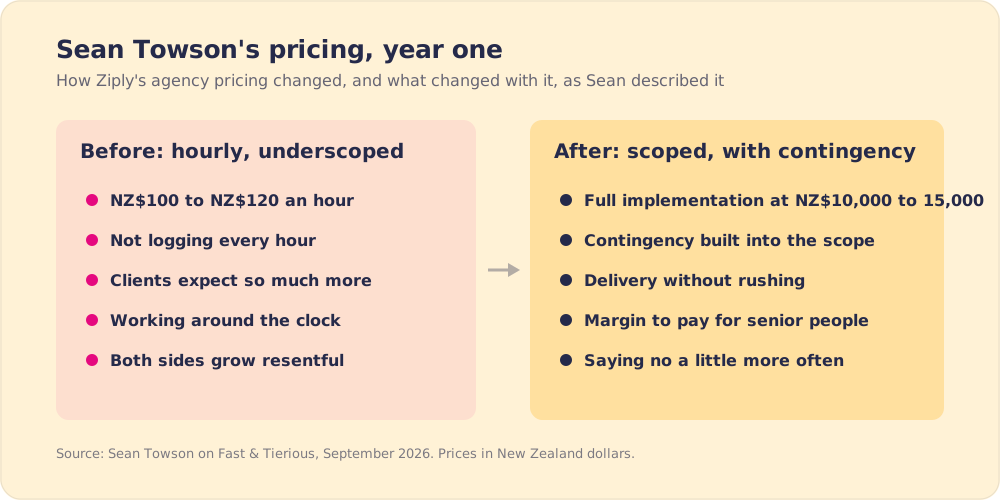
When Sean came on Fast & Tierious to tell the story of that year, he kept coming back to pricing, and to the agency retainer model he is building now. He started at about NZ$100 to NZ$120 an hour, did not log every hour, and scoped too little into nearly every project. The clients who paid the least asked for the most.
He named three hurdles from year one: pricing, going without a mentor, and finding people. In his telling they hang together. What he charged decided which clients came in and which people he could afford, and those people decided how much of his week he could spend growing Ziply instead of delivering its projects.
Why does cheap agency pricing attract the wrong clients?
Sean did not set out to build a big company. “I always wanted to run my own thing and I always felt like I wanted to be my own boss,” he said. He wanted flexibility. What he got in the first year was “very little balance.”
Work came quickly. New Zealand is small, and Sean described it as a little village where word of mouth carries. Businesses there wanted HubSpot help from people who were “genuine and transparent,” and “all of my growth has been referrals.” He said yes to the work and left his rate where it started.
Some of that was nerves. A HubSpot implementation has no price tag you can look up, and early on “you’re going to have that imposter syndrome and like feel like a fraud at the beginning.” So he billed by the hour, left hours off the invoice, and scoped low.
He paid for it in the clients he attracted. “I think one thing is it just attracts the wrong type of clients,” Sean said. “You feel like you’ve been taken along for a ride.” He calls himself a people pleaser, so he went the extra mile and expected clients to notice. They noticed less than he hoped: “they actually just almost devalue it when you treat it that way, I feel. And they expect so much more.” Both sides ended up resentful of each other. “You’re working around the clock.”
I told him on the show that the people who want cheap tend to have the highest demands, and he laughed and said it was so weird. In a 2008 Caltech experiment published in PNAS, 20 volunteers liked the same wine more when it carried a $90 tag than a $10 tag, and brain scans showed more activity in a region tied to experienced pleasure (Caltech, 2008).
The advice I gave him on air was short: “Charge more, get better clients.” Sean said he wished someone had told him that at the start.
What changes when an agency prices the scope instead of the hour?
Today Ziply prices a full implementation at NZ$10,000 to NZ$15,000, and Sean is still working out how to present value-based packages on the new website. Some work will stay custom. The bigger change is what he puts inside the price: “having enough contingency in there to allow us to actually deliver the project without everything feeling rushed.” The team is less stressed, he says, and he has started saying no to work that does not fit.
The margin is where the change shows up. McKinsey’s pricing team worked through the average income statement of the S&P 1500 and found that a price rise of 1%, with volume steady, would lift operating profit by 8% (McKinsey, The power of pricing). On the episode I put it in agency terms: “at some point you have to have enough margin so you can eventually hire other people to help you work.” For a five-person shop, a few points of price can decide whether a senior specialist joins this year or the founder keeps doing the work.
If your agency still bills by the hour, scope the outcome and put contingency in on purpose, as Sean did. Our guide to HubSpot implementation shows how smaller partners package that first project.
Why does a founder need a sounding board?
Sean’s second hurdle was doing it alone. He had plenty of unsolicited advice and no real guide. “There’s no real blueprint for doing this, especially with the complex business model like a HubSpot partner,” he said.
Three or four months in, he hit what he calls the awkward phase. The thrill of launching wore off and he realized “this is kind of lonely and this is like not exciting at all and this is actually kind of stressful.” So he started asking other agency owners out for coffee. They were generous with their time, and he “bombarded them with questions about every aspect,” from accounting to operations. He said the coffees felt like therapy.
His advice to anyone starting out is to find a coach, a mentor or a partner, “even if it’s just a sounding board, like it doesn’t have to be like a wise guru.” I have never started a business by myself. At Supered I have Steve, and when I tell him what I want to charge, he asks why I don’t double it.
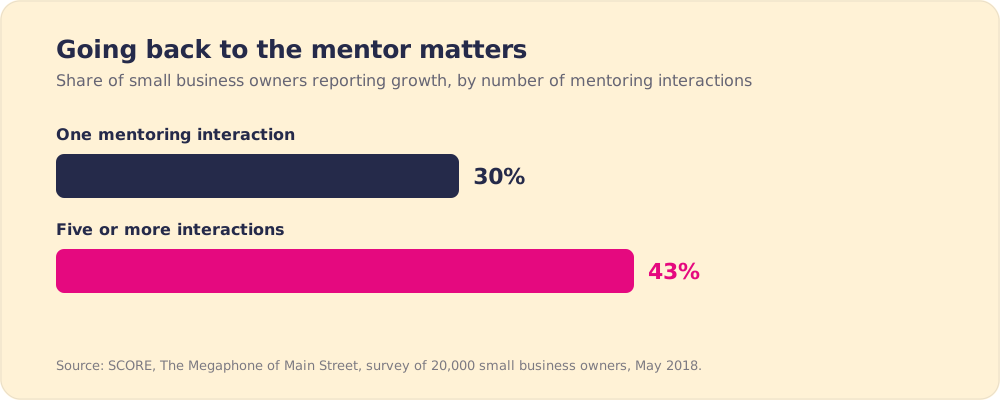
The research favors going back more than once. In SCORE’s survey of 20,000 small business owners, 30% of those with a single mentoring interaction reported growth, against 43% of those who met a mentor five or more times (SCORE, 2018).
Who should a small agency hire first?
The third hurdle was people, and New Zealand made it harder. HubSpot specialists are “thin on the ground” there, and plenty of candidates talk a good game in the interview. Sean wanted someone who “knows it deeply” and can also talk to a client about their business.
Early on he hired someone fresh out of university, planning to train them. “I realized I’ve actually got no time and this is actually really stressful.” He came out of it sure of one thing: “because you’re not a big team you’re not going to be able to get a junior in there and train them up. You just need like ready-made talent and you know that comes at a premium.” Today Ziply has two senior HubSpot specialists in Auckland, each with more than five years of experience, plus a VA, an outside marketing agency and a delivery manager about to start.
I had the same lesson at the start of my own companies. A new hire at a young agency gets almost no onboarding, so “it’s probably a better idea at the beginning to bring in someone senior,” I told Sean, “because you’re going to throw them at a wall.” He laughed. His onboarding, he said, was “let’s work on this project together and just see how it goes.”
“It’s a service-based business so the people is everything,” Sean said, and “I’ve noticed a distinct bump or growth in the business every time I’ve brought on that really good talent.” Each hire took delivery work off his plate. The delivery manager will take the project management too, so Sean can spend his days on the commercial side of Ziply.
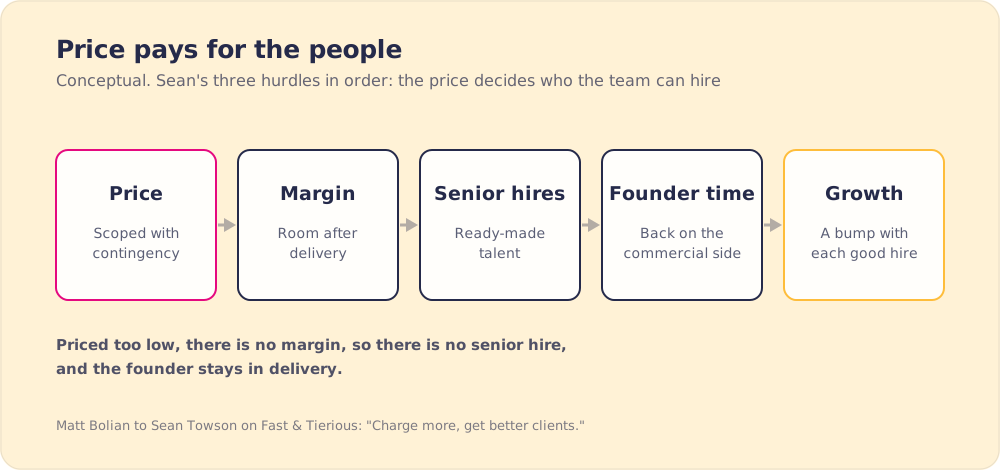
Sean tied the hiring back to price himself. You have to be “priced so that you can actually bring them on and not be resentful of them as well.” A senior specialist’s salary does not fit inside NZ$100 an hour.
Why is Sean moving Ziply to an agency retainer model?
Referrals built Ziply, but “I don’t feel like that’s what’s going to get us to the next step,” Sean said. This year he wants leads that arrive on a schedule: a new website to replace the Squarespace site he built himself in a weekend, a batch of case studies, and some ads.
He also wants recurring revenue. Ziply’s income leans toward projects, and his reason for changing that has as much to do with the client as with his books. In an 8-week project, he said, it is hard to understand a business, and in a longer relationship “everything becomes a little bit more stickier.”
Plenty of agencies want the same. In SparkToro’s State of Digital Agencies survey for 2025, 85% of agencies said they prefer to work on retainer, and 25% said their typical client stays less than 12 months (SparkToro, 2026).
What goes into a retainer when clients want to do it themselves?
Sean has not settled what a retainer for HubSpot clients should hold, and he was open about the reason. “A lot of the clients just want us to set them up and enable them so that they can do it themselves.” A client trained well needs the agency less, so the monthly fee has to cover something worth paying for after the training ends.
What he said on the show already fixes a few parts of his model:
- The project as the way in. Clients start with Ziply through the scoped NZ$10,000 to NZ$15,000 implementation. The retainer is what he wants to follow it.
- Time to learn the business. That is what a longer engagement buys that eight weeks cannot, and why he expects clients to stay.
- A team size that sets the client count. Sean wants 10 to 12 all-rounders, because at 30 or 40 people he expects capacity planning to become “a little bit of a nightmare.” He wants to be “a very partnership-focused agency.”
We would add one thing from his project pricing. Build the same contingency into the monthly fee, so a busy month does not turn into the round-the-clock weeks Sean had in year one. Our guide to client onboarding covers the first 90 days with a new client.

Sean Towson’s lessons from year one
- Price as a client filter. Underpricing drew clients who valued the work less and demanded more. A scoped price with contingency drew better ones.
- Contingency on purpose. Ziply’s NZ$10,000 to NZ$15,000 implementations include room to deliver without rushing.
- A sounding board, early. There is no blueprint for a HubSpot partner business, so Sean asked agency owners who had already built one.
- Ready-made talent over trainees. A small team has no time to train juniors. Senior hires cost more, and Sean saw growth each time one started.
- Retainers for the long game. Sean is building a recurring base, sized to a small senior team, and a lead flow that does not depend on referrals.
What should an agency owner change first?
We would follow Sean’s order. He fixed price first, because nothing else works until the margin exists. The senior hires came next, since NZ$100 an hour could never cover them. The retainer model comes last for him, because a retainer is only as good as the team delivering it, and he now has that team.
Sean paid for this lesson with a year of long hours. If you still bill by the hour, you can have it from him for the price of reading this.
Agencies that want a retainer to include something clients use every day can look at our partner program. Supered keeps a client’s sales process in front of their reps inside HubSpot long after go-live. For the project that usually comes first, read our guide to HubSpot implementation.
Frequently asked questions
How should a new agency set its pricing?+
Why do low prices attract difficult clients?+
What is an agency retainer model?+
Should an agency charge by the hour or by retainer?+
What should an agency retainer include when clients want to self-serve?+
Your process, running itself.
Turn the playbook into rep behavior.
More from Fast & Tierious

Moving Upmarket: Sam McCann's Three Moves From a Stalled Sales Floor to the Mid-Market
Sam McCann
Performance-Based Pricing: Why Matthew Kay Puts Coleman Rose's Fee on the Line
Matthew Kay