HubSpot Freelancer to 16-Person Firm: Adam Sand's Road Rules
Adam Sand went from roofer to HubSpot freelancer to a 16-person firm, selling from the passenger seat of a truck. His rules: charge for the outcome, screen clients for adoption, and get paid to fix what you built.
A HubSpot freelancer is an independent consultant who configures, migrates, or runs HubSpot for clients, usually billed by the hour or the project, often working solo or with a small bench.
For 17 months, Adam Sand sold HubSpot to roofers from the passenger seat of a Yukon. His fiancée drove, a 150-pound dog took up the back, and the firm’s production calendar was the drive time between states. If a roofer in New York signed for June, Adam needed a buyer somewhere near South Carolina in May. Some nights they pulled over and slept on the shoulder because the hotel would not check them in until two. He got engaged on that road, married on it, and, as he put it, “got pregnant on the road.”
He began as a HubSpot freelancer in the plainest sense, one man fixing roofers’ CRMs. By the time he sat down with me for the first episode of Fast & Tierious, his firm, Roofing Business Partner, had 16 employees, builds of $150,000 to $300,000, and retainers up to $20,000 a month. It had reached Diamond 22 months after its first deal. A solo consultant can take a few of his habits into the next discovery call: price the owner’s outcome, find out whether the client’s people want the change before signing, and sell the upkeep that growth creates.
How did a roofer become a HubSpot freelancer?
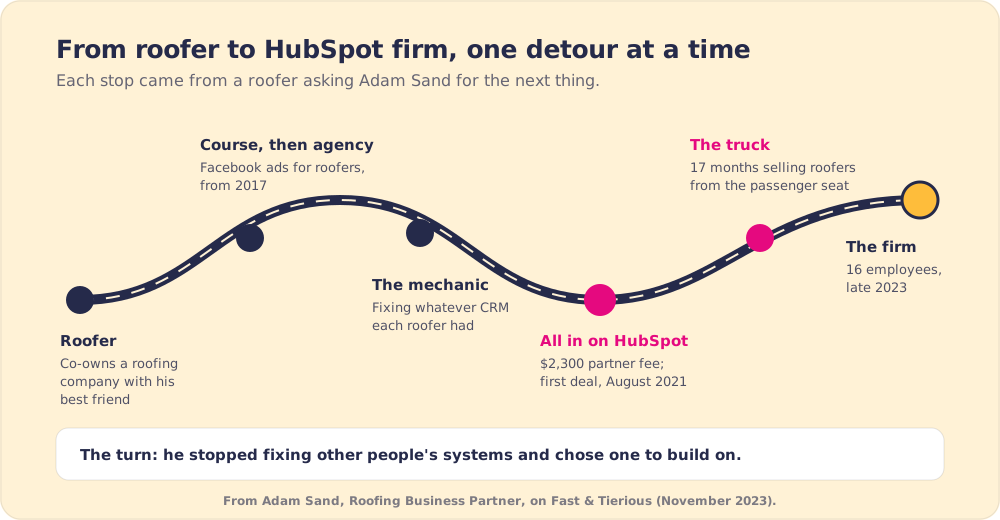
Adam comes from northern Alberta. He owned a roofing company with his best friend, a shingler, and Adam ran marketing, sales and systems. The company collected three times the reviews of competitors ten times its size, and that got him invited onto a Facebook ads podcast. Afterward, roofers started calling to ask how he did it.
He covered an ugly striped office wall in Sharpie, podcast names on one part and lead magnet ideas on another, and Roofing Business Partner began in 2017 as a course on the Facebook pixel. Roofers with money asked him to run the ads for them, and he became an agency. Then some of them fired him for sending more leads than they could handle. When he asked how they ran the business, he found whiteboards, folders, Post-it notes and magnets. He offered to build them a CRM.
For a while he built on whatever each roofer already owned: Podio, Pipedrive, Zoho. “I was just a mechanic at that time,” he said. “I would come in and fix” whatever was broken. He heard about HubSpot during an argument at a weekly mastermind, read through the Academy and the knowledge base, and decided to stop repairing other people’s systems: “I want to make them from scratch and I want to tell people to use this one.” The $2,300 partner fee scared him. He paid it anyway and sold his first deal in August 2021.
Choosing one trade and one system is what let him sell bigger jobs. As a mechanic he billed for repairs on five platforms. Once he knew roofing and HubSpot deeply, he could promise an owner how the business would run.
Why did Adam charge more instead of less?
Most of the market prices this work by the hour, whether the buyer wants a strategist or a freelance HubSpot developer. Upwork reports a median of $25 an hour for HubSpot experts on its platform, with advanced freelancers near $150 (Upwork). Profoundly analyzed more than 2,000 HubSpot proposals and found $100 to $150 an hour was the most accepted band, with large implementations at a median of about $15,000. The same study found quotes for an identical workflow setup ranging from $5,000 to $75,000 (Profoundly, 2026).
Adam watched other providers try to “do a little bit more for a little bit less.” He went the other way. “We’re going a hell of a lot more for a whole lot more.” He modeled it on the Tesla Roadster, an expensive first product for buyers who did not need “another car or another motorcycle.” His buyers were owners who wanted to see the business run the way they pictured it, and he said they will “throw a briefcase of cash at it if someone’s willing to come in and make it their problem.”
He describes Roofing Business Partner as “a consulting company that uses HubSpot as the infrastructure to make the advice that we give permanent.” Any HubSpot consultant could borrow that sentence for a pitch.
Clients did the pricing math for him. One owner ran a business doing 46 million a year and worked it out on the spot: 220 working days, eight hours a day, roughly $10,000 an hour moving through the system. Two hours of downtime cost $20,000, so paying $20,000 a month to keep someone on the phone looked cheap. Another client, a Stanford MBA who had bought a roofing company, went to a whiteboard and showed Adam that one clean operating system raised the multiple a buyer would pay for the business. “I didn’t realize I was selling that too,” Adam said.
Which clients should a HubSpot freelancer turn down?
Adam’s hardest lesson is about the people who have to use the system. If 70% of a client’s staff does not love technology, he said, “change management is going to make you want to jump out” of a window. The consultant becomes the bad guy, and the holdouts “plant flags” on what he calls I-don’t-want-to-do-it island.
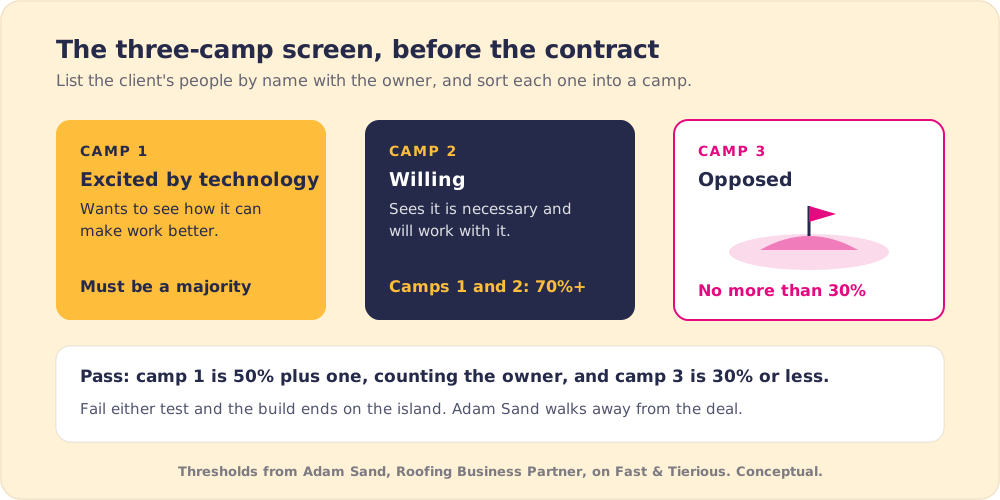
So he checks before he signs. In discovery he tells the owner there are three kinds of employees and asks where each person falls, name by name. Camp one: “I am excited by technology and I’m interested to see how it can make my work life better.” Camp two: “I understand the technology is necessary and I will work with it.” Camp three: “I hate technology and it does not make my life better.”
The deal has to pass two tests. Camp one has to be “50% plus one,” counting the owner, “so that they can outrank the 30.” Camps one and two together have to reach 70%, which gives him a pilot group that will “carry the flag” when the slow adopters stall during onboarding and go-live. If a client fails either test, he walks away. “It’s a recipe for disaster.”
Change management research supports the screen. Prosci’s work across more than 2,600 change practitioners found projects with excellent change management met or exceeded their objectives 88% of the time, against 13% for projects with poor change management (Prosci). A freelancer has little time to run a long adoption campaign after go-live, so Adam does the sorting on the discovery call.
The second part of his method starts the minute the deal is signed. He calls it solution extraction: about 20 questions in a HubSpot form, sent to each user. How has software let you down? What is your favorite tool, and why? With a magic wand, what one thing would you fix in the CRM? What does someone else do in the system that makes your day worse?
At go-live, the team uses the answers to introduce the build. “Hey Mary, remember that thing that you don’t like that Tommy does? Well, now Tommy’s not going to do that anymore.” Then Mary gets her one new checkbox and hears that it saves Billy a headache. Each person meets the new system as a fix for a complaint they named. The firm’s mission line is “make work more rewarding through engineering better customer experiences.”
How does a build turn into a retainer?
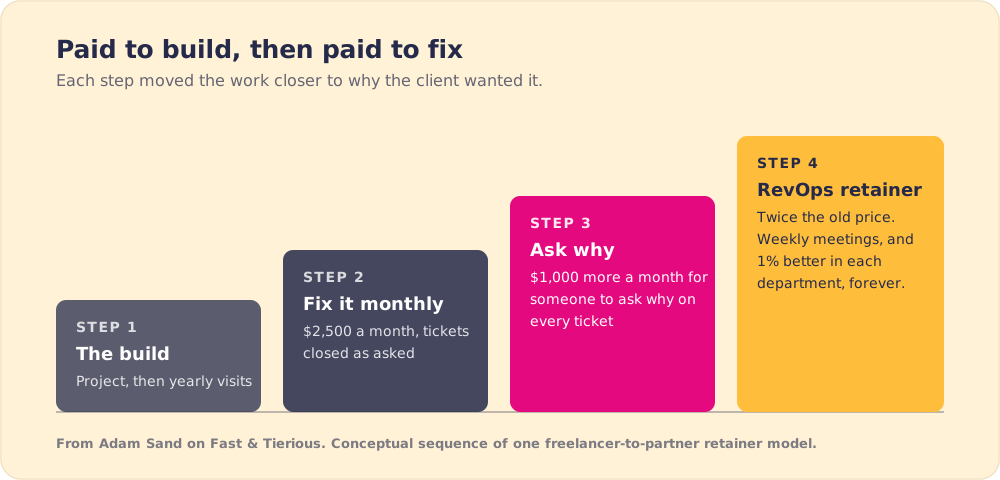
Adam’s retainer business started with a question he did not see coming. His team made yearly trips to update client systems, and one client asked if Adam could charge monthly and fix things as they came up. Adam was surprised the client did not blame him for what needed fixing. To the client it was obvious: the business was growing, so it needed new things. Adam quoted $2,500 a month, and the client agreed on the spot. “I meant 5,000 a month,” he admitted.
The fix-it retainer had a problem he found six months in. His team closed tickets exactly as requested. Then a client asked him to look at the portal because it was not working for them, and Adam asked who had built it that way. “They’re like, oh, you built that.” He concluded that “customers don’t know what to ask for,” and his team had never asked why.
So he charged $1,000 more a month and paid someone to ask why on each ticket. Then he read about RevOps and pitched it to a roofer in Hawaii as RevOps for roofing: weekly meetings, work on the gaps between departments, and a promise to make the business “1% better in these departments all the time, consistently, forever.” The price was twice what the client had paid before. “They’re like, deal.”
I told Adam why I think the model keeps working: growth begets complexity. The system a client asks for fits the business they have today. A year later the business has changed, and the old request no longer fits.
What would Adam never do again?
One regret was about his own team. HubSpot sent Adam a deal in June, and his team could not start the build until December. In the gap he kept talking to the customer, then comparing connected tools with them, then holding calls on Facebook Messenger, until he was running the project around his own people. It became the only customer his firm ever fired: keep the money, keep the build, find another partner.
“I will never sidestep or take the power away from my team ever again,” he said. His advice to himself was to get out of the way and “focus on the four corners of being a CEO, and none of those is building the HubSpot for the customer.”
His next bet started with waste. His firm bought Zapier actions in 100,000-unit blocks and lost whatever it did not use. He compared it to Henry Ford turning scrap wood into charcoal (Kingsford traces its start to 1919, when E.G. Kingsford helped Ford secure timberland for his plants, per Kingsford). Adam’s plan was a free CRM for roofers under $2 million in revenue, run on the spare automation, and a packaged offer for $3 million to $8 million roofers, where he wanted to sell 129 HubSpot deals in a year. He wanted the volume for his team. “They need more at bats,” he said, to build pattern recognition before the next big build.
What can a HubSpot freelancer take from Adam’s road?
- One trade, one platform. Adam stopped being a mechanic when he chose roofing and HubSpot. Knowing both well let him sell an outcome.
- Pricing on the owner’s outcome. Ask what an hour of downtime costs and what a clean system does to the value of the business. Owners will tell you.
- The three-camp screen. Camp one at 50% plus one with the owner, camp three at 30% or less. Below either line, decline.
- Solution extraction at kickoff. About 20 questions to each user, so the build answers complaints they named.
- A retainer with a why. Sell the maintenance that growth creates, and pay someone to ask why before closing each ticket.
- A founder who stays out of delivery. Once someone else owns delivery, the founder sells and leaves the build to them.
Where should a HubSpot freelancer start?
Start with the three-camp screen. It costs one discovery call, and Adam’s pricing and retainers only paid off because he took clients whose people wanted the change and then asked those people what to fix. Price the outcome next. Write the maintenance offer before go-live, while the client can still see the growth coming.
After the build, Adam still had to keep the process alive in each client’s portal once his team stepped back. He used Supered’s white label for his own roofing mission control. If you are packaging your method for clients, our partner program was built for that job.
For the build itself, read our HubSpot implementation guide, then why CRM adoption fails and how to fix it before your next discovery call.
Frequently asked questions
How much does a HubSpot freelancer cost?+
How did Adam Sand go from HubSpot freelancer to a 16-person firm?+
Which clients should a HubSpot consultant turn down?+
What is solution extraction?+
How do HubSpot freelancers get recurring revenue?+
Your process, running itself.
Turn the playbook into rep behavior.
More from Fast & Tierious

Capacity Planning for Agencies: How Tom Richard Learned to Plan by Skill
Tom Richard
Agency Growth Strategy: Jake Fisher on Going Narrow to Grow
Jake Fisher